





A courier knocks, nobody answers, and the tracking page changes to “delivery failed.” Most brands notice hours later, and by then the courier has already queued its next step. AI in NDR management is built for exactly this moment. An NDR, or Non-Delivery Report, is the courier’s record that a delivery attempt failed, along with the reason. If someone acts on it quickly, the order still gets delivered. If nobody does, it turns into a return to origin (RTO).
Every RTO was an NDR first, and the gap between the two is your recovery window. AI can turn many of those failed attempts into completed deliveries by reaching the customer within minutes, fixing the cause, and rescheduling the attempt without anyone copying data between courier panels. The market is already moving this way. A Business Standard report from August 2026 says logistics firms are using AI to cut failed deliveries by up to 20% for D2C and ecommerce brands. It also describes a wellness startup that went from 48-72 hour NDR resolution to closing 80% of cases within a day.
This guide covers why deliveries fail, what a failed delivery costs, how AI-powered NDR management works at each stage, and a five-step plan you can start this week.
Why Deliveries Fail (and Why Manual NDR Handling Doesn’t Scale)
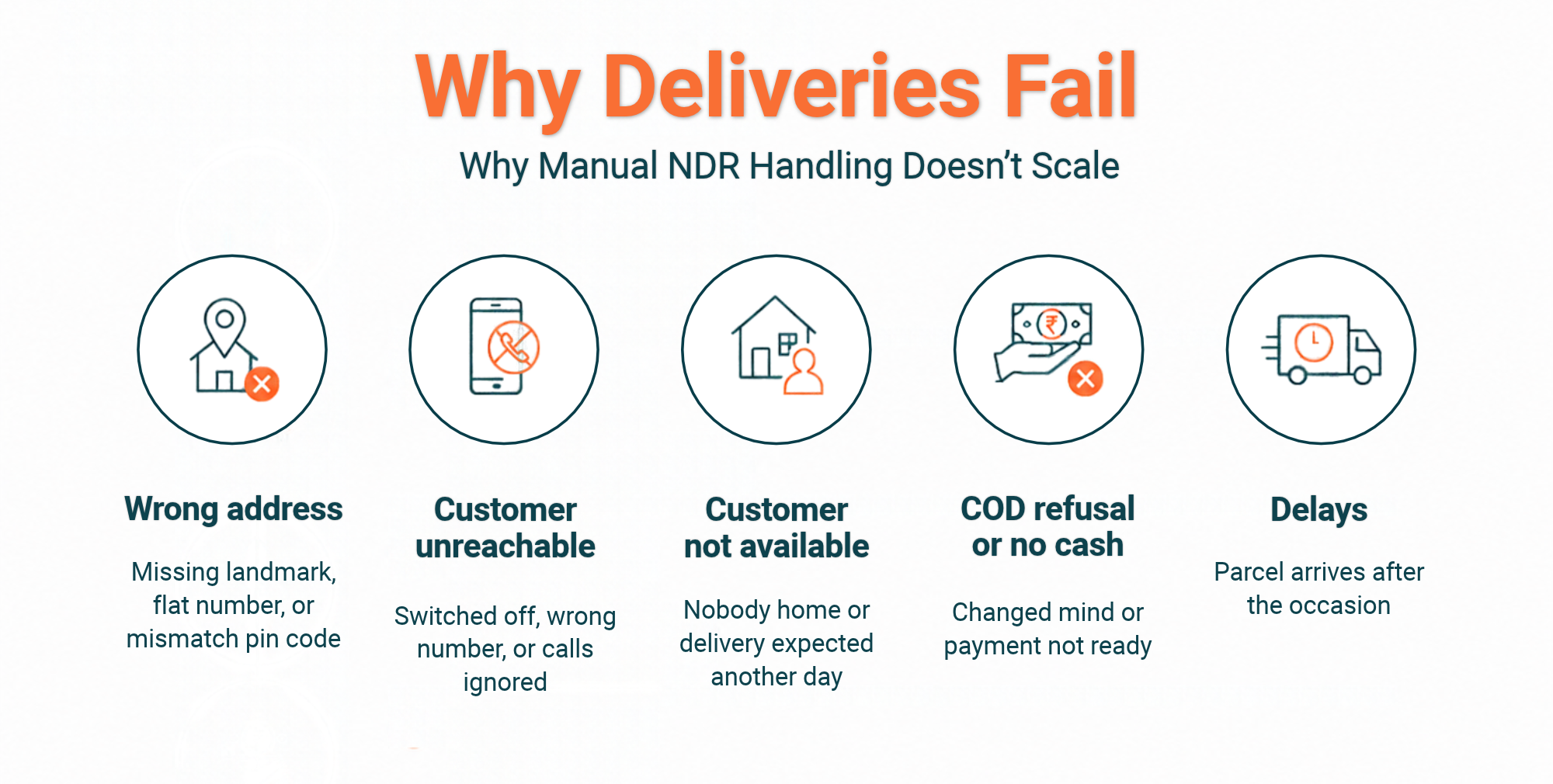
Most failed delivery cases in India trace back to a short list of causes:
- Wrong or incomplete address. A missing landmark, a flat number that does not exist, or a pin code that does not match the locality.
- Customer unreachable. The phone is switched off, the number has a typo, or the customer ignores calls from unknown numbers.
- Customer not available. Nobody is home during the attempt, or the buyer expected a different day.
- COD refusal or no cash. The buyer changes their mind at the door or does not have the amount ready.
- Delays. The parcel arrives after the occasion has passed, and the customer refuses it.
Each reason needs a different fix: a corrected address, a new time slot, or a conversation that gives a COD buyer a reason to pay online. That variety is what makes manual handling hard.
On a manual day, every courier has its own panel, its own reason codes and its own way of taking action. Someone exports the list, the support team calls customers one by one, and then someone returns to each panel to submit the instruction. As a rough illustration, 200 NDRs a day at 4-5 minutes each is about 15 hours of work daily, before a single callback.
The clock makes it worse. The window between the first failed attempt and the RTO decision is typically 24-72 hours, and most Indian couriers allow three attempts before marking the order RTO automatically. If your instruction reaches the courier after the second attempt, the third one often goes out with the same bad information as the first. Manual teams also work office hours, while many customers can only pick up a call in the evening.
This is the point where a spreadsheet and a few support agents stop being enough, and where AI in NDR management earns its place.
Why This Is Essential: The Real Cost of a Failed Delivery
A failed delivery costs money in more places than the courier invoice shows:
- Forward shipping that earned no revenue.
- Reverse shipping to bring the parcel back.
- Lost revenue from the sale itself, and cash stuck on COD orders.
- Wasted ad spend, since you paid to acquire a customer who never received the product.
- Restocking and quality checks, plus the occasional damaged or missing item.
- Support load, because every failed order creates “where is my order” calls.
The numbers add up quickly. RedSeer has estimated that Indian ecommerce businesses lose over ₹20,000 crore a year to RTO and failed deliveries. Base’s 2026 India ecommerce benchmarks put average RTO rates at 20-30% for prepaid orders and 30-40% for COD orders. Amazon Shipping’s guide for Indian sellers estimates that one failed delivery costs ₹180-400 in combined logistics spend, with no revenue in return. The same guide reports that 67% of customers avoid buying again from a brand after a poor delivery experience.
Take a mid-range ₹250 per RTO. A brand ships 1,000 COD orders a month at a 35% RTO rate, which means 350 returned parcels and ₹87,500 in logistics cost alone. Base’s benchmark shows that lifting NDR re-delivery success from 30% to 65% can bring a COD-heavy brand’s RTO from 35% down to 17%. At 17%, the same brand sees 170 returns and ₹42,500 in cost, a saving of ₹45,000 per 1,000 orders before counting the 180 extra delivered sales.
This is why AI in NDR management is a profit question as much as an operations question. Re-delivery success moves RTO more than almost anything else.
Market Trend: Logistics Is Moving from Reactive to Predictive
For years, NDR work meant chasing. A failed attempt appeared in a panel, a person noticed it, and a person responded. The shift now underway is toward AI in NDR management that predicts problems and acts before a person opens a dashboard. Four trends stand out.
- AI spending in supply chains is rising fast. Gartner forecasts that spending on supply chain software with agentic AI will grow from under $2 billion in 2025 to $53 billion by 2030.
- Indian logistics players are using AI voice and messaging for follow-ups. The Business Standard report mentioned earlier says ClickPost estimates that brands using its AI voice agent have seen RTO fall by 15-20%, and that its customer MyMuse now resolves 80% of NDR cases within a day. Shiprocket reports a drop of nearly 20% in RTOs from steps such as address checks at checkout and delivery rescheduling, and Unicommerce found brands held RTO at 17% in this year’s summer sales, against nearly 25% a year earlier.
- Brands are moving from monitoring NDRs to preventing them. That means address validation at checkout, courier selection by pin code, and delivery date promises that match what the courier can actually do.
- COD-heavy D2C growth is forcing the issue. ET Prime Research puts COD at roughly 60-65% of ecommerce orders in India. When most orders carry refusal risk, manual follow-up cannot keep up, and ecommerce NDR automation becomes a requirement.
The difference between the two approaches is easier to see side by side.
| Area | Manual NDR handling | AI-led NDR handling |
| First contact with customer | Hours later, during office hours | Within minutes, at any hour |
| Reading the failure reason | Agent interprets courier remarks | Remarks are classified into standard reasons automatically |
| COD refusals | Handled only if someone has time | Flagged early, with a prepaid offer before the last attempt |
| Courier instruction | Submitted by hand in each panel | Sent automatically through courier integrations |
| Visibility | Spreadsheets and separate panels | One dashboard across all couriers |
| Learning | Rarely reviewed | Courier and pin code scorecards feed the next decision |
How AI in NDR Management Reduces Failed Deliveries
This is the core of the topic. AI-powered NDR management works in three stages: prevent the failure, recover it when it happens, and learn from every case. Most guides cover only the middle stage. The strongest results come from linking all three.
Stage 1: Before dispatch (prevent)
The cheapest NDR is the one that never happens. Three capabilities do most of the work here.
Address and contact validation. AI checks each address as the order is placed. It looks for missing landmarks, pin codes that do not match the city and phone numbers that look wrong, then asks the customer to fix them before the parcel ships. That removes one of the most common causes of a delivery failed status.
COD risk scoring and prepaid nudges. A model can score each COD order using signals such as the customer’s past refusals, order value, pin code history, first-time buyer status and time of order. Low-risk orders go ahead as normal. Higher-risk orders can get a confirmation call or message, a small prepaid discount, or a limit on COD for that pin code.
AI courier allocation by pin-code performance. Couriers perform differently across regions. A carrier that handles one city well can struggle in another. AI picks the courier for each order by looking at past delivery success, speed and cost for that pin code and payment type. If you want a closer look at how this works in practice, eShipz explains it in its post on courier allocation and automatic carrier selection.
Stage 2: After a failed attempt (recover)
Once the attempt fails, speed and accuracy decide the outcome. This is where AI in NDR management shows the clearest gain over manual work.
Automatic reason detection and categorization. Couriers write NDR remarks in free text and in their own formats. AI reads them and sorts each case into a standard reason, such as address issue, customer unavailable, refused or reschedule requested. It can also flag odd patterns, like a “customer not available” remark that does not fit the delivery route, which may point to a fake attempt.
Instant customer outreach. The system contacts the customer within minutes through the channels you have set up, such as messaging, SMS or a voice call, in the customer’s own language. The message asks one clear question and offers a link to reschedule or correct the address. Replies update the case on their own.
Smart re-attempt scheduling and courier escalation. Once the customer responds, the instruction goes to the courier through its integration, with the new date, slot or address. If the courier does not act, or the case sits unresolved close to the final attempt, the system escalates it.
Prepaid conversion before the final attempt. For COD orders at risk of refusal, a payment link sent before the last attempt gives the buyer an easy way to confirm. A customer who pays online has made a commitment, and the cash-handling problem at the door disappears.
Human escalation for high-value cases. AI handles the volume. Agents handle large orders, angry customers and repeat failures, with the full case history attached.
Stage 3: After resolution (learn)
Every closed NDR carries information. AI collects it into courier and pin-code scorecards, tracks how many NDRs turn into RTO, and feeds the findings back into courier allocation and COD rules. A courier that keeps failing in one region loses volume there. A pin code with high refusal rates gets a stricter COD rule. The loop only works if the data from each stage sits in one place, which is why many teams pair AI in NDR management with wider logistics analytics.
AI will not save every order. A customer who has decided to cancel stays cancelled, and patchy courier data weakens any model. Use it for the routine cases, and keep people for the rest.
Benefits and Outcomes of AI in NDR Management
When the three stages of AI in NDR management work together, the gains are measurable:
- Higher first-attempt and re-attempt success. Better addresses and better courier choices raise the first rate. Faster follow-up raises the second.
- Lower RTO and lower reverse-logistics cost. Fewer parcels travel back, so fewer rupees are spent twice.
- Less manual work for ops and support. Routine NDRs resolve without an agent, and agents focus on exceptions.
- Faster resolution. Customers hear from you in minutes instead of days.
- Better NPS and repeat purchases. A brand that fixes a missed delivery fast often keeps the customer.
- Protected cash flow on COD orders. Money tied up in returning parcels comes back into the business.
Well-managed NDR processes can recover 30-40% of failed deliveries, which turns a likely loss into a completed sale. Results differ by category, region and starting point, so treat published numbers as ranges to test against your own baseline.
Where to Start: A 5-Step Roadmap
Adopting AI in NDR management does not need a large project. Here is an order of work that a small team can follow.
Step 1: Baseline. Measure your NDR rate, your NDR-to-RTO conversion, and your RTO split by courier, pin code and payment mode. Without a starting point, you cannot tell whether anything improved.
Step 2: Centralize. Bring NDR data from every courier into one dashboard. This is the base for any NDR solution for ecommerce, and for NDR RTO management software, because it ends the daily tour of courier panels.
Step 3: Automate the first response. Contact the customer within minutes of the first failed attempt. This single change often delivers the largest early gain, because speed is what the manual process lacks.
Step 4: Add intelligence. Introduce reason-based workflows, address correction and COD-to-prepaid conversion. At this point you are using the full range of AI in NDR management, not just faster messaging.
Step 5: Close the loop. Review results every week. Feed courier and pin code performance back into allocation, and tighten COD rules where refusal is high.
Quick wins in 30 days
- Pull 90 days of NDR and RTO data, split by courier, pin code and payment mode
- List your top five NDR reasons and the action each one needs
- Set a target for first customer contact (for example, under 30 minutes)
- Add a prepaid offer for COD orders before the final attempt
- Review courier choice for your ten worst pin codes
How eShipz Approaches It
eShipz is a shipping automation platform that links prevention, NDR recovery and delivery visibility in one place. Here is how its main modules support AI in NDR management across the three stages above.
- NDR Management and ReDelivR. AI detects failure reasons, triggers smart retries and works to prevent RTOs. NDR automation runs across every connected courier from a single dashboard. eShipz has also launched an AI voice agent for NDR follow-ups.
- CarrierSmart AI. Picks the courier for each order by balancing speed, cost and performance, which prevents many failures before dispatch.
- Track360 and PredictShip ETA. Real-time tracking, delay alerts and a delivery estimate customers can rely on, so they expect the parcel at the right time.
- IntelliProof ePOD. Signature, photo and OTP proof of delivery, which reduces disputes over whether a parcel arrived.
- COD management and ReturnEase. Visibility into COD collections and a clear return flow when a delivery cannot be saved.
- Scale and integrations. More than 500 carrier integrations, 350+ brands on the platform, and connections with Shopify and ERPNext.
The reason to connect these pieces is simple. Courier allocation affects how many NDRs occur, and NDR recovery affects how many become RTOs. When each runs in a separate tool, the data gets lost between them.
Key Metrics to Track
Whatever tool you use, track the same six numbers every week to see if AI in NDR management is paying off:
- NDR rate: the share of shipments that hit a failed attempt.
- NDR-to-RTO conversion: the share of NDRs that end in a return.
- Re-attempt success rate: the share of re-attempts that deliver.
- RTO by pin code and courier: where returns concentrate.
- Cost per RTO: forward, reverse, handling and lost revenue combined.
- Average NDR resolution time: from first failed attempt to final action.
Conclusion: Failed Deliveries Are a Recoverable Revenue Leak
A failed delivery is not a lost sale yet. It is a short window in which speed and accuracy decide whether the order is delivered or returned. AI in NDR management gives brands a way to act inside that window, at the volume Indian ecommerce now produces. Start with a baseline, centralize your data and automate the first response.
Ready to see what this looks like for your own shipments? Book a demo and walk through your NDR and RTO data with the eShipz team.
FAQs
- What is NDR in ecommerce?
NDR stands for Non-Delivery Report. It is a notification from your courier partner that a delivery attempt failed, along with the reason. An NDR does not cancel the order. It means the delivery failed for now and can still be recovered if the cause is fixed in time.
- What is the difference between NDR and RTO?
An NDR is a failed delivery attempt, and the shipment is still with the courier and open to re-attempt. An RTO is the outcome after all attempts are used up or the buyer refuses the parcel, and the shipment travels back to you. Good RTO management starts at the NDR stage.
- How does AI help in NDR management?
AI in NDR management helps in three ways. Before dispatch, it validates addresses, scores COD risk and picks the best courier for each pin code. After a failed attempt, it classifies the reason, contacts the customer in minutes and sends the new instruction to the courier. After resolution, it tracks courier and pin-code performance so the next decision is better.
- What is a good NDR-to-RTO conversion rate?
There is no single standard, because it depends on your category, COD share and courier mix. The useful comparison is your own trend over time. Base’s benchmark suggests that a re-delivery success rate near 65% can bring a COD-heavy brand’s overall RTO down to around 17%.
- Can small D2C brands use NDR automation?
Yes. Small brands often gain the most, because each RTO takes a bigger share of their margin and they have fewer people to chase cases. Start with one dashboard for all couriers and an automated first message, then add reason-based workflows.
- How fast should you contact a customer after a failed delivery?
Within minutes if you can, and the same day at the latest. The window to RTO is often 24-72 hours, so every hour of delay cuts the chance of a successful re-attempt.
- Does AI in NDR management work for COD orders?
Yes, and COD is where it often matters most. AI can score COD risk before dispatch, confirm intent with the buyer, and offer a prepaid link before the final attempt. This lowers refusals and keeps cash from being tied up in returning parcels.