
Over 45% of online shoppers say they want real-time package tracking updates as part of their delivery experience, highlighting how post-purchase visibility has become critical in ecommerce. Nearly 40% of consumers check their order status at least once per day, showing just how much customers value transparency in delivery
Track360 in logistics is a solution designed to address this challenge. It provides a 360-degree view of every shipment, connecting updates from multiple carriers into a single, unified operational dashboard. With Track360, logistics teams can monitor shipment progress in real time, detect delays or exceptions early, and coordinate more effectively with support teams, ensuring that customers stay informed and operations run smoothly.
This gap has led to the rise of solutions like Track360 in logistics. Rather than simply showing “where is my package,” Track360 provides a 360-degree view of every shipment, connecting updates from multiple carriers into one operational dashboard. It enables logistics teams to proactively manage exceptions, supports timely customer communication, and ensures smoother post-dispatch operations.
In this blog, we’ll explore why centralized shipment tracking is now the modern control tower for logistics teams, what capabilities define it, and how platforms like eShipz help bring this visibility to life.
Why Is Shipment Visibility a Critical Business Pain Point?
Shipment visibility is no longer just an operational metric, it has become a core driver of business performance and customer satisfaction. For ecommerce brands in India, a lack of clear, real-time tracking creates several pain points that affect both operations and customer trust.
Key Pain Points for Logistics Teams:
- High support ticket volume: Customers repeatedly call or email asking, “Where is my order?” This not only strains support teams but also increases operational costs.
- Customer anxiety and cancellations: Unclear or delayed shipment information leads to frustration, negative reviews, and even order cancellations.
- Undetected SLA breaches: Without centralized visibility, missed delivery commitments often go unnoticed until escalation, risking penalties or lost business.
- Limited accountability across courier partners: Fragmented data makes it difficult to identify which carrier or stage is causing delays, limiting the ability to optimize operations.
These challenges highlight the real operational and strategic consequences of poor shipment visibility. Teams are forced to react to problems rather than prevent them, creating inefficiencies that ripple across the business.
As delivery timelines shrink and customer expectations rise, logistics teams can no longer rely on reactive tracking. What’s required is a post-dispatch visibility system that consolidates shipment data from multiple carriers and presents it in a single, actionable view.
A robust ecommerce shipment monitoring solution enables teams to:
- Anticipate delays before they impact customers
- Reduce support ticket volume by providing accurate, real-time tracking
- Maintain accountability and performance insights across carriers
- Enhance overall operational efficiency and decision-making
By addressing these pain points, centralized shipment visibility becomes not just a tool for tracking parcels, but a strategic advantage that strengthens customer trust, improves delivery reliability, and enables scalable operations.
Fragmentation in Multi-Carrier Tracking
Most ecommerce brands today do offer shipment tracking. Customers receive links and status updates, yet logistics teams still struggle with visibility, not because tracking is missing, but because tracking information is scattered across systems.
Each courier partner follows its own operational logic. Status milestones differ, update frequencies vary, and scan consistency isn’t uniform. When shipments move across multiple partners, this fragmentation makes it difficult to understand what’s actually happening at any given moment.
This leads to real operational pain points:
- Delivery risks surface only after customers raise concerns
- Performance issues remain hidden without a consolidated view
- Teams react to problems instead of preventing them
The issue isn’t a lack of data. It’s the absence of consolidation and context. When tracking information lives in isolated systems, visibility becomes passive and decisions become delayed, making it harder for teams to stay in control after dispatch.
Logistics Control Tower Through Centralized Tracking
When shipment data is spread across multiple courier portals, logistics teams are forced to react rather than lead. Centralized tracking changes this by bringing every in-transit order into a single operational layer, giving teams one clear view of what’s happening after dispatch.
Instead of switching between systems, teams can work from:
- A unified dashboard showing all active shipments
- Consistent tracking milestones across courier partners
- Early visibility into delays, exceptions, and delivery risks
This consolidated view enables a fundamental shift in how logistics operations are run. Issues are identified before they escalate, customer communication becomes timely and accurate, and courier accountability is backed by data rather than assumptions.
That’s why centralized tracking is increasingly seen as the logistics control tower, not just a monitoring tool, but a coordination layer that provides oversight, alignment, and clarity across the entire delivery lifecycle.
What Defines a Modern Shipment Tracking Control Tower
Not all tracking systems deliver the same value. Teams evaluating advanced tracking capabilities typically look for:
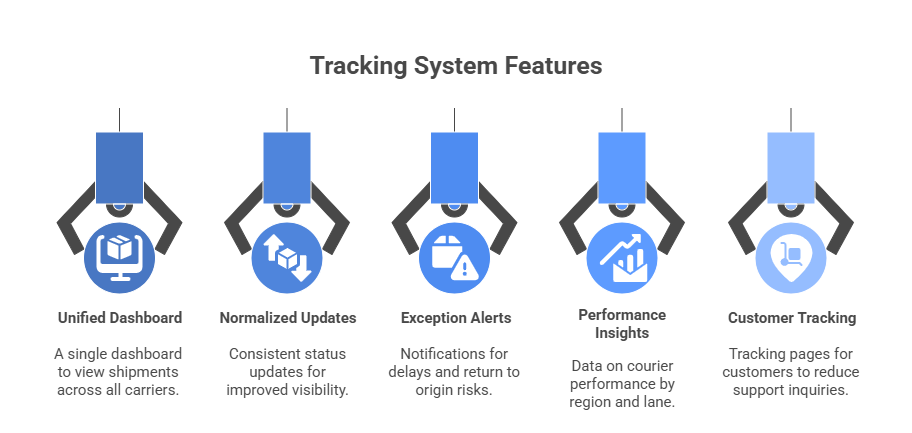
- Unified shipment dashboard across all carriers
View every in-transit order in one place, regardless of which courier is handling the delivery. This eliminates the need to switch between multiple portals and gives teams a single source of truth after dispatch. - Normalized status updates for consistent visibility
Shipment updates are presented in a standardized format, even when different couriers follow different scan processes. This makes it easier for teams to understand progress at a glance and communicate accurate updates. - Exception management alerts for delays and RTO risks
Potential issues such as delivery delays, failed attempts, or return-to-origin risks are flagged early, allowing teams to step in before they escalate into customer complaints. - Courier performance insights by region and lane
Track how different courier partners perform across cities, zones, and delivery routes, helping teams identify patterns, improve accountability, and make better routing decisions over time.
Together, these capabilities transform tracking into an active operational function rather than a passive status page.
Fragmented vs Centralized Tracking: A Practical Comparison
As logistics operations scale, the way shipment data is structured starts to matter as much as the data itself. While fragmented tracking may work at low volumes, it quickly becomes a bottleneck as order counts, courier partners, and delivery regions increase. Centralized tracking approaches visibility as a system, not a set of disconnected updates.
| Aspect | Fragmented Tracking | Centralized Tracking |
| Shipment visibility | Spread across portals | Single dashboard |
| Status consistency | Courier-dependent | Standardized |
| Delay detection | Reactive | Proactive |
| Support effort | High manual effort | Reduced |
| Performance analysis | Limited | Data-backed |
The difference between fragmented and centralized tracking goes far beyond convenience. It directly impacts how well logistics teams can monitor delivery performance, manage exceptions, and scale operations without increasing complexity. With consolidated shipment data, teams move from firefighting to foresight, making delivery operations easier to manage, easier to measure, and easier to improve over time.
Industry Trends Accelerating Adoption in India
India’s ecommerce and logistics landscape has changed rapidly over the last few years, pushing teams to rethink how they manage shipment visibility. What once worked for smaller volumes and fewer partners is no longer sufficient at scale, especially in a market as diverse and fast-moving as India.
Several trends are driving logistics teams toward centralized visibility:
- Growing reliance on multi-carrier strategies: To balance cost, coverage, and reliability, brands increasingly work with multiple courier partners. While this improves reach, it also adds complexity, making a unified view of shipments essential.
- Rising pressure on delivery SLAs: Marketplaces and customers alike expect faster, more predictable deliveries. Missed SLAs now carry higher consequences, increasing the need for early detection and proactive intervention.
- Greater focus on post-purchase experience: Customers closely track orders and expect timely, accurate updates. Any gap in communication after checkout quickly affects trust and repeat purchases.
- Seasonal and peak-sale complexity: Events like festive sales and flash campaigns dramatically increase shipment volumes, amplifying the risk of delays, exceptions, and support escalations without proper visibility.
Across the industry, data consistently shows that teams with real-time shipment visibility face fewer escalations, resolve issues faster, and maintain better delivery performance, without adding extra operational overhead. As a result, centralized tracking is no longer viewed as an upgrade, but as a necessity for managing logistics at scale in the Indian market.
eShipz as a Shipping Visibility Layer for Multi-Carrier Logistics
As logistics operations scale, visibility cannot rely on individual courier systems alone. With multiple delivery partners, regions, and shipment volumes in play, teams need a central layer that brings order to post-dispatch operations, without disrupting existing courier relationships.
Platforms like eShipz are designed to serve as this visibility layer. Instead of replacing courier partners, they sit above them, connecting shipment data from different carriers into one structured operational view. This approach allows logistics teams to maintain flexibility in carrier choice while gaining consistency in how shipment information is monitored and managed.
What a Unified Visibility Layer Enables
- Single operational view across carriers
All in-transit shipments are visible in one place, eliminating the need to log into multiple courier portals.
- Consistent tracking structure
Shipment statuses are normalized so teams can understand progress clearly, regardless of how each courier reports updates.
- Early visibility into exceptions
Delays, failed delivery attempts, and RTO risks surfaced early, enabling timely intervention. - Shared context across teams
Logistics, support, and business teams operate from the same data, reducing misalignment and internal follow-ups.
How It Changes Day-to-Day Operations
| Area | Without a Visibility Layer | With a Unified Visibility Layer |
| Shipment monitoring | Disconnected courier portals | One consolidated dashboard |
| Exception handling | Reactive and manual | Proactive and prioritized |
| Team coordination | Information silos | Shared operational context |
| Scalability | Complexity increases with volume | Operations scale with control |
By consolidating tracking updates, exceptions, and performance signals into one structured layer, teams gain a clearer understanding of how shipments move across regions and partners. Issues that once surfaced only through escalations can now be identified earlier, addressed faster, and prevented more consistently.
In high-volume ecommerce environments, this kind of unified visibility doesn’t just simplify tracking, it enables better coordination, clearer accountability, and sustained operational control as logistics complexity grows.
Clarity Is the New Control in Logistics
As logistics operations scale, control comes from clarity, not complexity. When teams have a single, reliable view of shipments across carriers and regions, decisions become faster, calmer, and more effective.
Centralized visibility helps teams anticipate issues early, reduce delivery friction, and deliver a consistent post-checkout experience. It shifts operations from reactive firefighting to structured, predictable execution.
If your teams are still working with fragmented tracking systems, it may be time to rethink how logistics decision clarity can support scalable shipping operations. A more unified approach to post-dispatch visibility can simplify daily execution and improve delivery outcomes.
Explore how a centralized shipment visibility layer can simplify post-dispatch operations. Connect with us to see how unified tracking fits into your logistics workflow.