
The world is delivering more than ever, global parcel volumes touch 161 billion in 2022, and are on track to reach 256 billion by 2027. With this explosion in deliveries and service requests, delays, misrouting, and manual scheduling have become costly bottlenecks for logistics companies, field technicians, courier businesses, and home-service brands. This is where Dispatch Management Software steps in.
Dispatch Management Software is a digital system that automates how businesses schedule, assign, and monitor field tasks or deliveries. It uses real-time data, route optimization, and intelligent task allocation to ensure the right person reaches the right job at the right time, while keeping customers informed with accurate updates and ETAs..
In this blog, we’ll explore: Real problems businesses face before implementing dispatch management, Key features of modern dispatching systems, How route optimization, real-time tracking, and automated communication strengthen operations, Industry-wise use cases, and Ranking of the best dispatch management software. By the end, you’ll know exactly how a dispatch system fuels efficiency across logistics, deliveries, and field service operations.
How Inefficient Processes Impact Service and Delivery Teams
Before companies shift to dispatch automation, they often face a set of recurring operational challenges that slow down productivity, increase costs, and frustrate both customers and frontline teams. These problems might seem small individually, but together they create inefficiency across the entire workflow.
1. Inefficient Scheduling
Manual dispatching sounds simple, but in reality, it creates chaos:
- Workloads end up unevenly distributed
- Technicians or delivery agents travel long distances without reason
- Peak hours become messy, with too many jobs and too little visibility
- Small delays snowball into failed deliveries or missed service appointments
Without automation, dispatchers spend more time solving conflicts than actually planning.
2. Lack of Real-Time Visibility
This is one of the biggest gaps highlighted in Silent Infotech and LogiNext case studies.
When dispatchers don’t have live information about where drivers or technicians are:
- They rely on back-and-forth phone calls
- Managers struggle to intervene when delays happen
- Customers receive vague ETAs, which affects trust
- Service teams cannot reroute or reassign tasks intelligently
A lack of visibility creates blind spots that slow down decision-making.
3. Poor Communication Loop
When systems don’t automatically push updates:
- Technicians miss new instructions or last-minute changes
- Customers remain uninformed and anxious
- Re-deliveries and re-visits increase
- Support teams get flooded with “Where is my order?”
This leads to wasted time, frustrated teams, and unhappy customers.
4. High Fuel & Operational Costs
Poorly optimized routing has a direct cost impact.
No GPS visibility means:
- Higher fuel consumption
- Longer travel times
- More backtracking and unnecessary trips
- Manual paperwork slowing down job closure and billing
Small inefficiencies stack up into large monthly expenses.
Powerful Tools and Features of Smart Dispatch Platforms
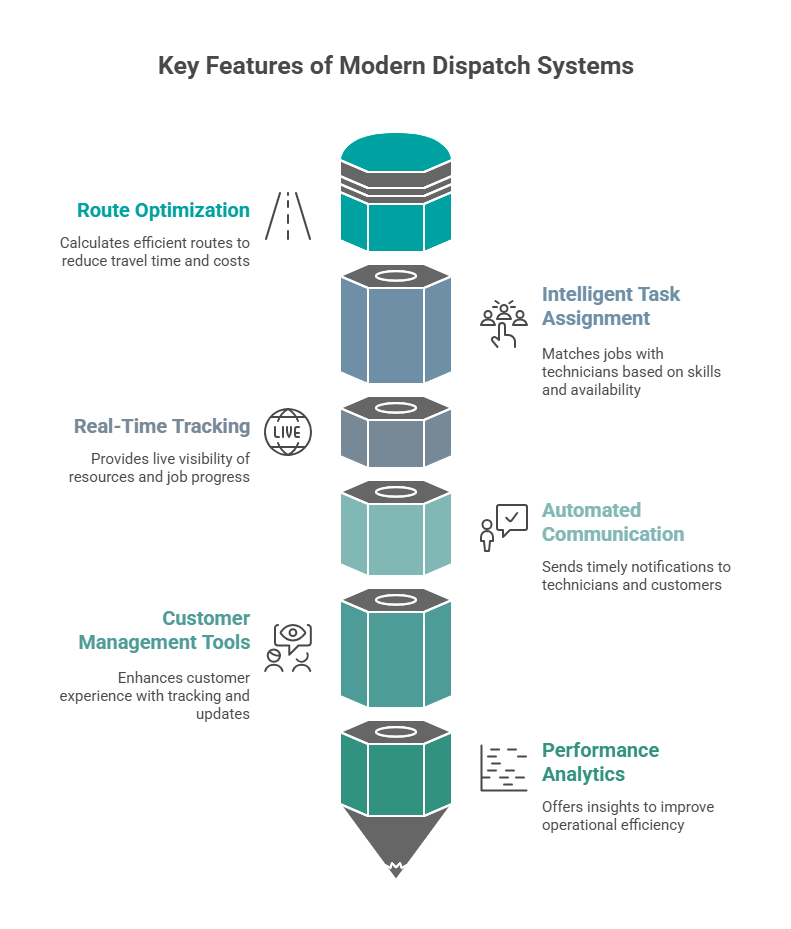
Efficient dispatching is no longer just about assigning tasks, it’s about using technology to streamline operations, reduce costs, and enhance customer satisfaction. Modern dispatch management software combines intelligent routing, task allocation, real-time tracking, and communication tools into a single platform. Let’s explore the key features that make these systems indispensable for logistics, field service, and delivery businesses.
Route Optimization
Modern dispatch systems intelligently calculate the most efficient routes by analyzing distance, fuel usage, real-time traffic, and technician proximity. This dramatically reduces travel time, lowers fuel costs, and increases the number of daily jobs completed. For example, businesses that previously travelled long, unplanned routes can cut their distance by almost half and significantly increase output once optimized routing is activated.
Intelligent Task & Resource Assignment
Dispatching platforms automatically match each job with the right technician based on skill level, availability, job complexity, and proximity to the task location. This ensures quicker responses, fewer revisits, and a higher first-time resolution rate. It also helps businesses maintain balanced workloads across teams and prevents overloading of certain resources.
Real-Time Tracking & Visibility
With GPS-enabled live dashboards, dispatchers gain complete visibility into every vehicle, delivery partner, or field technician. Instead of relying on phone calls or manual updates, managers can instantly identify where resources are, monitor job progress, and intervene proactively in case of delays. This visibility strengthens operational control and decision-making.
Automated Communication & Accurate ETA
Automated SMS or email notifications keep both technicians and customers informed at every step. Customers receive real-time tracking links, ETA updates, and delay alerts, while technicians get timely instructions without manual intervention. This reduces support calls, improves transparency, and builds trust in the service experience.
Customer Management & Experience Tools
Leading dispatch platforms include customer-facing tools like live tracking pages, Fappointment reminders, and service updates. These features ensure that customers feel informed and confident throughout the delivery or service process, which enhances satisfaction and reduces anxiety.
Performance Insights & Analytics
Dispatch software provides actionable analytics on technician performance, delivery turnaround times, SLA compliance, reattempt rates, and fuel usage. Managers can leverage these insights to spot bottlenecks, identify recurring issues, and implement improvements, leading to a more efficient and scalable operation.
Sector-Wise Benefits and Use Cases of Dispatch Automation
Dispatch management software is no longer limited to just logistics or delivery companies. Its intelligent automation, route optimization, and real-time tracking capabilities make it indispensable across a wide range of industries.
Logistics & Transportation
In logistics and transportation, dispatch management software helps optimize delivery routes, assign pickups, track fleets in real time, and ensure SLA-bound deliveries. This improves last-mile performance and efficiency for 3PL companies, eCommerce logistics players, manufacturing distributors, and freight operators.
On-Demand & Scheduled Delivery Services
Hyperlocal delivery apps, courier companies, and retail brands offering same- or next-day deliveries rely on dispatch systems to automate order assignment and provide accurate customer ETAs. These capabilities are crucial for delivery startups, medical and grocery delivery providers, and retailers managing time-sensitive shipments.
Field Service Operations
For field service teams, dispatch management software coordinates HVAC, repair, telecom, electrical, and installation services. Skill-based assignment combined with route optimization ensures technicians reach jobs efficiently, maximizing workforce utilization and improving service quality.
Retail & E-Commerce
Retailers and D2C brands use these systems to automate last-mile deliveries, schedule pickups and returns, track shipments, and manage delivery exceptions. Omnichannel stores benefit from smoother operations and enhanced customer satisfaction through timely and accurate updates.
Healthcare & Medical Services
Dispatch solutions in healthcare manage scheduling and dispatching for home care nurses, lab sample pickups, telemedicine support, and medical equipment deliveries. Hospitals, clinics, diagnostic labs, and home healthcare providers gain operational efficiency while ensuring timely patient care.
Food & Grocery Delivery
Food delivery apps, grocery chains, and cloud kitchens use dispatch management software to optimize delivery routes, assign orders to the nearest riders, manage peak-hour demand, and provide precise ETAs, enhancing both efficiency and customer experience.
Utilities & Public Services
Utility companies, municipal services, and public maintenance teams leverage these platforms to dispatch technicians for water, electricity, or gas maintenance, manage emergency service calls, and meet SLA compliance reliably.
Installation & Maintenance Services
Telecom, IT, and smart home service providers coordinate installation, repairs, preventive maintenance, and upgrades through intelligent dispatching, improving workforce utilization and reducing delays.
Dispatch management software has evolved into a versatile solution supporting multiple industries beyond traditional logistics. Whether managing fleets, coordinating field service teams, or ensuring timely deliveries for healthcare, retail, and public services, these systems improve operational efficiency, reduce manual effort, and enable businesses to provide faster, more reliable service to their customers.
Best Dispatch Management Software
With delivery volumes rising and customers expecting faster, more transparent services, businesses need dispatch systems that combine automation, visibility, and smart decision-making. Below is a refined top dispatch management platform, evaluated based on real features, industry adoption, and overall capability.
| Software | Best For | Why Choose | Unique Selling Point (USP) |
| eShipz | Multi-carrier shipping, retail, D2C brands, 3PLs | AI-backed dispatching, automated control tower, multi-carrier orchestration, and advanced visibility. | A complete logistics automation layer, not just dispatch, covering routing, allocation, tracking, NDR, returns, & analytics |
| LogiNext Mile | Enterprise logistics, courier companies | Enterprise-grade real-time visibility, route optimization, and workflow automation. | AI planning engine for high-scale dispatching |
| Salesforce Field Service | Field technicians, service businesses | Skill-based routing, intelligent scheduling, connected workflows. | Deep CRM-driven service management |
| Onfleet | Last-mile delivery companies | Clean driver app, POD capture, easy UI. | Extremely simple and fast to deploy |
| Routific | Small to medium delivery teams | Accurate routing at an affordable price | Quick setup and easy onboarding |
Choosing the best dispatch management software depends on your operational scale and the level of automation you require. eShipz takes the top spot for 2025 due to its end-to-end logistics automation approach, making it ideal for retailers, D2C brands, and 3PLs who need unified workflows across dispatching, tracking, carrier allocation, and post-shipping operations. Platforms like LogiNext and Salesforce FSL excel in enterprise and field-service environments, while Onfleet, Routific, and Tookan are strong fits for simpler, last-mile or startup-level operations.
How eShipz Fits into Modern Dispatch Management
In today’s logistics environment, dispatch isn’t limited to assigning drivers or printing labels. It requires coordination across orders, carriers, routes, customer expectations, and real-time visibility. This is where platforms like eShipz naturally align with dispatch-management needs.
1. Centralized Control Across Carriers & Orders
Most businesses use multiple carriers, transport partners, or service providers. eShipz functions as a unified layer over these networks, allowing teams to manage dispatch activities from a single interface, instead of switching across portals, calls, and manual entries.
2. Automated Dispatch Workflows
Dispatch often slows down when teams rely on manual steps like rate checks, label generation, manifest creation, or scheduling pickup requests. eShipz automates these repetitive processes so dispatchers can focus on exceptions rather than routine actions.
3. Intelligent Allocation & Routing Support
While dispatch systems optimize routes, eShipz strengthens this by using:
- rules-based carrier allocation,
- service-level selection,
- pin-code/capacity validation.
This ensures the right shipment is dispatched through the right carrier automatically, reducing delays or operational mismatches.
4. Real-Time Tracking for All Stakeholders
Effective dispatch isn’t complete without end-to-end visibility. eShipz provides unified tracking across multiple carriers, allowing dispatch teams, warehouse staff, customer service, and customers to see shipment status without dependency on external tools or manual follow-ups.
5. Exception Handling as Part of Dispatch Flow
A large portion of dispatch inefficiencies come from failed pickups, delays, address issues, or NDR loops. eShipz integrates NDR workflows, automated alerts, and corrective actions directly into the dispatch cycle, ensuring issues are addressed before they impact delivery commitments.
6. Scalable Framework for Growing Volume
As businesses expand into new warehouses, cities, or channels, dispatch processes become more complex. eShipz scales with volume, carriers, and operational layers, allowing teams to maintain the same level of control even as daily shipments increase.
7. Insight & Optimization
Dispatch decisions are stronger when backed by data. Through shipment analytics, pickup performance dashboards, SLA adherence, and cost insights, eShipz helps operations teams refine strategies and continuously improve dispatch efficiency.
In Nutshell
In today’s fast-moving delivery and service environment, smart dispatching is no longer optional, it’s the backbone of fast, predictable, and customer-friendly operations. Manual scheduling, routing guesswork, and constant follow-ups slow teams down and create unnecessary service delays. Modern dispatch automation solves this by bringing everything together in one place, intelligent route planning, real-time tracking, skill-based assignment, automated customer updates, and clear visibility for managers. The result is simple: faster fulfilment, lower operational costs, and a smoother experience for both teams and customers.
If you want a unified layer that streamlines dispatch management software, visibility, and multi-carrier logistics, platforms like eShipz can help you move faster.
Explore the solution that aligns with your goals and start building a more efficient, customer-first operation today.