
India’s ecommerce market is projected to cross $160 billion by 2026 (IBEF). Growth is accelerating at an unprecedented pace, but growth itself is no longer the real challenge, managing that growth is. As order volumes expand across marketplaces, D2C websites, retail outlets, and B2B wholesale channels, operational cracks begin to surface: inventory mismatches, shipping delays, rising return-to-origin rates, fragmented dashboards, and teams switching between platforms just to process a single order. Scaling today isn’t about selling more, it’s about controlling more, with clarity, speed, and precision.
This is where EasyEcom becomes strategically important. Built to support both omnichannel and B2B commerce, EasyEcom helps brands manage bulk wholesale orders, distributor networks, multi-warehouse inventory, tiered pricing, GST workflows, and marketplace fulfillment from a single unified system. For B2B-focused brands, where order volumes are higher and operational accuracy is critical, centralized visibility and structured automation are no longer optional, they are foundational to sustainable growth.
EasyEcom shipping integration takes this a step further by aligning commerce operations with logistics execution in real time. Instead of functioning as just another software layer, it creates a connected infrastructure where inventory, order management, and shipping workflows operate seamlessly together. In this blog, we’ll explore why ecommerce operations are becoming harder to manage, what capabilities truly matter today, how integration reshapes fulfillment outcomes, and the measurable impact brands are already seeing. Let’s dive in.
Scaling Ecommerce with Inventory Automation & Multi-Carrier Shipping Control
Five years ago, most brands sold on one or two channels. Today, the average ecommerce business operates across:
- Marketplaces (Amazon, Flipkart)
- D2C websites
- Social commerce
- Offline retail or warehouse networks
Each channel generates orders independently. Without omnichannel sync, stock levels fall out of alignment. That leads to overselling, cancellations, and delivery errors.
At the same time:
- Customer expectations demand fast fulfillment
- Cash-on-delivery remains significant in India
- Returns & NDR optimization directly affect profitability
- Shipping costs fluctuate across carriers
What used to be a simple order dispatch process has evolved into a complex logistics automation requirement.
Disconnected systems create operational friction. Centralized operations reduce it.
Building Modern Ecommerce Infrastructure with eShipz at the Core
When evaluating any commerce-logistics integration, features alone are not enough. The system must reduce complexity.
Here are the core capabilities that directly influence operational efficiency:
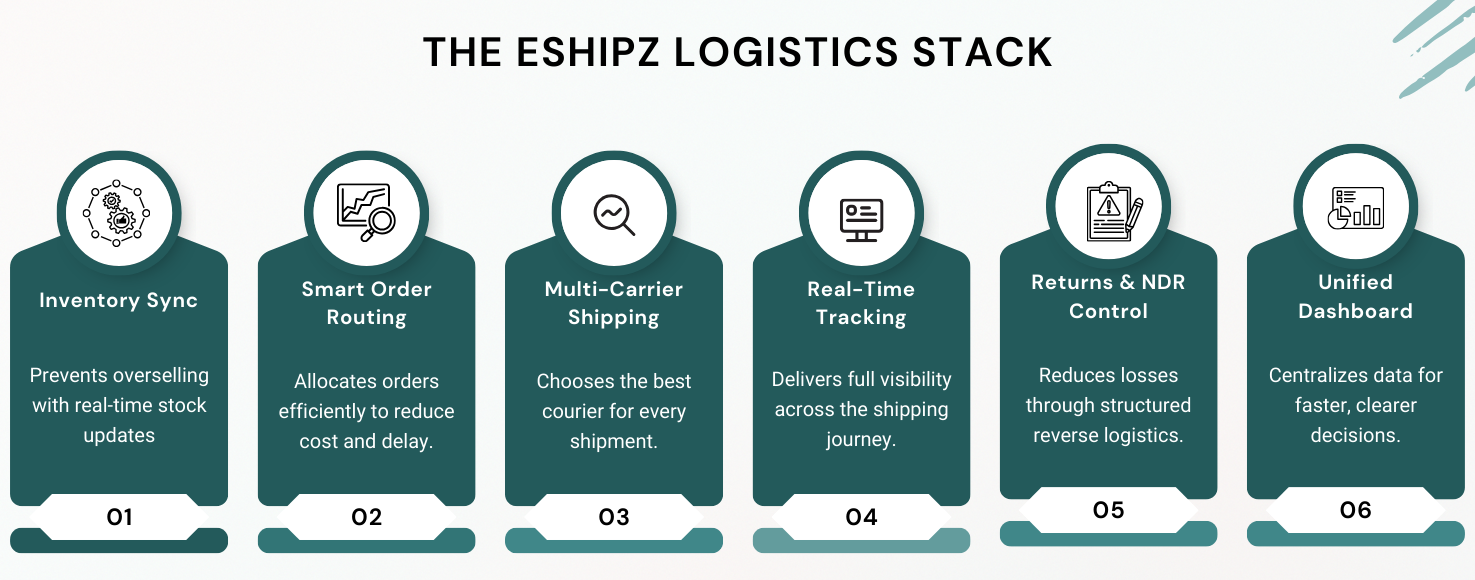
1. Inventory Automation Across Channels
Inventory errors are a major cause of cancellations and delivery issues in ecommerce. Without real-time stock synchronization across marketplaces and warehouses, overselling becomes inevitable. Automated inventory updates ensure accurate stock visibility, prevent mismatches, and create a stable foundation for scalable growth.
2. Intelligent Order Management
Shipping every order from a single warehouse increases costs and delays. Smart order routing considers stock availability, location proximity, and delivery timelines. Automated allocation speeds up dispatch, reduces errors, and improves overall fulfillment efficiency.
3. Multi-Carrier Shipping Flexibility
No single courier performs best across every region and shipment type. Multi-carrier integration enables dynamic selection based on cost, speed, and reliability. Automated carrier allocation protects margins while maintaining consistent delivery performance.
4. Real-Time Tracking & Visibility
Customers expect complete transparency once an order is placed. Real-time tracking reduces support queries and builds trust through proactive updates. Internally, it helps teams detect delays early and maintain stronger operational control.
5. Returns & NDR Optimization
Returns and RTOs directly impact ecommerce profitability, especially in high-COD markets. Structured reverse logistics ensures faster reattempts and better exception handling. Automated returns management minimizes losses and improves recovery efficiency.
6. Unified Dashboard for Operational Control
Using multiple tools often fragments visibility across systems. A centralized dashboard brings inventory, orders, shipping, and analytics into one interface. With a single source of truth, teams make faster, data-backed decisions with greater clarity.
These capabilities are not optional enhancements layered on top of operations. They form the structural backbone required for sustainable growth. As order volumes increase and sales channels multiply, complexity rises exponentially. Without integrated systems, teams spend more time resolving issues than driving expansion.
B2B & Ecommerce Workflow Integration for Supply Chain Efficiency
Modern logistics operations often struggle not because of effort, but because of disconnected systems. When inventory, order management, and shipping tools operate in silos, inefficiencies quietly slow down growth. Let’s explore the difference between fragmented workflows and a truly integrated logistics ecosystem.
|
Operational Layer |
Disconnected Tools |
Integrated Workflow |
|
Inventory Updates |
Manual sync, delays | Automated, real-time updates |
|
Carrier Selection |
Manual comparison | Rule-based auto allocation |
| Shipment Tracking | Platform switching |
Centralized real-time tracking |
| Returns Handling | Spreadsheet tracking |
Structured returns & NDR optimization |
| Reporting | Fragmented analytics |
Data-driven insights from one dashboard |
When inventory automation, order management, and logistics automation work together, operational excellence becomes repeatable, not accidental. Errors reduce, fulfillment accelerates, and decisions are driven by real-time data instead of guesswork. Instead of reacting to disruptions, your operations evolve into a predictive, performance-driven engine.
Warehouse & Logistics Management Powered by Real-Time Data Insights
Growth without visibility doesn’t create scale, it creates chaos. As order volumes increase, so do shipping costs, delivery exceptions, and operational blind spots. Without structured data, teams are forced to react to problems instead of preventing them.
An integrated logistics ecosystem changes this completely. When inventory management, order processing, and shipping systems work together, every transaction generates clean, structured logistics data. This data becomes the foundation for smarter decisions across the supply chain.
What Structured Logistics Data Enables
With integrated systems, businesses gain visibility into:
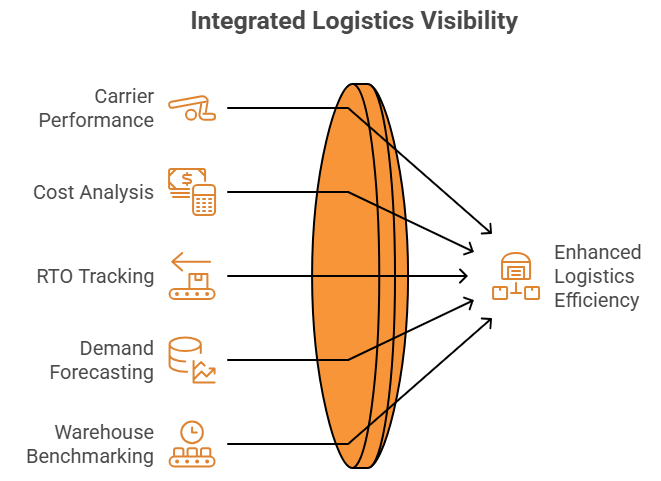
Carrier Performance Comparison
Identify which partners deliver the fastest, most reliably, and at the lowest cost. This helps you allocate shipping volumes strategically instead of splitting them evenly without insight. Over time, performance-based decisions improve customer satisfaction and reduce delivery escalations.
Cost-Per-Shipment Analysis
Understand the true shipping cost across zones, weights, and service levels. Clear visibility into cost drivers prevents hidden margin leaks in daily operations. It also strengthens your ability to negotiate smarter contracts with carrier partners.
RTO (Return to Origin) Rate Tracking
Pinpoint patterns behind failed deliveries and recurring return reasons. Identifying high-risk pin codes, payment modes, or product categories allows proactive intervention. Reducing RTO directly protects revenue and lowers reverse logistics expenses.
Demand Forecasting Insights
Use historical shipment data to predict demand more accurately. Better forecasting ensures inventory is placed closer to high-demand regions. This reduces stockouts, improves fulfillment speed, and minimizes excess holding costs.
Warehouse Performance Benchmarking
Measure picking speed, dispatch timelines, and fulfillment accuracy across locations. Performance benchmarking highlights inefficiencies that may otherwise go unnoticed. Continuous monitoring enables consistent process improvement and scalable operational growth.
According to industry reports, logistics costs can account for 10–15% of total ecommerce revenue in emerging markets. Even small efficiency improvements can create a measurable impact on profitability. When decisions are data-backed, optimization becomes consistent rather than occasional.
Scalable Logistics Automation Supporting Every Stage of Growth
As businesses grow, operational complexity grows with them. Each stage of expansion brings new logistics challenges that require smarter systems, tighter visibility, and stronger process control. While the scale may differ, the need for streamlined logistics operations remains constant.
Expanding D2C Brands
Require seamless omnichannel synchronization between marketplaces and owned websites to prevent stock mismatches. Real-time inventory visibility ensures customers only purchase what’s truly available. This protects brand trust while enabling consistent order fulfillment across channels.
Fast-Growing SMBs
Need centralized logistics operations without increasing headcount. Automation replaces manual coordination across carriers, warehouses, and order systems. This allows lean teams to scale efficiently without operational chaos.
Omnichannel Retail Brands
Must balance in-store fulfillment with warehouse dispatch operations. Unified inventory and order visibility prevent stock conflicts between retail outlets and online demand. This creates a smoother customer experience across every sales touchpoint.
Logistics-Heavy Businesses
Depend on scalable multi-carrier shipping and structured reverse logistics control. Intelligent carrier allocation improves delivery performance while reducing costs. Efficient returns and NDR management protect margins and customer satisfaction.
Operations & Growth Teams
Require clear visibility into shipping costs, NDR rates, carrier performance, and delivery timelines. Data-backed insights help teams optimize routes, reduce RTO losses, and forecast demand more accurately. This turns logistics from a cost center into a growth enabler.
Despite varying operational needs, the core requirement remains the same: operational simplicity at scale through integrated logistics automation.
Lay the Foundation Before Scaling
Ecommerce is growing at an unprecedented pace, but operational complexity is growing even faster. What once worked with manual coordination and disconnected tools no longer holds up under scale. The real question today isn’t whether automation is needed, but whether your logistics systems are truly built to scale.
When inventory, order processing, carrier allocation, and analytics function in silos, friction becomes inevitable. Delays increase, visibility reduces, and teams spend more time fixing issues than driving growth. But when these systems operate as one connected workflow, performance doesn’t just improve, it compounds.
EasyEcom shipping integration represents that structural shift. By unifying inventory automation, intelligent multi-carrier shipping, real-time tracking, and centralized analytics into a single ecosystem, it transforms logistics from a reactive function into a strategic growth engine.
If your operations are scaling, your logistics infrastructure should scale with them.
Ready to build a smarter, more resilient shipping ecosystem? Connect with us