
eCommerce shipping, the process of moving an online order from warehouse to doorstep, has evolved rapidly, driven by consumer expectations for speed, transparency and convenience. In India alone, the online transaction value is expected to rise from US $83 billion in 2022 to nearly US $150 billion by 2026. As we look at the evolution of e-commerce and how it shapes delivery, one thing is clear, 2026 will redefine how brands fulfil, ship and serve their customers..
The future of ecommerce in 2026 will be powered by AI, hyperlocal fulfilment, sustainable delivery methods and real-time visibility across the supply chain. With shoppers demanding faster, greener and smarter deliveries, shipping is no longer a backend function, it is becoming a core part of customer experience. Understanding these trends is essential for retailers preparing for the top business trends in 2026.
In this blog, we’ll break down what the future of ecommerce in 2025 and 2026 looks like, how eCommerce shipping is evolving, the major trends shaping 2026, and what retailers must do to stay competitive. This sets the stage for a clear, structured guide to the next era of digital commerce and logistics.
What Is the Future of eCommerce in 2026, and How It Sets the Stage for Next Year?
The future of eCommerce in 2025 set the foundation for the major logistics and shipping upgrades we see in 2026. Last year, brands were still experimenting, mobile-first shopping, AI-driven personalisation, early same-day delivery pilots, and the first steps toward sustainability. These were promising trends, but not fully matured.
By 2026, the shift is clear: what felt like a “nice to have” in 2025 has now become a non-negotiable. The pace of evolution is fast. Retailers that started early with AI, micro-fulfilment centres, and greener shipping practices are the ones who are now ahead, ready to deliver faster, cleaner, and fully transparent shipping experiences.
2025 vs 2026
| 2025 | 2026 |
| Mobile, live–stream & social commerce rise | Predictive and hyper-personal shopping |
| AI for personalisation | AI for full supply-chain orchestration |
| Early same-day & micro-fulfilment pilots | Instant & hyperlocal delivery becomes standard |
| Sustainability in early stages | Sustainability becomes mandatory |
| Systems still siloed | Full real-time API integration |
AI becomes smarter, deliveries get faster, sustainability gets stronger, and seamless integration turns into a must-have. Together, these shifts shape a shipping landscape that’s more efficient, intelligent, and truly customer-centric.
eCommerce Shipping Evolution
The evolution of e-commerce shipping is marked by a shift from volume and reach to speed, precision, and customer-centricity. We’re moving beyond “ship-it-fast” to “ship-it-smart”. Here’s how:
Hyperlocal Fulfillment and Predictive Delivery
Same-day and even instant delivery will become a standard expectation, not a premium service. This speed is enabled by micro-warehouses and city-hub fulfilment centres, combined with sophisticated AI and machine-learning that optimise routes dynamically and provide customers with highly accurate, pre-emptive delivery windows.
AI and Automation in the Supply Chain
AI will evolve from a supportive role to an operational command. In warehouses, autonomous mobile robots (AMRs) will become common; predictive analytics will anticipate demand spikes, ensuring optimal inventory levels and “smart slotting” (placing fast-moving products closer to dispatch zones).
Sustainability as a Core Requirement
Eco-conscious shipping is a major purchasing factor. Brands will embed sustainability into their core operations: recyclable/compostable packaging, green fleets (electric vans/bikes), carbon-tracking dashboards. Transparency will be key.
Data Integration and Real-Time Visibility
Disconnected systems are being replaced by integrated digital supply chains. APIs connect retailers, carriers, and warehouses in real time. This unified data flow allows for end-to-end visibility, proactive exception management (fixing delays before customers see them), and data-driven decision making across the logistics network.
Omnichannel and Cross-Border Optimisation
E-commerce journeys are increasingly fluid across devices and physical stores. Shipping strategies must support this “fractal shopping” journey, offering seamless options like Buy Online, Pickup In-Store (BOPIS). Cross-border shipping will also be streamlined with automated customs clearance and localised shipping partners to provide a global reach with a local feel.
The shipping component of e-commerce is evolving to become faster, smarter, greener and more seamlessly integrated than ever before.
Emerging Business Trends in Logistics & Shipping
In 2026, logistics and shipping move from being backend functions to core business drivers. Speed is now non-negotiable, customers expect fast, predictable delivery, and any delay can impact trust. Shipping also becomes a strategic differentiator, shaping brand perception as much as product quality. Sustainability shifts from a side initiative to a business requirement, with companies judged on how responsibly they ship. Operations turn deeply data-centric, powered by real-time visibility, AI-led decisions and tightly integrated systems. Businesses also navigate the balance of scaling globally while delivering hyper-local speed. With rising regulatory pressures and constant cost volatility, companies can no longer rely on reactive operations, 2026 demands proactive, intelligent and customer-first supply chains.
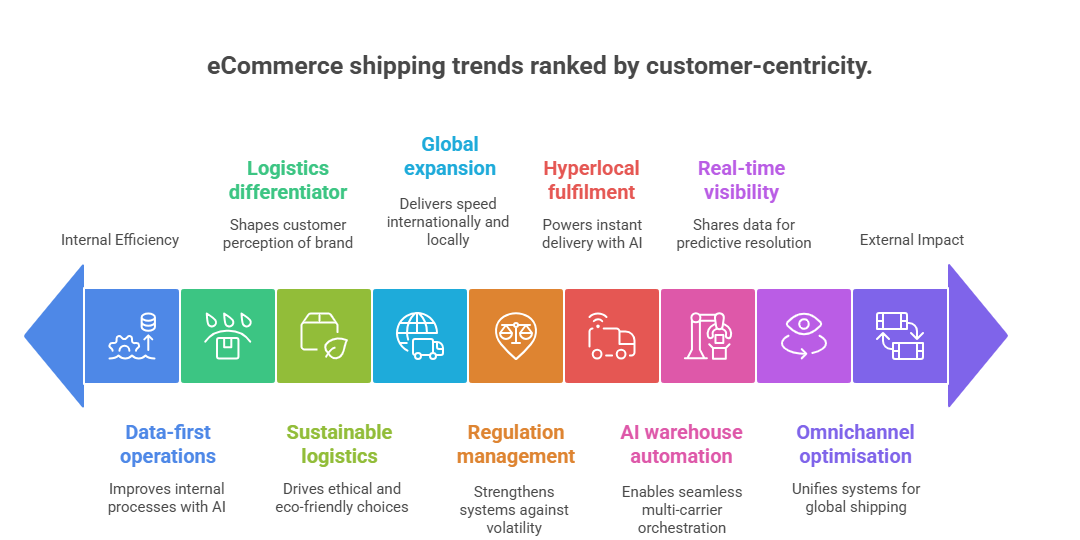
- Speed as the new baseline – Customers expect fast, reliable delivery; delays directly impact trust.
- Logistics as a brand differentiator – Shipping influences how customers perceive and remember a brand.
- Sustainability becomes mandatory – Eco-friendly operations, ethical sourcing and carbon tracking shape buying decisions.
- Data-first, AI-driven operations – Real-time tracking, predictive decisions and integrated systems improve efficiency.
- Global expansion + local immediacy – Brands grow internationally while delivering hyperlocal speed.
- Regulation & risk management – Compliance, customs and fuel volatility push companies toward stronger systems.
Core eCommerce Shipping Trends
- Hyperlocal fulfilment & predictive delivery – Same-day and instant delivery powered by city hubs and AI routing.
- AI & warehouse automation – Smarter forecasting, autonomous picking, and seamless multi-carrier orchestration.
- Sustainable logistics – Electric fleets, eco-packaging and greener returns become expected.
- Real-time visibility & proactive alerts – Retailers and carriers share data end-to-end, enabling predictive issue resolution.
- Omnichannel & cross-border optimisation – Unified systems support BOPIS, curbside, lockers and global shipping without friction.
For logistics providers and e-retailers in India and globally, success in 2026 will require shifting from reactive operations to proactive, intelligent, customer-centric supply chains.
Key Challenges in eCommerce Shipping
Even as 2026 brings smarter, faster and more sustainable shipping, businesses must navigate several critical challenges that shape the future of logistics.
1. Balancing Speed, Sustainability & Cost
Ultra-fast delivery often increases operational costs and carbon footprint. Brands must find the right balance between speed, eco-friendly methods and profitability, without compromising customer experience.
2. High Infrastructure Investment Needs
Micro-warehouses, city hubs, dark stores and last-mile delivery fleets demand significant capital and strategic placement. Poor location decisions or underused infrastructure can drive up long-term costs.
3. Rising Regulatory & Compliance Complexity
Cross-border shipping introduces layers of customs rules, duties, tariffs and data privacy regulations. Evolving carrier guidelines and government policies require businesses to stay agile and compliant across markets.
4. Escalating Consumer Expectations
As same-day and instant delivery become the norm, customer expectations rise even faster. Any delay failed delivery attempt or poor tracking experience can damage trust and push shoppers toward competitors.
In short, the brands that win in 2026 will be the ones that solve these challenges not reactively, but with smart systems, agile operations and a customer-first mindset, turning obstacles into long-term competitive advantages.
What This Means for Brands in 2026 and Beyond
The future of eCommerce in 2026 is clear: speed, sustainability, intelligence and transparency are no longer differentiators, they are expectations. Brands that master hyperlocal fulfilment, AI-driven decision making, eco-friendly delivery and real-time visibility will define the next era of online retail. In this new landscape, logistics is no longer “back office”; it becomes the engine of customer experience and a core driver of brand trust.
For India’s fast-growing D2C ecosystem and 3PLs, this shift opens a massive competitive edge. Whether it’s offering predictive delivery windows, sustainable shipping choices, or flawless end-to-end tracking, the ability to deliver with precision will separate market leaders from the rest. In short: eCommerce in 2026 won’t be won by the lowest price, but by the smartest, fastest and most customer-centric delivery.
In 2026, customers choose brands that deliver smarter, not just faster.
Equip yourself with eShipz today and stay ahead of every expectation.