
Global logistics spending crossed $10.3 trillion in 2023, with freight expenses accounting for nearly 40% of that cost. As parcel volumes continue to surge across ecommerce, retail, manufacturing, and distribution, one quiet challenge has become increasingly costly for companies worldwide: hidden billing errors. This is exactly where Freight Audit comes in.
Freight Audit is the process of verifying, validating, and reconciling every shipping charge to ensure a business pays only the correct amount, nothing more, nothing less. It reviews billed rates, weight calculations, zone mappings, surcharges, and carrier contracts to detect discrepancies and prevent overcharging. In a world where thousands of shipments move daily, this simple process can save companies millions over time.
In this blog, we will explore what freight audit really means, why businesses need it today, real-world use cases, key benefits and how automated systems make it simpler, smarter, and error-free.
Why Freight Audit Matters for Modern Logistics Billing
When you’re shipping with multiple carriers, each with its own rate cards, weight slabs, fuel surcharge rules, and additional fees, the gap between your expected cost and the actual billed amount can become surprisingly wide.
That’s where a structured freight audit becomes essential. A digital freight audit and reconciliation system brings clarity by automating:
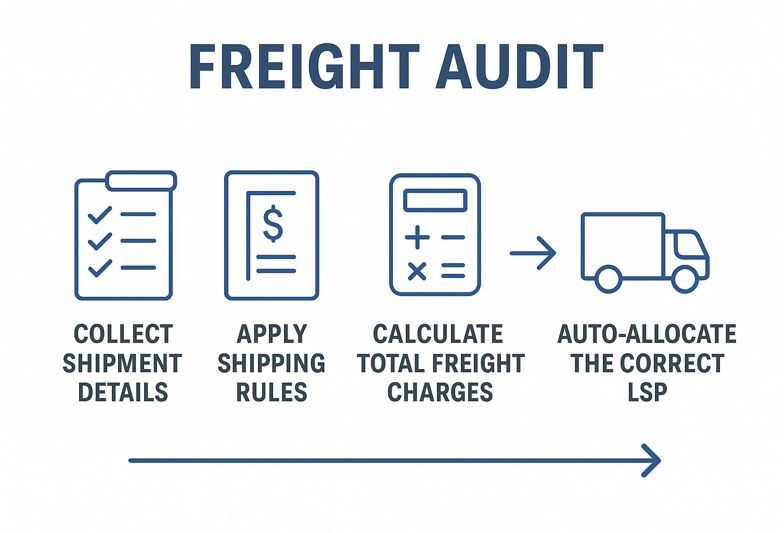
Contract vs. invoice comparison
Every invoice line is matched back to the exact contract rate you’ve signed with each carrier. This ensures that billed charges strictly follow the agreed slabs, weight brackets, and service levels. Any deviation, no matter how small, is immediately flagged, preventing silent leakages over thousands of shipments.
Weight, zone, and volumetric validation
Shipments are audited across actual weight, charged weight, and volumetric weight calculations. The platform checks whether the billed zone matches the delivery region and validates if the carrier’s weight computation is justified. This eliminates the most common source of hidden overspend in logistics.
Fuel surcharge and accessorial checks
Fuel surcharges, handling fees, COD charges, and other accessorials are verified against your contracted rules. Unnecessary add-ons, incorrect percentages, or services that were never availed are spotted instantly, ensuring you pay only for what was truly used.
Overbilling and duplicate charge detection
Automated scans identify duplicate invoices, repeated charges for the same AWB, incorrect rate multipliers, and any inconsistencies that manual reviews often miss. This keeps your monthly reconciliation clean, predictable, and error-free.
Cost optimisation insights
Beyond auditing, the system highlights actionable insights, carrier inefficiencies, high-cost lanes, frequent mismatches, or patterns of surcharge misuse. This helps logistics and finance teams optimise both operations and spending in the long run.
Together, these capabilities allow logistics teams to see every cost with total clarity, improve carrier performance, and remove guesswork from decision-making. Finance teams benefit from accurate billing, predictable month-end cycles, and zero leakage, strengthening overall cost control.
Key Use Cases of a Digital Freight Audit System
As shipping volumes rise and businesses work with multiple carriers, maintaining billing accuracy becomes harder and far more critical. Small errors across thousands of shipments quickly turn into avoidable cost leakages. A modern digital freight audit system brings transparency, consistency, and control back into logistics spending by automating checks that manual teams simply cannot keep up with.
| Use Case | Explanation | Benefit / Impact |
| Multi-Carrier Contract Management | Managing several carriers means juggling different rate cards, zones, weight brackets, and contract rules. A digital freight audit engine checks every shipment against the correct contracted rate, removing guesswork and avoiding manual cross-checking. | Prevents billing errors, ensures accuracy, and saves time for operations teams. |
| Cost Control for High-Volume Shippers | For D2C brands, 3PLs, retailers, and manufacturers, large shipment volumes lead to complex invoices. Automated freight audits validate each charge accurately. | Reduces unnecessary costs, ensures every rupee billed is correct, and improves overall ROI. |
| Incorrect Billing Detection | Errors like wrong zone mapping, incorrect weight slabs, fuel surcharges, or GST miscalculations are common. A freight audit system detects these instantly. | Eliminates recurring overspend and ensures invoices reflect true shipment costs. |
| Powering Smart Shipping Decisions | Insights from freight audits help optimise carrier allocation, refine shipping rules, and enable faster dispatch decisions. | Enables smarter, data-driven logistics strategies and cost-efficient carrier selection. |
| Enhanced Carrier Performance Tracking | Verified audit data allows businesses to track carrier performance accurately, including billing reliability and service quality | Supports better negotiations, stronger SLAs, and long-term carrier partnerships. |
A digital freight audit system does more than spot errors, it gives businesses a sharper, data-driven understanding of their logistics spending. By combining accuracy, transparency, and actionable insights, it empowers operations and finance teams to run leaner, negotiate smarter, and scale with confidence. In today’s competitive landscape, freight audit isn’t just a safeguard; it’s a strategic advantage.
Maximising Savings and Efficiency with Freight Audits for Better Freight Cost Visibility
Freight audit is much more than a tool for spotting invoice mistakes, it is a system that reshapes how your logistics and finance teams work every day. By validating every shipment against contracted rules, it gives your business a level of freight cost visibility that manual checks can never achieve. The result is tighter control, smarter decisions, and a logistics engine that runs with precision instead of guesswork.
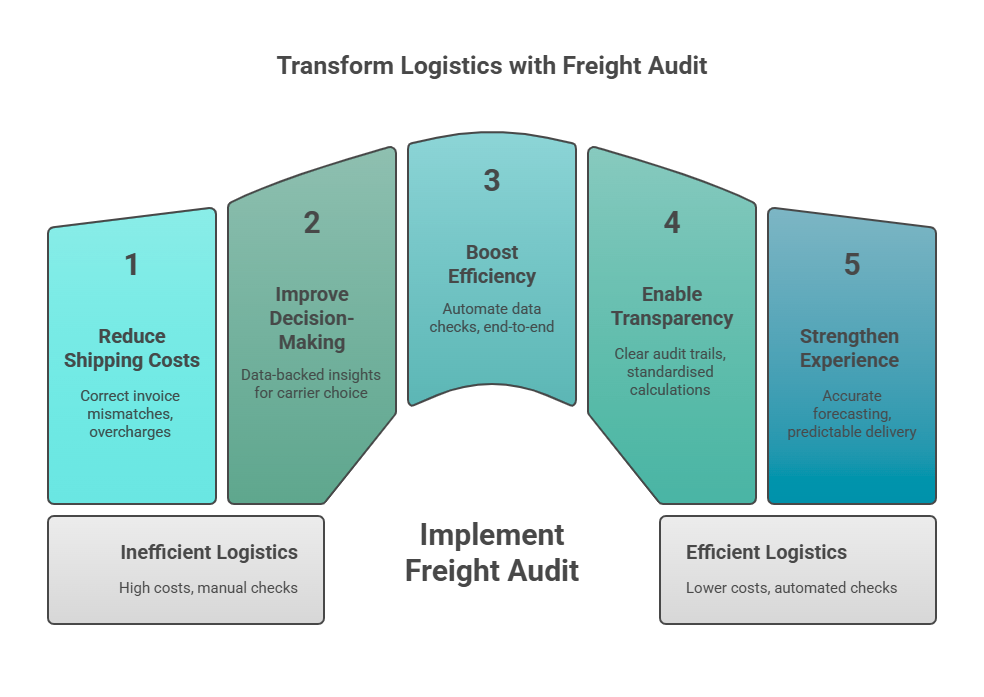
One of the biggest advantages is cost reduction. A detailed freight audit helps businesses uncover overcharges, duplicate billings, incorrect weight slabs, or unnecessary surcharges that often go unnoticed. Across thousands of shipments, these small leaks add up quickly. Companies typically save 5–15% simply by correcting mismatches and ensuring carriers bill exactly as per contract. This isn’t just cost-cutting, it’s reclaiming money that was already yours.
Freight audit also elevates decision-making across the organisation. With clean, verified logistics intelligence, teams can compare carriers based on true performance, cost, speed, accuracy, and consistency. This helps businesses choose the right carrier for the right shipment, optimise service types, and plan more efficient delivery routes. Decisions become data-backed instead of relying on assumptions or incomplete reports.
The impact is equally strong for operations and finance. Instead of teams spending hours checking PDFs, reconciling spreadsheets, or validating carrier invoices manually, automation handles the entire workflow end-to-end. This frees up valuable time, reduces human error, and allows both teams to focus on strategic improvements instead of repetitive review tasks.
Stronger, more transparent carrier relationships are another major benefit. When both parties operate with standardised calculations and clear audit trails, conversations shift from disputes and escalations to collaboration and performance improvement. Freight audit software provides the clarity needed to build trust and negotiate better contracts without ambiguity.
Most importantly, a robust freight audit process leads to a better customer experience. Accurate cost forecasting enables businesses to maintain predictable delivery promises, reduce operational errors, and manage carrier performance more effectively. When shipments move smoothly and costs stay under control, customers receive their orders on time, and stay satisfied.
eShipz Freight Audit for Optimized Shipping Costs
Freight audits may exist in many tools, but very few are designed to handle the real-world complexity of Indian ecommerce, retail, manufacturing, and 3PL operations. What makes this audit engine stand apart is its ability to adapt to every business model, whether it’s high-volume D2C shipments, multi-location warehousing, or enterprise-grade billing structures. Here’s what makes it truly powerful:
Handles Every Real-World Billing Scenario
The engine supports the same complexity carriers use while billing you, weight slabs, zone mapping, fuel surcharge rules, volumetric weight calculations, COD charges, handling fees, minimum billing thresholds, and more. This means every possible mistake or mismatch is caught, keeping logistics teams confident and financially protected.
Easy & Transparent Rate Card Configuration
Instead of relying on complicated interfaces, teams can simply upload rate cards in Excel. Finance, procurement, or ops teams can configure new carriers, change slabs, update zones, or modify surcharges without dependency on developers.This flexibility ensures changes go live quickly, perfect for fast-moving businesses.
Seamless Integration with Dispatch & EDD Systems
Because the audit engine works hand-in-hand with the dispatch management and delivery-date (EDD) systems, teams get a connected view from shipment creation to billing. Ops sees accurate dispatch, finance sees accurate billing, and business teams get transparent performance insights, all from one place.
Real-Time Reconciliation for Faster Approvals
No more month-end chaos. Invoices are validated automatically the moment they arrive, highlighting discrepancies instantly. Finance teams can close books faster, avoid back-and-forth with carriers, and maintain stronger governance with clear audit trails.
Built for Enterprises
Large enterprises need deep complexity; D2C teams need simplicity and speed. This system delivers both:
- For enterprises: multi-carrier, multi-zone, multi-warehouse, GST logic, volumetric calculations.
- For D2C: plug-and-play rate uploads, quick validations, and simple dashboards.
It scales effortlessly with your growth, no matter how fast your shipping volume increases.
With automated checks, transparent insights, and AI-driven optimisation, businesses experience:
- Zero billing leakage
- Higher profitability on every shipment
- Faster invoice approvals
- Error-free financial reporting
- Stronger carrier negotiation power
- 100% audit accuracy, without manual effort
Every team benefits: Ops gets clarity, finance gets accuracy, CX gets reliability, and leadership gets predictable cost control.
The Future of Freight Audit and Intelligent Automation
As supply chains grow increasingly complex and dynamic, the future of freight audit is no longer just about checking invoices,it is about strategic cost management, operational efficiency, and logistics intelligence. Modern businesses need tools that can handle multiple carriers, evolving rate structures, fuel surcharges, and GST calculations without slowing teams down. In this landscape, digital freight audit engines are becoming essential to stay ahead.
A robust freight audit system offers far more than error detection. It enables companies to gain complete visibility into shipping costs, monitor carrier performance, and ensure contract compliance in real time. By automating reconciliation and audit processes, teams can focus on smarter decision-making rather than repetitive manual checks. This translates into predictable, scalable logistics operations where shipping costs are controlled, and operational errors are minimized.
For brands, this shift is critical. Automated freight audits help identify cost-saving opportunities, optimise carrier allocation, and provide actionable insights that influence daily operations. Companies can now make data-driven shipping decisions that reduce overspending, improve efficiency, and support better customer experiences. In a fast-paced logistics environment, these insights are invaluable.
Platforms like eShipz demonstrate how a modern freight audit engine can combine automation, intelligence, and operational visibility. By integrating freight audit with dispatch management, EDD tracking, and carrier performance analytics, businesses can close the gap between operations and finance, ensuring every shipment is optimised for cost and accuracy. This indirect approach ensures teams work smarter, not harder.
Freight That Feels Effortless
The future of freight audit lies in leveraging technology to streamline logistics, prevent billing leakage, and deliver cost transparency. Companies that adopt such solutions gain a competitive edge, turning what was once a back-office necessity into a core strategic advantage. For those looking to simplify freight cost management while ensuring accurate shipping invoices and full freight cost visibility, exploring a digital freight audit engine is the next logical step.
Don’t wait until hidden freight charges pile up and slow your margins, unlock real-time auditing now and see everything you’ve been missing.