
Imagine this scenario.
Your online store is seeing steady orders. Marketing campaigns are working, customers are adding products to their carts, and sales are growing. But then the complaints begin. One customer receives a fragile item damaged. Another in a remote location gets their delivery three days late. A bulk B2B shipment meant for a retail outlet misses its promised timeline. The problem is not demand or pricing. It is choosing the wrong courier partner for the wrong shipment.
This is where choosing the right courier partner becomes critical. Not all shipments are the same, and not all courier partners perform equally across products, locations, and delivery timelines. Businesses that align courier selection with SKU characteristics, delivery zones, and SLA expectations reduce costs, improve customer experience, and scale with confidence.
This blog breaks down how courier selection actually works when these three elements come together, and why this approach is becoming essential for logistics decision making in 2026.
Why Choosing the Right Courier Partner Is Needed and How It Works
At a basic level, courier selection is often treated as a rate comparison exercise. Businesses shortlist partners based on price per shipment or brand reputation. While this may work at a low scale, it fails as order volumes grow and shipment diversity increases.
Why it is needed
Every logistics operation faces three recurring challenges.
- Different SKUs behave differently in transit
- Courier performance varies by zone
- Customer expectations around delivery speed are rising
A single courier partner cannot consistently meet all these requirements. Some excel in metro deliveries but struggle in tier 3 locations. Others handle heavy parcels well but underperform on fragile or high value SKUs. Ignoring these differences leads to higher RTOs, SLA breaches, and customer dissatisfaction.
Choosing the right courier partner allows businesses to align shipment requirements with courier strengths rather than forcing one courier to handle everything.
How it works in practice
Modern courier selection works on a decision framework rather than fixed assignments. Each shipment is evaluated based on key parameters such as product type, destination zone, and delivery promise. The courier partner best suited for that combination is selected automatically or operationally.
This approach shifts logistics from reactive problem solving to proactive optimization.
How SKU, Zone and Delivery SLA Work Together in Courier Selection
Most blogs discuss SKU analysis, zone mapping, or SLA planning in isolation. In reality, the real advantage comes when all three are evaluated together for every shipment.
Understanding SKU behavior
SKU stands for Stock Keeping Unit, but in logistics, it represents much more than an inventory code. Each SKU has a logistics personality.
Key SKU attributes that impact courier choice include:
- Weight and dimensions
- Fragility or handling sensitivity
- Product value and theft risk
- Packaging requirements
- B2B or B2C nature
For example, a lightweight apparel SKU can be shipped efficiently through a different courier than a bulky home appliance. A fragile cosmetic item requires better handling and lower touchpoints compared to a durable product.
Couriers also vary in how well they handle specific SKU types. Some have better packaging compliance checks, while others specialize in heavy or volumetric shipments.
Role of delivery zones
Delivery zones define the geographic complexity of a shipment. These are typically categorized as:
- Local and hyperlocal
- Metro
- Non metro
- Tier 2 and tier 3 cities
- Remote or extended areas
Courier performance is not uniform across zones. A courier that delivers the next day consistently in metros may take significantly longer in remote regions. Cost structures also change with zone distance, fuel surcharges, and last mile reach.
Zone based courier selection ensures that shipments are routed through partners with proven delivery density and infrastructure in that area.
Importance of delivery SLA
Delivery SLA defines the promised delivery timeline shared with the customer or business partner. It directly impacts customer trust and repeat purchases.
SLAs may vary based on:
- Same day or next day delivery
- Standard delivery timelines
- B2B replenishment deadlines
- Seasonal or campaign driven commitments
Not all couriers offer the same SLA reliability. Some provide faster transit but higher failure rates, while others offer stable but slower delivery. Matching SLA expectations with courier performance data is essential to avoid overpromising.
Bringing all three together
When SKU, zone, and SLA are evaluated together, courier selection becomes precise.
For example:
- A fragile, high value SKU going to a metro location with a next day SLA requires a courier with strong handling and fast metro connectivity
- A bulky SKU heading to a tier 3 city with a relaxed SLA can be assigned to a cost efficient courier with wider reach
- A B2B shipment to a retail store with a fixed delivery window needs a courier known for schedule adherence rather than speed
This combined evaluation ensures the right courier is chosen for the right shipment every time.
Benefits of This Approach and How to Implement It
Key benefits for businesses
Adopting a structured courier selection framework delivers measurable improvements.
- Reduced logistics costs: Assigning cost effective couriers where speed is not critical helps control shipping expenses without compromising service quality.
- Improved delivery success rates: Matching courier strengths with SKU and zone requirements reduces delivery failures, damages, and RTOs.
- Better customer experience: Accurate SLAs and reliable delivery improve trust, reviews, and repeat purchases.
- Scalability during growth: As order volumes and product categories expand, this approach prevents operational bottlenecks.
- Data driven decision making: Courier performance data across SKU types and zones enables continuous optimization.
Implementation process
Implementing this framework does not require complex infrastructure at the start. It can be built in phases.
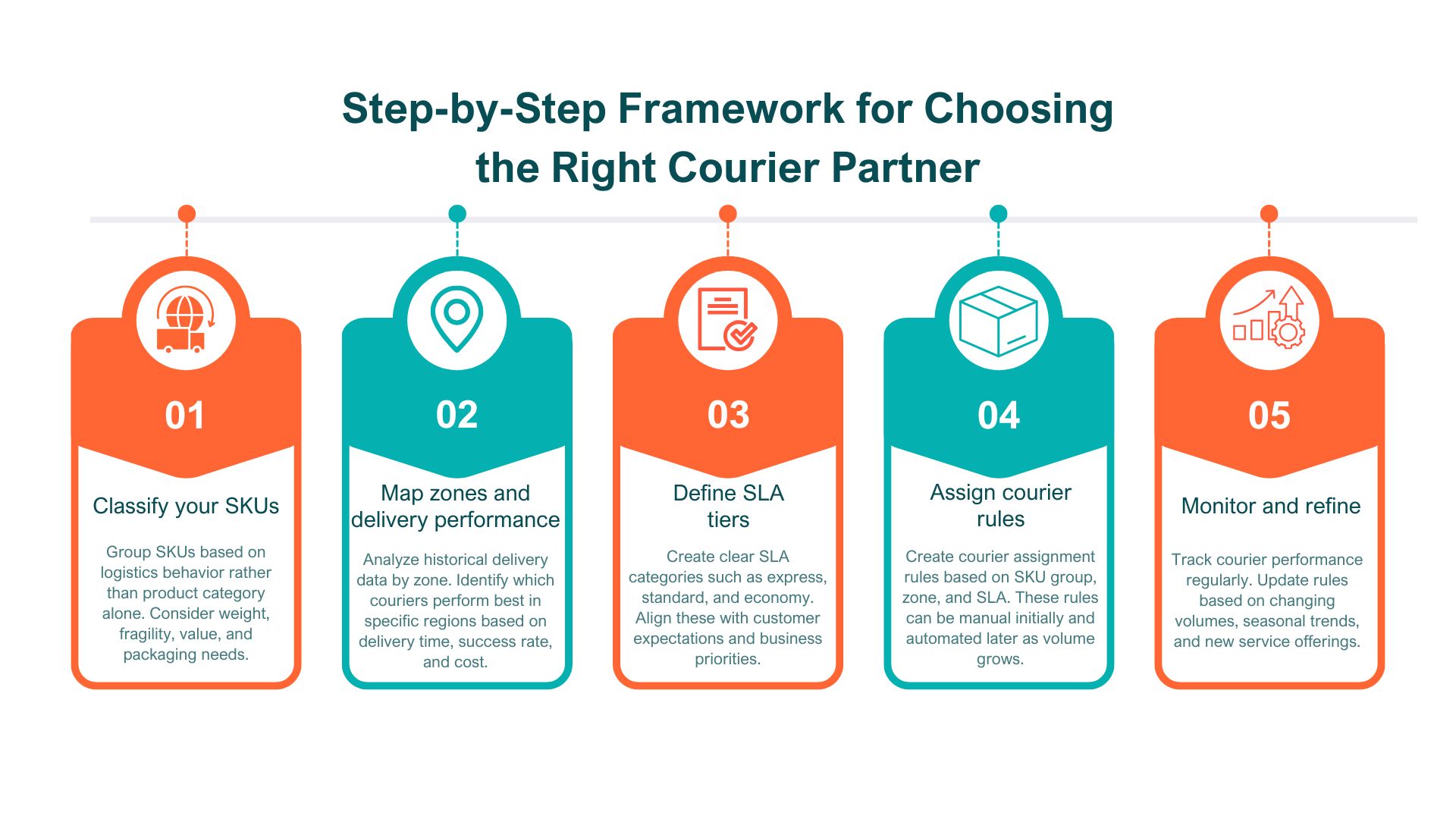
This structured yet flexible approach ensures that courier selection evolves alongside the business.
From Courier Choice to a Scalable Logistics Strategy
Choosing the right courier partner in 2026 is no longer about relying on a single service provider. It is about building a flexible courier network that adapts to different SKUs, delivery zones, and evolving delivery SLAs. Businesses that align courier selection with these factors are better positioned to meet customer expectations while maintaining cost efficiency as volumes and geographies expand.
Platforms like eShipz enable this shift by providing actionable visibility through intuitive dashboards. Businesses can analyze historical delivery data by zone and identify which couriers perform best in specific regions based on delivery timelines, success rates, and shipping costs. These insights help logistics teams move away from assumptions and make informed decisions grounded in real performance data.
eShipz also simplifies execution through courier allocation rules. Businesses can define their allocation logic once, whether prioritising the lowest cost, the fastest delivery time, or the highest-rated courier. The system then automatically assigns the right courier partner to every order, reducing manual intervention and dispatch errors. By turning courier selection into a data-driven logistics strategy, businesses can reduce delivery failures, improve customer experience, and scale confidently. To see how this approach can work for your operations, connect with eShipz experts and explore smarter ways to manage courier selection at scale.