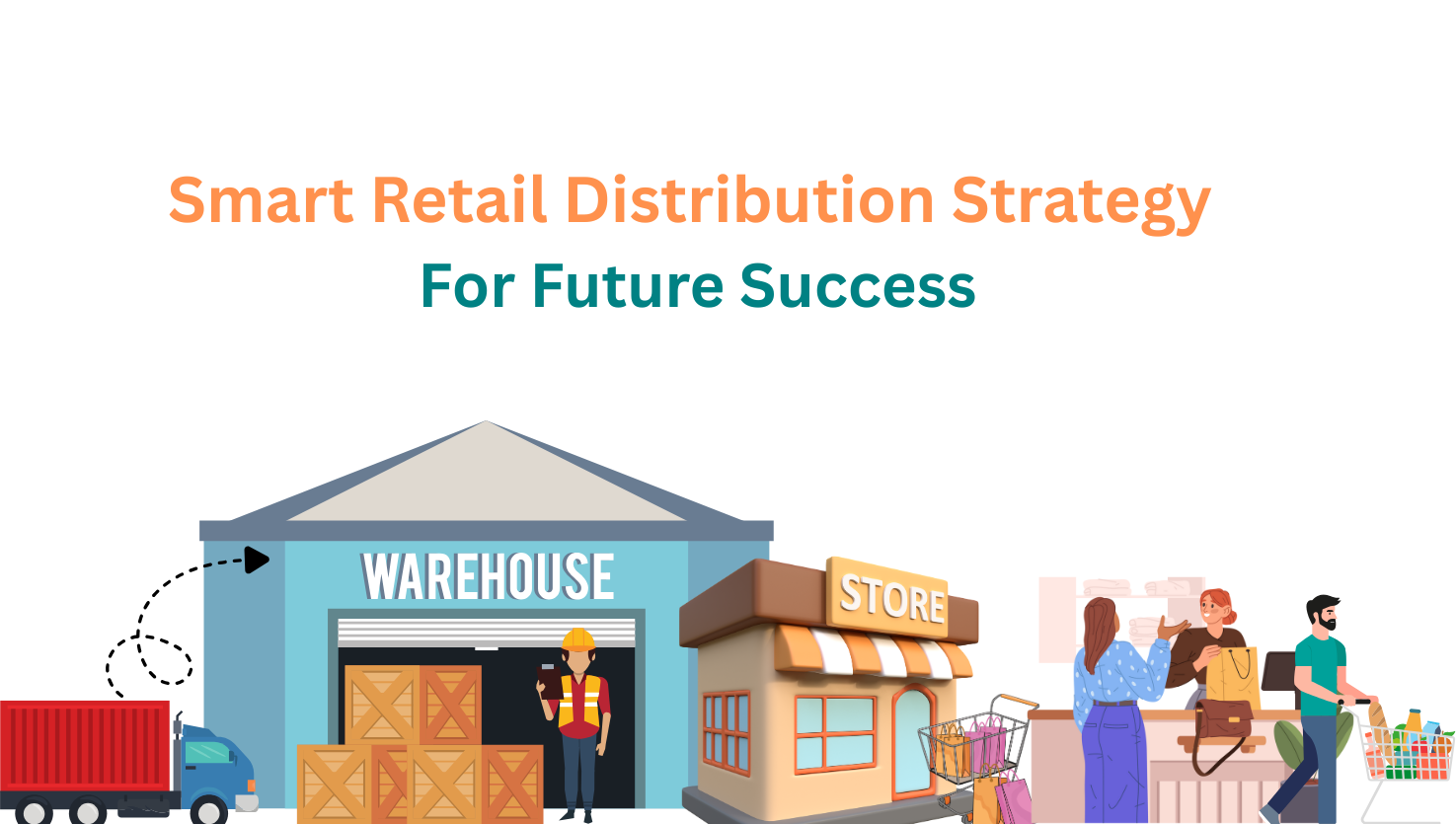
In today’s fast-moving retail landscape, how products reach customers determines business success. Modern shoppers expect instant availability and smooth delivery—making retail distribution strategy a crucial part of retail operations.
Retail distribution is the process of moving goods from manufacturers to end consumers through multiple intermediaries such as wholesalers, distributors, or retailers. Its key components include sourcing, warehousing, transportation, order fulfilment, and returns management. A strong strategy ensures that products are available at the right place, in the right quantity, and at the right time—while keeping costs under control and customers satisfied.
Key Components of Retail Distribution
- Manufacturing and Procurement – Where goods are produced or sourced.
- Warehousing and Storage – Facilities where goods are stored before shipment.
- Transportation and Logistics – Movement of goods between suppliers, warehouses, and retail outlets.
- Retail Channels – Includes physical stores, online platforms, or distribution partners.
- Order Fulfilment and Returns – The final stage, ensuring timely delivery and efficient reverse logistics.
A well-structured distribution system helps retailers reduce costs, avoid stockouts, and improve customer satisfaction. Let’s take a look at how this process typically flows.
Flowchart: How Retail Distribution Works
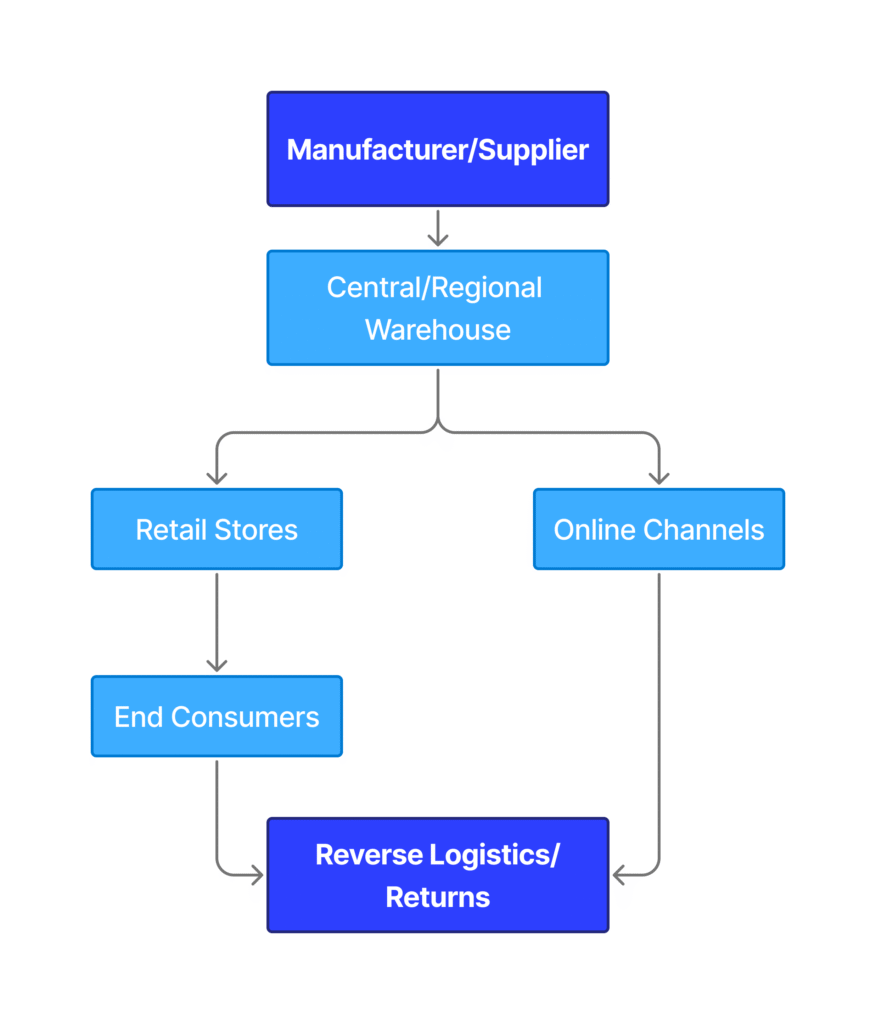
Retail distribution can vary widely depending on product type, customer expectations, and business model. Some brands want maximum market penetration, while others prefer exclusivity and brand control. The following section explains the main types of retail distribution and how each functions in real-world retail.
Types of Retail Distribution
Retailers use different distribution approaches based on product type, customer base, and desired market reach. Each type offers varying levels of control, coverage, and brand positioning.
Intensive distribution focuses on maximum reach, placing products in as many outlets as possible. It suits high-volume goods like packaged foods or beverages, where convenience and visibility drive sales.
Selective distribution limits sales to a smaller number of authorized outlets, balancing reach with quality control—common among electronics or mid-tier fashion brands.
Exclusive distribution restricts sales to one or very few retailers in a region, protecting brand prestige and pricing. It is ideal for luxury goods.
Direct-to-Consumer (D2C) models let brands sell directly through owned channels, gaining better margins and customer insights.
Omnichannel distribution connects online and offline sales channels into one seamless experience, giving customers flexibility to browse, buy, and return anywhere.
Distributor-based models rely on regional partners who manage wholesale deliveries, helping brands expand into new markets efficiently.
Overview of Major Retail Distribution Types
Understanding the distinctions between these distribution models helps retailers choose the right mix based on their products, market goals, and brand positioning. The table below summarizes how each type of retail distribution differs in terms of market coverage, control, and ideal use cases.
| Distribution Type | Coverage | Control | Suitable For | Example |
| Intensive | Very wide | Low | FMCG & daily goods | Coca-Cola |
| Selective | Moderate | Medium | Electronics, apparel | JBL |
| Exclusive | Limited | High | Luxury goods | Rolex |
| D2C | Direct | Very high | Digital-first brands | Nike |
| Omni-channel | Broad, unified | High | Retail chains, fashion | Zara |
| Distributor-based | Regional | Medium | FMCG, household items | Unilever |
Each approach offers a unique balance between reach, control, and brand experience. Retailers often combine multiple models – like pairing D2C with omnichannel distribution – to build flexible, customer-centric networks that can adapt to evolving market needs.
Key Ways to Implement Retail Distribution Strategies
- Set Clear Distribution Goals
Begin with measurable objectives—whether to expand into new markets, improve delivery time, or reduce logistics costs. These goals define which distribution type and technology setup best support your business.
- Map the Target Market
Understand your customers and where they buy. Segment markets by geography, behavior, and product type. Urban areas may favor omnichannel models, while rural or regional markets may rely more on distributors.
- Choose the Right Distribution Model
Select a strategy aligned with your brand and supply capabilities:
- Intensive for mass-market products
- Selective for mid-range goods
- Exclusive for luxury brands
- D2C for personalized experiences
- Omnichannel for unified shopping journeys
A mix of these models often yields the best balance between control and coverage.
- Build Reliable Partner Networks
Distribution success depends on strong collaboration with logistics partners and retailers. Evaluate partners on coverage, delivery speed, and reliability. For expanding brands, regional distributors can ensure faster local delivery and smoother market entry.
- Integrate Technology and Automation
Technology is the backbone of modern retail distribution.
Adopt tools like:
- Warehouse Management Systems (WMS) for inventory accuracy
- Transportation Management Systems (TMS) for route optimization
- Multi-carrier shipping automation platforms such as eShipz Logistics Automation to manage order fulfilment, courier selection, and live shipment tracking
Automation minimizes manual effort and improves fulfilment speed—key for high-volume retailers.
- Optimize Inventory and Fulfilment
Use real-time visibility to manage stock levels and avoid overstocking or shortages.
Centralized inventory systems and data-driven forecasting ensure goods are available where demand is highest. Just-in-time replenishment also helps lower warehousing costs while keeping service levels high.
- Strengthen Reverse Logistics
Returns are now part of customer experience, not a back-end task.
Efficient reverse logistics systems help brands recover value from returned goods and maintain customer satisfaction. Automating returns through digital tools improves both transparency and response time.
- Monitor and Analyze Performance
Track logistics performance using KPIs like:
- On-time delivery rates
- Order accuracy
- Inventory turnover
- Return-to-origin (RTO) rate
- Cost per delivery
Regular analysis helps identify weak areas and optimize routes, partners, and resource allocation. Retailers using data-driven insights, as seen in eShipz case studies, have improved fulfilment times and reduced logistics costs.
- Stay Adaptive and Scalable
Retail markets evolve quickly. To remain competitive, regularly assess your distribution model and scale with new technologies or customer trends.
- Introduce micro-fulfilment centers for faster last-mile delivery
- Integrate sustainability by optimizing routes and packaging
- Expand to new digital channels such as quick commerce or social commerce
Being agile ensures long-term growth even as buying behavior shifts.
- Prioritize Customer Experience
Ultimately, distribution should enhance customer satisfaction. Offer flexible delivery and pickup options, transparent tracking, and easy return processes.
Automation tools empower retailers to deliver consistent service quality while keeping fulfilment personalized and efficient.
How Technology is Redefining Retail Distribution
As we move toward 2025 and beyond, traditional distribution models are evolving with digital integration, automation, and data-driven decision-making. Retailers need to combine physical and digital infrastructure to stay competitive.
- Real-Time Visibility and Tracking
Retailers now rely on real-time data from integrated logistics platforms to track shipments, forecast demand, and respond to disruptions quickly. Visibility reduces delays and helps maintain service-level agreements (SLAs).
- Automation and Smart Fulfilment
Automated warehousing, AI-based route planning, and rule-based shipping systems are replacing manual tasks. These tools minimize human error and speed up operations.
- Data-Driven Decision Making
Retailers analyze purchasing patterns, shipping performance, and return data to refine distribution networks and optimize carrier selection. Predictive analytics also help manage inventory and reduce stock imbalances.
- Seamless Reverse Logistics
Returns management has become a critical component of retail distribution. Automated return portals and intelligent routing ensure smooth reverse logistics, reducing costs and improving customer satisfaction.
How Platforms Like eShipz Are Raising the Retail Distribution Standard
As retailers embrace new distribution strategies, the role of technology platforms becomes central. Solutions like eShipz enable companies to simplify complex logistics processes, integrate multiple carriers, and automate fulfilment tasks. They bridge the gap between physical operations and digital intelligence.
Through carrier integrations and order automation, eShipz allows retailers to manage multi-channel orders, select couriers based on performance or cost, and track every shipment in real time. The platform also supports seamless multi-carrier management and returns optimization, ensuring that both outbound and reverse logistics work efficiently.
In the retail and fashion sector, for instance, eShipz Retail & Fashion Logistics Software has helped brands streamline delivery operations, reduce manual errors, and manage warehouse-to-store shipments more effectively. Case studies from clients across industries – available on the eShipz Case Studies page – show measurable outcomes such as faster fulfilment cycles, reduced Return-to-Origin (RTO) rates, and improved customer satisfaction.
This kind of automation not only enhances operational efficiency but also provides decision-makers with actionable insights for smarter logistics planning. In essence, platforms like eShipz demonstrate how digital logistics infrastructure can underpin a retailer’s entire distribution strategy – making it faster, more transparent, and customer-focused.
Conclusion
The future of retail will belong to businesses that treat distribution not as a background process but as a strategic differentiator. An effective retail distribution strategy for 2025 and beyond should blend traditional strengths – reliable networks, strong partnerships, and cost efficiency – with new-age enablers like automation, analytics, and real-time visibility.
Whether it’s an intensive approach for mass-market products, a selective or exclusive model for brand control, or an omnichannel network for unified shopping experiences, the right mix can create a significant competitive advantage. By integrating smart technology and data-driven insights, retailers can ensure every shipment, store, and customer interaction contributes to growth and satisfaction.
As retail continues to evolve, the future belongs to businesses that view distribution not just as an operational necessity, but as a strategic advantage. And with digital solutions like those offered by eShipz, the pathway to smarter, scalable, and efficient retail distribution has never been clearer.