

Parcel volumes have more than doubled in the past decade. According to the Pitney Bowes Parcel Shipping Index, global parcel shipments crossed 161 billion in 2022, nearly twice the volume recorded just five years earlier. At the same time, cross-border ecommerce continues to expand at double-digit growth rates, with projections showing 14 -16% CAGR through 2030 (Statista).
What once worked as a regional dispatch model is now stretched across continents, time zones, and increasingly fragmented carrier ecosystems.
Yet the pressure is no longer just about speed.
Customers expect delivery certainty, not just fast shipping, but accurate ETAs and proactive delay communication. Enterprises demand SLA predictability across multi-carrier networks handling billions of annual parcels (the US Postal Service alone processed over 7 billion packages in FY2023). Operations teams need fewer escalations, not more dashboards. And support teams are overwhelmed by post-purchase queries that tracking links alone cannot resolve.
This shift is redefining how global courier operations are designed and managed. Real-time data alone is not enough. Visibility tells you what happened. It does not reliably tell you what will happen next.
The next evolution lies in predictive intelligence, systems that anticipate disruptions before they surface as complaints, SLA breaches, or NDR escalations.
In this article, we explore why courier networks are becoming more complex, how real-time visibility became foundational, how predictive orchestration is emerging, and what measurable impact unified intelligence models are delivering across global and US markets.
From Multi-Carrier Visibility to Predictive Courier Intelligence
International fulfillment has evolved from a linear movement process into a multi-layered coordination challenge. Today’s shipments move across carriers, regions, compliance checkpoints, and service levels, each with different data formats and performance standards. The issue is no longer just moving parcels efficiently; it is aligning fragmented systems into a unified intelligence layer.
1. Fragmented Multi-Carrier Ecosystems
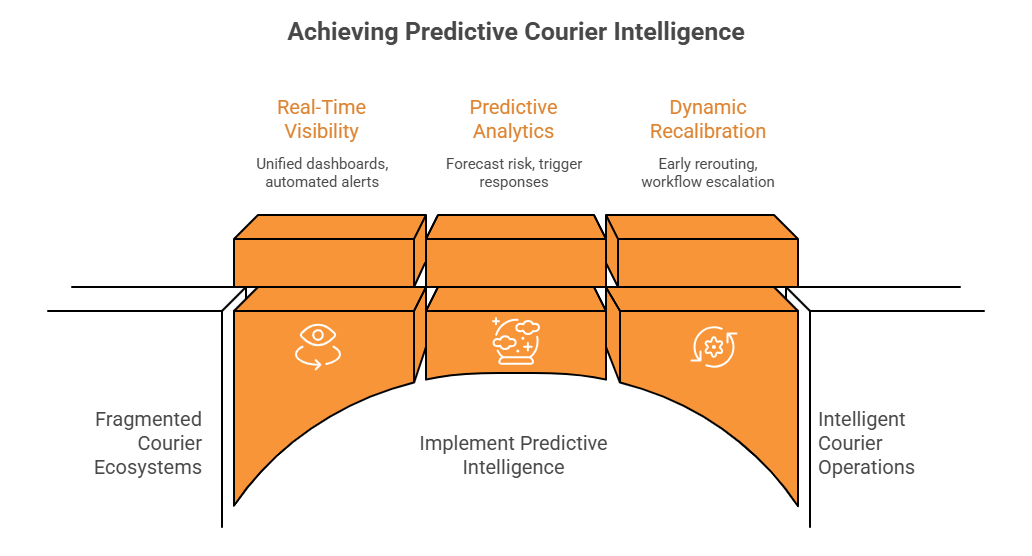
As enterprises expanded across North America, Europe, and APAC, operational complexity increased. Every carrier reports milestones differently. Event codes vary. Exception triggers are inconsistent. ETA calculations follow separate logic.
Without standardization, visibility becomes fragmented, and fragmented visibility creates decision gaps. In high-volume markets like the US, where parcel density and carrier diversification are high, even minor inconsistencies multiply operational strain.
2. Real-Time Visibility as the First Structural Fix
Real-time shipment visibility addressed the first layer of this complexity.
It introduced unified dashboards, standardized milestone mapping, automated alerts, proactive customer notifications, and centralized SLA monitoring. This reduced reactive firefighting and improved intervention speed. Support costs declined. Recovery cycles shortened. Customer confidence increased.
But real-time systems still operate in the present moment. They report what has already occurred.
3. Predictive Courier Intelligence: The Next Evolution
Modern logistics maturity requires anticipation.
Predictive courier intelligence builds on historical carrier data, transit behavior, lane-level patterns, and exception frequency to forecast risk before service failure occurs. Instead of monitoring every shipment manually, systems calculate probability thresholds and trigger automated responses. This enables dynamic ETA recalibration, early rerouting decisions, automated workflow escalation, and SLA breach prevention instead of SLA recovery.
The future of global courier operations will not be defined by speed alone, but by intelligence. As networks grow more complex, organizations must move beyond tracking events to understanding patterns, beyond reacting to delays to preventing them.
When courier ecosystems are treated as intelligent, self-optimizing systems rather than transportation pipelines, operations teams shift from monitoring dashboards to refining performance logic. The competitive edge will belong to those who redesign their logistics architecture around prediction, automation, and continuous learning, because in modern commerce, foresight is the real differentiator.
Unified Courier Control Tower for Multi-Carrier Logistics
A unified courier control framework brings structure to fragmented delivery ecosystems. By standardizing carrier data, centralizing execution, enabling real-time visibility, automating exception handling, and integrating cross-border compliance, organizations create a single operational layer that connects shipment movement with intelligence.
Instead of juggling disconnected portals and reactive interventions, teams operate from a coordinated system designed for scale, consistency, and proactive control.
Core Components of a Scalable Courier Control Tower
| Framework Layer | What It Solves | Operational Impact |
| Data Normalization Layer | Different carriers use inconsistent scan events, terminology, and reporting formats. | Standardizes event language, ensures accurate SLA calculations, enables reliable exception analysis, and feeds clean data into predictive tracking models. |
| Centralized Execution Hub | Multi-carrier portals create inefficiencies and blind spots. | Consolidates shipment monitoring, carrier performance comparison, corrective workflows, and documentation access into one unified operational environment. |
| Unified Real-Time Dashboard | Fragmented visibility limits decision-making. | Provides live performance metrics, SLA adherence tracking, at-risk shipment alerts, and regional comparisons from a single source of truth. |
| Automated Exception Workflows | Manual escalation does not scale in high-volume networks. | Triggers proactive notifications, internal alerts, carrier follow-ups, and service-level adjustments based on predefined risk rules. |
| Cross-Border Compliance Integration | Customs and regulatory checkpoints create coordination gaps. | Tracks clearance milestones in real time, identifies delays early, aligns documentation workflows, and improves global transit predictability. |
A unified control tower model transforms courier management from isolated tracking links into coordinated orchestration, enabling organizations to operate from a single version of truth across carriers, regions, and service levels.
Performance Impact in the US Ecommerce Logistics Market
When courier intelligence is implemented effectively, measurable performance improvements follow across global and US networks. Organizations commonly report a 30–60% reduction in WISMO inquiries, higher ETA accuracy, stronger SLA adherence, faster exception resolution, and reduced manual monitoring effort. These gains come from early risk detection and coordinated workflows rather than reactive escalation. In the US ecommerce environment, where two-day and next-day delivery benchmarks define customer expectations, even marginal improvements in ETA precision can significantly lower support costs and operational strain. The shift toward structured visibility and predictive coordination is not theoretical; it delivers clear economic value.
The United States also acts as a catalyst for courier innovation due to its operational complexity. High ecommerce penetration, diverse regional carriers, rural and urban delivery variability, strict delivery standards, and significant reverse logistics volumes create a demanding environment. Carrier fragmentation alone requires enterprises to manage multiple providers with different reporting structures and performance behaviors. As a result, US multi-carrier management and last-mile visibility models often shape broader global strategies. Innovations developed to manage parcel scale in the US increasingly influence international courier frameworks, proving that scale does not just challenge systems, it accelerates their evolution.
Predictive, Automated & Self-Optimizing Courier Networks
The future of courier strategy will not be defined by speed alone, but by intelligence. As parcel volumes grow and customer expectations tighten, simply tracking shipments is no longer enough. Networks are evolving toward systems that dynamically recalibrate ETAs, anticipate disruptions, and continuously learn from performance patterns.
This shift changes the role of operations teams. Instead of reacting to delays, they refine logic, strengthen predictive models, and optimize coordination across carriers. Courier networks begin to function less like transportation pipelines and more like intelligence systems designed to adapt in real time.
For organizations reassessing their visibility maturity and multi-carrier frameworks, this is a natural turning point.
The advantage will increasingly belong to those who move beyond reactive tracking and start building predictive control into their operations. In modern logistics, anticipation is what truly separates leaders from the rest.
If you’re exploring what that shift looks like in practice, you can explore the full whitepaper and see how eShipz approaches unified, predictive orchestration.