Here’s a Scenario,
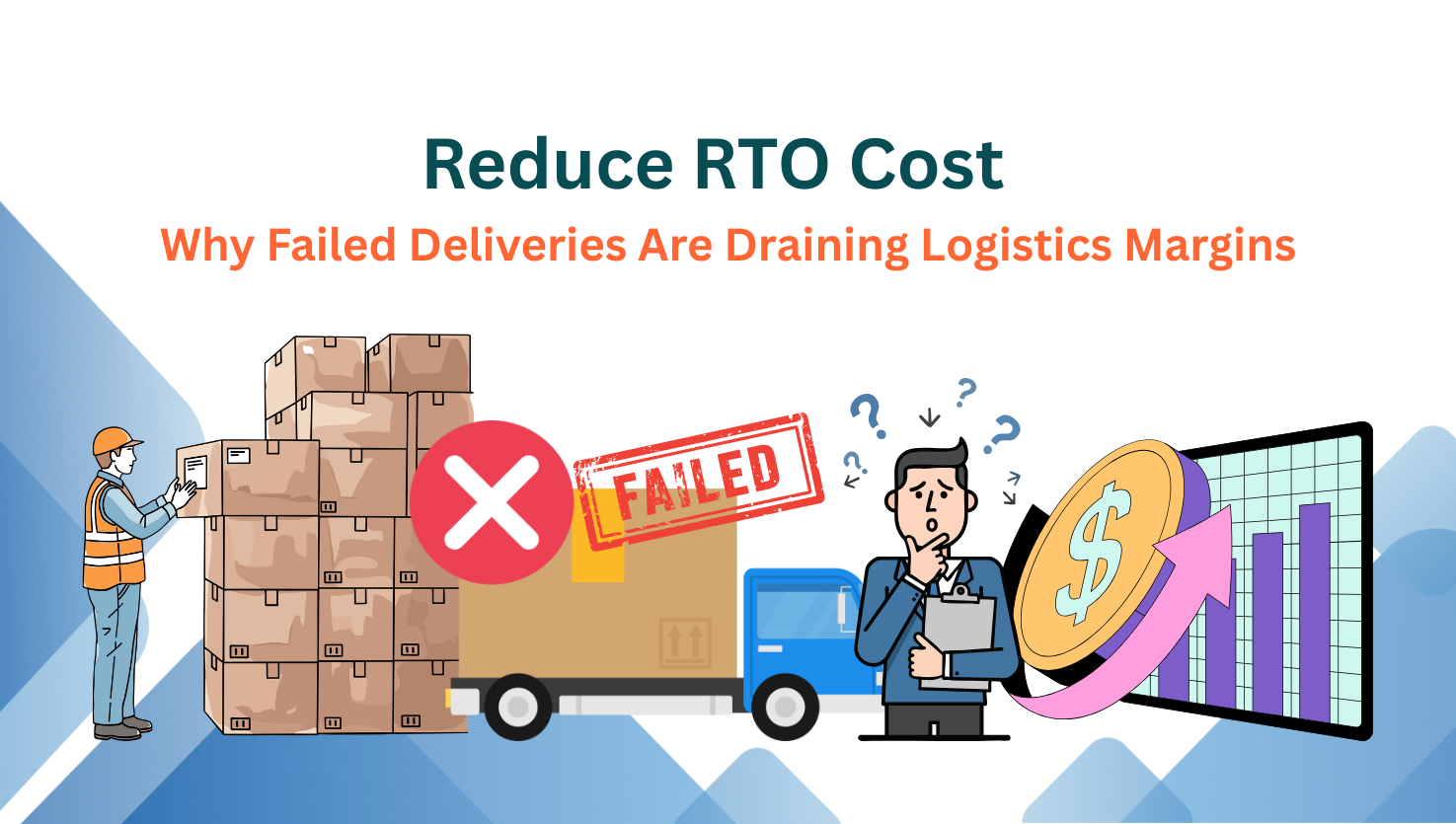
At 9 a.m., a shipment leaves the warehouse marked as “successfully dispatched.” By the end of the week, it quietly returns to the same shelf it started from. No revenue earned, no product sold, and yet multiple costs have already been incurred. This is how the hidden cost of Returns to Origin (RTO) typically shows up in logistics operations, not as a visible failure, but as a silent margin drain.
What appears to be a single failed delivery actually triggers a chain reaction. Forward shipping charges are paid, reverse logistics costs are added, inventory remains blocked in transit, and warehouse teams spend additional time handling and reprocessing the same order. Over time, these repeat failures inflate logistics expenses without being clearly reflected in headline metrics.
Industry research reinforces how damaging this cycle can be. Gartner’s analysis on reverse logistics highlights that only about 48 percent of returned products can be resold at full value, meaning more than half of return-related shipments result in depreciation, write-offs, or delayed recovery of capital. This directly explains why RTO is far more expensive than it appears, as every failed delivery increases the likelihood of value erosion across the supply chain.
As ecommerce and B2B shipping volumes continue to grow, businesses are realizing that RTO is not just a delivery issue. It is a cost, inventory, and customer experience problem that requires smarter, tech-led decisions to reduce RTO cost and protect margins at scale.
What is RTO, Why Does It Happen, and What Are Its Outcomes?
RTO refers to shipments that fail to reach the customer and are returned to the seller’s warehouse or origin hub. While returns initiated by customers are a part of normal ecommerce operations, RTOs are largely unplanned, avoidable, and expensive.
What causes high RTO?
High RTO typically results from a combination of logistical, behavioral, and systemic factors.
Incorrect or incomplete delivery information is one of the most common reasons. Address errors, missing landmarks, or wrong phone numbers prevent successful delivery attempts.
Customer unavailability also plays a major role. Failed delivery attempts occur when customers are not present at the delivery location or are unreachable during the last mile.
Cash on delivery orders contribute significantly to RTO. Order refusals at the doorstep due to change of mind or payment hesitation are common in COD-heavy markets.
Courier performance inconsistencies add another layer of risk. Limited delivery attempts, poor route optimization, and lack of real-time communication with customers increase failure rates.
Outcomes of high RTO
The impact of RTO extends well beyond logistics.
Operational costs increase as shipments travel twice across the network, once for delivery and once for return.
Inventory cycles get disrupted. Products remain stuck in transit, delaying restocking and increasing the risk of damage or obsolescence.
Customer experience deteriorates. Repeated delivery failures reduce trust and increase churn.
Decision-making suffers due to lack of actionable insights. Without granular RTO data, businesses struggle to identify root causes and improve performance.
These outcomes collectively erode margins and slow down growth, making RTO reduction a critical focus area.
Where Do RTO-Related Charges Actually Arise?
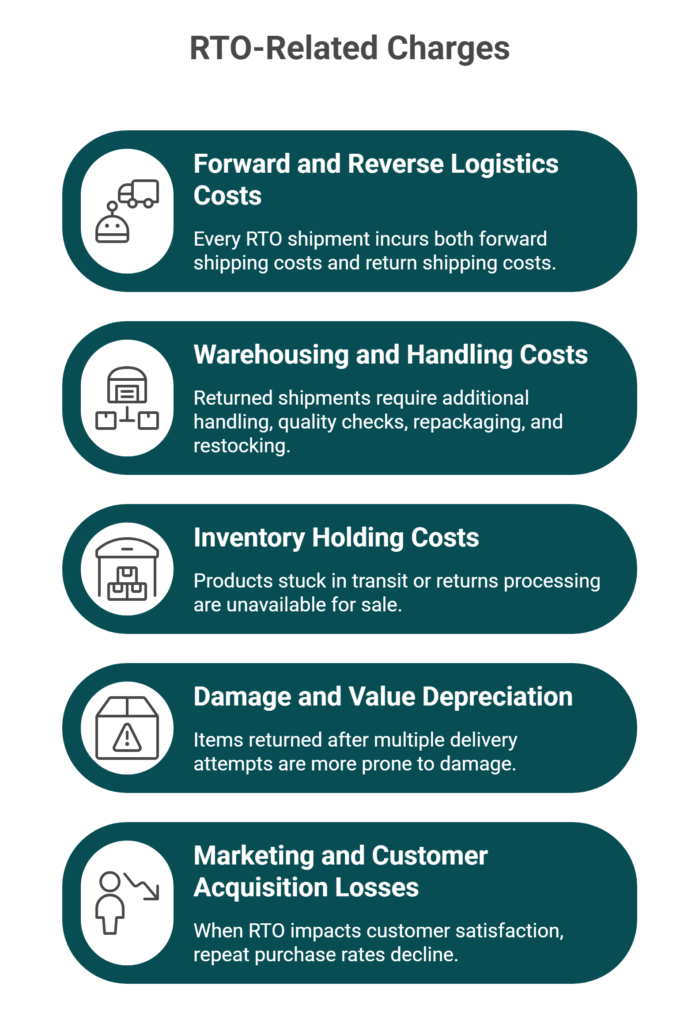
One of the biggest gaps in most RTO discussions is the underestimation of how many cost layers are involved. RTO is rarely a single expense. It is a cluster of compounding charges.
Forward and reverse logistics costs
Every RTO shipment incurs both forward shipping costs and return shipping costs. These are often billed separately, effectively doubling courier expenses for the same order.
Warehousing and handling costs
Returned shipments require additional handling, quality checks, repackaging, and restocking. For high-volume sellers, this leads to increased labor costs and warehouse congestion.
Inventory holding costs
Products stuck in transit or returns processing are unavailable for sale. This ties up working capital and increases carrying costs, especially during peak demand periods.
Damage and value depreciation
Items returned after multiple delivery attempts are more prone to damage. Packaging integrity suffers, resale value drops, and in some cases, inventory becomes unsellable.
Marketing and customer acquisition losses
When RTO impacts customer satisfaction, repeat purchase rates decline. Businesses then spend more on acquiring new customers to compensate for lost revenue.
Most existing blogs discuss these elements individually, but few connect them to decision-making systems that can prevent RTO before it occurs.
How Can RTO Be Reduced Using Tech-Led Redelivery Management?
Reducing RTO is no longer about adding more delivery attempts. It is about making smarter decisions at every stage of the delivery lifecycle. This is where technology-driven redelivery management becomes critical.
Predictive RTO intelligence
Modern logistics platforms analyze historical delivery data to identify high-risk shipments before dispatch. Factors like delivery location, courier performance, order type, and customer behavior are evaluated to flag potential RTO cases early.
This allows businesses to take preventive actions such as address verification, proactive customer communication, or alternative courier allocation.
Intelligent redelivery orchestration
Redelivery management solutions like those enabled by eShipz focus on salvaging failed deliveries instead of letting them default into RTO.
Automated workflows trigger redelivery attempts based on real-time feedback from couriers and customers. Delivery windows can be rescheduled dynamically, increasing the likelihood of successful handover.
Courier performance optimization
Not all couriers perform equally across regions. Technology-led routing assigns shipments to couriers based on historical success rates, delivery timelines, and RTO percentages for specific pin codes.
This data-backed allocation significantly improves first-attempt delivery success and helps reduce RTO cost over time.
Customer communication and intervention
Real-time notifications, IVR calls, and WhatsApp alerts keep customers informed and engaged. Customers are more likely to accept deliveries when they are aware of delivery schedules and can respond quickly to confirmation requests.
This proactive engagement reduces refusals and missed deliveries.
Data-driven feedback loops
Every failed or successful delivery feeds into analytics dashboards. These insights help businesses identify recurring issues, whether they are address-related, courier-specific, or category-driven.
Over time, this creates a continuous improvement cycle where RTO rates steadily decline, often by up to 40 percent when redelivery intelligence and courier optimization work together.
How Technology-Led Platforms Like eShipz Help Control the Hidden Cost of RTO
Reducing RTO is not only about reacting to failed deliveries. The real impact comes from preventing avoidable failures and minimizing cost exposure when exceptions occur. This is where technology-led logistics platforms such as eShipz play a critical role in addressing the hidden cost layers associated with RTO.
One of the biggest challenges businesses face is fragmented visibility across the delivery lifecycle. When shipment data, courier performance, and customer responses sit in silos, RTO becomes harder to predict and control. Platforms like eShipz unify these data points, enabling operations teams to identify risk patterns early and take corrective action before a shipment turns into a costly return.
A key capability in this process is AI-powered redelivery automation. By leveraging machine learning and predictive analytics, redelivery automation systems can intelligently decide the best course of action when a delivery attempt fails. Rather than allowing a failed delivery to automatically convert into an RTO, automated redelivery workflows reattempt delivery using updated customer availability, preferred time windows, or alternate instructions. This significantly cuts down unnecessary reverse logistics and reduces the total cost impact of returns. More details on how AI redelivery automation works can be found here:
Another driver of hidden RTO costs is inconsistent courier performance. Not all couriers perform equally across regions or shipment types. By analyzing historical delivery success, delay patterns, and RTO percentages for specific areas, platforms like eShipz support smarter courier allocation. Assigning the right courier to the right delivery location reduces failure rates and prevents redundant handling.
Delayed decision-making during delivery exceptions also adds unseen costs. Without real-time alerts and centralized visibility, operations teams often miss the optimal window for intervention. With integrated dashboards and live updates, logistics teams can act faster when a delivery is at risk. Faster interventions mean fewer idle shipments, reduced inventory blockage, and lower handling costs at return hubs.
Continuous data feedback drives long-term improvement. Every resolved or prevented RTO contributes to a richer intelligence layer that helps businesses refine delivery strategies, forecast risk more accurately, and systematically reduce avoidable losses tied to failed deliveries.
By shifting from reactive handling to proactive delivery orchestration through AI and automation, technology-led platforms help businesses address RTO at its root, significantly lowering its hidden financial impact without increasing operational complexity.
Shipping Smoothly by Aligning RTO and NDR Solutions
Smooth shipping today is no longer defined by speed alone. It is driven by predictability, reliability, and consistent customer experience. Returns to Origin disrupt all three by introducing avoidable costs, operational friction, and trust gaps across the delivery journey.
The most effective way to address RTO is not through isolated fixes but through integrated systems that connect redelivery management with Non-Delivery Report (NDR) solutions. While NDR workflows focus on identifying and resolving delivery exceptions in real time, RTO management ensures that unresolved issues do not escalate into costly returns. Together, they create a closed-loop delivery process where failures are intercepted early and corrected intelligently.
This is where platforms like eShipz add measurable value. By combining AI-led redelivery automation, courier intelligence, and centralized visibility, eShipz enables businesses to act on delivery risks proactively rather than absorbing their financial impact later. The result is fewer failed deliveries, lower reverse logistics costs, and improved inventory flow without adding operational complexity.
When NDR and RTO solutions work in tandem, businesses gain end-to-end visibility into delivery performance, faster resolution cycles, and stronger customer communication. Over time, this integrated approach not only lowers logistics costs but also builds long-term trust and scalability into the supply chain.
As logistics networks grow more complex, tech-led decision-making is no longer optional. Businesses looking to sustainably reduce RTO cost and improve delivery outcomes need intelligent systems that adapt in real time.
If reducing hidden RTO costs is a priority, speaking with logistics experts who understand delivery intelligence, automation, and exception management can help identify the right approach. The eShipz team works closely with enterprises to design smarter RTO and NDR strategies aligned to scale, cost control, and customer experience.