



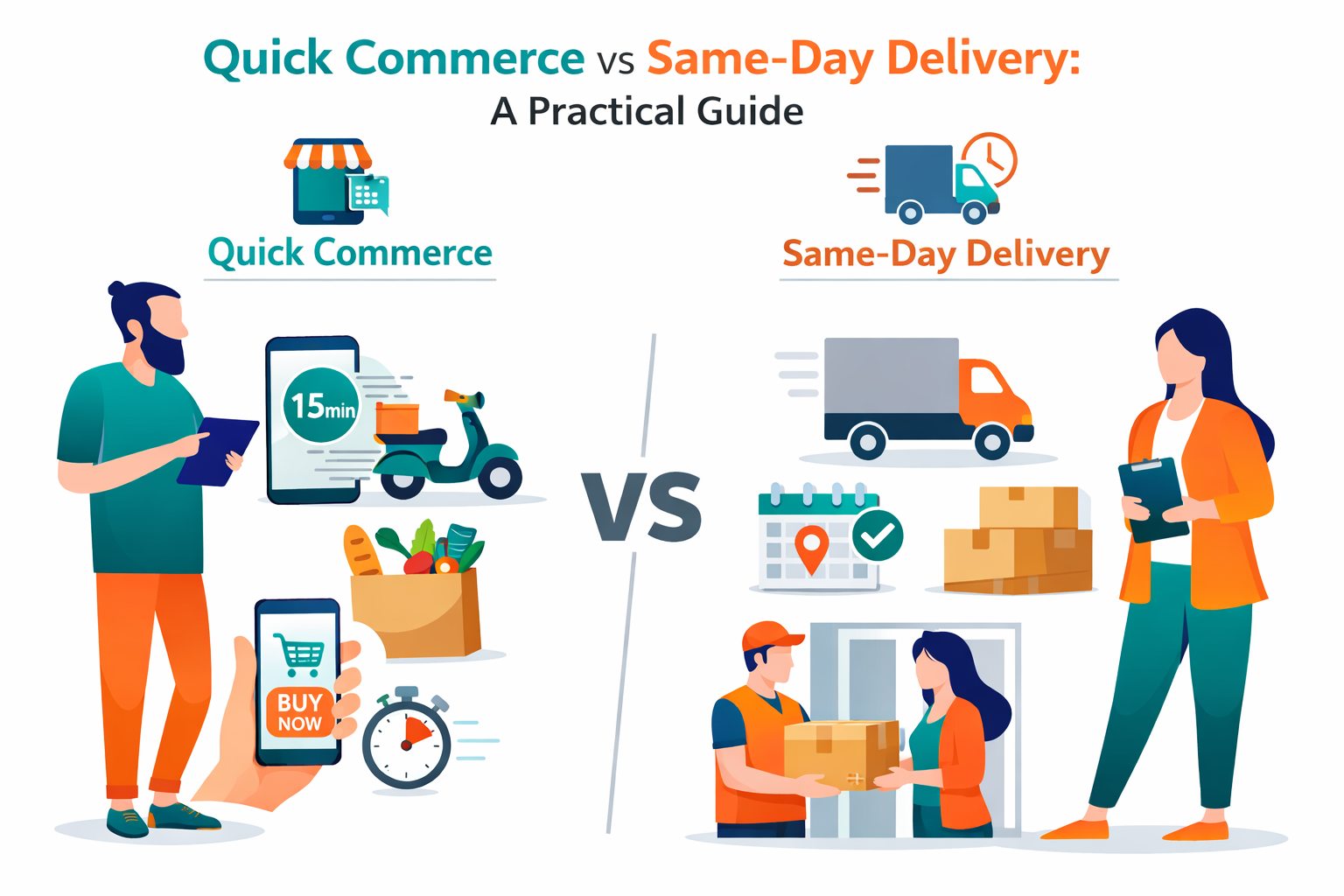
India’s demand for faster deliveries is growing rapidly. The country’s quick commerce sector expanded from about $0.5 billion in 2021 and is projected to reach nearly $5 billion by 2025, showing how quickly consumer expectations are shifting toward instant fulfillment.
Both options simply look like fast delivery. However, the logistics behind them work very differently, especially in how inventory is stored and orders are dispatched.
Quick commerce relies on small neighborhood warehouses that keep essential items close to customers, allowing deliveries to happen within 10–30 minutes. Same-day delivery usually works through larger warehouses or retail stores, with orders reaching customers within a few hours or by the end of the day.
In this blog, we’ll break down how these two models work, the key differences between them, and how businesses can decide which approach fits their logistics strategy.
Why Businesses Are Investing in 10-Minute Urban Delivery Services
India’s quick commerce market is booming, projected to grow from $0.5 billion in 2021 to nearly $5 billion by 2025, driven by urban consumers who expect faster deliveries. By 2024, quick commerce accounted for over two‑thirds of online grocery orders, supported by around 1,290 dark stores nationwide. Forecasts suggest the market could reach $9.9 billion by 2029 and $40–$57 billion by 2030, with GMV growing 280% between FY 22 and FY 24.
This growth reflects changing shopping habits: customers now favor frequent small orders over large, planned purchases, prompting ecommerce companies to invest in faster, hyperlocal fulfillment models.
Several factors are accelerating this trend:
- Mobile-first shopping habits make it easier for customers to place instant orders from anywhere.
- Rising competition among delivery platforms pushes companies to shorten delivery timelines.
- High population density in cities allows logistics networks to operate efficiently within smaller areas.
- Convenience-driven lifestyles are increasing demand for on-demand services across groceries, medicines, and everyday essentials.
What is the difference between same day shipping and same day delivery?
Same-Day Shipping: Refers to the shipment of the order on the same day it was placed, but the delivery might take longer depending on the destination. Same-Day Delivery: Ensures that the order is both shipped and delivered on the same day it was placed.
What is the Difference Between Quick Commerce and Same-Day?
Although customers may see both options simply as “fast delivery,” the infrastructure behind them differs significantly.From a customer’s perspective, both options may simply appear as “fast delivery.” However, the way these services operate behind the scenes is quite different. The infrastructure, inventory placement, and delivery networks used in each model vary significantly, which ultimately affects speed, cost, and product availability.
Here is a simple breakdown of how the two approaches differ:
|
Aspect |
Quick Commerce |
Same-Day Delivery |
| Delivery Time | Usually delivered within 10–30 minutes | Delivered within a few hours or by the end of the same day |
| Fulfillment Location | Small micro-warehouses or dark stores located close to residential areas | Regional warehouses or retail stores that already hold inventory |
| Product Range | Mostly everyday essentials such as groceries and medicines | Broader product selection, including electronics, apparel, and home goods |
| Typical Order Behavior | Urgent, small purchases made on impulse | Planned purchases where customers expect delivery later the same day |
| Delivery Network | Local riders operating within a small geographic radius | Courier or logistics networks handling city-wide deliveries |
The biggest difference lies in where inventory is stored. Quick commerce places products very close to customers through neighborhood fulfillment hubs, allowing orders to be dispatched almost immediately. Same-day delivery, on the other hand, relies on centralized inventory and efficient transportation networks to move products across the city within a few hours.
The Role of Logistics Technology in Hyperlocal Quick Commerce
In today’s fast-paced ecommerce environment, speed alone isn’t enough to keep customers satisfied. Even with a network of strategically located warehouses or dark stores, fulfillment can falter without the right technology in place. The backbone of modern quick commerce lies in smart logistics systems, like eShipz, that seamlessly coordinate every step, from order placement to doorstep delivery. These digital tools are what transform hyperlocal networks into high-speed, reliable operations that meet the ever-growing expectations of urban consumers.
Several key technology layers work together to make this possible:
Key technology layers:
- Inventory Synchronization: Real-time stock visibility prevents delays. eShipz keeps inventory synced across stores and warehouses.
- Automated Order Allocation: Orders are routed intelligently to the nearest store or optimal warehouse for faster delivery.
- Intelligent Dispatch: Delivery assignments are optimized for location, capacity, and timing, reducing delays and costs.
- Real-Time Tracking: End-to-end tracking boosts transparency and minimizes failed deliveries.
With eShipz, quick commerce is not just fast, it’s reliable, helping businesses win loyalty in India’s competitive instant-delivery market. In essence, logistics technology turns speed into reliability. Platforms like eShipz ensure that even the most ambitious quick commerce networks can deliver not just fast, but consistently excellent service. By leveraging these digital systems, businesses can achieve rapid fulfillment while building the trust and loyalty of India’s urban consumers, critical in the country’s competitive instant-delivery market.
Future-Ready Ecommerce Delivery
Fast delivery is no longer just a convenience, it’s an expectation for today’s urban shoppers. Quick commerce and same-day delivery both meet this demand, but in different ways: one offers instant access to everyday essentials, while the other supports broader ecommerce catalogs with flexible delivery timelines.
For businesses, the goal isn’t simply to pick the fastest option. It’s about designing a fulfillment strategy that balances product type, customer expectations, and operational efficiency. That’s where eShipz comes in. With its advanced logistics automation, multi-carrier integration, and real-time tracking, eShipz helps brands blend multiple delivery models seamlessly, ensuring speed, reliability, and cost control all at once.
Whether you’re scaling quick commerce operations or optimizing same-day delivery, eShipz makes it easier to deliver smarter, faster, and more efficiently, helping your business stay ahead in India’s competitive ecommerce landscape.