



The rise of Quick Commerce Logistics is transforming how consumers think about delivery speed and convenience. Customers no longer see same-day delivery as impressive. Today, they expect groceries, medicines, fashion items, and even electronics to arrive within minutes or hours. A customer ordering a phone charger at 9 PM now expects it before bedtime, not two days later.
This shift in consumer behavior has fueled the rapid growth of quick commerce platforms across India and global markets. Convenience has become a major competitive advantage, and businesses are under constant pressure to fulfill orders faster while maintaining delivery accuracy and customer satisfaction.
According to a report by Kearney, quick commerce is significantly changing retail consumption patterns in India, with customers increasingly prioritizing speed and accessibility over traditional shopping models. This growth is forcing logistics operations to become more agile, technology-driven, and hyperlocal.
What started as a grocery delivery trend has now reshaped customer expectations across industries. From beauty products to electronics, instant fulfillment is becoming the new standard.
Market Insights: The Growing Demand for Instant Delivery
Quick commerce adoption has accelerated because modern consumers value convenience more than ever before. Urban customers are increasingly relying on hyperlocal delivery platforms for daily essentials, emergency purchases, and impulse buying.
Several market trends are driving this shift:
- Increased smartphone and digital payment adoption
- Growth of hyperlocal warehouses and dark stores
- Rising demand for instant fulfillment in metro cities
- Expansion of AI-powered logistics operations
- Higher competition among delivery platforms
Research from Kearney highlights that quick commerce is not only changing consumer buying habits but also influencing employment models, urban logistics infrastructure, and retail operations.
The market is moving toward a model where delivery speed directly affects purchasing decisions. Customers are increasingly choosing brands that can deliver faster, provide real-time updates, and ensure a seamless delivery experience.
This evolution is putting enormous pressure on logistics teams to reduce delivery timelines while maintaining operational efficiency.
Why Traditional Last-Mile Logistics Models Are Struggling
Traditional logistics systems were originally designed for scheduled deliveries and bulk shipment movement. They were never built to support 10 to 30-minute delivery expectations.
Conventional delivery workflows often depend on manual processes, static courier assignments, and delayed operational decisions. These systems struggle to adapt to the fast-moving demands of quick commerce ecosystems.
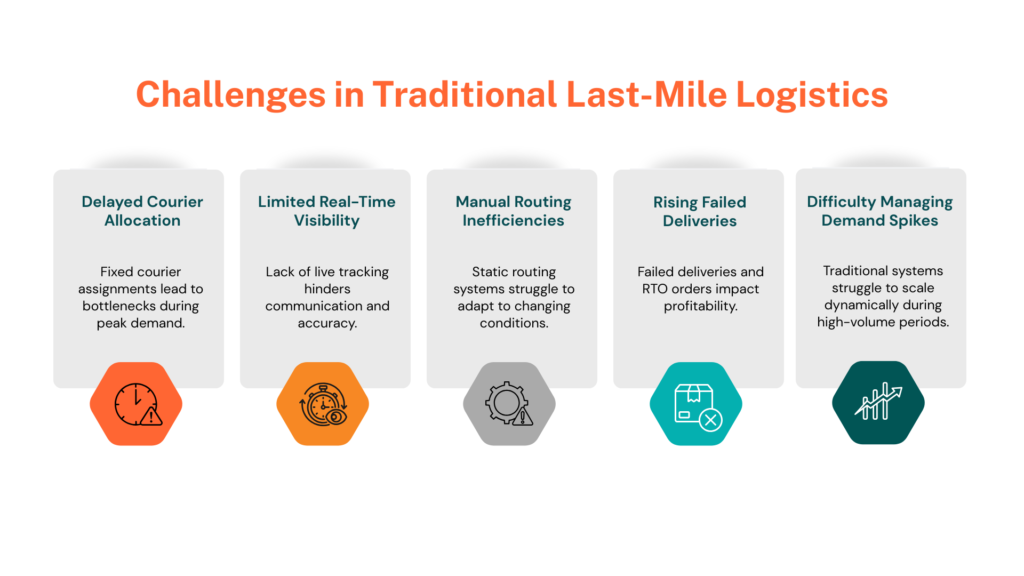
Some of the biggest challenges include:
Delayed Courier Allocation
Many traditional logistics operations still rely on fixed courier assignment methods. During peak demand periods, this creates bottlenecks that slow down dispatch times and increase delivery delays.
Limited Real-Time Visibility
Without live tracking and centralized visibility, businesses often face communication gaps between warehouses, courier partners, and customers. This reduces delivery accuracy and creates customer dissatisfaction.
Manual Routing Inefficiencies
Static routing systems cannot respond effectively to changing traffic conditions, weather disruptions, or courier availability. As a result, delivery timelines become inconsistent.
Rising Failed Deliveries and RTO Issues
Failed deliveries and Return-to-Origin (RTO) orders continue to impact profitability. Customers expecting instant delivery are far less tolerant of delays or unsuccessful delivery attempts.
Difficulty Managing Hyperlocal Demand Spikes
Festive sales, flash discounts, and weekend order surges create unpredictable demand spikes. Traditional logistics operations often struggle to scale dynamically during these high-volume periods.
For example, during festive shopping seasons, brands frequently experience delayed dispatches because static workflows cannot adjust courier allocation and routing decisions in real time.
This is why intelligent routing and logistics automation are becoming essential for modern businesses. Companies can no longer rely solely on manual coordination to meet customer expectations.
The Technology Powering Modern Quick Commerce Logistics
Technology is now at the center of modern last-mile fulfillment strategies. Businesses are adopting advanced logistics systems to improve speed, visibility, and operational agility.
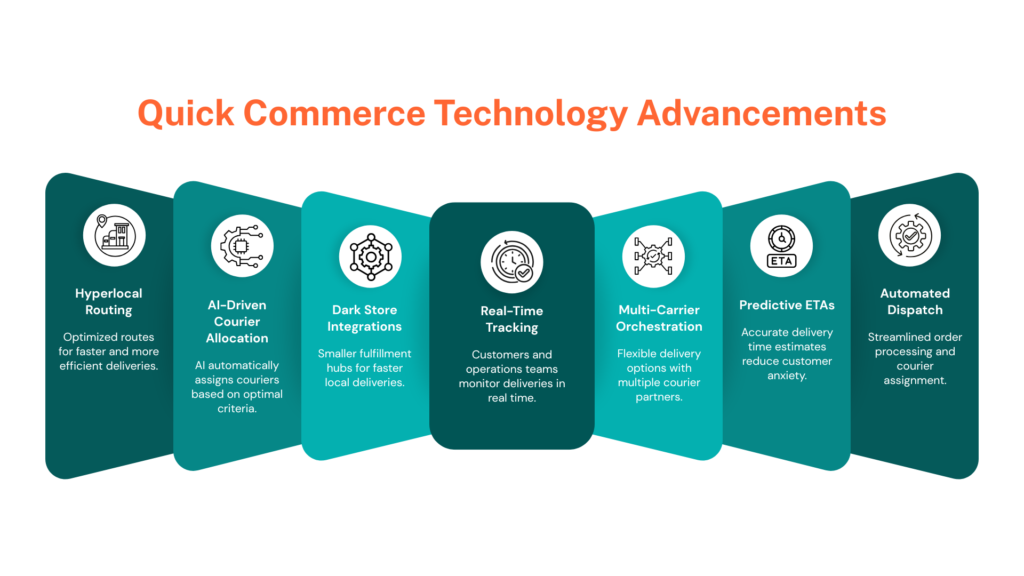
Modern Quick Commerce Logistics depends heavily on automation, AI, and real-time decision-making capabilities.
AI-Driven Courier Allocation
AI-powered systems can automatically assign the best courier partner based on delivery location, traffic conditions, SLA performance, and courier availability.
This reduces manual effort while improving delivery speed and reliability.
Real-Time Tracking and Visibility
Customers now expect continuous visibility throughout the delivery journey. Real-time tracking helps businesses provide accurate delivery updates and improve customer confidence.
It also enables operations teams to identify delays proactively and take corrective action before customer satisfaction is affected.
Predictive ETAs
Advanced logistics platforms use historical delivery data, traffic conditions, and route intelligence to generate predictive Estimated Time of Arrival (ETA) calculations.
Accurate ETAs help reduce delivery anxiety and improve customer trust.
Automated Dispatch Workflows
Automation allows businesses to streamline order processing, dispatch management, and courier assignment without constant manual intervention.
This becomes especially important during high-order-volume periods.
Multi-Carrier Orchestration
Modern delivery ecosystems often rely on multiple courier partners instead of a single provider.
If one delivery partner experiences delays because of traffic congestion or capacity overload, intelligent logistics systems can instantly reroute orders to another available courier.
This flexibility improves fulfillment reliability and minimizes operational disruptions.
Dark Store Integrations
Dark stores and micro-fulfillment centers are becoming critical for quick commerce operations. These smaller fulfillment hubs help businesses reduce delivery distances and improve delivery speed.
Integrated logistics systems help coordinate inventory availability, dispatch operations, and hyperlocal delivery workflows seamlessly.
Hyperlocal Routing Intelligence
Hyperlocal routing technology enables faster delivery planning based on local traffic conditions, delivery density, and customer proximity.
This helps businesses optimize delivery routes while reducing fuel consumption and delivery delays.
To meet these expectations, businesses are increasingly adopting logistics orchestration platforms like eShipz that help automate courier allocation, improve tracking visibility, and optimize hyperlocal deliveries in real time.
Customer Experience Is Now Defined by Delivery Experience
Logistics is no longer just an operational function. It has become a major customer retention strategy.
Today’s customers evaluate brands not only based on product quality but also on the delivery experience. A delayed or failed order can damage customer trust much faster than a product-related issue.
Real-Time Delivery Notifications
Customers expect regular updates throughout the delivery process. Automated notifications improve transparency and reduce uncertainty.
Transparent ETAs
Accurate ETAs help customers plan their schedules and build confidence in the delivery process.
Unexpected delays without communication often lead to customer frustration.
Faster Issue Resolution
Modern logistics systems help support teams identify delivery issues early and respond proactively before customer complaints escalate.
Reduced Failed Deliveries
Predictive delivery systems improve address validation, optimize routing, and improve communication with delivery agents, reducing failed delivery attempts.
Post-Purchase Communication
Post-purchase engagement plays an important role in customer satisfaction. Timely notifications, delivery confirmations, and feedback requests help strengthen customer relationships.
Customers today often forgive product issues faster than they forgive poor delivery experiences.
This is why predictive tracking, proactive communication, and reliable fulfillment operations are becoming critical components of customer experience strategies.
Businesses that invest in smarter delivery operations are more likely to improve repeat purchases, customer retention, and brand loyalty.
The Future of Last-Mile Logistics: Smarter, Faster, More Adaptive
The future of last-mile logistics will be driven by intelligence, flexibility, and automation.
As quick commerce continues to evolve, businesses will increasingly depend on adaptive logistics ecosystems capable of responding instantly to changing demand patterns.
Several trends are expected to shape the future of logistics operations:
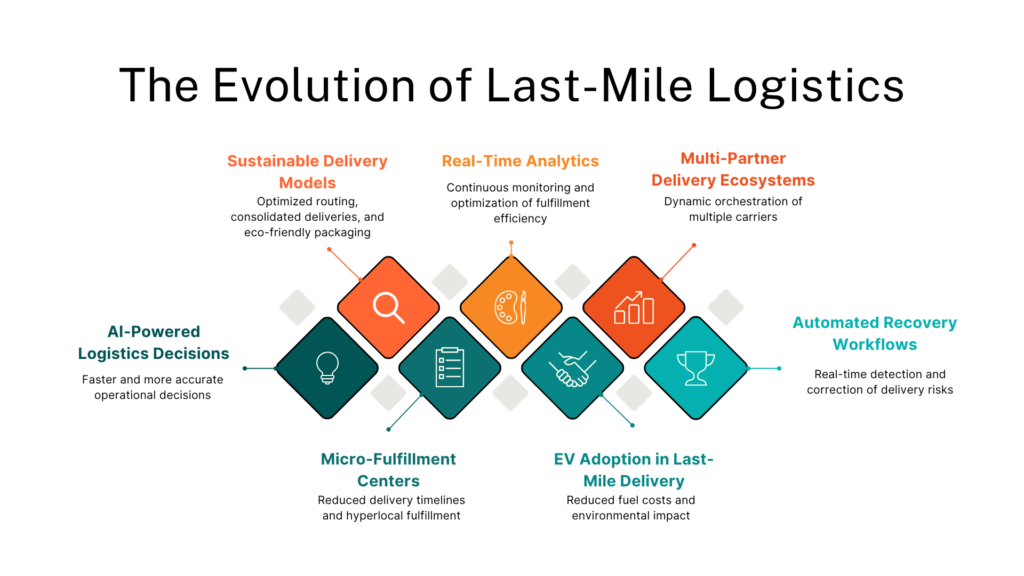
AI-Powered Logistics Decisions
AI will continue improving courier allocation, route optimization, demand forecasting, and delivery planning.
This will help businesses make faster and more accurate operational decisions.
Micro-Fulfillment Centers
Smaller fulfillment hubs located closer to customers will reduce delivery timelines and improve hyperlocal fulfillment capabilities.
Sustainable Delivery Models
Businesses are increasingly focusing on sustainability initiatives such as optimized routing, consolidated deliveries, and eco-friendly packaging.
EV Adoption in Last-Mile Delivery
Electric vehicles are becoming an important part of urban logistics strategies as businesses look to reduce fuel costs and environmental impact.
Real-Time Analytics
Data-driven insights will help logistics teams monitor operational performance, identify bottlenecks, and optimize fulfillment efficiency continuously.
Automated Recovery Workflows
Future logistics systems will automatically detect failed delivery risks and trigger corrective actions in real time.
Multi-Partner Delivery Ecosystems
Future-ready logistics networks will not rely on a single courier partner. Instead, they will dynamically orchestrate multiple carriers based on SLA performance, delivery urgency, location, and capacity availability.
Conclusion
Quick commerce has fundamentally changed how customers perceive delivery speed, convenience, and reliability. What was once considered premium service is now becoming a basic expectation across industries. Businesses are no longer competing only on product quality or pricing. They are also competing on how quickly and efficiently they can fulfill customer orders.
This shift is forcing logistics operations to become smarter, faster, and more adaptive. Traditional delivery models that rely on manual coordination and static workflows are struggling to keep pace with rising customer expectations. In contrast, technology-driven logistics ecosystems powered by AI, automation, predictive tracking, and multi-carrier orchestration are helping businesses build more agile and scalable fulfillment networks.
As customer expectations continue to evolve, brands that invest in intelligent last-mile delivery infrastructure will be better positioned to improve customer satisfaction, reduce operational inefficiencies, and strengthen long-term loyalty.
Platforms like eShipz Logistics Automation Platform are helping businesses simplify complex logistics operations with real-time visibility, automated courier allocation, and optimized delivery workflows designed for the future of quick commerce.