
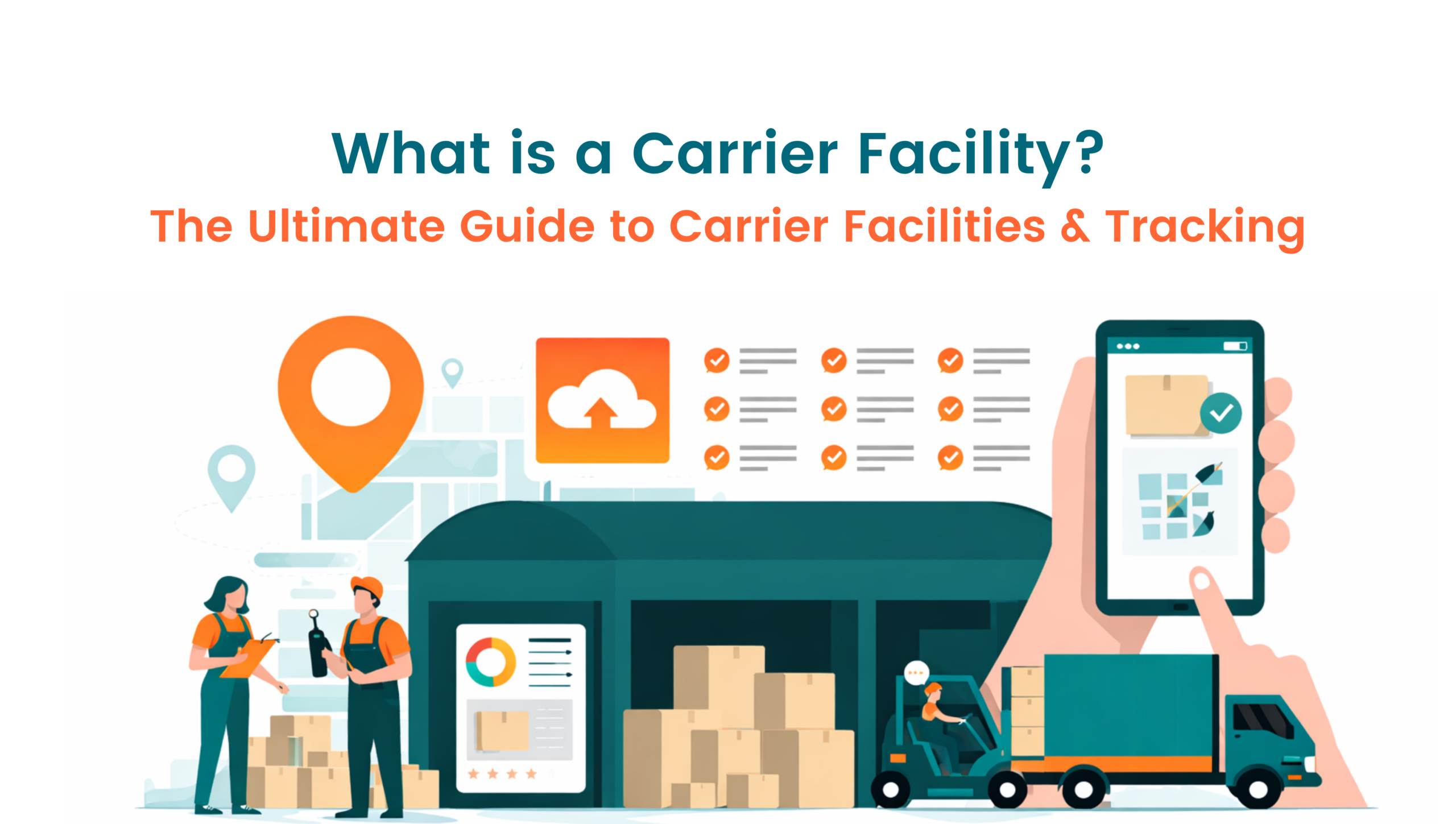
A carrier facility is a central logistics hub where packages are received, scanned, sorted, and routed to their next destination. These facilities are critical to keeping shipments moving, but they’re also where most bottlenecks occur. Studies show that 6 – 12% of shipments face daily delays, rising up to 30% during peak seasons, while nearly 80% of customers have experienced at least one delivery delay, highlighting how common these disruptions have become.
You’re tracking your order, everything seems smooth, and then suddenly, the update reads: “Arrived at carrier facility.” Hours pass. Sometimes even days. No movement. For both businesses and customers, this becomes one of the most confusing stages in the shipping journey.
In this blog, we’ll break down what’s happening behind the scenes, why delays occur, how long packages usually stay here, and what happens next in the delivery process.
Logistics Hubs: Key Trends Shaping Modern Delivery Networks
India’s eCommerce logistics ecosystem is expanding at an unprecedented pace, driven by rising online demand and deeper penetration into Tier 2 and Tier 3 cities. The market was valued at over $10 billion in 2025 and is projected to reach nearly $46.8 billion by 2035, growing at a steady pace as infrastructure and delivery networks scale across the country. This rapid growth means carrier facilities are now handling significantly higher shipment volumes than ever before, turning them into critical pressure points in the delivery network.
At the same time, customer expectations are evolving faster than infrastructure can keep up. With the rise of quick commerce and express shipping, same-day and next-day delivery models are becoming the norm, pushing logistics providers to process and dispatch orders at much higher speeds. In fact, standard delivery still dominates today, but faster delivery segments are steadily growing, forcing facilities to operate with tighter turnaround times and higher efficiency. This growing demand is placing immense operational pressure on sorting hubs, where even small inefficiencies can lead to noticeable delays.
To address these challenges, companies are increasingly investing in AI-driven routing, automation, and predictive logistics systems. Technology adoption is accelerating across warehouses and carrier facilities, with advanced systems enabling real-time tracking, demand forecasting, and smarter route optimization. These innovations are helping reduce delays, improve shipment accuracy, and enhance overall supply chain performance. As logistics becomes more data-driven, the efficiency of carrier facilities is no longer just operational, it’s becoming a key competitive advantage in India’s fast-growing eCommerce landscape.
Distribution Centers: Features Enabling Faster Order Processing
Modern logistics networks are evolving rapidly, especially with the rise of eCommerce in India. Today, carrier facilities are no longer just transit points, they are intelligent, high-performance hubs designed to move shipments faster, with greater accuracy and visibility.
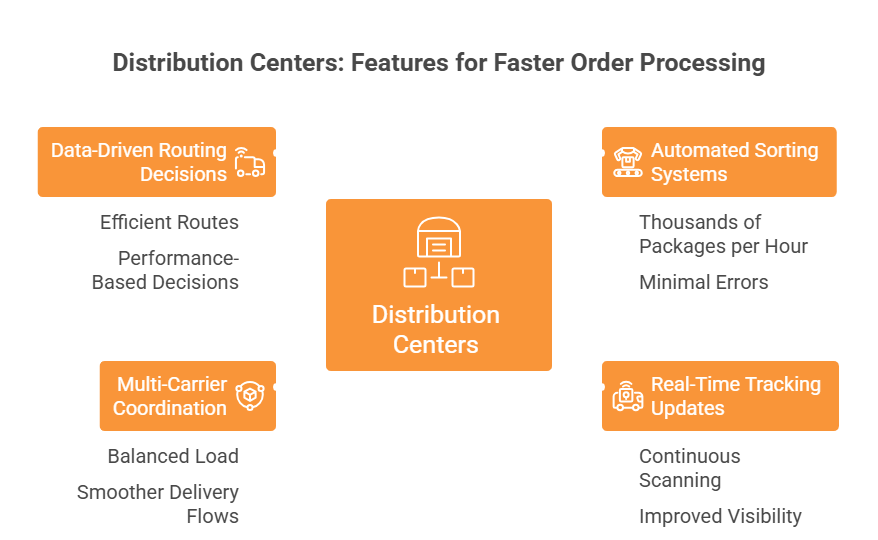
To keep up with growing demand and tighter delivery timelines, high-performing facilities focus on a few critical capabilities:
- Automated sorting systems for faster processing
Advanced automation helps facilities handle thousands of packages per hour with minimal errors. By reducing manual intervention, shipments are sorted and dispatched much faster, even during peak volumes. - Real-time tracking updates for better transparency
Continuous scanning and system updates ensure that every movement is recorded. This improves shipment visibility for both businesses and customers, reducing uncertainty during transit. - Multi-carrier coordination for greater flexibility
Instead of relying on a single carrier, modern logistics setups distribute shipments across multiple partners. This helps balance load, avoid bottlenecks, and ensure smoother delivery flows across regions. - Data-driven routing decisions to optimize delivery speed
Facilities increasingly rely on data and analytics to determine the most efficient routes. This includes selecting the right carrier, route, and transit path based on performance, location, and delivery timelines.
For businesses managing high order volumes, platforms like eShipz bring all these elements together by offering a unified layer of control across carriers, tracking systems, and shipment flows. This makes it easier to identify delays at the facility level, optimize routing decisions, and maintain consistent delivery performance.
As India’s eCommerce ecosystem continues to grow, these capabilities are becoming essential, not just for faster deliveries, but for building a reliable and scalable logistics operation.
What Happens Inside a Carrier Facility: Behind the Scenes of Delivery
How shipments are processed, sorted, and moved efficiently
A carrier facility is more than just a storage point, it’s a fast-moving logistics hub where thousands of packages are processed every day. Behind every tracking update is a system working continuously to ensure shipments move in the right direction, at the right time.
Once a package arrives, it goes through a streamlined process designed to keep deliveries on track:
- Inbound scanning: Packages are scanned and registered, triggering tracking updates
- Sorting: Shipments are grouped by destination (PIN/ZIP code)
- Routing: The most efficient delivery path is assigned (air, road, or local network)
- Dispatch: Packages are loaded and sent to the next destination
All of this typically happens within hours. While it may seem like a pause in movement, your package is actively being processed behind the scenes to ensure accurate and timely delivery.
The Silent Engine of Every Delivery
A carrier facility might look like just another stop in the journey, but in reality, it’s where the entire delivery experience quietly takes shape. It’s the point where speed, accuracy, and coordination come together to decide whether a package moves seamlessly forward or gets held back.
From precise sorting to timely dispatch, every action inside these hubs has a direct impact on delivery timelines. For businesses, this stage is more than operational, it’s where customer experience is won or lost. And for customers, a pause in tracking doesn’t always signal a problem; more often, it simply reflects the complex processes happening behind the scenes to move the shipment forward.
As delivery expectations continue to rise, visibility and control across these touchpoints are becoming essential. This is where platforms like eShipz help bring clarity, by unifying tracking, improving carrier coordination, and enabling smarter logistics decisions.
Because in today’s fast-moving ecosystem, it’s not just about moving packages, it’s about moving them with confidence.
FAQs:
a) What does “Package arrived at a carrier facility” mean?
When your tracking shows this update, it means your package has reached a key point in the carrier’s network, usually a sorting or distribution center. At this stage, the shipment is being scanned, sorted, and prepared for its next movement. In simple terms, it has successfully completed one leg of its journey and is now being processed for the next step toward delivery.
b) What does “Package has left the carrier facility” mean?
This update indicates progress. Your package has already been processed inside the facility and has now been dispatched, either to another hub or toward the final delivery center. It’s a positive sign that the shipment is moving forward and getting closer to its destination.
c) Why is tracking your order important?
Tracking plays a key role in both customer experience and logistics visibility. Here’s why it matters:
- Shipment visibility: You can monitor your package in real time, from dispatch to delivery
- Peace of mind: Knowing where your order is reduces uncertainty and anxiety
- Better planning: Helps you prepare for delivery or make alternate arrangements
- Faster issue resolution: Tracking data helps identify and resolve delays quickly
- Improved customer experience: Builds transparency and trust, especially for businesses handling multiple order.
d) Can you pick up your package at a carrier facility?
In some cases, yes, but it depends on the carrier and the type of shipment. Certain providers offer options like “Hold for Pickup,” allowing you to collect your package directly from a facility. This can be useful if you want to avoid missed deliveries. However, not all facilities allow public access, so it’s always best to check with the carrier beforehand.