





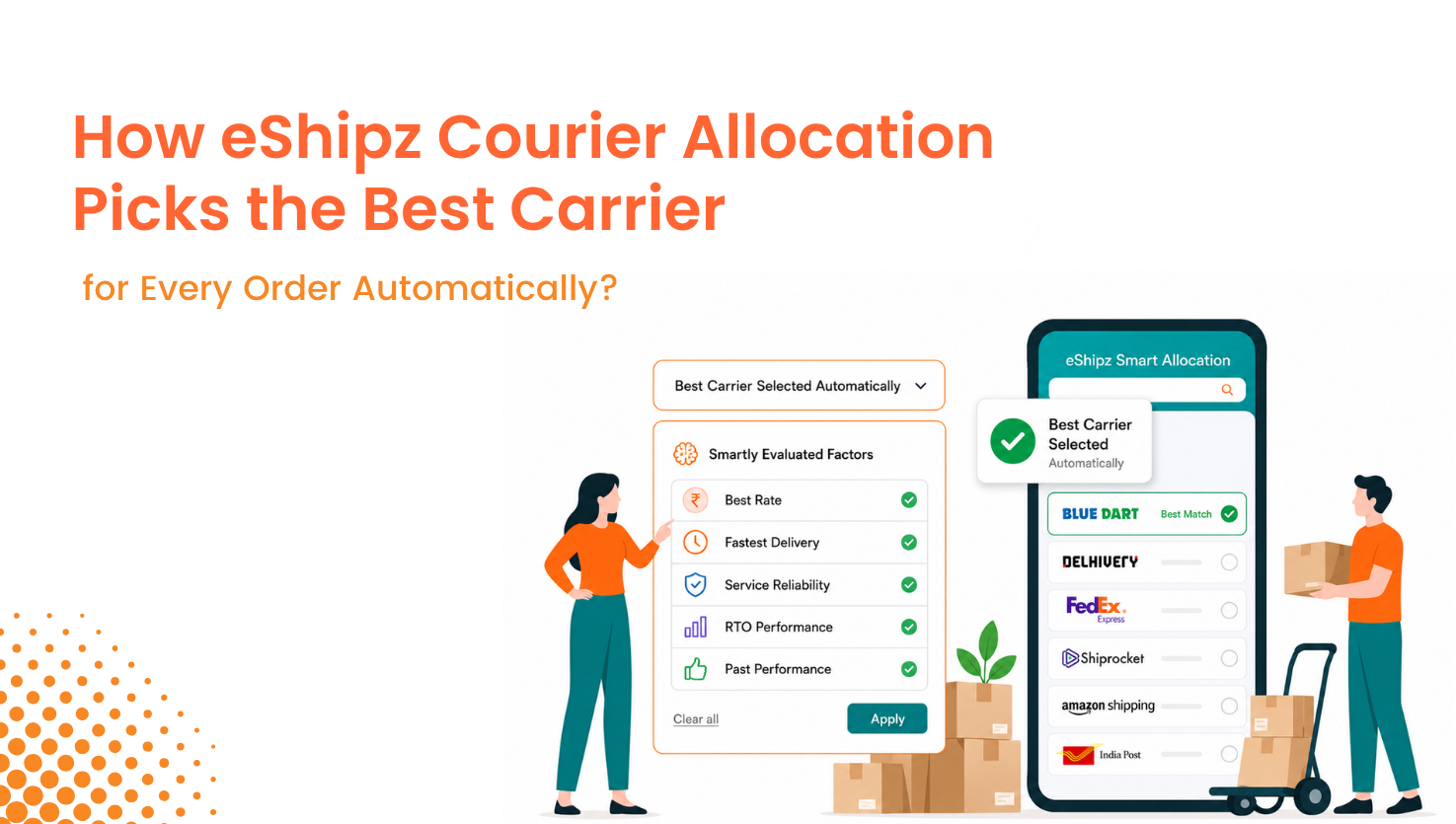
Courier allocation software is rapidly becoming a core driver of logistics efficiency, especially as ecommerce volumes continue to surge. Courier allocation refers to the process of selecting and assigning the most suitable delivery partner for each shipment based on factors such as cost, delivery speed, serviceability, and performance history.
With global ecommerce parcel volumes expected to cross 200+ billion shipments annually, fulfillment teams are under increasing pressure to make faster and more accurate delivery decisions. Last-mile delivery alone can account for nearly 40–53% of total shipping costs, while 20–25% of deliveries may face delays or failed attempts due to inefficient carrier selection and routing challenges.
Traditional courier selection methods often rely on fixed rules, manual decisions, or basic preferences. However, as order volumes grow, businesses need smarter ways to evaluate multiple carriers in real time and choose the right partner for every shipment.
In this blog, we explore how intelligent courier allocation works, why it matters for scaling ecommerce and D2C operations, and how platforms like eShipz automate carrier selection to improve delivery performance and operational efficiency.
Why courier selection is becoming a hidden cost in logistics
At first glance, courier assignment seems like a simple operational task. But in reality, it directly impacts:
- Delivery speed and customer experience
- Shipping cost per order
- RTO (Return to Origin) rates
- SLA breaches and penalties
- Carrier performance consistency
Most businesses still depend on:
- Manual selection by ops teams
- Static routing rules (pin code mapping, weight slabs)
- Fixed carrier preferences
The problem? These methods don’t adapt to real-time changes like courier delays, weather disruptions, capacity issues, or performance drops. Over time, this creates invisible inefficiencies that scale with order volume.
Courier Allocation: How Intelligent Carrier Selection Works in eShipz
Modern logistics operations often struggle not because of a lack of courier partners, but because of the complexity involved in selecting the right one for every order. As shipping volumes grow and delivery expectations increase, manual courier selection becomes time-consuming, inconsistent, and difficult to scale.
eShipz courier allocation helps businesses simplify this process by automatically selecting the most suitable courier partner based on shipment requirements, carrier availability, serviceability, performance history, and business preferences. It enables faster, more reliable shipping decisions without depending on manual intervention.
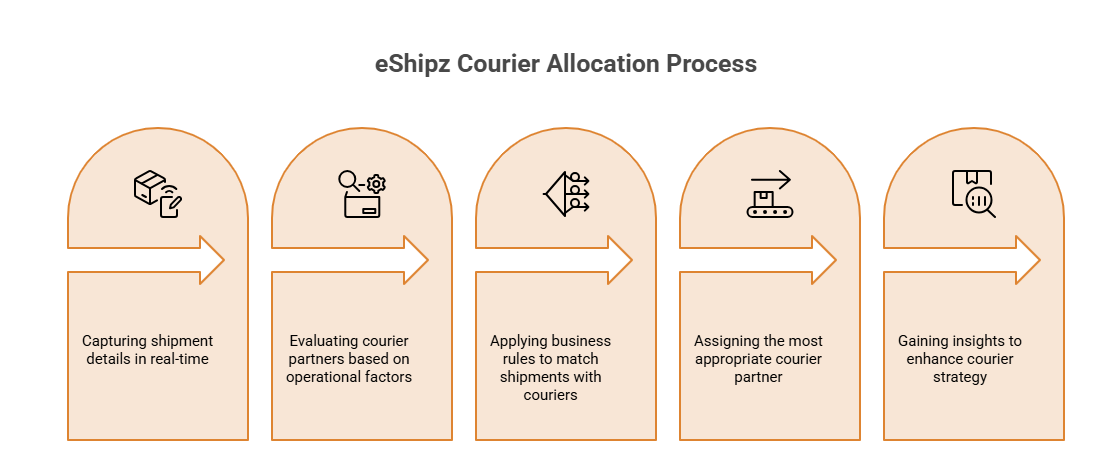
Here’s how it works step by step:
- Order Ingestion (Real-Time Shipment Capture)
As soon as an order is created, eShipz captures all essential shipment details required for courier selection. This includes pickup and delivery locations, package weight and dimensions, shipment priority, and other relevant order information.
This ensures every shipment is evaluated with the right context before assigning a courier partner.
- Carrier Mapping (Evaluating Available Partners)
The system evaluates available courier partners based on important operational factors such as destination serviceability, delivery timelines, shipping costs, and historical carrier performance.
This helps businesses identify the right courier option for every shipment instead of relying on fixed carrier preferences.
- Rule-Based Allocation (Business-Driven Selection)
eShipz applies predefined allocation rules and business requirements to match shipments with the most suitable courier.
Businesses can configure preferences based on factors such as:
- Delivery location
- Shipment type
- Courier availability
- Cost considerations
- Service expectations
This ensures courier selection aligns with operational goals.
- Optimal Carrier Selection (Best-Fit Assignment)
Based on the configured rules and shipment details, eShipz automatically assigns the most appropriate courier partner.
The selection focuses on balancing delivery performance, cost efficiency, and customer expectations rather than simply choosing the cheapest available option.
- Performance Improvement Over Time
As shipment data grows, businesses gain better visibility into courier performance, delivery trends, and operational patterns.
These insights help teams continuously improve their courier strategy, reduce inefficiencies, and make better allocation decisions at scale.
Effective courier allocation is no longer just about having multiple shipping partners, it is about choosing the right partner for every shipment.
By bringing carrier selection, shipment data, and operational rules together, eShipz helps businesses create a more structured and scalable shipping workflow that improves delivery reliability, reduces manual effort, and supports growing logistics operations.
Benefits of Courier Allocation Software for Modern Logistics
Efficient courier allocation helps businesses move beyond manual carrier selection by choosing the right delivery partner based on shipment requirements, operational priorities, and carrier performance. It enables faster decisions, better delivery outcomes, and more control over shipping operations.
- Lower Shipping Costs Without Manual Effort
Courier allocation helps businesses identify the most cost-effective carrier for every shipment by considering factors like delivery location, shipment type, and carrier pricing. This allows teams to maintain cost efficiency without manually comparing multiple courier options for every order.
- Higher Delivery Success Rates
Selecting the right courier partner directly impacts delivery performance. By evaluating serviceability, delivery history, and regional performance, courier allocation helps businesses avoid unreliable carrier choices and improve successful delivery rates.
- Reduced RTO Rates
Return-to-Origin (RTO) impacts both operational costs and customer experience. Courier allocation helps businesses choose carriers with better performance records for specific locations, reducing failed deliveries and improving shipment success.
- Faster Decision-Making at Scale
As order volumes increase, manual courier selection becomes difficult to manage. Automated courier allocation enables businesses to assign shipments quickly and consistently, helping operations teams handle large shipping volumes efficiently.
- Consistent SLA Performance
Meeting delivery commitments requires choosing carriers that match specific shipment needs. Courier allocation helps businesses maintain service levels by aligning shipments with suitable courier partners based on reliability, timelines, and delivery expectations.

When Businesses Should Adopt Courier Allocation Software
Courier allocation becomes increasingly important when shipping operations grow more complex. Businesses managing multiple carriers, high order volumes, or expanding delivery networks can benefit from a structured approach to selecting the right courier partner for every shipment.
|
Business Use Case |
Common Challenge |
How Courier Allocation Helps |
| D2C brands scaling beyond 1,000+ daily orders | Manual courier selection becomes time-consuming and difficult to manage | Automatically assigns suitable courier partners based on shipment requirements, helping teams handle higher volumes efficiently |
| Ecommerce businesses using multiple carriers | Choosing the right carrier for every order becomes complex | Evaluates available courier options and helps select the best-fit partner based on serviceability, cost, and performance |
| Businesses facing high RTO or delivery failures | Poor courier selection impacts delivery success rates | Helps route shipments through more reliable courier partners for specific regions and locations |
| Enterprises managing complex delivery networks | Multiple warehouses, regions, and carrier workflows create operational challenges | Creates a structured allocation process that improves visibility and consistency across shipping operations |
| Businesses expanding into new regions | New locations require better understanding of courier availability and performance | Helps identify suitable courier options based on destination coverage and delivery capabilities |
When shipping decisions become a daily operational bottleneck, courier allocation helps businesses create a faster, more scalable, and more reliable delivery process.
Building a Smarter Courier Allocation Strategy for Scalable Logistics
Courier selection is no longer just a routine operational decision, it plays a major role in controlling shipping costs, improving delivery performance, and creating a better customer experience.
As businesses scale, relying on manual selection or fixed courier preferences becomes difficult to maintain. A structured courier allocation process helps companies evaluate the right delivery partner for every shipment based on factors like serviceability, performance, cost, and delivery expectations.
With the right courier allocation approach, businesses can reduce operational complexity, improve shipment reliability, and build a more scalable logistics workflow.
The future of shipping is not about adding more courier partners, it is about making better decisions with the partners you already have. By optimizing how every order is assigned, businesses can create a faster, more efficient, and customer-focused delivery network.
Explore how eShipz helps businesses simplify courier selection and build a smarter shipping process.
FAQ
Is AI courier allocation software better than manual selection?
Yes, especially at scale. It removes human bias and improves consistency using real-time data and predictive models.
What is the difference between rule-based and AI courier allocation?
Rule-based systems follow fixed logic (like pin-code mapping), while AI systems continuously learn and adapt based on performance data.
Does AI courier allocation reduce shipping costs?
Indirectly, yes. It optimizes carrier choice based on cost and reliability, reducing inefficiencies like delays and RTOs.
Can it improve customer delivery experience?
Yes. Faster and more reliable courier selection leads to better SLA adherence and improved customer satisfaction.