





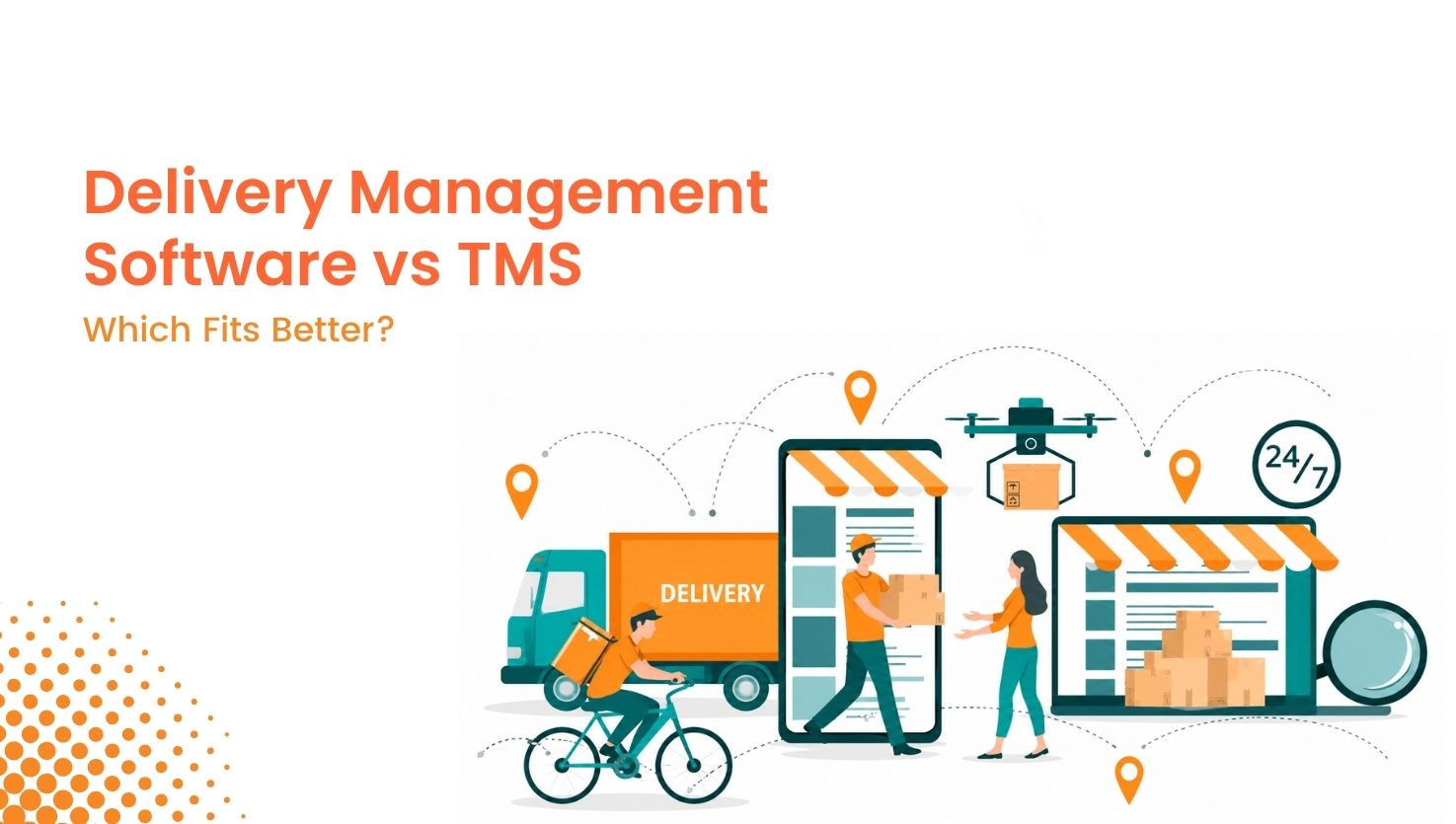
Delivery management software is becoming essential as modern logistics teams are under constant pressure to move faster, stay visible, and control costs at the same time. With global ecommerce expected to cross $8 trillion in the next few years and customer expectations now shaped by same-day and next-day deliveries, even small delays can impact retention and revenue. At the execution level, delivery management software has become a key enabler for handling rising order volumes and improving last-mile reliability. This is exactly why the comparison between delivery management software vs TMS has become so important for growing businesses.
At first glance, both systems may look similar since they help move goods from one point to another. But in reality, they sit at very different layers of logistics. One is focused on last-mile execution and customer experience, while the other is built for large-scale transportation planning, freight optimization, and network efficiency.
Getting this distinction right is important before investing in any logistics platform, especially for businesses that are scaling across multiple regions, carriers, and fulfillment models.
What is Delivery Management Software?
Delivery management software is designed to streamline the execution side of logistics, especially last-mile delivery. It focuses on ensuring that shipments move quickly from warehouses or fulfillment centers to end customers with full visibility and control.
This system is widely used by ecommerce brands, D2C companies, and hyperlocal delivery businesses that prioritize speed and customer experience.
Key capabilities include:
- Real-time shipment tracking and visibility
- Automated carrier assignment
- Delivery route optimization
- Proof of delivery (POD) capture
- Customer notifications and updates
- Exception management for failed deliveries
Unlike traditional logistics systems, delivery management tools are built for agility. They help operations teams respond quickly to delivery issues and improve customer satisfaction through transparency.
For brands operating high-volume order flows, especially in ecommerce, this layer becomes essential for managing the final stage of fulfillment.
What is a Transportation Management System (TMS)?
A Transportation Management System (TMS) operates at a broader supply chain level. It is designed to plan, execute, and optimize the movement of goods across multiple transportation modes like road, rail, air, or sea.
Where delivery-focused tools handle the “last mile,” a TMS manages the entire transportation lifecycle from procurement to final delivery coordination.
This system is typically used by large enterprises, manufacturers, 3PL providers, and global supply chain operators.
Core functions include:
- Freight planning and consolidation
- Carrier rate management and procurement
- Route and load optimization
- Shipment scheduling across networks
- Freight auditing and cost control
- Multi-modal transportation coordination
A TMS is less about individual parcel delivery and more about optimizing large-scale logistics flows. It helps reduce transportation costs, improve capacity utilization, and enforce standardized logistics operations across geographies.
Key Differences Between Delivery Systems and TMS
The distinction becomes clearer when comparing both systems side by side.
|
Dimension |
Delivery Management Software |
Transportation Management System |
|
Primary Focus |
Last-mile execution | End-to-end transportation planning |
| Scale | SMBs, D2C, ecommerce |
Enterprises, global supply chains |
|
Core Function |
Delivery tracking & fulfillment | Freight optimization & planning |
| Users | Operations & fulfillment teams |
Supply chain & logistics planners |
|
Cost Structure |
Subscription based SaaS | Complex enterprise licensing |
| Optimization Layer | Delivery speed & visibility |
Cost, capacity & route efficiency |
In simple terms, delivery management software improves how shipments reach customers, while a TMS improves how goods move across the entire logistics network.
This distinction is also highlighted in industry comparisons across logistics platforms and aggregators, where execution-focused tools and planning systems are increasingly evaluated as separate layers of a modern supply chain stack.
When to Use Delivery Management Software:
Ideal use cases:
- D2C and ecommerce brands handling high order volumes
- Businesses with strong last-mile dependency
- Companies requiring real-time delivery visibility
- Operations with multiple courier partners
- Hyperlocal or same-day delivery models
For these businesses, speed and transparency matter more than complex freight planning. The ability to track every order in real time and manage delivery exceptions becomes a competitive advantage.
This is why many fast-scaling ecommerce companies adopt delivery execution tools early in their growth journey.
When to Use a TMS
A Transportation Management System is better suited for organizations that deal with large-scale, multi-node logistics operations.
Ideal use cases:
- Manufacturing and distribution networks
- Global or multi-region enterprises
- 3PL and logistics service providers
- Businesses managing freight contracts and carriers
- Supply chains with multimodal transport requirements
Here, the focus shifts from individual deliveries to optimizing transportation costs, improving route efficiency, and managing long-haul logistics.
A TMS becomes critical when logistics complexity increases beyond last-mile execution and requires centralized planning and control.
Can They Work Together?
In modern logistics architecture, the answer is increasingly yes.
Instead of choosing one over the other, many organizations are adopting a composable logistics stack, where different systems handle different layers of the supply chain.
For example:
- A TMS handles freight planning, carrier contracts, and bulk transportation
- Delivery management software handles last-mile execution and customer delivery experience
This hybrid approach ensures both cost optimization and customer satisfaction are addressed simultaneously.
Platforms like eShipz operate in this evolving space by enabling orchestration across carriers, tracking systems, and delivery workflows, bridging the gap between execution and visibility layers.
Make the Right Logistics Choice
Choosing between delivery execution platforms and transportation planning systems isn’t about picking the “best” option, it’s about understanding what your logistics actually needs today, and what it will need as it grows.
If your priority is fast, reliable last-mile delivery with full visibility for customers, delivery management software is the right fit. If your operations are more complex, focused on freight movement, cost optimization, and large-scale transportation planning, a TMS becomes more relevant.
But in modern logistics, this is rarely an either-or decision. The real value comes from connecting both layers so planning decisions flow smoothly into execution without friction.
This is where platforms like eShipz help bring clarity, by unifying visibility, carrier control, and delivery execution into one streamlined logistics flow.
FAQs
- Is TMS better than delivery management software?
Neither is inherently better. A TMS is designed for enterprise-level transportation planning, while delivery management software focuses on last-mile execution and customer delivery experience.
2. What is the difference between DMS and TMS?
DMS focuses on shipment execution, tracking, and delivery optimization. TMS focuses on freight planning, cost control, and end-to-end transportation management.
3. Which is better for ecommerce logistics?
For ecommerce businesses, delivery management software is typically more relevant because it directly improves order fulfillment speed and customer experience.