




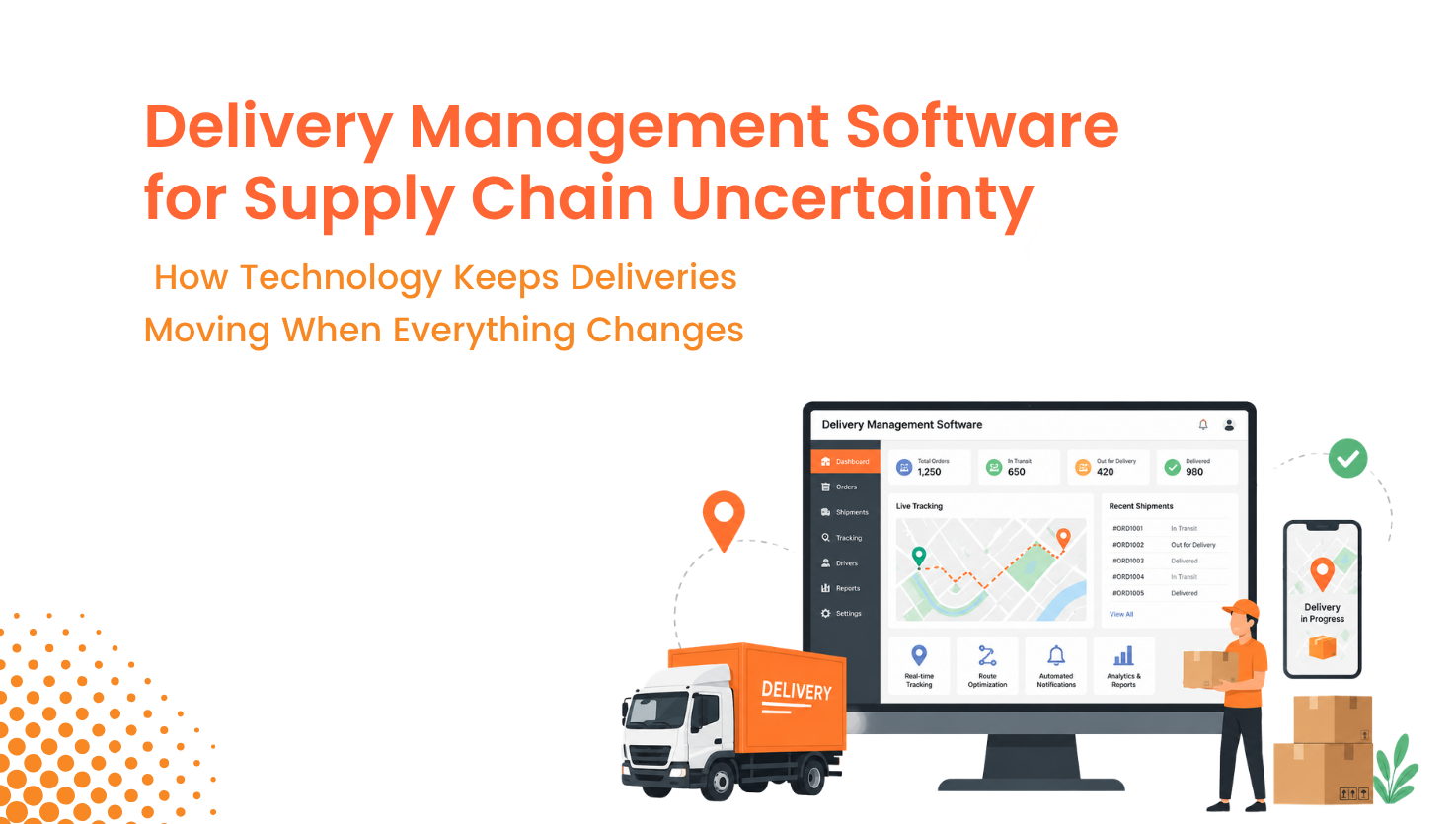
Delivery management software has become a critical part of how modern businesses operate in an increasingly unpredictable world. The way products move from businesses to customers has changed forever. What was once a predictable journey involving warehouses, transportation networks, and retail stores has now evolved into a complex ecosystem influenced by global disruptions, shifting customer expectations, and constant operational challenges.
From lockdowns and product restrictions to economic uncertainty and broader supply chain disruptions, businesses across industries have been forced to navigate situations they were not fully prepared for. In many markets, eCommerce demand saw a sharp double-digit surge (often estimated in the 20–40% range during peak disruption periods), especially in essential categories such as healthcare and daily necessities. Yet, for essential categories such as healthcare, daily necessities, and eCommerce retail, demand remained strong, while the real challenge shifted to fulfilling it consistently and efficiently.
This is where the fundamental question changed for businesses: it was no longer just “How do we sell?” but more importantly, “How do we deliver reliably at scale?”
As physical retail channels faced limitations and consumer behaviour rapidly moved toward digital-first experiences, companies began expanding online, entering new markets, and experimenting with flexible fulfilment models. However, success in this shift depends heavily on having the right technology backbone, dependable logistics partners, and real-time visibility across the entire supply chain.
Modern logistics technology has therefore become a strategic necessity rather than an operational upgrade. A connected delivery ecosystem allows businesses to automate workflows, respond faster to disruptions, and maintain continuity even when traditional supply chain structures are under pressure.
In this blog, we explore the major challenges businesses face during uncertain times, how technology helps overcome these disruptions, and why digital logistics systems are now essential for building resilient and scalable supply chains.
Why Supply Chains Become Vulnerable During Uncertain Times
A supply chain is a network of multiple moving parts, manufacturers, warehouses, carriers, delivery management software, delivery teams, technology platforms, and customers. When one part slows down, the impact spreads across the entire system.
Some of the biggest challenges businesses experience include:
-
Workforce availability issues
-
Changing delivery capabilities
-
Transportation disruptions
-
Inventory uncertainty
-
Customer expectation changes
-
Increased pressure on logistics teams
Companies that depended heavily on manual operations often struggled the most. Processes such as order allocation, shipping label generation, tracking updates, and delivery management required significant human involvement, making it difficult to scale during disruptions.
Technology became the bridge between businesses, logistics partners, and customers.
The Growing Need for Delivery Management Software
When businesses operate across multiple sales channels, managing shipments manually becomes complicated. Orders arrive from marketplaces, websites, stores, and other channels, each requiring accurate processing and real-time updates.
Delivery management software helps businesses connect these different operations into a single workflow.
Instead of handling every shipment manually, companies can automate important logistics activities such as:
-
Order processing
-
Carrier selection
-
Shipping label generation
-
Tracking updates
-
Delivery performance monitoring
-
Exception management
This becomes especially valuable when supply chains are under stress because businesses need flexibility and faster decision-making.
This becomes especially valuable when supply chains are under stress because businesses need flexibility and faster decision-making.
A technology-driven logistics approach allows companies to reduce dependency on manual processes and create smoother customer experiences.
Major Challenges Faced by Enterprises During Supply Chain Disruptions
When uncertainty enters the supply chain, even well-established businesses face unexpected operational pressure. A disruption at any stage, from sourcing and warehousing to transportation and final delivery, can impact customer experience, revenue, and business continuity. Traditional processes that worked during stable conditions often struggle when demand changes suddenly, resources become limited, or logistics networks face restrictions.
For enterprises, the biggest challenge is not only keeping products moving but maintaining visibility, speed, and control across every step of the fulfilment journey. From workforce shortages to changing delivery capabilities, businesses are forced to rethink their supply chain strategies and adopt more flexible, technology-driven approaches.
1. Shortage of Manpower
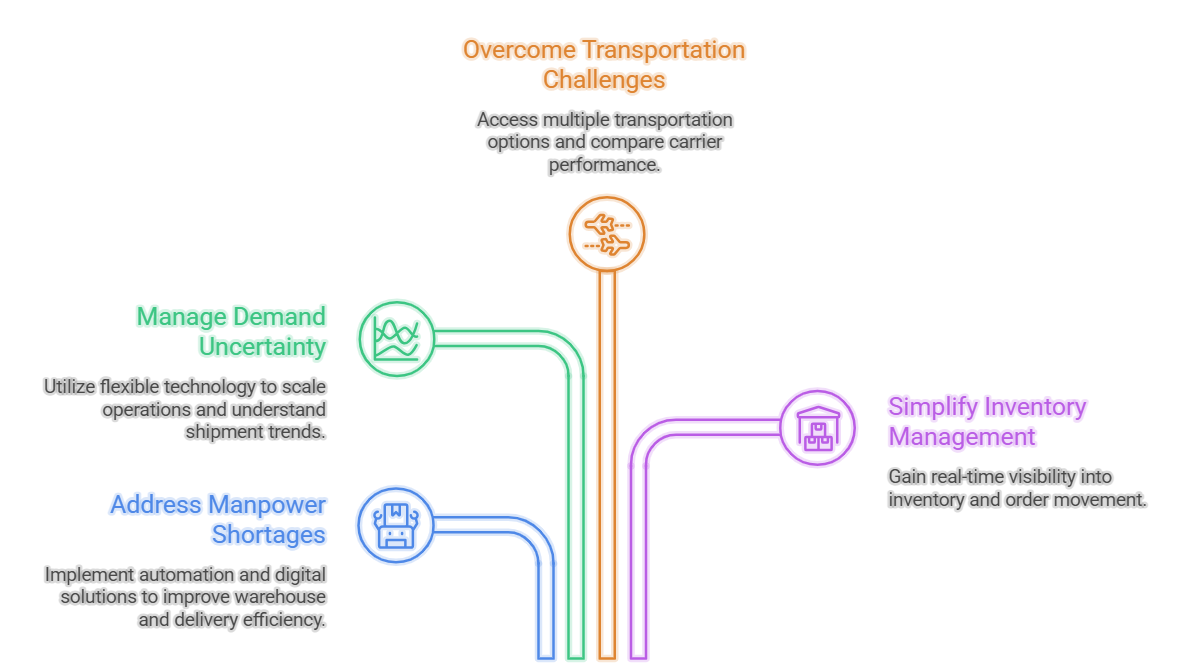
One of the most immediate impacts of supply chain disruptions is the sudden shortage of skilled and available workforce across logistics operations. From warehouse staff handling inventory to delivery executives managing last-mile fulfillment, every stage of the supply chain depends heavily on human effort. When workforce availability reduces or becomes inconsistent, it directly slows down processing speed, increases operational delays, and creates bottlenecks that affect overall delivery performance.
Warehouse Operations:
Warehouses are the foundation of fulfilment. Every order depends on inventory availability, picking, packing, and dispatch processes working together.
However, many businesses historically relied on large teams performing repetitive manual tasks. Because labour was easily available, technology investments were often delayed.
During workforce shortages, this dependency created operational challenges.
Businesses started looking for ways to improve warehouse efficiency through:
-
Automated order processing
-
Digital inventory visibility
-
Connected warehouse systems
-
Faster shipment workflows
Automation helps warehouse teams handle more orders with fewer manual touchpoints while reducing errors.
Pickup and Delivery Operations:
Last-mile delivery is one of the most complex parts of the supply chain.
Traditional shipping processes often involve multiple manual steps:
-
Creating labels
-
Preparing manifests
-
Assigning shipments
-
Tracking parcels
-
Updating customers
Even small delays in these activities can create shipment delays. Sometimes a parcel may already be near its destination but remain inactive because of process gaps.
A connected logistics platform reduces these delays by ensuring every step moves smoothly from order creation to final delivery.
2. Demand Uncertainty
Economic disruptions directly impact customer purchasing behaviour.
When consumer confidence decreases, businesses experience lower demand across categories. At the same time, certain segments continue seeing high demand and require faster fulfilment.
This creates a difficult situation:
Businesses need to be prepared for both sudden growth and sudden decline.
A flexible technology infrastructure helps companies:
-
Scale operations when demand increases
-
Reduce unnecessary operational costs
-
Understand shipment trends
-
Make faster logistics decisions
Real-time visibility allows businesses to plan better instead of reacting after problems occur.
3. Transportation and Infrastructure Challenges
Transportation networks are highly interconnected.
Air cargo, road transportation, rail networks, and regional delivery operations all influence how quickly products reach customers.
When infrastructure faces restrictions, businesses need alternatives.
A single logistics partner may not always be enough. Companies require access to multiple transportation options to maintain continuity.
Technology enables businesses to:
-
Compare carrier performance
-
Select suitable shipping partners
-
Monitor delivery timelines
-
Switch providers when required
This creates a more resilient delivery network.
4. Inventory Management Complexity
Inventory planning becomes difficult when market conditions change quickly.
Manufacturers depend on raw materials, suppliers, and predictable demand cycles. However, during uncertain periods, businesses struggle with questions like:
-
How much stock should be maintained?
-
When should replenishment happen?
-
Which locations need inventory?
Connected logistics systems help businesses gain better visibility into order movement, inventory demand, and fulfilment performance.
Better data leads to better decisions.
How Technology Creates More Resilient Logistics Operations
Modern supply chains operate in an environment where change is constant, demand fluctuates, carrier capacity shifts, and customer expectations continue to rise. In such a landscape, businesses can no longer rely on disconnected tools or manual coordination to keep operations running smoothly. What they need instead is a unified, connected logistics ecosystem that brings together every moving part of the fulfillment journey.
Technology plays a critical role in building this resilience by integrating orders, warehouses, carriers, and customer communication into a single flow of information. When systems are connected, businesses gain real-time visibility into shipments, better control over exceptions, and the ability to respond quickly when disruptions occur. This reduces dependency on manual intervention and ensures that even during uncertainty, operations remain consistent and predictable.
A strong logistics technology layer also helps businesses move from reactive decision-making to proactive planning. Instead of identifying issues after they happen, teams can anticipate delays, optimize carrier selection, and improve delivery performance using live data. The result is a more agile and resilient supply chain that continues to perform even under pressure, while maintaining a seamless experience for customers.
1. Paperless and Automated Order Processing
Manual order handling creates delays and increases the possibility of errors.
With integrations across sales channels, warehouse systems, and carriers, businesses can automate shipment creation.
This helps teams:
-
Avoid duplicate data entry
-
Reduce processing time
-
Improve shipment accuracy
-
Manage higher volumes efficiently
When combined with mobile applications and digital printing solutions, warehouse and delivery teams can manage shipments faster with fewer dependencies.
2. Mobile-Based Logistics Operations
Modern logistics teams need access to information wherever they operate.
A mobile logistics application can provide access to:
-
Shipment creation
-
Order updates
-
Manifest generation
-
Carrier performance reports
-
Delivery tracking
-
Failed delivery analysis
This creates better coordination between warehouses, delivery teams, and business managers.
Instead of waiting for reports, teams can access real-time operational insights.
3. Smarter NDR and Returns Management
Failed deliveries are one of the biggest challenges for online businesses.
A failed delivery can happen due to:
-
Customer availability issues
-
Incorrect address details
-
Serviceability changes
-
Communication gaps
A strong delivery management system helps businesses identify these issues early and take corrective action.
By combining data from customers, carriers, and shipment history, businesses can:
-
Improve delivery success rates
-
Reduce unnecessary returns
-
Improve customer experience
Returns management also becomes easier when companies have clear visibility into reverse movement.
4. Multiple Carrier Connectivity
Relying on a single carrier can create operational risks.
During high-demand periods, some logistics providers may face capacity limitations while others may have additional availability.
A multi-carrier approach gives businesses flexibility.
With connected carrier networks, companies can:
-
Choose the right partner for each shipment
-
Reduce delivery delays
-
Improve geographical coverage
-
Maintain business continuity
This approach helps businesses adapt quickly when logistics conditions change.
5. Expanding Access to Logistics Partners
The future of logistics is becoming more connected.
Businesses are no longer limited to traditional shipping models. They can expand into new regions by connecting with logistics providers, marketplaces, and technology partners.
A connected logistics ecosystem helps companies:
-
Enter new markets
-
Improve delivery reach
-
Create scalable operations
-
Build stronger customer experiences
Technology enables businesses to focus on their products while logistics operations become easier to manage.
Delivery Management Software vs Transportation Management System: Understanding the Difference
Businesses often compare different logistics technologies when building their supply chain stack.
A transportation management system focuses mainly on transportation planning, freight movement, route optimisation, and large-scale logistics coordination.
Delivery management software focuses more on shipment execution, order fulfilment, tracking, last-mile operations, and customer delivery experience.
The two solutions solve different problems.
| Area | Delivery Management Software | Transportation Management System |
|---|---|---|
| Primary Focus | Shipment execution and delivery experience | Transportation planning and optimisation |
| Main Users | Ecommerce teams, operations teams, fulfilment teams | Supply chain and logistics teams |
| Best For | Last-mile and order fulfilment | Large-scale freight movement |
| Core Features | Tracking, carrier allocation, delivery visibility | Route planning, freight management, transportation analytics |
| Business Impact | Faster deliveries and better customer experience | Lower transportation costs and improved planning |
For many modern businesses, logistics can no longer be managed as separate, isolated functions. Shipping, warehousing, carrier coordination, and customer communication all need to work in sync rather than as independent steps. This is where a connected logistics strategy becomes essential.
When systems are integrated, businesses are able to create a single flow of information across their entire supply chain. Orders move seamlessly from checkout to fulfilment, carriers receive real-time updates, and customers stay informed at every stage of delivery. Instead of teams working in silos, every stakeholder operates on the same data, reducing confusion and improving decision-making speed. More importantly, this connected approach allows businesses to stay flexible during uncertainty. Whether it’s switching carriers, adjusting to demand changes, or handling unexpected delays, integrated systems make it easier to adapt without disrupting the entire operation. In essence, when logistics systems work together, businesses gain not just efficiency, but the ability to stay resilient and responsive in any situation.
Building a Future-Ready Logistics Stack
The future of supply chains will require flexibility.
Businesses need systems that can adapt to:
- Changing customer expectations
- New delivery models
- Market disruptions
- Growing sales channels
A connected logistics platform creates a foundation where businesses can improve visibility, automate repetitive tasks, and make faster decisions.
Technology is no longer only an operational advantage. It has become an essential part of business continuity.
Keeping Deliveries Moving When Everything Else Slows Down
During uncertain times, customer expectations remain surprisingly consistent, they still want their orders delivered safely, quickly, and without confusion. What changes is everything behind the scenes: the pressure on operations, the unpredictability in logistics networks, and the need to constantly adapt.
In such moments, businesses that rely on connected and technology-driven logistics systems are better positioned to stay steady. When orders, carriers, and teams are working in sync through a unified platform, it becomes easier to respond to disruptions, reduce delays, and maintain service quality even under pressure.
Because in the end, every successful delivery is not just a shipment completed, it is trust delivered, expectations met, and reliability proven.
To build this level of resilience into your supply chain, explore how eShipz helps businesses streamline shipping, improve visibility, and stay in control even during uncertainty.
FAQs
Is delivery technology important during supply chain disruptions?
Yes. Technology improves visibility, automates workflows, and helps businesses quickly adjust when logistics conditions change.
What is the difference between delivery management software and a transportation management system?
A delivery management platform focuses on shipment execution and customer deliveries, while a transportation management system focuses on freight planning and transportation optimisation.
Which solution is better for ecommerce businesses?
Ecommerce businesses usually benefit from delivery-focused solutions because they need faster fulfilment, tracking visibility, and efficient last-mile operations.
Can businesses use multiple logistics partners?
Yes. Multi-carrier connectivity helps businesses improve reliability, coverage, and flexibility.