



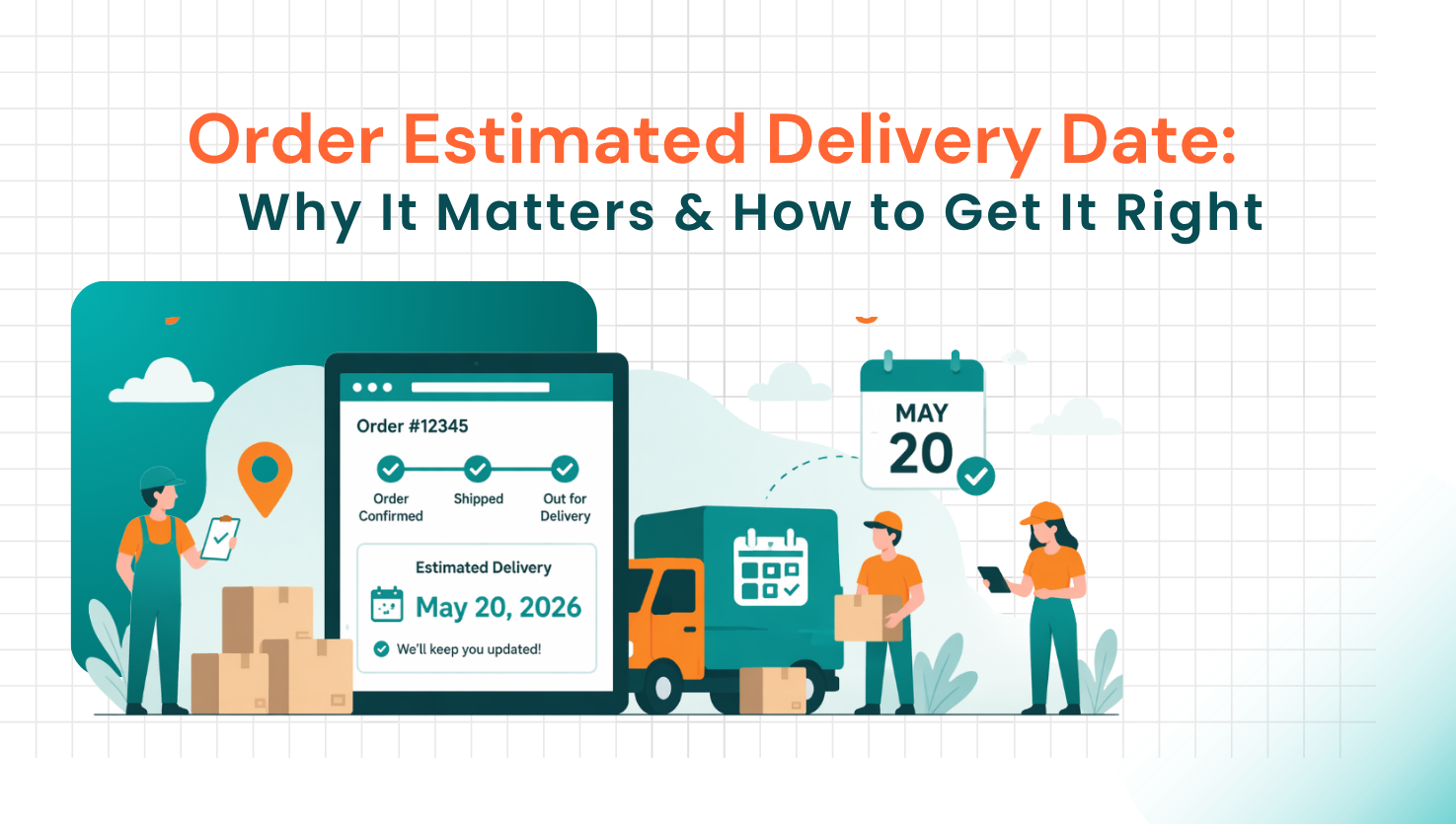
Estimated Delivery Date: The Moment That Decides a Purchase
An order estimated delivery date (EDD) is the expected date when a product will reach the customer, calculated based on processing time, shipping timelines, and location-specific factors.
You’ve done everything right, great product, competitive pricing, smooth checkout.
And then comes the hesitation.
“Will this reach me on time?”
That one question quietly determines whether a customer clicks “Buy Now” or leaves.
In 2026, delivery expectations have shifted. It’s no longer about being the fastest, it’s about being predictable. Studies show that 62% of shoppers now prefer accurate delivery timelines over faster but uncertain shipping, and more than 75% are influenced to complete a purchase when they see a clear delivery date upfront. An order estimated delivery date is no longer just a backend calculation, it’s a decision-making signal.
In this blog, we’ll break down why this, Estimated Delivery Date matters more than ever, what the data reveals, and how brands can get it right without overpromising.
Why Reliable Delivery Timelines Are Now a Competitive Advantage
Ecommerce has evolved, and so have customer expectations. Today, it’s no longer enough to promise fast delivery. What truly matters is how dependable that promise feels.
1. When Accuracy Feels More Valuable Than Speed
Fast shipping can attract attention, but only if customers believe it. A realistic, well-calculated delivery date often performs better than an ambitious promise that might not be met. People would rather plan around certainty than gamble on speed.
2. Removing Doubt at the Buying Moment
Uncertainty is one of the biggest reasons customers hesitate. When there’s no clear delivery timeline, even an interested buyer may pause or abandon the purchase altogether. Showing a date upfront gives them the confidence to move forward.
3. Fewer “Where Is My Order?” Questions
A large portion of support queries come from customers simply looking for updates. When expectations are clearly set from the beginning, there’s far less need for follow-ups, reducing pressure on support teams and improving operational efficiency.
4. Building Trust That Lasts Beyond One Order
Trust isn’t built through promises, it’s built through consistency. When deliveries happen as expected, customers start relying on the brand. And over time, that reliability turns into repeat purchases and long-term loyalty.
In a landscape where every brand can offer speed, reliability is what truly stands out. Because at the end of the day, customers don’t just remember how fast you delivered, they remember whether you delivered as promised
Trends & Data Insights: What the Numbers Say
Customer expectations around delivery have become more defined, and the data clearly reflects this shift. What once felt like a “nice-to-have” is now directly influencing buying decisions, customer satisfaction, and even operational costs.
Key Insights to Highlight
- 62% of customers prefer accurate delivery timelines over faster shipping
Reliability is now valued more than speed. Customers are willing to wait slightly longer, as long as they know exactly when their order will arrive. - More than 75% of shoppers are influenced by visible delivery dates
Showing a clear timeline early in the journey reduces hesitation and plays a direct role in improving conversion rates. - Brands report up to 20–30% fewer WISMO queries with proactive updates
When customers are informed upfront and kept updated, the need to reach out for order status drops significantly, reducing pressure on support teams.
And in today’s ecommerce experience, confidence is often the final push a customer needs to complete a purchase.
What Goes Into a Reliable Delivery Timeline
A reliable delivery timeline isn’t built on a single data point, it’s the result of multiple moving parts working together behind the scenes. When even one of these factors is overlooked, the entire promise can fall apart.
Key Factors That Influence Estimated Delivery Date: 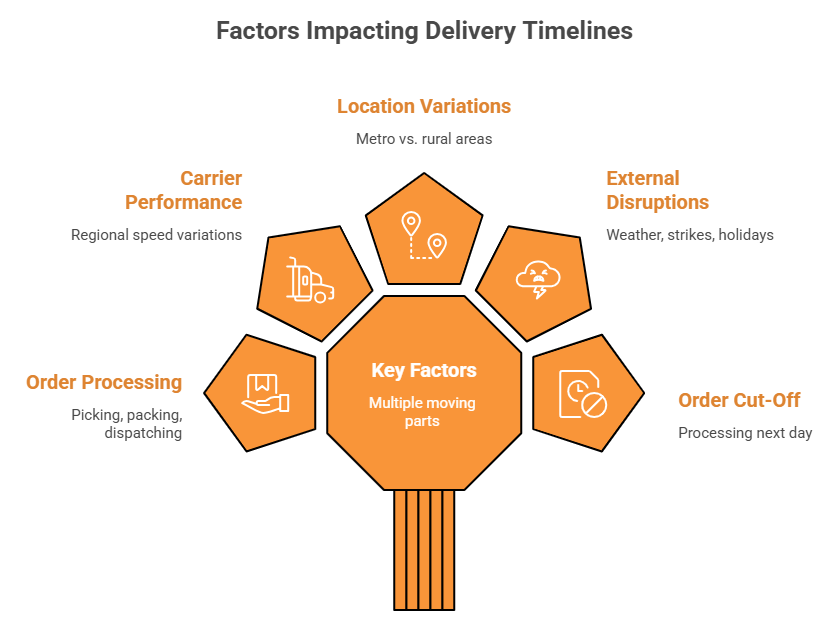
Estimated Delivery DateA reliable delivery timeline isn’t built on a single data point, it’s the result of multiple moving parts working together behind the scenes. When even one of these factors is overlooked, the entire promise can fall apart.
Order Processing Time
Before a shipment even leaves the warehouse, there’s work to be done. Picking, packing, and dispatching orders take time, and small delays here can shift the final delivery date more than expected.
Carrier Performance Differences
Not all courier partners perform the same way across regions. A carrier that’s fast in metro cities might be slower in Tier 2 or remote areas, making consistency a challenge.
Location-Based Variations
Where the customer is located plays a major role. Deliveries within metros are usually faster, while shipments to smaller towns or rural areas often require additional time.
External Disruptions
Weather conditions, strikes, public holidays, or peak-season congestion can all impact delivery timelines. These are unpredictable, but they can’t be ignored.
Order Cut-Off Timings
The time at which an order is placed matters more than most realize. Orders placed after a daily cut-off often get processed the next day, pushing delivery timelines further out.
The difference between an average estimate and a reliable one lies in how well these factors are accounted for. Because in the end, a strong delivery promise isn’t just calculated, it’s continuously adjusted to reflect what’s actually happening on the ground.
Getting Delivery Timelines Right : What Actually Works in Estimated Delivery Date
Most brands today don’t struggle because they lack data, they struggle because they don’t use that data in a way that reflects real-world conditions.
Getting delivery timelines right is less about estimation and more about how intelligently different systems work together behind the scenes.
1. Move Beyond Static Estimates with Smarter Predictions (Including Platforms like eShipz)
Modern logistics is no longer driven by fixed rules or generic timelines. Today, delivery predictions are shaped by data that evolves in real time.
Instead of relying on static estimates, systems now continuously learn from:
- Historical delivery performance
- Real-time carrier efficiency
- Route-level delays and disruptions
This shift allows brands to move from guesswork to informed, data-backed timelines that actually reflect what’s happening on the ground.
Many logistics platforms, including solutions like eShipz, bring together analytics and automation to make this possible. By combining multiple data points into a single view, they help generate delivery timelines that feel far more realistic, consistent, and dependable than traditional methods.
2. Make Delivery Dates Visible from the Start
Customers shouldn’t have to wait until checkout to understand when their order will arrive.
Displaying delivery timelines:
- On product pages
- Inside the cart
- During checkout
has now become a standard practice across ecommerce platforms. Several shipping and checkout optimization tools support this, helping brands reduce hesitation early in the journey.
3. Think End-to-End, Not Just Transit Time
One of the most common mistakes brands make is focusing only on shipping time. But from a customer’s perspective, delivery starts the moment the order is placed, not when it’s shipped.
Accurate timelines require visibility into the entire order lifecycle, including:
- Warehouse processing and handling
- Dispatch delays
- Courier pickup schedules
Even small inefficiencies in these early stages can push delivery timelines further than expected.
This is where connected logistics platforms come into play. Solutions like eShipz are designed to bring order processing, carrier allocation, and shipment movement into a single workflow, making it easier to account for delays before the package even leaves the warehouse. Instead of treating each step in isolation, this kind of setup helps brands build a more complete and realistic delivery timeline, rather than relying only on transit estimates.
4) Build in Buffers That Protect Your Promise
No delivery journey is perfectly predictable, which is why buffer logic plays a critical role.
- Weekends and holidays need to be accounted for
- Peak-season slowdowns should be anticipated
- Operational delays should be factored in automatically
Many advanced logistics tools now allow brands to configure these buffers dynamically, ensuring timelines remain practical and achievable.
5) Keep Customers Informed with Real-Time Updates
Even the best estimates can change once a shipment is in transit.
This is where real-time tracking systems come in. Solutions that provide live shipment visibility, such as tracking and post-purchase experience platforms, help:
- Update delivery timelines dynamically
- Notify customers of delays
- Reduce uncertainty after dispatch
For example, tools like real-time tracking modules (including those offered within platforms like eShipz) are designed to keep customers informed throughout the journey, rather than leaving them guessing.
6) Personalize Timelines Based on Location
A single delivery estimate for all customers no longer works.
Accurate timelines today are often powered by:
- Pin-code level delivery data
- Regional courier performance insights
- Last-mile delivery constraints
Many logistics and shipping automation platforms now incorporate this level of granularity, helping brands provide location-specific delivery expectations instead of broad averages.
At its core, getting delivery timelines right in 2025 isn’t about adding more tools, it’s about connecting the right ones. Because when systems work together seamlessly, delivery promises stop being assumptions, and start becoming commitments customers can trust.
Certainty Is the New Speed
Ecommerce in 2025 isn’t just about how fast you can deliver, it’s about how reliably you can meet expectations.
Customers today don’t just look at delivery speed; they look for clarity, consistency, and confidence in what they’re being promised. And that’s where the difference lies. A well-calculated delivery timeline doesn’t just move orders faster, it removes hesitation, builds trust, and creates a smoother post-purchase experience.
More importantly, it aligns your operations with what customers actually value: knowing when their order will arrive, and being right about it.
The shift is clear.
It’s no longer about asking, “How fast can we ship?”
But rather, “How reliably can we deliver?”
Because in the end, speed might win attention, but certainty is what wins the customer.
If you’re looking to improve how delivery timelines are calculated and communicated, exploring platforms like eShipz can be a practical next step, especially for teams aiming to bring together automation, real-time tracking, and smarter carrier decisions in one place.