

Multicarrier parcel management software allows businesses to manage shipping across multiple carriers (UPS, FedEx, DHL, and local couriers) within a single system. It automatically selects the best carrier based on cost, speed, and destination, while also handling label generation, order processing, and real-time tracking across the shipment lifecycle.
This isn’t just a convenience layer, it’s becoming essential. Recent industry data highlights why, Up to 30% reduction in shipping costs through real-time carrier rate comparison, 20–40% improvement in delivery efficiency with automated carrier allocation, 58–64% of ecommerce orders in India still come from Tier-2/3 regions, where carrier performance varies widely, COD orders have ~13× higher failure rates than prepaid, making smarter carrier selection critical, Businesses using automated shipping workflows report significant drops in manual errors and processing time, These numbers reflect a clear shift: logistics is no longer just execution, it’s decision-making at scale.
In this blog, we’ll break down why this model is becoming essential, what features actually matter, how leading platforms compare, and what trends are shaping logistics decisions today.
Why Shipping Complexity Is Rising in Ecommerce Logistics
A few years ago, shipping was fairly simple, most businesses relied on one or two courier partners, and that worked well when volumes were steady and expectations were flexible. But as ecommerce has expanded beyond metros, especially into Tier-2 and Tier-3 cities, logistics has become far more dynamic and harder to control.
Today, 58–64% of orders in India come from these regions, where delivery conditions and carrier performance can vary widely. At the same time, COD orders fail nearly 13× more often than prepaid, increasing the risk of returns and lost revenue. Add to that the fact that logistics costs can make up 10–20% of the total order value, and every shipping decision starts to have a direct impact on margins.
What this creates is a shift in the problem itself. It’s no longer just about shipping orders, it’s about choosing the right way to ship each one. When carrier performance, costs, and delivery success rates vary so much, even small inefficiencies can scale into larger operational challenges.
Key Features That Actually Improve Multicarrier Shipping Operations
Not every shipping setup struggles because of scale, most struggle because of how decisions are made. Two businesses can use similar tools and still see very different outcomes, simply because one relies on manual processes while the other builds smarter, automated workflows. The difference isn’t just in having features, it’s in how effectively those features are used to reduce effort, improve accuracy, and make better decisions at every step.
Here are a few capabilities that genuinely make a difference on the ground:
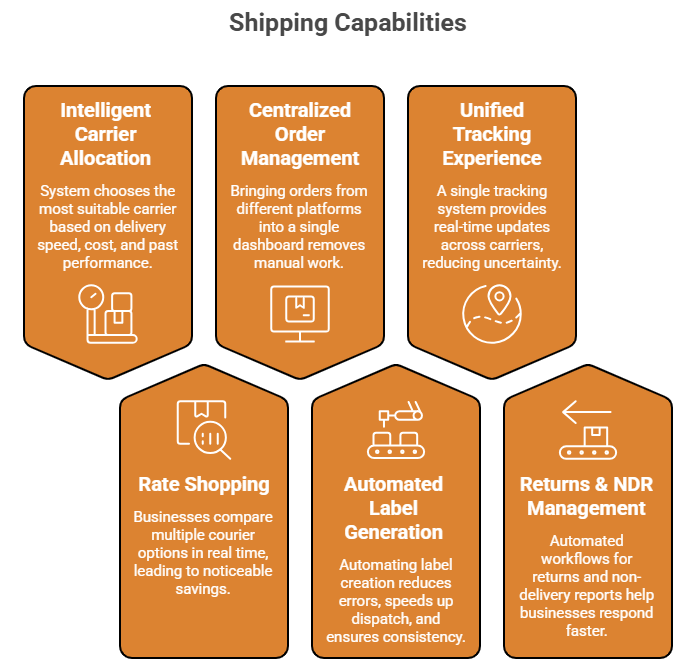
- Intelligent Carrier Allocation: Instead of assigning shipments manually, the system chooses the most suitable carrier for each order based on delivery speed, cost, and past performance. This helps avoid common issues like delays in certain regions aster services where they’re not needed.
- Rate Shopping: Rather than sticking to fixed pricing, businesses can compare multiple courier options in real time. This flexibility often leads to noticeable savings, some brands see up to 30% reduction in shipping costs simply by switching carriers dynamically based on each order.
- Centralized Order Management: Managing orders across different platforms can quickly become chaotic. Bringing everything into a single dashboard,whether it’s from Shopify, Magento, or other systems, removes manual work and gives teams better control over daily operations.
- Automated Label Generation: Label creation might seem like a small step, but at scale, it can slow down warehouse operations. Automating this process reduces errors, speeds up dispatch, and ensures consistency across shipments.
- Unified Tracking Experience: Customers expect visibility once an order is placed. A single tracking system that works across carriers helps provide real-time updates, reduces uncertainty, and cuts down on “Where is my order?” queries.
- Returns & NDR Management: Failed deliveries and returns are part of ecommerce, but handling them manually adds friction. Automated workflows for returns and non-delivery reports (NDR) help businesses respond faster, communicate better with customers, and recover orders more efficiently.
Individually, these features may seem operational. But together, they reshape how logistics works, reducing dependency on manual decisions, improving consistency, and making outcomes more predictable. Over time, this is what drives better delivery performance, lower costs, and a smoother customer experience.
Comparative Breakdown of Multicarrier Shipping Platforms
Choosing the right shipping platform isn’t about picking the “best” one, it’s about finding what fits your operational needs. Some tools are built for high-volume ecommerce, others for global shipping, and a few focus more on automation and analytics. The real difference shows up in how well they handle scale, flexibility, and day-to-day execution.
Here’s a simplified comparison to help understand how different platforms are positioned:
| Platform | Best For | Strength |
|
eShipz |
Growing ecommerce & SMBs | Multi-carrier automation, visibility |
| ShipnStation | High-volume ecommerce (US) |
Strong integrations, ease of use |
|
Shippo |
Small to mid-sized businesses | Simple setup, discounted rates |
| ShipyPro | Global shipping operations |
180+ carrier integrations |
|
FarEye |
Enterprise logistics | Automation and analytics |
| Shiprocket | Indian SMBs |
Wide local carrier network |
|
ClickPost |
Growing ecommerce brands | AI-based carrier allocation |
|
Ordoro |
Inventory-focused businesses |
Shipping + inventory management |
| Centiro | Complex supply chains |
Enterprise-level control |
Each of these platforms solves a slightly different problem. Some focus on ease of use, others on depth of control, and a few on automation at scale. That’s why the right choice often depends on where a business is in its growth journey and how complex its logistics network has become.
At a broader level, this comparison reflects how the logistics ecosystem itself is evolving, from basic shipping tools to more intelligent systems that help businesses make better decisions, not just execute them.

Trends & Data Insights in Ecommerce Logistics and Shipping
Logistics decisions today are no longer straightforward. As ecommerce scales, especially across diverse regions, businesses are dealing with rising costs, higher delivery expectations, and less room for error. What’s changing is not just volume, but how every shipping decision needs to be made.
Cost optimization has become continuous, not periodic. With logistics contributing 10–20% of order value, businesses are now optimizing at the shipment level, leading to up to 30% cost savings and 15–25% efficiency gains. At the same time, delivery expectations are rising, over 70% of customers prefer faster delivery options, making speed a key differentiator.
Carrier strategy is also evolving. With 58–64% of orders coming from Tier-2/3 regions, relying on a single courier is no longer reliable. Diversifying carriers helps improve delivery success rates, especially when COD failures are ~13× higher than prepaid. Alongside this, automation is reducing manual effort, improving processing speed by 20–40%, while better tracking visibility can cut customer queries by up to 30%.
Taken together, these shifts show a clear direction, logistics is becoming more data-driven, where smarter decisions directly impact cost, speed, and customer experience.
What This Means for Growing Ecommerce Brands
As ecommerce brands grow, shipping stops being a simple task and starts impacting margins, delivery timelines, and customer experience. What used to be about choosing a courier becomes a bigger question, how to make the right shipping decision every single time, across different regions, costs, and delivery expectations.
This is where multi-carrier systems make a difference. They add a layer of intelligence between orders and logistics, helping businesses choose better, faster, and more cost-effective options automatically.
For brands reaching this stage, solutions like eShipz help bring that control, making shipping more predictable without adding operational complexity.