




Market Insights: What the Industry is Saying
The apparel industry continues to grow, but managing inventory at the SKU level is becoming more complex. During peak sales, the challenge is not demand generation but matching the right size, color, or style with real-time demand.
Industry trends show a clear imbalance. Brands often face stockouts of fast-moving SKUs while holding excess inventory of slower variants. This highlights the limitations of traditional planning methods in a fast-changing market.
There is also a strong shift toward data-driven decision-making. Businesses are moving beyond static forecasts and using real-time signals to improve demand forecasting and inventory accuracy, especially during high-volume sales periods.
At the same time, supply chain disruptions and limited visibility continue to slow replenishment. In response, brands are adopting more agile systems with real-time tracking and automated replenishment.
The takeaway is simple. Success in peak sales depends less on inventory volume and more on SKU-level accuracy and responsiveness.
What is the SKU Replenishment Gap?
The SKU replenishment gap refers to the mismatch between demand at the SKU level and the availability of that specific inventory. In apparel, a single product can have multiple variations such as size, color, and fit. This complexity increases the risk of imbalance.
For example, a medium-sized black t-shirt may sell out quickly, while extra-large or less popular colors remain overstocked. Even though the product itself is available, the exact variant customers want is not. This creates a perceived stockout, which is often worse than an actual shortage because it directly affects conversion rates.
Apparel brands face this issue more than most industries due to their heavy reliance on assortment variety. Each SKU behaves differently based on trends, location, and seasonality. Without precise control at this level, replenishment strategies tend to fall short.
Key Causes Behind the Gap
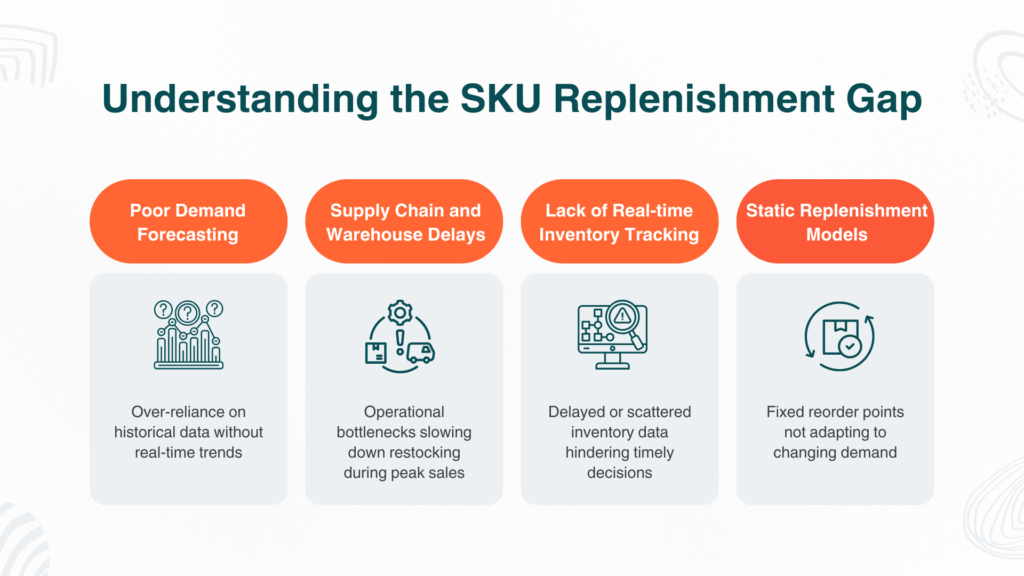
The SKU replenishment gap is usually not caused by a single issue. It is the result of multiple inefficiencies across forecasting, inventory visibility, and supply chain execution, especially during high-demand periods.
- Poor demand forecasting: Many brands rely heavily on historical data without factoring in real-time trends, influencer impact, or sudden demand spikes. This leads to inaccurate predictions at the SKU level.
- Lack of real-time inventory tracking: When inventory data is delayed or scattered across systems, businesses struggle to make timely decisions. This often results in missed replenishment opportunities.
- Supply chain and warehouse delays: During peak sales, operational bottlenecks in warehouses and logistics slow down restocking, leaving fast-moving SKUs unavailable for longer.
- Static replenishment models: Fixed reorder points and safety stock levels do not adapt to changing demand, leading to overstocking of some SKUs and shortages of others.
Business Impact of Poor Replenishment
Poor SKU-level replenishment affects more than just inventory. It directly impacts revenue, customer satisfaction, and operational efficiency across the business.
- Lost sales opportunities: When high-demand SKUs are unavailable, customers either abandon their purchase or switch to competitors.
- Customer dissatisfaction: Stockouts of preferred sizes or styles reduce trust and negatively impact the overall shopping experience.
- Excess inventory of slow-moving SKUs: Overstock ties up capital and often leads to heavy discounting, which impacts profit margins.
- Operational inefficiencies: Teams spend more time managing imbalances and reallocating inventory instead of focusing on growth initiatives.
Strategies to Solve the Replenishment Gap
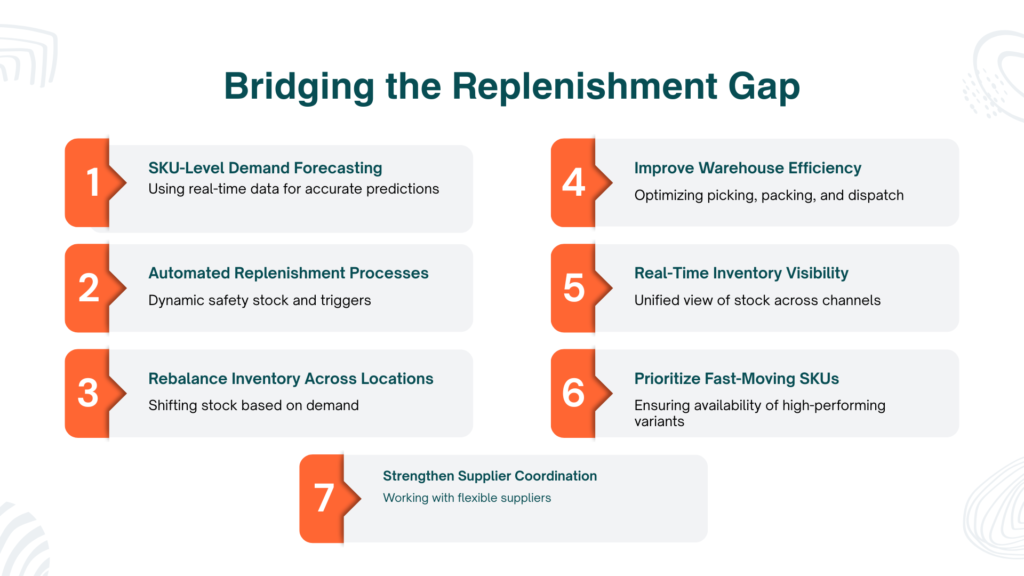
Addressing the replenishment gap requires a more responsive and data-driven approach that aligns inventory with real-time demand patterns.
- Adopt SKU-level demand forecasting: Use real-time data such as browsing behavior and regional demand trends to improve forecasting accuracy.
- Enable real-time inventory visibility: Maintain a unified view of stock across all channels to support faster and better decision-making.
- Automate replenishment processes: Use dynamic safety stock and automated triggers to ensure faster response to demand fluctuations.
- Prioritize fast-moving SKUs: Focus on high-performing variants and ensure their availability during peak periods.
- Rebalance inventory across locations: Shift stock between warehouses based on demand instead of waiting for fresh inventory.
- Strengthen supplier coordination: Work with flexible suppliers who can respond quickly to restocking needs.
- Improve warehouse efficiency: Optimize picking, packing, and dispatch processes to reduce delays in replenishment cycles.
Building a Resilient Apparel Supply Chain
Closing the SKU replenishment gap is essential for building a more responsive and efficient apparel supply chain. When businesses align inventory closely with real-time demand, they not only improve sales performance but also enhance customer satisfaction and reduce excess stock.
A strong replenishment strategy ensures that the right SKUs are available at the right time, leading to better conversions and smoother operations during peak sales. It also helps brands minimize markdowns, optimize inventory movement, and make more confident, data-driven decisions.
Looking ahead, the focus will continue to shift toward automation and predictive analytics. Businesses that invest in smarter systems will be better equipped to handle demand fluctuations and stay competitive in a fast-moving market.
To make this shift easier, solutions like those offered by eShipz help brands automate inventory visibility, streamline replenishment workflows, and respond faster to real-time demand changes. By leveraging such automation, apparel businesses can reduce manual effort, improve accuracy, and ensure consistent SKU availability during critical sales periods.
In the end, success in peak sales comes down to precision. Brands that adopt automation and data-driven replenishment strategies will be the ones that consistently stay ahead.