




The logistics industry is moving faster than ever. Customers now expect accurate delivery timelines, proactive shipment updates, and minimal delays regardless of where their orders are headed. At the same time, supply chains are becoming increasingly complex due to cross-border commerce, multi-carrier operations, rising transportation costs, and frequent disruptions caused by geopolitical issues, weather events, and fluctuating demand.
In this environment, Real-Time Supply Chain Visibility has shifted from being a value-added feature to a business necessity. Mid-size logistics companies, in particular, face growing pressure to deliver enterprise-level service without the extensive infrastructure or budgets of larger competitors. Relying on spreadsheets, manual status updates, fragmented carrier communication, or outdated software creates operational blind spots that directly affect customer satisfaction and profitability.
A recent report by McKinsey’s Global Supply Chain Leader Survey 2024 found that while 60% of companies have improved visibility into tier-one suppliers, deeper supply chain visibility remains a major gap, limiting businesses’ ability to respond quickly to disruptions and operational risks. This reflects a larger market shift where end-to-end transparency is increasingly linked to supply chain resilience, cost optimization, and faster decision-making.
Market Shift: Visibility Is Becoming a Core Logistics Priority
The logistics industry has entered an era where uncertainty is no longer an exception. Port congestion, labor shortages, fuel price fluctuations, customs delays, and changing customer demand patterns have made supply chain management more unpredictable.
At the same time, the rapid growth of eCommerce and omnichannel fulfillment has raised customer expectations significantly. Businesses are no longer judged only on delivery speed. They are also evaluated on transparency throughout the shipping journey.
This has led to a major market trend: logistics companies are investing heavily in systems that provide live shipment updates, inventory visibility, predictive alerts, and centralized operational dashboards.
Real-time visibility is no longer limited to large enterprises with complex global operations. Mid-size logistics companies are now adopting these capabilities to remain competitive, improve service reliability, and reduce operational inefficiencies.
Some of the strongest market drivers behind this shift include:
- Growing demand for same-day and next-day deliveries
- Increased use of multi-carrier shipping strategies
- Expansion into cross-border logistics
- Pressure to reduce transportation costs
- Rising customer expectations for proactive communication
Without a strong visibility framework, mid-size logistics providers risk falling behind both larger competitors and digitally enabled startups.
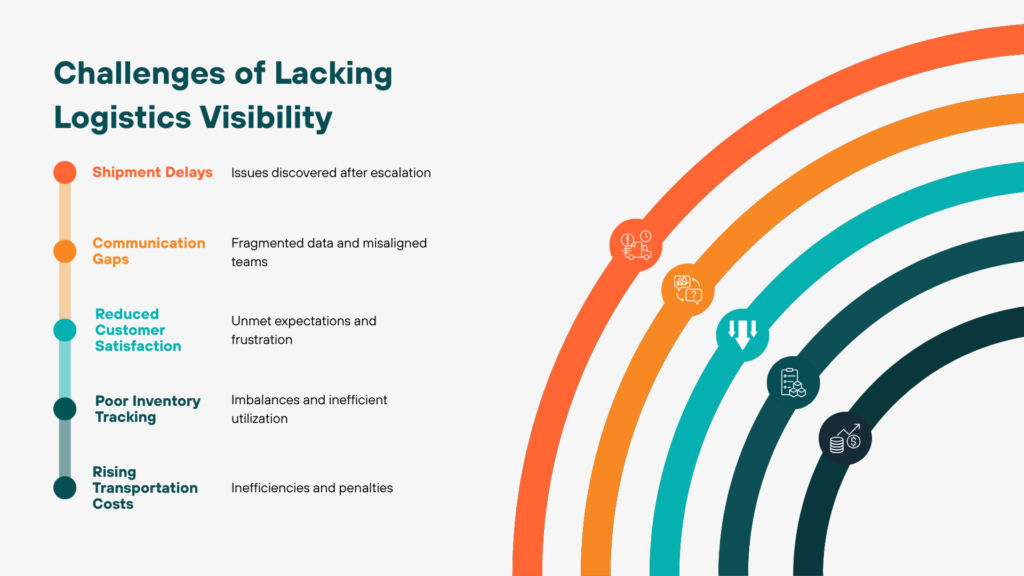
Key Challenges Mid-Size Logistics Companies Face Without Visibility
Lack of visibility creates a chain reaction of inefficiencies that impacts nearly every part of logistics operations.
Shipment Delays and Reactive Issue Management
When shipment data is delayed, inaccurate, or scattered across multiple systems, logistics teams often discover issues only after they have escalated.
A delayed truck, missed scan, customs hold, or route disruption may go unnoticed until a customer raises a complaint. By then, the business is already in reactive mode.
This leads to:
- Delayed deliveries
- Missed SLAs
- Increased exception management workload
- Lower customer trust
Without real-time tracking, teams spend more time chasing updates instead of solving problems proactively.
Poor Inventory Tracking and Stock Imbalances
Inventory visibility remains a major challenge for growing logistics businesses managing multiple warehouses, fulfillment centers, or partner locations.
Limited inventory transparency can cause:
- Overstocking in one location
- Stockouts in another
- Delayed replenishment decisions
- Inefficient warehouse utilization
These issues create unnecessary costs and impact order fulfillment accuracy.
Real-time inventory visibility allows logistics teams to understand stock movement, availability, and replenishment needs instantly, reducing planning errors.
Communication Gaps Across Stakeholders
A typical shipment involves multiple stakeholders including shippers, carriers, warehouse teams, customs agents, and end customers.
When data is fragmented, communication becomes inconsistent. Teams rely heavily on phone calls, emails, spreadsheets, and manual follow-ups.
This creates:
- Information silos
- Duplicate work
- Misaligned teams
- Slow decision-making
Without a centralized source of truth, operational coordination becomes difficult and delays multiply.
Rising Transportation Costs
Transportation costs continue to rise due to fuel volatility, route inefficiencies, detention charges, failed deliveries, and underutilized assets.
Without visibility, companies struggle to identify where money is being lost.
Common cost issues include:
- Inefficient route planning
- Delayed shipments causing penalties
- Poor carrier performance monitoring
- Excessive manual intervention
Real-time insights help logistics teams identify cost leakages early and optimize resource allocation.
Reduced Customer Satisfaction and Retention
Customers today expect more than delivery confirmation. They want continuous shipment updates, accurate ETAs, and early alerts when delays occur.
Without visibility, logistics providers often fail to meet these expectations.
This results in:
- Increased support tickets
- Customer frustration
- Lower retention rates
- Negative brand perception
For mid-size logistics businesses trying to scale, customer experience can quickly become a competitive weakness if visibility is lacking.
The Role of Technology in Enabling End-to-End Supply Chain Transparency
Technology is the foundation of modern supply chain visibility. Real-time data collection, predictive analytics, and centralized platforms are helping logistics companies operate with greater control and agility.
IoT Sensors and Connected Devices
Internet of Things (IoT) devices are widely used to capture live shipment data across transportation networks.
These sensors track variables such as:
- Shipment location
- Temperature
- Humidity
- Shock exposure
- Container movement
This is especially valuable for industries handling pharmaceuticals, perishables, electronics, and high-value goods.
IoT enables logistics teams to monitor shipments continuously rather than relying solely on milestone scans.
GPS Tracking for Live Shipment Monitoring
GPS tracking has become a core component of logistics visibility.
It provides real-time location data for:
- Trucks
- Delivery fleets
- Containers
- Last-mile vehicles
Benefits include:
- Accurate ETAs
- Better route optimization
- Faster delay detection
- Improved fleet utilization
Live GPS data helps logistics providers communicate with customers more confidently while improving operational planning.
AI-Powered Analytics for Smarter Decisions
Artificial intelligence is transforming how logistics companies analyze operational data.
AI can process large datasets to identify patterns, predict disruptions, and recommend actions.
Use cases include:
- Demand forecasting
- Route optimization
- Delay prediction
- Carrier performance analysis
- Risk detection
Rather than reacting to problems after they occur, logistics teams can take preventive action.
For example, AI can flag weather disruptions or recurring route delays before they impact service levels.
Cloud-Based Logistics Platforms
Cloud-based logistics platforms centralize operational data across carriers, warehouses, and fulfillment systems.
Instead of working through disconnected tools, teams gain access to a unified dashboard.
Advantages include:
- Centralized shipment tracking
- Automated workflow updates
- Shared stakeholder visibility
- Improved scalability
- Lower infrastructure costs
Cloud systems are particularly valuable for mid-size logistics companies because they offer enterprise-grade capabilities without large IT overhead.
Predictive Analytics for Proactive Operations
Predictive analytics goes beyond current shipment status by forecasting future risks.
These systems analyze historical and live data to predict:
- Late deliveries
- Inventory shortages
- Capacity issues
- Seasonal demand spikes
This improves planning accuracy and allows logistics teams to allocate resources more effectively.
Companies using predictive analytics are better positioned to maintain service continuity even during disruptions.

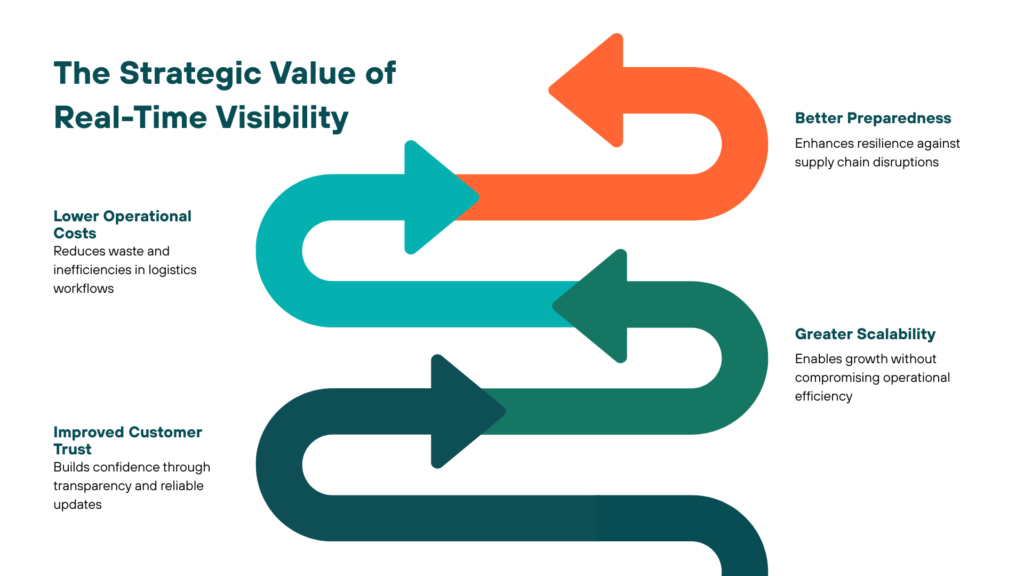
Why Investing in Real-Time Supply Chain Visibility Is a Competitive Advantage
For mid-size logistics companies, visibility is not just an operational improvement. It is a strategic differentiator.
Businesses that invest in visibility solutions gain stronger control over operations while improving service quality.
Improved Customer Trust
Transparency builds confidence.
When customers receive accurate tracking updates, proactive alerts, and reliable ETAs, they are more likely to trust the logistics provider.
This improves:
- Customer retention
- Repeat business
- Long-term partnerships
In competitive logistics markets, trust often becomes a deciding factor.
Lower Operational Costs
Visibility reduces waste across logistics workflows.
By identifying inefficiencies early, businesses can lower costs related to:
- Manual tracking efforts
- Failed deliveries
- Route inefficiencies
- Inventory mismanagement
- Delay penalties
Over time, these savings can significantly improve margins.
Greater Scalability
As logistics businesses grow, operational complexity increases.
Managing larger shipment volumes, additional carriers, warehouse networks, and new geographies becomes difficult without strong visibility systems.
Real-time visibility creates a scalable operational foundation by standardizing data flows and reducing dependency on manual processes.
This allows mid-size logistics companies to grow without operational chaos.
Better Preparedness for Future Disruptions
Supply chain disruptions are no longer rare events.
From geopolitical instability to climate-related disruptions, logistics businesses need resilience built into their operations.
Companies with real-time visibility can:
- Detect disruptions earlier
- Respond faster
- Communicate proactively
- Minimize service impact
This operational resilience will become even more important as supply chains continue to evolve.
Conclusion
The logistics industry is no longer operating in a predictable environment. Customer expectations are rising, supply chains are becoming more interconnected, and disruptions are increasingly common.
For mid-size logistics companies, operating without visibility creates unnecessary risks that impact efficiency, customer experience, and profitability.
Real-Time Supply Chain Visibility enables businesses to move from reactive operations to proactive decision-making. It improves shipment monitoring, reduces inefficiencies, strengthens customer trust, and supports long-term growth.
Companies that adopt visibility-driven logistics strategies today will be far better prepared for tomorrow’s supply chain challenges. In an industry where speed, accuracy, and transparency define success, visibility is no longer optional. It is a competitive necessity.