




Shipping platform decisions are becoming increasingly important as India’s eCommerce market continues to grow rapidly, with industry estimates projecting it could reach $325 billion by 2030. As online shopping expands across the country, customer expectations are rising just as fast.
Today’s shoppers expect quick deliveries, real-time tracking, accurate delivery updates, and hassle-free returns. At the same time, businesses are managing increasing shipping costs, delivery challenges, and growing operational complexity.
This is why choosing the right shipping platform is no longer just a logistics decision, it’s a business decision. The platform you choose can influence everything from delivery performance and customer experience to operational efficiency and profitability.
But with so many options available, how do you know which one is right for your business?
The answer lies in asking the right questions.
In this guide, we’ll explore 15 essential questions every eCommerce business should ask before choosing a shipping platform in 2026, helping you evaluate your options and make a decision that supports long-term growth.
Why Your Shipping Platform Choice Matters More Than Ever
For many eCommerce brands, logistics directly impacts customer experience, repeat purchases, and profitability.
A delayed order, inaccurate tracking update, or failed delivery attempt can quickly erode customer trust. Meanwhile, businesses that automate shipping workflows often gain greater visibility, better carrier management, and improved operational control.
The challenge is that not all solutions are built for the realities of modern eCommerce.
Before deciding, it’s important to evaluate whether the technology can support both your current needs and future growth plans.
15 Questions to Ask Before Choosing a Shipping Platform for Your eCommerce Store in 2026
Choosing a shipping platform in 2026 is about much more than generating labels and dispatching orders. As eCommerce businesses scale across marketplaces, regions, and customer segments, logistics has become a critical driver of customer experience, operational efficiency, and profitability.
The challenge is that not all shipping platforms are built for long-term growth. While some solve immediate shipping needs, they may struggle to support automation, multi-carrier operations, delivery visibility, returns management, and evolving customer expectations. Before making a decision, businesses need to evaluate whether a platform can support both their current requirements and future growth plans.
To help you make an informed choice, here are 15 essential questions every eCommerce brand should ask before selecting a shipping platform in 2026.
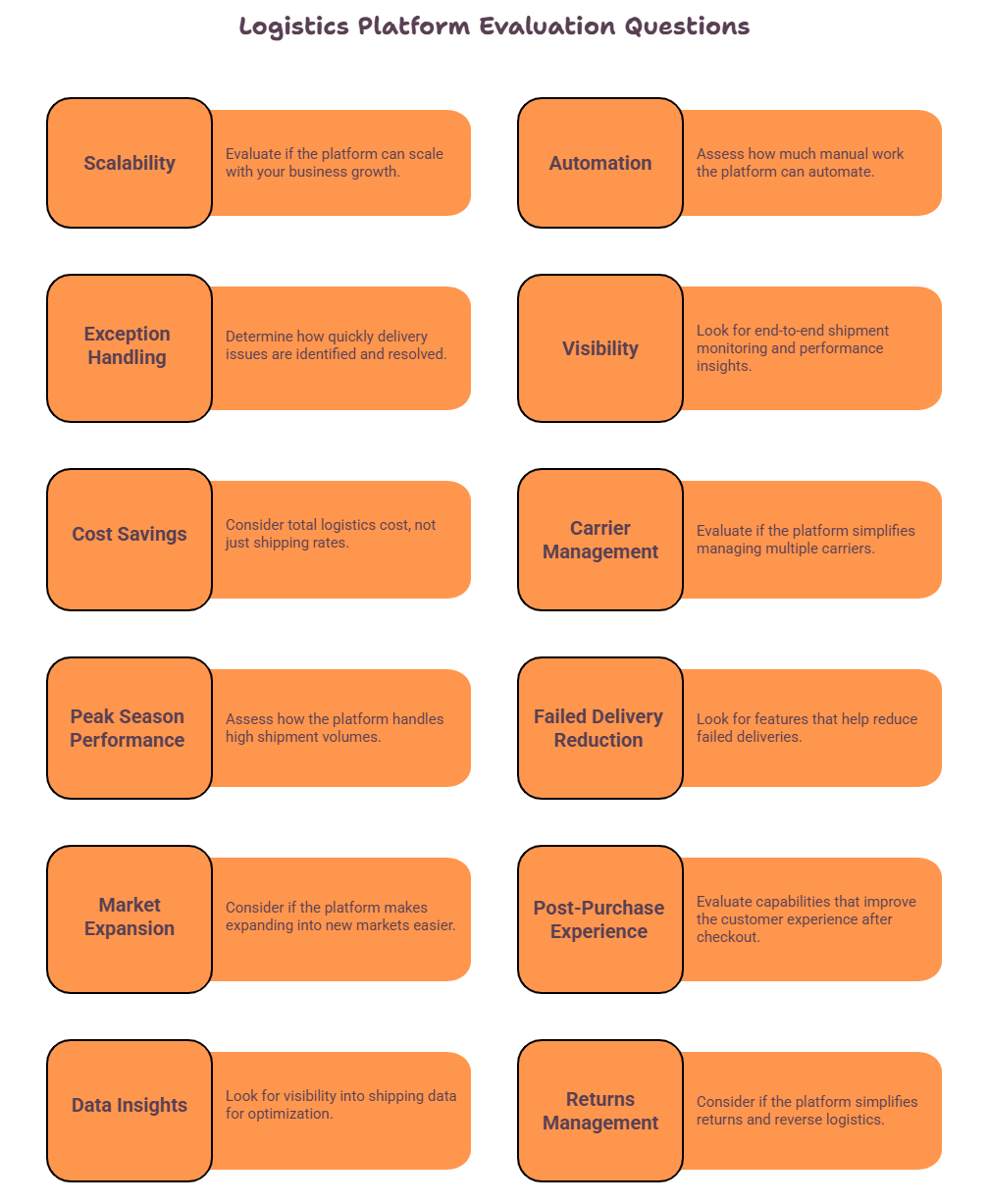
Question 1: Will This shipping platform Still Meet Your Needs Two Years From Now?
Many businesses choose logistics technology based on their current order volumes. But what happens when your business expands into new marketplaces, regions, or product categories?
A solution that works today may become a bottleneck tomorrow. Before deciding, evaluate whether the platform can scale alongside your growth plans.
Look for:
- Multi-warehouse support
- API flexibility
- High-volume shipment processing
The right technology should support your next stage of growth, not limit it.
Question 2: How Much Manual Work Will Your Team Still Be Doing?
Shipping operations often involve repetitive tasks that consume valuable time and resources.
As order volumes increase, manual processes can create delays, errors, and operational inefficiencies.
Evaluate whether the platform can automate:
- Order synchronization
- Carrier assignment
- Tracking updates
- Customer notifications
Automation helps teams focus on strategic priorities rather than routine administrative work.
Question 3: What Happens When Deliveries Don’t Go as Planned?
Every logistics operation experiences delivery exceptions.
The difference lies in how quickly those issues are identified and resolved.
A strong solution should provide:
- Exception alerts
- Delivery status visibility
- NDR management workflows
- Customer communication tools
- Escalation mechanisms
The faster you respond to delivery issues, the better the customer experience.
Question 4: Are You Getting Visibility or Just Tracking Updates?
Tracking links are no longer enough.
Businesses need complete visibility into shipment performance, carrier reliability, and delivery outcomes.
Look for capabilities such as:
- End-to-end shipment monitoring
- Delivery milestone tracking
- Carrier performance insights
- Operational dashboards
- Returns visibility
Better visibility often leads to better decision-making.
Question 5: Is the Lowest Shipping Rate Actually Saving You Money?
Cheaper shipping costs don’t always translate into lower logistics expenses.
Failed deliveries, inefficient processes, and poor customer experiences can create hidden costs.
When evaluating solutions, consider:
- Delivery success rates
- Operational efficiency
- Carrier performance
- Returns handling
- Automation capabilities
Total logistics cost matters more than carrier pricing alone.
Question 6: Can the Platform Support Multiple Carriers Without Creating Complexity?
Depending on a single courier can limit flexibility and increase risk.
A multi-carrier approach allows businesses to optimize delivery performance across different regions and service levels.
Evaluate whether the platform can simplify carrier management rather than complicate it.

Question 7: How Well Does It Handle Peak Season Demand?
Many logistics systems perform well under normal conditions but struggle during festive sales and promotional events.
The real test comes when order volumes surge unexpectedly.
Assess how the platform manages:
- High shipment volumes
- Order spikes
- Carrier capacity challenges
- Fulfillment bottlenecks
Scalability during peak periods can directly impact revenue.
Question 8: Can It Help Reduce Failed Deliveries?
Failed deliveries remain one of the biggest operational challenges in eCommerce.
Without proactive intervention, businesses often face increased costs and dissatisfied customers.
Look for features that support:
- Address validation
- Automated customer communication
- NDR recovery workflows
- Reattempt management
Reducing failed deliveries can significantly improve profitability.
Question 9: How Easy Is It to Expand Into New Markets?
Growth often involves entering new cities, regions, or international markets.
Your logistics technology should make expansion easier, not require additional complexity.
Consider whether the platform supports:
- Cross-border shipping
- Regional carrier networks
- Customs documentation
- Local delivery partners
Expansion should be enabled, not restricted.
Question 10: Does It Improve the Post-Purchase Experience?
Customer expectations continue to rise after checkout.
The delivery journey has become a critical part of brand perception.
Evaluate capabilities such as:
- Branded tracking pages
- Shipment notifications
- Delivery updates
- Customer communication workflows
A strong post-purchase experience can encourage repeat purchases.
Question 11: What Insights Will You Gain From Your Shipping Data?
Data-driven decisions often outperform assumptions.
Without proper reporting, businesses may struggle to identify delivery bottlenecks and carrier performance issues.
Look for visibility into:
- Delivery timelines
- Carrier performance
- Shipping costs
- Return rates
- Failed delivery trends
Analytics can help optimize logistics operations over time.
Question 12: Can It Simplify Returns and Reverse Logistics?
Returns are no longer an afterthought.
A complicated returns process can negatively impact customer satisfaction and operational efficiency.
Consider whether the platform offers:
- Automated return requests
- Reverse logistics workflows
- Return tracking visibility
- Customer self-service options
An efficient returns process benefits both businesses and customers.
Question 13: How Well Does It Integrate With Your Existing Systems?
Disconnected tools create data silos and manual work.
A logistics platform should fit naturally into your broader technology ecosystem.
Assess integration capabilities for:
- eCommerce platforms
- Marketplaces
- ERP systems
- WMS solutions
- CRM platforms
Strong integrations help create a more connected operation.
Question 14: How Reliable Is the Platform Itself?
Technology downtime can impact fulfillment operations, customer communication, and business continuity.
Before choosing a provider, understand:
- Platform uptime
- System reliability
- Security standards
- Data protection measures
- Technical support availability
Reliability is often overlooked until problems arise.
Question 15: If You Had to Make This Decision Again Next Year, Would You Choose the Same Solution?
Perhaps the most important question of all.
A logistics platform should deliver long-term value, not simply solve an immediate challenge.
The right solution should help your business become more efficient, adaptable, and customer-focused over time.
Before making a final decision, step back and evaluate the broader impact the platform will have on your operations, customer experience, and future growth.
Choosing the Right Shipping Platform in 2026
Choosing the right shipping platform is ultimately about how well it supports your business as it grows, not just how it performs today. The right solution should simplify operations, reduce delivery friction, improve visibility, and help you deliver a better customer experience at scale. When you step back and evaluate the 15 questions discussed above, the goal is not just to compare features, but to understand whether the platform can handle real-world complexity across carriers, orders, returns, and customer expectations.
Modern eCommerce brands need more than basic shipping tools, they need a system that brings everything together in one place. Platforms like eShipz are built around this idea, helping businesses streamline shipping operations and improve control across the entire fulfillment journey.
If you’re currently evaluating options, the next step is simple: map these questions to your own operations and see where the gaps are. To explore how this approach can work for your business, you can connect with the team via the contact page.