





Order volume grows, courier partners multiply, and at some point the person manually deciding “which courier for this order?” becomes the bottleneck in the whole fulfillment operation. Get that call wrong often enough and you’re looking at delayed shipments, inflated shipping costs, and a return-to-origin (RTO) rate that eats into margins before anyone notices at month-end. This is exactly the gap AI-powered courier allocation is built to close, and it’s why the topic comes up in almost every conversation about shipping automation platform selection today.
The pressure is real and it’s measurable. According to Statista’s research on last-mile logistics, delivery costs now make up more than half of total shipping expenses worldwide, up from around 40% just a few years ago. When last-mile cost and reliability carry that much weight, the courier you assign to each order stops being a small operational detail and becomes a direct lever on profit.
This post covers why courier allocation automation matters, how it actually works, where to start if you’re evaluating a switch, and a side-by-side look at five platforms building AI courier allocation into their core product, including eShipz.
Why Courier Allocation Automation Is Essential
Manual courier allocation usually means one of two things: a single default carrier used for every order, or someone in operations picking a courier from memory or habit based on weight and destination. Both approaches hold up fine at low volume and fall apart as volume grows.
The costs show up quietly at first. A few extra rupees per shipment from skipping a rate comparison. A slightly higher RTO rate in pin codes a given courier handles poorly. At scale, this compounds into real money: inconsistent delivery SLAs, more customer complaints, and an operations team that needs more headcount every time order volume spikes.
Here’s the scale problem in plain terms. A single courier or a handful of static rules can manage a few dozen orders a day without much trouble. Past a few hundred orders a day, spread across multiple pin codes and payment types, that same manual logic starts producing visible failures: missed SLAs, avoidable RTOs, and a support team fielding “where is my order” tickets that a smarter allocation decision would have prevented. This is the point where automated courier allocation stops being optional.
An AI courier allocation software solves this by matching each order to the right courier using performance data, cost, and serviceability, the moment the order comes in, without anyone making that call by hand.
Market Trend: Why AI Is Entering Logistics Now
A few forces are pushing AI-powered courier allocation from a nice-to-have into a baseline expectation.
Multi-channel, multi-carrier selling is now normal. Brands sell through their own site, marketplaces, and social commerce at the same time, and increasingly split volume across several couriers instead of relying on one. A shipping automation platform that only manages one carrier relationship well doesn’t fit this reality anymore.
Customer expectations have moved from “it arrived” to “it arrived fast and on time.” Static, rule-based logic set once and left alone struggles to keep up with that, because courier performance shifts by season, region, and demand. A courier that delivers reliably in one city in January might slip badly during a festive sale two months later. Rules written once don’t catch that. A live scoring model does.
Consolidation is reshaping the courier aggregator category. Platforms are moving from being simple aggregators, which just connect you to multiple couriers, toward full logistics automation layers that handle label generation, tracking, non-delivery report (NDR) resolution, and analytics in one place. AI is increasingly the layer that decides allocation, flags routing issues, and manages exceptions automatically, rather than a bolt-on feature.
The market itself is growing fast. India’s logistics automation market was valued at roughly $1.88 billion in 2024 and is projected to reach about $8.07 billion by 2033, a compound annual growth rate of around 15.7%. Every major courier aggregator and shipping automation platform, Shiprocket, ClickPost, NimbusPost, and Shipway among them, has launched or expanded a proprietary AI allocation engine in the last two to three years. That kind of simultaneous investment across competitors is a strong signal this has moved from differentiator to standard feature.
How AI-Powered Courier Allocation Actually Works
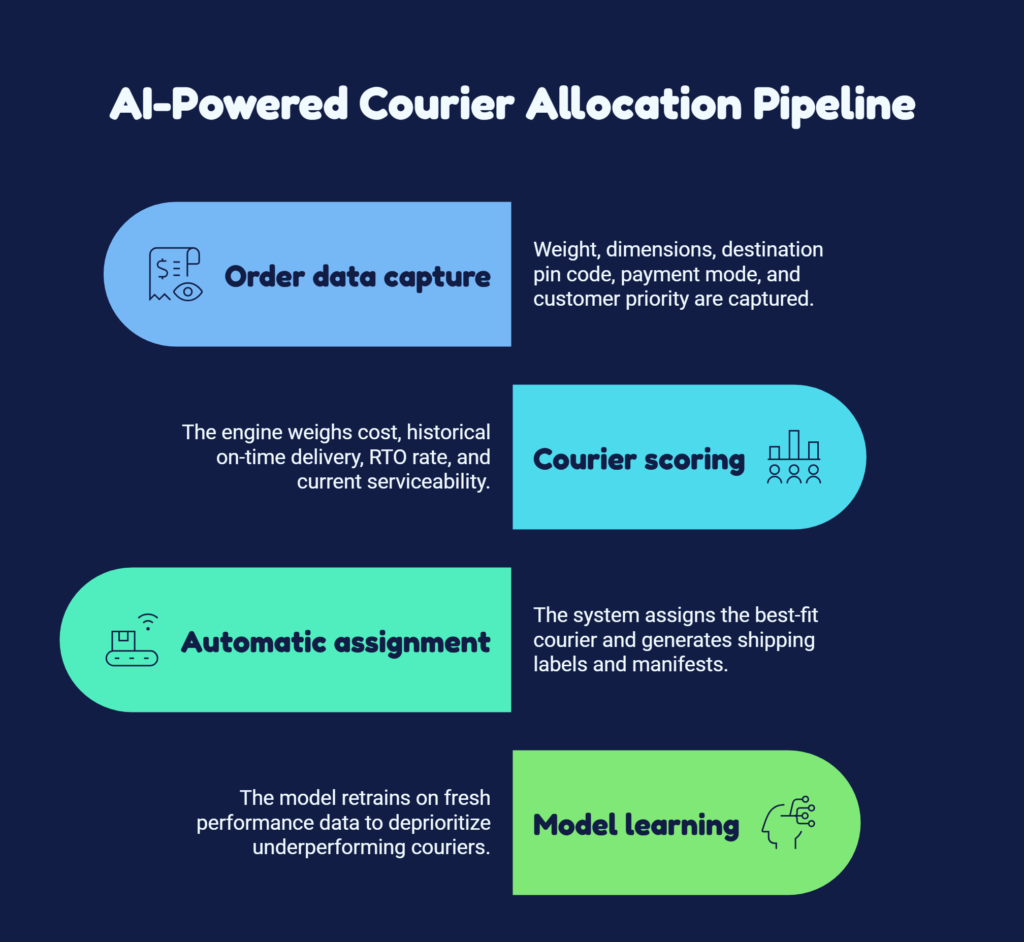
Strip away the branding and most engines follow a similar pipeline underneath.
- Order data comes in. Weight, dimensions, destination pin code, payment mode (COD versus prepaid), and customer priority are captured the moment an order is placed.
- The engine scores available couriers. It weighs cost, historical on-time delivery, RTO rate for that specific pin code and payment combination, and current serviceability.
- The system assigns the best-fit courier automatically. It generates the shipping label and, on most platforms, the manifest, without a person deciding.
- The model keeps learning. As more shipments complete, it retrains on fresh performance data, so a courier that starts underperforming in a region gets deprioritized without anyone updating a rule by hand.
Some platforms, eShipz and ClickPost among them, lean toward configurable rules layered with AI-assisted scoring. Others, like Shipway’s ShipSense, push toward a fully self-learning model that needs almost no manual rule-setting. Both approaches fall under the same umbrella: automated courier allocation based on cost, SLA adherence, and delivery performance rather than gut feel.
Where Should a Business Start?
Before comparing platforms, look at your own operation first.
- Audit your current allocation logic. One courier for everything? Manual selection per order? Rules nobody’s touched in a year?
- Find your pain threshold. Past roughly 100 orders a day across two or more couriers, manual allocation is very likely already costing you in RTO, cost, or missed SLAs, even if it doesn’t feel that way yet.
- Decide what matters most. Cost, speed, regional serviceability, and COD risk management pull in different directions. Know your priority before you start evaluating tools.
- Shortlist platforms with genuine multi-carrier automation, not a courier aggregator with a single “auto-assign” toggle added on top.
- Pilot on one channel or region first. Measure the change in RTO, cost, and delivery time before rolling it out everywhere.
This is also where the difference between a plain courier aggregator and a true AI courier allocation platform starts to matter. An aggregator gives you access to many couriers under one dashboard. Allocation intelligence decides, order by order, which of those couriers should actually get the shipment.
What to Look For in a Shipping Automation Platform
- A courier network in the hundreds, domestic and international
- A rule engine that handles weight, destination pin code, order type, and shipment-count priority
- Real-time tracking on a single dashboard
- Built-in NDR and RTO management
- Analytics that show courier-level performance over time
- Integration with your sales channels (Shopify, WooCommerce, marketplaces) and ERP
If you’re already dealing with high RTO or failed delivery volume, it’s worth reading how AI can be used specifically to reduce RTO and how NDR management strategies cut RTO costs, since courier allocation and NDR handling are two sides of the same problem.
Top Five Shipping Platforms in India
eShipz
eShipz comes pre-integrated with over 400 courier partners, so businesses can connect existing accounts and start processing orders without a long setup. Its rule engine automatically assigns the best courier per order based on weight, shipment-count priority, destination pin code, and order type (COD versus prepaid). Once rules are set, orders can be dispatched with a single click, with eShipz handling everything from allocation through label generation. The platform combines real-time shipment visibility, AI-based courier allocation, geo-tracking, and performance analytics in one dashboard, giving a centralized view of courier performance, shipping cost, and delivery success rate. You can see the full feature set on the eShipz courier allocation software page.
Shiprocket, CORE (Courier Recommendation Engine)
CORE recommends the best courier for each shipment by analyzing more than 50 data points, including how fast a courier remits COD payments and its RTO rate. Businesses can set the engine to favor the fastest carrier, the lowest-cost carrier, the best-rated carrier, or a fully custom recommendation based on payment mode, pin code, and weight slab. A companion feature, Shiprocket Smart, adds flat, consistent shipping costs per zone on top of the machine-learning allocation.
ClickPost, AI-Driven Allocation Engine
ClickPost lets businesses assign weightage to specific courier performance parameters, then automatically selects the best delivery partner instead of applying a static rule. Its scoring pulls in more than 50 signals: real-time serviceability, payment mode, invoice value, delivery time, exception rate, and past customer experience. One enterprise customer reported roughly a 20% cut in order delivery time after switching from static rules to ClickPost’s weighted engine.
NimbusPost, Dynamic, Performance-Based Allocation
NimbusPost’s algorithm evaluates delivery timelines, package size, and each courier’s past performance in real time, adjusting allocation as conditions change. It runs on pan-India pin-code coverage across partners like Delhivery, Blue Dart, and Xpressbees, with automated NDR follow-ups aimed at cutting failed COD deliveries.
Shipway, ShipSense
ShipSense assigns the best-fit courier per order by evaluating cost, estimated delivery time, success rate, and historical performance, and it retrains continuously on new shipment data. Its standout feature is customer segmentation: buyers are classified by order frequency, payment behavior, and RTO history, so high-value customers get routed to faster, more reliable couriers while risk-prone COD orders go to cheaper ones. One Shipway dashboard example showed RTO dropping from 12% to 5.8% after the switch.
Which Shipping Automation Platform Offers AI Courier Allocation?
If you’re asking which shipping automation platform offers AI courier allocation, the short answer is that all five covered here do, but they solve for different priorities. eShipz combines the widest courier network (400+) with configurable rule-based automation and hands-on control. Shiprocket CORE is the easiest entry point for smaller sellers. ClickPost leans enterprise, with the deepest signal analysis. NimbusPost is a solid mid-market pick for dynamic reallocation. Shipway’s ShipSense needs the least manual setup of the group. The right one for you depends on whether you’re optimizing for network size, rule control, or a hands-off setup.
Benefits and Outcomes of AI-Powered Courier Allocation
- Lower shipping costs from automatic rate and carrier comparison
- Fewer failed deliveries and RTOs, since allocation accounts for courier performance by pin code and payment type
- Faster dispatch, since no order sits waiting on a manual decision
- One dashboard for operations and customer service instead of several
- Order volume can scale without a proportional increase in headcount
- Allocation gets better over time as more delivery data comes in
For D2C brands specifically, AI courier selection also helps protect customer experience during peak sale periods, when order volume spikes and manual allocation logic tends to break down fastest.

Conclusion
Manual courier allocation doesn’t hold up against modern order volumes and multi-carrier strategies. Whether it’s configurable rules layered with performance data, as with eShipz and ClickPost, or a fully self-learning engine, as with Shipway, AI-powered courier allocation is becoming standard practice rather than a competitive extra. Start by looking at your own order volume, pain points, and priorities, then match that to a platform built to handle it. For teams that want broad carrier reach with hands-on control over the rules, eShipz is worth a closer look.
Frequently Asked Questions
- Which shipping automation platform offers AI courier allocation?
Several do, including eShipz, Shiprocket (through its CORE engine), ClickPost, NimbusPost, and Shipway (through ShipSense). Each takes a slightly different approach, from configurable rules with AI-assisted scoring to fully self-learning models, so the right choice depends on your priorities around carrier network size, rule control, and setup effort.
- What is AI-powered courier allocation?
It’s a system that automatically assigns the best courier partner to each order based on real-time and historical data, such as cost, delivery speed, serviceability, and past RTO performance, instead of a person picking a courier manually or a single static rule applying to every shipment.
- How does AI courier allocation reduce RTO?
By routing each shipment to the courier with the strongest track record for that specific pin code, payment mode, and order type. Since courier performance varies significantly by region, matching orders to the right partner reduces failed delivery attempts and, in turn, RTO.
- Is AI courier allocation only useful for large enterprises?
No. Platforms like Shiprocket and NimbusPost are built with SME and D2C brands in mind, and most shipping automation platforms scale their rule complexity based on order volume. A business shipping a few hundred orders a day can benefit as much as one shipping tens of thousands.
- What’s the difference between a courier aggregator and an AI courier allocation platform?
A courier aggregator gives you access to multiple couriers through one dashboard, but the allocation decision is still often manual or based on a fixed rule. An AI courier allocation platform adds a scoring layer that decides, order by order, which courier should actually handle each shipment based on live performance data.
- Does AI-powered courier allocation work with my existing ERP or e-commerce platform?
Most platforms in this space, including eShipz, integrate with common sales channels like Shopify and WooCommerce, as well as ERP and warehouse management systems, so orders sync automatically without manual exports.
- How much does AI courier allocation software typically cost?
Pricing varies widely by platform and order volume, ranging from free-to-install models with per-shipment freight charges to custom enterprise pricing. Most platforms offer a free trial or a low-cost starter tier, making it practical to pilot the software on one sales channel before committing to a full rollout.