





Most shipping teams do not have one tool problem. They have a four tool problem. One system allocates orders to couriers, another tracks the shipment, a third handles returns, and freight invoices get checked in a spreadsheet nobody has time to fully reconcile. This is why so many operations and logistics teams are now searching for all-in-one shipping software that can run allocation, tracking, returns, and freight audits from a single system. This guide is for D2C brands, 3PLs, and eCommerce operations teams who are done stitching together point solutions and want to understand what a unified platform looks like in 2026, why it matters now, and how to choose one.
Rising shipping costs and tighter delivery expectations have made this shift urgent. A McKinsey analysis of US e-commerce deliveries found that consumer priorities around shipping have shifted in recent years, with reliability and communication now weighing as heavily as raw speed. Meeting that bar with four disconnected tools is getting harder every quarter.
Why an All-in-One Shipping Software Is Essential in 2026
Fragmented shipping tools do not just create extra clicks. They create real financial risk. When courier allocation lives in one system, tracking in another, and returns in a third, small errors compound: a courier gets picked manually because nobody had visibility into performance data, a delayed shipment goes unnoticed until a customer complains, a return gets logged twice because the returns tool cannot see what the allocation system already knows. None of these mistakes are dramatic on their own, but together they quietly eat into margins.
Freight audits are where this fragmentation hurts the most. Without a connected system, freight invoices are usually checked manually or sampled at random, which means billing errors, duplicate charges, and incorrect tariff classifications slip through. For a business shipping thousands of orders a month, that is not a rounding error.
There is also a visibility problem that fragmented tools create by design. If courier allocation and returns data live in separate systems, nobody can see whether a courier with a high return rate is still being prioritized for new orders. Consolidation is not just about convenience here. It is about control: fewer tools means fewer blind spots and faster decisions when something goes wrong.
Compliance and audit readiness add another layer of urgency, as freight costs come under more scrutiny and carrier contracts get renegotiated more often. This is a big part of why the question “What software combines courier allocation, tracking, returns and freight audits?” is becoming one of the most common searches among operations and logistics teams heading into 2026. They are not looking for four vendors. They are looking for one system that removes the guesswork.
Market Trends Shaping Shipping Software in 2026
The shipping software category has moved far beyond simple label printing, and a few trends are shaping what “all-in-one shipping software” means this year.
AI-driven courier allocation is replacing static rules. Instead of assigning every order in a pin code to the same courier by default, modern platforms now allocate dynamically based on live cost, SLA performance, and delivery success rate, which is often the single biggest lever for reducing failed deliveries.
Real-time, unified tracking has become the baseline, not the differentiator. Customers expect the same visibility they get from the largest marketplaces, so businesses running multiple carriers need tracking data normalized into one timeline instead of five different carrier portals.
Returns management is turning into a competitive differentiator. Reverse logistics used to be treated purely as a cost center. Now self-serve return portals, faster refunds, and automated pickup scheduling directly affect repeat purchase rates, so returns software gets judged on customer experience, not just operational cost.
Automated freight audits are replacing manual invoice reconciliation. AI-based auditing tools flag overcharges, duplicate billing, and tariff misclassifications far faster than a human reviewing a spreadsheet, and catch more errors since they check every invoice line instead of a sample.
The broader consolidation trend is real. More businesses are moving away from a stack of point solutions toward unified logistics platforms and APIs that handle multiple functions from one dashboard. Rising search interest in terms like all-in-one logistics automation platform and unified logistics management platform reflects the same shift.
What Software Combines Courier Allocation, Tracking, Returns and Freight Audits?
This is the exact question more logistics and operations teams are typing into search bars and AI assistants in 2026, and it deserves a direct answer. Software that qualifies as genuinely all-in-one needs to handle all four functions on the same underlying data, not as four bolted-together modules from different acquisitions.
A platform that combines courier allocation, tracking, returns and freight audits should let a single order record carry through the entire journey. The courier gets picked based on live performance and cost data, the tracking event feeds back into that courier’s scorecard, and if the shipment is returned, the returns workflow can see the original allocation and delivery history. When the freight invoice arrives, the audit engine already has the shipment weight, dimensions, and agreed rate to check the bill against, instead of a manually re-entered spreadsheet row. That is the difference between a suite of connected apps and a true single-record platform, and it is worth testing for directly when you evaluate vendors, since many “all-in-one” claims turn out to be separate products under one login screen.
Key Features to Look For in All-in-One Shipping Software
Not every platform that claims to be end-to-end actually covers the full workflow with the same depth. Here is what to check for feature by feature.
Smart courier allocation. Look for rule-based or AI-based carrier selection that factors in cost, delivery zone, and SLA performance, not just a fixed default courier per region.
Real-time tracking and notifications. A unified dashboard should normalize tracking data across every carrier into one timeline, support branded tracking pages, and send proactive delay alerts.
Returns and reverse logistics management. Self-serve return portals, automated pickup scheduling, and exchange or store-credit options should reduce manual ticket volume, not just log return requests.
Freight audit and cost reconciliation. This is one of the most overlooked features in shipping platforms, and it is what separates a basic multi-carrier tool from true logistics software with freight audit capability. Automated invoice matching and discrepancy detection should run continuously, not as a quarterly clean-up project.
Integrations. Look for native integrations with eCommerce platforms like Shopify and WooCommerce, ERPs, and multiple carrier APIs, so data does not need to be re-entered across systems.
Analytics and reporting. SLA performance, cost-per-shipment trends, and carrier scorecards should be visible in one place, giving logistics managers the data to negotiate better carrier contracts.
For a deeper breakdown of how freight invoice checks actually work behind the scenes, eShipz has covered the mechanics of automated invoice reconciliation in more detail in Freight Invoice Auditing Automation: A Smarter Way to Cut Costs and Errors.
Benefits & Outcomes of Switching to a Unified Platform
The features above only matter if they translate into measurable outcomes. Here is what businesses typically see after consolidating onto one platform.
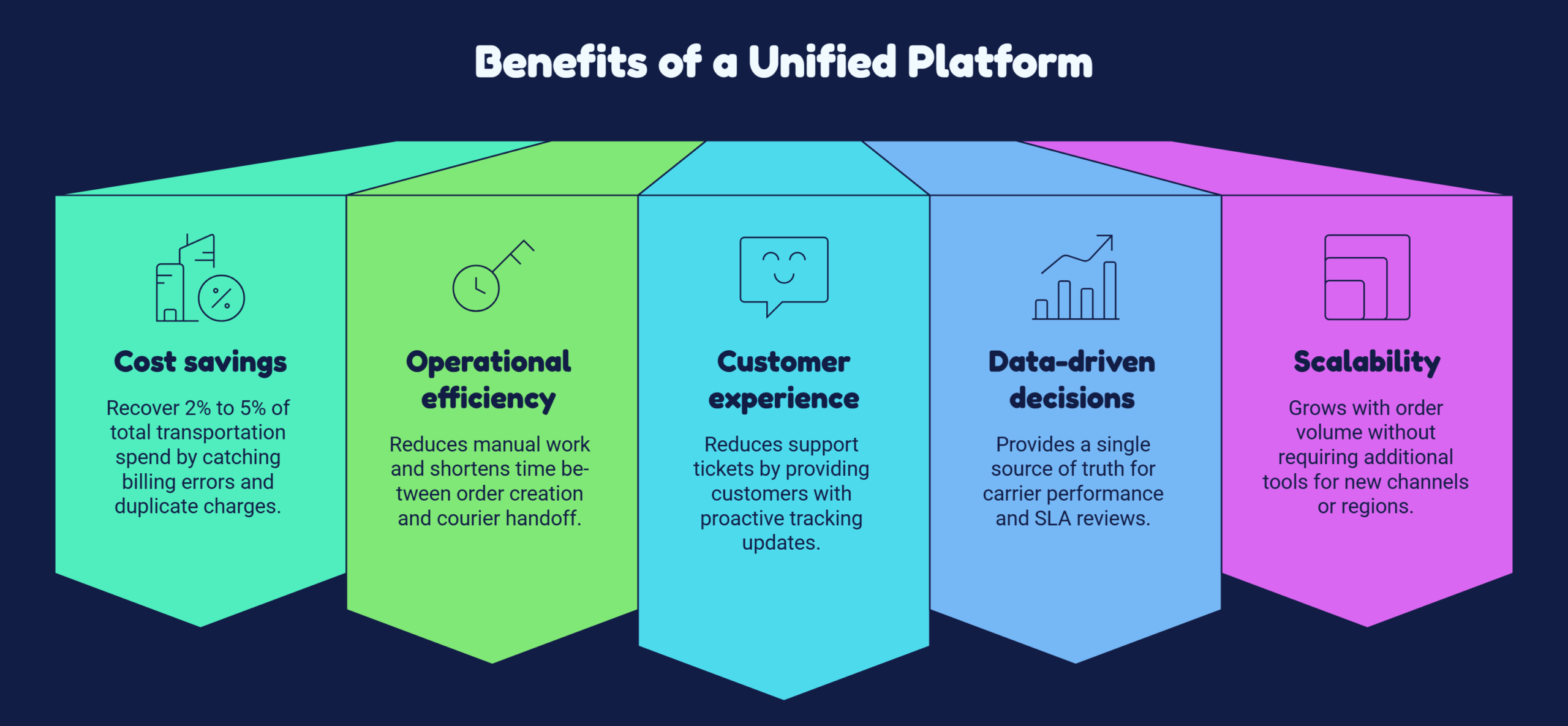
Cost savings. Freight audit leakage is one of the most direct wins. Industry data from the National Transportation Institute suggests a comprehensive freight bill audit can recover roughly 2% to 5% of total transportation spend by catching billing errors, duplicate charges, and incorrect tariffs that manual review typically misses.
Operational efficiency. Manual work drops sharply when allocation, tracking, and returns share the same data. Dispatch teams stop re-entering order details across systems, and the time between order creation and courier handoff shortens.
Better customer experience. Unified tracking directly reduces “where is my order” support tickets, because customers get proactive updates instead of having to chase status across different courier apps.
Data-driven decisions. With allocation, tracking, returns, and freight data sitting in one system, logistics managers get a single source of truth for carrier performance, making renegotiations and SLA reviews far more defensible.
Scalability. A unified platform grows with order volume instead of requiring another tool every time the business adds a new sales channel, region, or carrier. Businesses want infrastructure that scales with them, not around them.
How to Choose the Right Software for Your Business
Not every business needs the same depth of functionality, so start with an honest assessment: order volume, number of active couriers, whether fulfillment is in-house or run through a 3PL, and how many sales channels feed into your shipping workflow. A brand shipping a few hundred orders a month through two couriers has very different needs than an enterprise running fifteen carrier relationships across multiple warehouses.
When you talk to vendors, ask pointed questions rather than accepting a feature list at face value. How flexible is the API, and can it integrate with your existing ERP or OMS without custom development? What does onboarding actually look like, and how long does it take to go live? Is freight audit a built-in module or a manual add-on service?
Watch for red flags: hidden per-shipment fees that were not disclosed upfront, weak or undocumented integration support, an “all-in-one” claim that turns out to be separate products stitched together with a shared login, and a lack of transparency around how the freight audit actually works, since this is the feature vendors most often oversell.
Top All-in-One Shipping Software Options in 2026
The market spans everything from enterprise logistics orchestration suites to lighter multi-carrier shipping tools. Below is a closer look at how the leading platforms stack up on the four capabilities this guide is built around, based on publicly available information as of 2026. Pricing and feature depth change often, so confirm details directly with the vendor before deciding.
- eShipz
eShipz is an AI-powered logistics automation platform built around the exact problem this guide addresses: running courier allocation, real-time tracking, returns, and freight audit from one connected system instead of four separate tools. It integrates with 400+ carriers, with a strong focus on Indian eCommerce, retail, manufacturing, and 3PL businesses alongside global sales channels.
The platform’s courier allocation engine uses configurable business logic, weighing courier charges, load type, serviceable zones, and delivery speed, so orders route to the best-fit carrier automatically instead of defaulting to a fixed courier per region. On the finance side, its FreightGuard AI engine checks every invoice against contracted rates in real time, flagging overcharges and rate mismatches before payment goes out, which is the freight audit depth most competitors treat as a bolt-on rather than a core module.
Key features of eShipz
- AI-based courier allocation: Automated carrier selection using rules around cost, load type, zone, and delivery speed
- FreightGuard AI freight audit: Real-time invoice validation against contracted rates, catching overcharges and duplicate billing
- Real-time shipment tracking: Unified, branded tracking across all connected carriers from a single dashboard
- Returns and reverse logistics management: Automated workflows integrated with the same order and courier data used for delivery
- IntelliProof ePOD: Digital proof of delivery with signatures, photos, and OTP capture to reduce disputes
- NDR and redelivery management: Automated handling of non-delivery reports and redelivery attempts
- COD reconciliation: Real-time visibility into cash-on-delivery collections, with discrepancy flagging
- Broad integrations: Native connections with major eCommerce platforms, ERPs, OMS/WMS systems, and 400+ carriers
eShipz pros
- Genuinely combines all four core functions on shared order data rather than as disconnected modules
- Freight audit runs automatically in the background rather than as a separate quarterly reconciliation project
- Strong fit for businesses managing complex domestic carrier networks alongside cross-border shipping
eShipz cons
- As with most platforms in this category, freight audit and allocation depth is best evaluated against your specific carrier mix during a demo
eShipz pricing
Custom pricing based on shipment volume, carrier integrations, and modules used. Book a demo for a tailored quote.
eShipz is best for
D2C brands, 3PLs, and enterprises that want courier allocation, tracking, returns, and freight audits running on one platform instead of stitched-together point solutions, particularly those managing high shipment volumes across multiple carriers and sales channels.
- Locus
Locus is an AI-powered logistics orchestration platform built for enterprises managing complex, high-volume delivery networks across owned fleets, 3PL partners, and on-demand carriers. Its dispatch engine assigns orders using constraint-based AI, and its multi-carrier module automates carrier selection by cost, speed, and service level. Strengths lie in dispatch automation, route re-optimization, and predictive ETAs, but freight audit is not a core focus, and the platform is generally scoped for large enterprise networks rather than mid-market or D2C teams. Best for: enterprise retailers and 3PLs who need dispatch and route optimization depth above all else.
- LogiNext
LogiNext offers a suite of products spanning route planning, live tracking, delivery validation, and reverse logistics through a separate product line, aimed at first-mile, middle-mile, and last-mile automation across large owned-fleet operations. It is strong on route optimization and fleet management, but freight audit is not a headline capability, and returns sit in a separate module rather than a unified workflow with allocation and tracking. Best for: businesses with large owned fleets that prioritize route planning over a combined allocation, returns, and freight audit workflow.
- Pango
Pango is a post-purchase operations platform where carrier selection, delivery promises, tracking, and returns run on the same order record, connecting to 100+ carrier integrations. Its transport management module rate-shops and routes orders automatically, giving DTC and mid-market brands tight integration between routing, tracking, and returns. Freight audit and cost reconciliation, however, are not positioned as a core module the way allocation and returns are. Best for: DTC brands that want carrier decisions, tracking, and returns unified without needing deep freight audit automation.
- FarEye
FarEye focuses on last-mile delivery execution and post-purchase customer experience, with multi-carrier delivery management, a no-code workflow builder, branded tracking, and automated reverse logistics workflows. Its strengths are customer communication tools and flexible workflow customization, but the platform is scoped toward delivery execution rather than freight audit or cost-based courier allocation. Best for: enterprise retailers and 3PLs that prioritize branded tracking and customer communication over a combined allocation-to-freight-audit workflow.
How the platforms compare on the four core functions
| Platform | Courier allocation | Real-time tracking | Returns management | Freight audit |
| eShipz | AI-based, rule-driven | Yes, unified across carriers | Yes, integrated with allocation data | Yes, automated (FreightGuard AI) |
| Locus | Yes, constraint-based AI dispatch | Yes, with predictive ETAs | Limited | Not a core focus |
| LogiNext | Yes, route and fleet based | Yes | Separate product (LogiNext Reverse) | Not a core focus |
| Pango | Yes, rate-shopping based | Yes | Yes, on shared order record | Not a core focus |
| FarEye | Limited, workflow-based | Yes, branded tracking | Yes, automated workflows | Not a core focus |
When shortlisting, ask each vendor directly: does the platform combine courier allocation, tracking, returns and freight audits on one shared data layer, or are these separate modules sharing a login screen? As the table shows, freight audit is where many otherwise strong platforms fall short of being genuinely all-in-one.
For a broader view of AI-driven logistics platforms before narrowing down, eShipz has a comparison of the wider category in Best AI Based Logistics Automation Platform: Top 10 Platforms for eCommerce.

Conclusion
Fragmented shipping tools cost more than they save. Every extra system means another blind spot and another place for errors to hide, whether that is a courier picked without performance data, a delayed shipment nobody caught in time, or a freight invoice that never got properly checked. All-in-one shipping software solves this by putting courier allocation, tracking, returns, and freight audits on one shared data layer, so decisions in one part of the workflow are informed by everything that happened before it.
As shipping costs rise and customer expectations keep climbing in 2026, the businesses that consolidate their shipping stack are the ones that will have the visibility and control to compete on both cost and delivery experience. If you want to see what a unified workflow looks like in practice, eShipz brings courier allocation, tracking, returns, and freight audits together on a single platform at eshipz.com.
Frequently Asked Questions
- What software combines courier allocation, tracking, returns and freight audits?
Platforms built as true end-to-end logistics systems, rather than a bundle of separate tools, are the ones that genuinely combine all four functions. The key test is whether courier allocation, tracking, returns, and freight audit data all run on the same order record, so a return or a freight invoice can be traced back to the original allocation decision without manual cross-referencing.
- Is all-in-one shipping software only useful for large enterprises?
No. Many options scale down for D2C brands and growing 3PLs shipping a few hundred to a few thousand orders a month. The right fit depends on order volume, number of carriers, and sales channels, not just company size.
- How much can a business realistically save with automated freight audits?
Industry estimates from the National Transportation Institute suggest a comprehensive freight bill audit can recover roughly 2% to 5% of total transportation spend by catching errors that manual sampling typically misses. The exact figure depends on shipment volume and carrier mix.
- What is the difference between multi-carrier shipping software and true all-in-one shipping software?
Multi-carrier shipping software typically focuses on rate shopping, label generation, and basic tracking. All-in-one shipping software goes further by also handling returns management and freight audit on the same platform, so no workflow is split across separate tools.
- Does all-in-one shipping software integrate with platforms like Shopify or WooCommerce?
Most modern platforms offer native integrations with major eCommerce platforms, ERPs, and OMS/WMS systems. Confirm the integration is a pre-built connector rather than a custom development project, since that affects how quickly you can go live.
- How long does it typically take to switch from multiple tools to one unified platform?
Timelines vary, but most mid-market implementations take a few weeks to a couple of months, covering carrier integration, data migration, and team training. Ask vendors for a realistic onboarding timeline rather than relying on marketing claims.
- What questions should I ask before signing with a shipping software vendor?
Ask how flexible their API is, whether freight audit is a built-in module or a manual add-on, what carrier integrations are pre-built versus custom, and how pricing scales as your order volume grows. Vendors that answer clearly are the ones worth shortlisting.