




If you sell on Shopify, getting your products in front of shoppers on Google is one of the highest-leverage things you can do, and that is exactly why the search for the best 10 Shopify Google Shopping apps has become so common among store owners this year. Google Shopping connects your catalog to shoppers who are actively comparing prices, checking availability, and ready to buy, and Shopify merchants use dedicated apps to keep that connection accurate. Shopify’s own Google and YouTube channel can sync your catalog automatically, but as catalogs grow or merchants expand into new markets, many turn to specialized feed-management apps for more control.
Google Shopping itself is evolving quickly. According to Shopify’s guide on Google’s AI shopping features, AI Mode now shows curated product panels and summaries instead of the plain list of links shoppers used to scroll through, which means the quality of your product feed matters more than ever before.
In this guide, we will explore the 10 best Shopify Google Shopping apps in 2026, comparing their key features, pricing, ideal use cases, and how they can help merchants improve product visibility and feed management.
Why Are Google Shopping Apps Essential for Shopify Stores?
A Google Shopping app is not simply an “ad app.” It is primarily a product-feed and catalog-management tool that sits between your Shopify store and Google Merchant Center. Shopify’s native Google and YouTube channel automatically syncs product information such as titles, prices, images, and availability with Merchant Center, and for many small stores that is enough to get started.
Once catalogs grow past a few hundred SKUs, or once a merchant starts selling in more than one country, the manual work involved in keeping a feed clean becomes harder to manage without extra tools. That is where dedicated Google Shopping apps step in. They typically help with:
- Connecting Shopify products with Google Merchant Center without manual file uploads
- Automatically syncing price, availability, titles, images, and descriptions as they change
- Reducing the hours spent on manual feed management every week
- Identifying and resolving product-feed errors and disapprovals before they hurt visibility
- Optimizing product titles, descriptions, categories, and attributes for better matching
- Supporting multiple countries, currencies, and languages from one dashboard
- Helping products qualify for free listings and paid Shopping campaigns
- Improving the overall quality of product data used across Google’s shopping ecosystem
What Problems Can a Google Shopping App Solve?
Most merchants who install a Google Shopping app are trying to fix one or more of the following:
- Manual product-feed updates that eat up hours every week
- Incorrect or incomplete product information that Google rejects
- Repeated Google Merchant Center disapprovals with unclear reasons
- Difficulty managing large or fast-changing catalogs
- Complex multiple-country feed management for global sellers
- A lack of flexibility to customize feeds for different campaigns
- Weak product attribute optimization that hurts ad relevance
What Does the Google Shopping Market Trend Say in 2026?
Google Shopping in 2026 is no longer just about traditional product ads sitting next to a search result. Google has been folding Shopping data into AI-powered product discovery, conversational shopping, AI Mode, Gemini, and increasingly agentic commerce experiences. As Shopify explains, Google’s AI shopping experiences depend on the structured data on your product pages as well as the titles, descriptions, and images in your listings, using all of it to match products to what a shopper is actually looking for.
AI Is Changing How Consumers Discover Products
Shoppers are increasingly moving away from short, keyword-style searches and toward natural, conversational questions. Instead of typing “women’s waterproof hiking jacket,” a shopper today might ask an AI shopping assistant for a lightweight jacket that works for a rainy weekend trek. This shift makes descriptive, well-structured product data far more valuable than it used to be, because the system has to understand nuance, not just match keywords.
Product Data Quality Is Becoming More Important
Titles, descriptions, identifiers, categories, pricing, availability, and images all help Google understand what a product actually is and who it is for. This matters even more now because Merchant Center feeds effectively power Google’s Shopping Graph, which in turn supports newer AI-driven experiences. Feed quality has quietly turned into an AI visibility asset, not just an advertising requirement.
Automation and AI-Powered Feed Optimization Are Growing
Many newer feed-management apps have moved beyond simple syncing and now offer AI-assisted product-feed optimization, automated attribute mapping, feed-error monitoring, bulk editing, rule-based automation, product scoring, and multichannel feed distribution. This trend is one reason the search for the best 10 Shopify Google Shopping apps keeps growing every year, as merchants look for tools that do more than basic syncing.
Who Can Benefit From Shopify Google Shopping Apps?
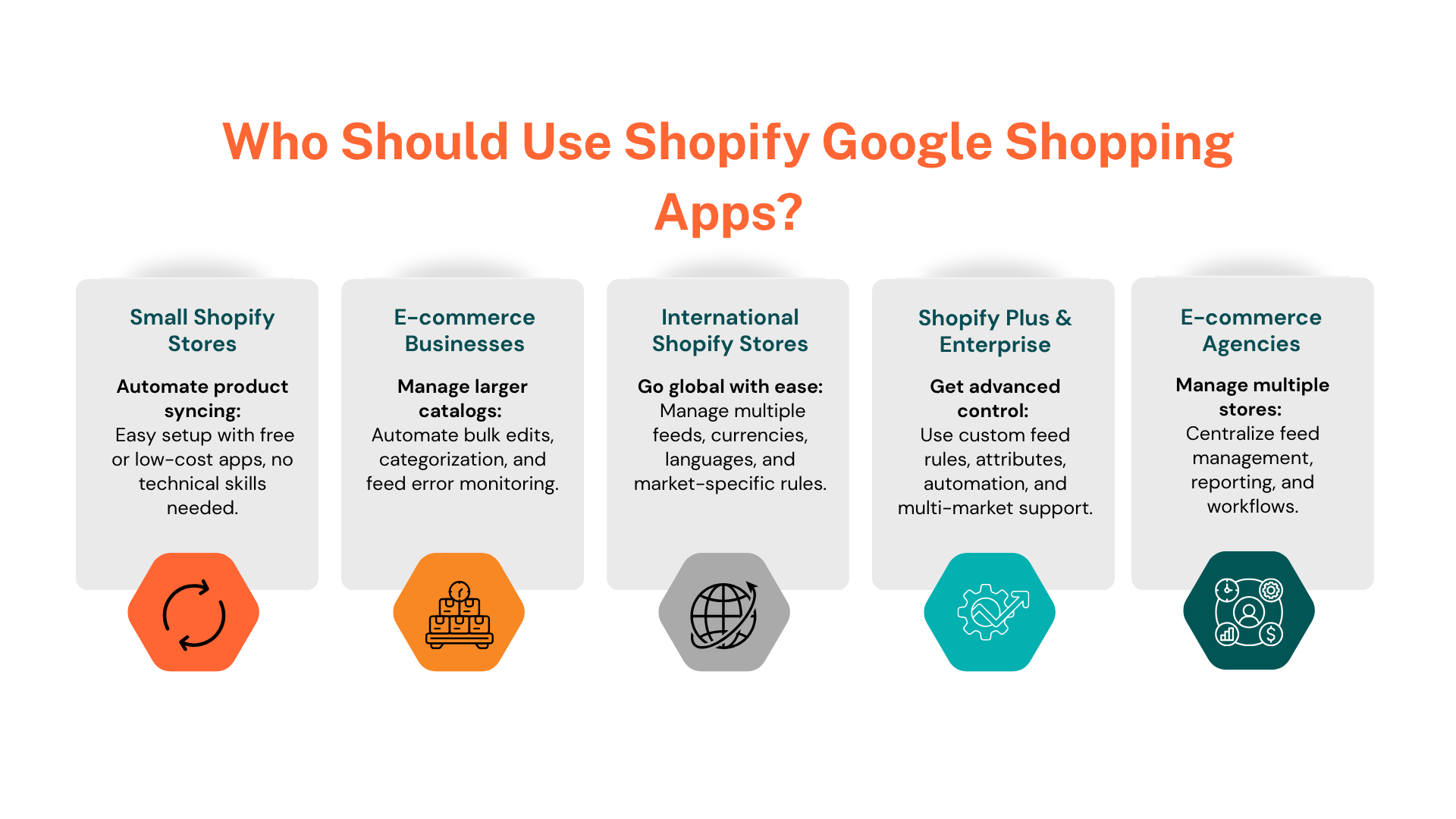
Not every merchant needs the same level of feed management. Here is how different types of Shopify sellers typically use these apps.
Small Shopify Stores
Small merchants can automate product syncing without needing any technical background. Free or low-cost apps are often enough to get a first Google Shopping feed live and start appearing in free listings.
Growing E-commerce Businesses
As catalogs expand, manually updating a feed becomes unrealistic. Feed-management apps take over bulk edits, categorization, and error monitoring so the team can focus on growth instead of spreadsheet cleanup.
International Shopify Stores
Stores selling in multiple countries benefit from apps that support several feeds at once, along with different currencies, languages, and market-specific rules, so each region sees accurate, localized listings.
Shopify Plus and Enterprise Merchants
Larger merchants often need advanced feed rules, custom attributes, support for multiple markets, deeper automation, and tighter control over what data actually reaches Merchant Center.
E-commerce Agencies
Agencies managing several Shopify stores at once benefit from centralized feed management, automation, reporting, and workflows that scale across clients without duplicating effort for each account.
How Do Google Shopping Apps Benefit Shopify Merchants?
Before jumping into the list, it helps to see the benefits side by side.
| Benefit | How It Helps |
| Automated syncing | Keeps Google product data updated without manual work |
| Feed optimization | Improves product information quality and relevance |
| Error monitoring | Helps identify disapprovals and missing attributes early |
| Bulk editing | Saves time when managing large catalogs |
| Multi-market support | Helps merchants sell across countries and currencies |
| AI optimization | Helps enrich and improve product data automatically |
| Custom rules | Gives merchants more control over what data is sent |
| Multichannel feeds | Allows products to be distributed beyond Google alone |
Not every merchant needs a paid app right away. Shopify’s Google and YouTube channel is a solid native starting point, and third-party apps become more valuable once merchants need extra customization, automation, optimization, or multichannel reach.
List of the Top 10 Shopify Google Shopping Apps in 2026
How We Selected the Best Google Shopping Apps
Each app on this list was evaluated on the following:
- Google Merchant Center integration quality
- Feed automation and refresh speed
- Product-feed optimization tools
- AI capabilities for attribute enrichment
- Feed customization and rule flexibility
- Error and disapproval management
- Multi-country and multicurrency support
- Ease of use for non-technical merchants
- Shopify App Store ratings and reviews
- Pricing across different catalog sizes
- Quality of customer support
- Suitability for different store sizes
With that in mind, here is our pick for the Best 10 Shopify Google Shopping Apps this year.
-
Google & YouTube: Best Native Shopify Option
Best for: Beginners and merchants who want a zero-cost starting point
Google & YouTube is Shopify’s own official sales channel, and it is usually the first stop for any merchant exploring Google Shopping. It syncs your product catalog directly with Google Merchant Center and lets eligible products appear in free listings.
Key features
- Native integration with no third-party app installation required
- Automatic syncing of core product data, including price and availability
- Support for free product listings and paid Smart Shopping style campaigns
- Direct connection to your existing Shopify Markets setup
Advantages: Free to use, simple setup, no extra vendor to manage.
Limitations: Limited customization for feed rules, attribute mapping, and multichannel expansion compared to dedicated apps.
Pricing: Free.
Who should use it: New stores, small catalogs, or merchants who just want to test the waters with Google Shopping before investing in a paid tool.
-
Nabu for Google ShoppingFeed: Best for AI-Powered Feed Optimization
Nabu for Google Shopping Feed, built by AdNabu, focuses on using AI to clean up and enrich product data before it ever reaches Google. It is a popular choice for merchants who want fewer manual fixes.
Key features
- AI-assisted optimization of product titles, descriptions, and attributes
- Bulk editing across dozens of product attributes at once
- Multicountry and multicurrency feed support for global sellers
- Alerts that flag Google Merchant Center errors before they become disapprovals
- Integrations with other Shopify apps for reviews and localization
Ideal merchant profile: Stores with sizable catalogs that want less manual feed cleanup and more automated compliance checking, especially across multiple markets.
Pricing: Free to install for very small stores, with paid plans available for growing catalogs. Always confirm current tiers on the Shopify App Store since pricing can change.
-
Simprosys Google Shopping Feed: Best for Affordable Feed Management
Simprosys is one of the longest-running and most widely reviewed Google Shopping apps on the Shopify App Store, known for reliability at a low starting cost.
Key features
- Feed submission to Google Shopping, Microsoft, Meta, and Pinterest
- Feed rules and metafield mapping for attribute customization
- Support for multiple markets and Performance Max campaign setup
- Conversion tracking and dynamic remarketing tagging
- Frequent product data refreshes to reduce stale listings
Advantages: Strong reputation, broad channel coverage, budget-friendly entry plans.
Pricing: Plans typically scale with catalog size, starting at an affordable monthly rate for smaller stores, with a free trial usually available.
-
Multifeed Google Shopping Feed: Best for Multi-Channel Feed Management
Multifeed is built for merchants who need more than one feed running at once, whether that is separate feeds per country, per storefront language, or per advertising channel.
Key features
- Support for multiple simultaneous feeds across regions or channels
- Expression-based rules for dynamic attribute adjustments
- Compatibility with additional marketplaces beyond Google
- Scheduling controls for high-change catalogs that need frequent refreshes
Ideal merchant profile: International sellers or multi-brand stores that need separate, localized feeds without maintaining duplicate product databases.
-
DataFeedWatch: Best for Advanced Multichannel Feed Management
DataFeedWatch is aimed at merchants and agencies that need serious control over how product data is transformed before it reaches any advertising channel.
Key features
- Automated feed rules, temporary product exclusions, and custom labels
- Support for Facebook, Pinterest, Bing, and Amazon alongside Google
- RegExp-based data transformation for complex catalogs
- A/B testing of feed variations to see what performs best
- Automatic exclusion of sold-out or low-stock products from active campaigns
Ideal merchant profile: Larger catalogs, agencies managing multiple accounts, and merchants running Shopping ads across several platforms at once who need one central hub.
-
CedCommerce Google Shopping Feed & Ads: Best for Google Shopping Plus Ads Management
CedCommerce combines feed management with more direct control over Google Ads campaigns, which suits merchants who want to manage both from a single app.
Key features
- Feed management for Buy on Google, Shopping Ads, and free listings
- Real-time product sync and automatic Google order tracking
- Custom profiling to filter which products go into which campaigns
- Performance Max campaign support to drive additional traffic
Ideal merchant profile: Merchants who want their feed management and ad campaign management under one roof rather than juggling separate tools.
-
FeedHub Google Shopping Feed: Best for Feed Management and Optimization
FeedHub is designed to be approachable for smaller teams while still offering enough depth for growing catalogs.
Key features
- Feed generation that stays synced as prices and inventory change
- Bulk edits for titles, descriptions, and category mapping
- Clear, guided fixes for Merchant Center issues instead of vague error messages
- Product-level filtering so your feed reflects your actual campaign strategy
Ideal merchant profile: Merchants who want a straightforward feed builder that does not require a steep learning curve, with room to grow into more advanced features later.
-
Mulwi: Best for Multiple Shopping Channels
Mulwi focuses on distributing product data across a wide range of shopping and marketplace channels beyond just Google.
Key features
- Support for a large number of shopping and marketplace feeds
- Feed customization for different regions and channel requirements
- Tools built with international selling in mind
Ideal merchant profile: Sellers who want to expand well beyond Google Shopping into multiple marketplaces and social commerce channels from one dashboard.
-
ShoppingFeeder: Best for AI-Assisted Feed Mapping
ShoppingFeeder positions itself as a product data platform rather than a simple feed connector, with attribute mapping designed to fill in the gaps automatically.
Key features
- AI-assisted attribute completion for titles, descriptions, and variant details
- Support for Google Shopping alongside other advertising and marketplace channels
- Dynamic mapping of attributes such as age, color, and gender for apparel and variant-heavy catalogs
- Catalog management tools built for scaling across channels
Ideal merchant profile: Variant-heavy catalogs, such as fashion and accessories stores, that need consistent attribute mapping across many SKUs.
-
Wixpa Google Shopping Feed: Best for Budget-Conscious Merchants
Wixpa rounds out the list as a practical, budget-friendly option for merchants who want solid feed management without paying for features they will never use.
Key features
- Real-time syncing so inventory and pricing changes reflect quickly in Google
- Bulk editing and rule logic for cleaner listings at scale
- Multilingual and multicurrency feed support for international traffic
- Optional local inventory workflows for stores with physical locations
Ideal merchant profile: Small and growing Shopify stores that want dependable feed management on a tight budget.
Comparison of the 10 Best Shopify Google Shopping Apps
| App | Best For | AI Optimization | Multi-Country Support | Feed Customization |
| Google & YouTube | Beginners, native integration | Limited | Yes | Basic |
| Nabu for Google Shopping Feed | AI-powered optimization | Strong | Yes | Strong |
| Simprosys Google Shopping Feed | Affordable feed management | Partial | Yes | Strong |
| Multifeed Google Shopping Feed | Multichannel feeds | Limited | Yes | Strong |
| DataFeedWatch | Advanced multichannel management | Partial | Yes | Very strong |
| CedCommerce Google Shopping Feed & Ads | Google Shopping plus ads | Limited | Yes | Moderate |
| FeedHub Google Shopping Feed | Feed management and optimization | Partial | Yes | Moderate |
| Mulwi | Multiple shopping channels | Partial | Yes | Moderate |
| ShoppingFeeder | AI-assisted feed mapping | Strong | Yes | Strong |
| Wixpa Google Shopping Feed | Budget-conscious merchants | Limited | Yes | Moderate |
Pricing has intentionally been left out of this table because plans and tiers change often. Verify current pricing directly on each app’s Shopify App Store listing before making a decision, since several apps update their plan structures throughout the year.
How to Choose the Right Google Shopping App for Your Shopify Store
Choose Based on Your Catalog Size
A small catalog with a few dozen products usually does fine with a simple or native solution. Larger catalogs with thousands of SKUs benefit from apps with stronger bulk-editing and automation features.
Consider Your Target Markets
A single-country store may not need much beyond a basic feed. An international store should prioritize apps with solid multicountry, multilingual, and multicurrency support.
Look at Your Level of Feed Customization
If your products have complex attributes or need custom Google categories, prioritize apps that offer feed rules and flexible attribute mapping rather than rigid, one-size-fits-all syncing.
Consider AI and Automation
If reducing manual optimization work is a priority, look for apps that offer AI-powered feed enrichment along with automated error monitoring, since these features save the most time as catalogs grow.
Compare Pricing With Your Ad Spend
A paid app is worth the investment when the time saved and the improvement in feed quality justify the monthly cost, especially once you are running active Shopping campaigns with real ad spend behind them.

Final Verdict : Which Shopify Google Shopping App Should You Choose?
There is no single Google Shopping app that is the right fit for every Shopify merchant, and that is really the point of comparing the best 10 Shopify Google Shopping apps side by side rather than picking one blindly.
Whichever app you choose, the underlying goal stays the same: keep your product data accurate, complete, and easy for Google to match against real shopper intent. That discipline pays off across free listings, paid Shopping campaigns, and the newer AI shopping experiences Google is building on top of Merchant Center data.
If you are also looking to tighten up other parts of your Shopify operations, our related guide on the best Shopify abandoned cart apps covers another area where the right app choice can meaningfully move the needle on recovered sales.
Frequently Asked Questions
- What are the best 10 Shopify Google Shopping apps in 2026?
Based on feed automation, AI optimization, multi-market support, and ease of use, the top picks are Google & YouTube, Nabu for Google Shopping Feed,Simprosys Google Shopping Feed, Multifeed Google Shopping Feed, DataFeedWatch, CedCommerce Google Shopping Feed & Ads, FeedHub Google Shopping Feed, Mulwi, ShoppingFeeder, and Wixpa Google Shopping Feed. - Do I need a paid app to use Google Shopping on Shopify?
No. Shopify’s native Google & YouTube channel is free and cansync your catalog with Google Merchant Center. Paid apps become useful once you need more customization, automation, or multichannel distribution. - Which Shopify Google Shopping app is best for small stores?
Google & YouTube is usually the best starting point for small stores because it is free and requiresvery little setup. Simprosys is a good next step if you outgrow the native channel. - Which app is best for international Shopify stores?
Apps like Nabu for Google Shopping Feed,DataFeedWatch, and Multifeed Google Shopping Feed support multiple countries, currencies, and languages, making them better suited to global selling. - How do Google Shopping apps help with Merchant Center disapprovals?
Most feed-management appsmonitor your feed continuously and flag missing or incorrect attributes before Google rejects them, along with guided suggestions on how to fix common errors. - Can these apps sync products to channels other than Google?
Many of them can. Apps such asDataFeedWatch, Mulwi, and ShoppingFeeder support additional channels like Meta, Bing, and Pinterest alongside Google Shopping. - How often should a Google Shopping feed be updated?
Ideally, your feed should update automatically whenever prices, availability, or product details change. Real-time or near-real-timesyncing reduces the risk of showing outdated information to shoppers and keeps your listings eligible for both standard Shopping results and newer AI-driven shopping experiences.