




Customer expectations around delivery have changed for good. Same-day delivery, live order tracking, and instant delivery updates are no longer premium features, they are the baseline that both business buyers and individual shoppers expect. End-to-end B2B and B2C logistics automation is what allows companies to meet these expectations without adding headcount every time order volumes grow. According to Grand View Research, the global logistics automation market is projected to grow at a compound annual growth rate of 16.8 percent between 2026 and 2033, a clear signal that manual, spreadsheet-driven logistics operations are being replaced at scale.
B2B and B2C logistics look very different on the surface. B2B logistics deals with bulk orders, negotiated contracts, multi-step approvals, and longer fulfilment cycles that often span days or weeks. B2C logistics is built around speed, personalization, flexible delivery slots, and a return process that has to feel effortless. Yet both sides of the business are converging on the same conclusion: automation is now the line between companies that scale profitably and companies that drown in manual operations, missed SLAs, and rising fulfilment costs.
This blog breaks down the core building blocks that make end-to-end logistics automation actually work, how B2B and B2C automation needs differ, and how a business can start automating without ripping out every existing system on day one.
Why Automation Is Essential in Today’s Supply Chain
Order volumes are climbing every year, warehouse and driver labor is harder to find, and margins keep getting thinner. That combination alone would be enough to push most companies toward automation, but there is more happening underneath it.
Manual, paper-based, or spreadsheet-driven logistics processes are naturally error prone. A single mistyped SKU, a missed carrier handoff, or a delayed status update can trigger a chain reaction. In B2B logistics, this shows up as SLA breaches, contract penalties, and damaged trust with long-term partners. In B2C logistics, it shows up as failed deliveries, negative reviews, and customers who quietly switch to a competitor.
At the same time, logistics has become more complex, not less. Businesses now sell across multiple channels at once, marketplaces, direct websites, retail partners, and social commerce, and each channel comes with its own order format and fulfilment rules. Omnichannel fulfilment and cross-border shipping have added even more variables to track manually.
Much of this pressure traces back to what is often called the Amazon effect. Once one major player normalizes two-day or same-day delivery with real-time visibility, every other business in that category is measured against it, regardless of size. Meeting that bar consistently is simply not realistic without some level of automated logistics platform behind the scenes.
Current Market Trends Driving Logistics Automation
A few trends are shaping how businesses are approaching logistics automation software right now.
AI and machine learning in forecasting and routing. Demand forecasting models are getting better at predicting order spikes, and AI-driven route optimization is shaving real time and fuel cost off last-mile delivery.
Warehouse robotics and autonomous mobile robots. Automated storage and retrieval systems, conveyor automation, and AMRs are no longer limited to large enterprise warehouses. Mid-sized operations are adopting modular robotics to handle picking and putaway.
API-first, cloud-based platforms replacing legacy systems. Older transportation management systems (TMS) and warehouse management systems (WMS) were often rigid, on-premise, and slow to update. Cloud-native, API-first platforms are replacing them because they integrate faster and scale without major infrastructure investment.
Real-time visibility and predictive ETAs. Both B2B partners and B2C customers now expect to know exactly where their shipment is and when it will arrive, not just a generic delivery window.
Sustainability pressure. Automation is also being used to reduce empty miles, optimize load consolidation, and cut down on packaging waste, which matters both for cost and for environmental reporting requirements many businesses now face.
These trends are not isolated. They all point toward the same shift: logistics automation software is moving from a nice-to-have efficiency tool to the operating backbone of the supply chain.
The Core Building Blocks of End-to-End Automation
End-to-end B2B and B2C logistics automation is not one single piece of software. It is a connected system made up of several building blocks that work together. Here is what each one covers.
- Order Management Automation
This is where automation starts. An order management system automatically captures orders from every sales channel, validates them against inventory and pricing rules, and routes them to the right fulfilment location without manual entry. For businesses selling across marketplaces, D2C websites, and B2B portals at the same time, this single layer removes one of the biggest sources of delay and error.
- Warehouse Management and Inventory Automation
Real-time stock visibility is the foundation here. Automated putaway and picking, combined with robotics integration where needed, reduce the time between an order being placed and it being ready to ship. Inventory automation also prevents overselling, a problem that quietly damages both B2B relationships and B2C customer trust.
- Transportation Management (TMS)
A modern TMS automates carrier selection based on cost, speed, and service level, optimizes routes, and consolidates loads where possible. This is one of the areas where an all-in-one logistics platform delivers the clearest cost savings, since manual carrier selection rarely accounts for every variable a good algorithm can.
- Last-Mile Delivery Automation
Last mile is usually the most expensive and most visible part of the delivery journey. Dynamic routing, delivery slot optimization, and automated proof-of-delivery capture (through OTP, geo-tagged photos, or e-signatures) reduce failed deliveries and give customers accurate, real-time updates.
- Returns and Reverse Logistics Automation
This matters more in B2C, where return rates can be significant, but it is not irrelevant in B2B either. Automated return authorization, pickup scheduling, and restocking workflows turn what is usually a frustrating manual process into something predictable for both the business and the customer.
- Data and Analytics Layer
None of the above building blocks are useful in isolation. A centralized dashboard that pulls data from order management, warehousing, transportation, and returns gives operations teams a single view of what is happening, along with predictive analytics and automated exception management for shipments that are at risk of delay.
- Integration Layer (APIs and EDI)
This is the layer that actually makes automation “end-to-end.” APIs and EDI connections tie together ERP systems, CRM platforms, marketplaces, and carrier networks. Without this integration layer, a business ends up with several automated tools that still require manual work to connect, which defeats the purpose.
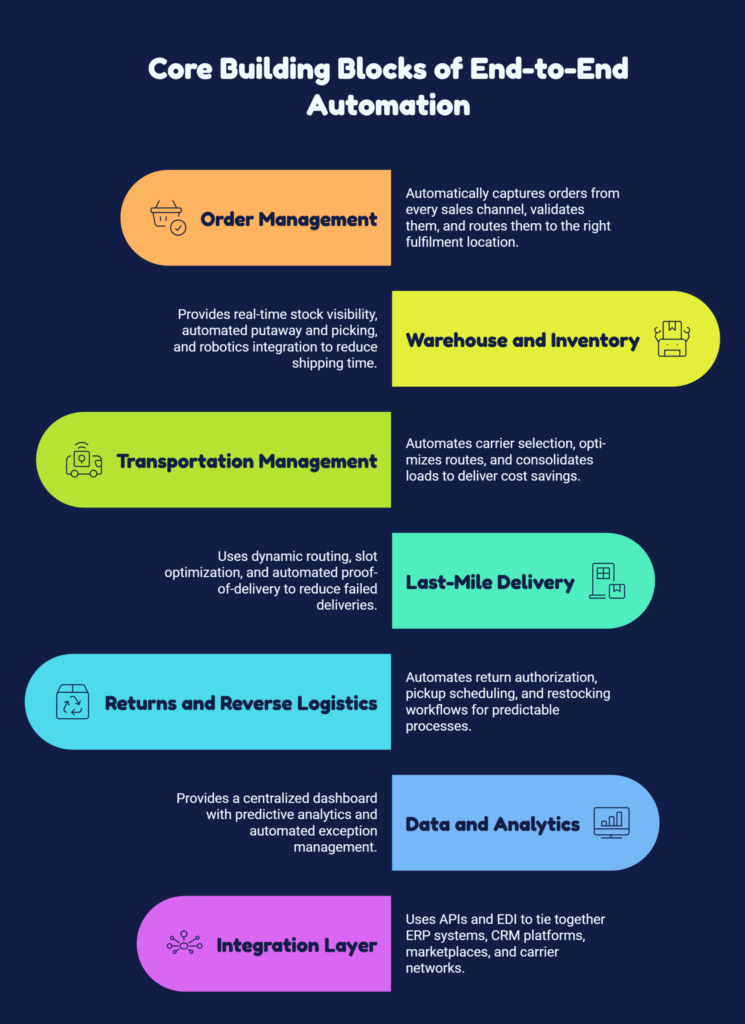
This is also a question worth asking directly: which platforms provide end-to-end B2B and B2C logistics automation? The honest answer is that very few platforms genuinely cover all seven building blocks well. Most logistics automation platforms are strong in one or two areas, like transportation management or warehouse automation, and rely on integrations to cover the rest. When evaluating a logistics management platform, it is worth checking how deep the integration layer actually goes, rather than assuming “end-to-end” on a website means all seven blocks are natively built in.
B2B vs. B2C Automation: Where the Building Blocks Differ
While the building blocks above apply to both sides of the business, how they are configured looks different depending on whether the customer is another business or an individual shopper.
| Building Block | B2B Focus | B2C Focus |
| Order Management | Bulk order handling, contract pricing automation, purchase order matching | Instant checkout validation, multi-channel order capture |
| Fulfilment Cycle | Longer fulfilment windows, account-based SLAs | Same-day or next-day expectations |
| Delivery | Scheduled bulk deliveries, freight consolidation | Flexible delivery slots, real-time tracking |
| Communication | Account manager and EDI-based updates | Automated SMS, WhatsApp, and email notifications |
| Returns | Structured return authorization tied to contracts | High-volume, self-service return automation |
| Personalization | Pricing tiers, negotiated terms | Delivery preferences, loyalty-based perks |
B2B logistics automation software tends to prioritize accuracy and contract compliance over speed, since a bulk order arriving a day late is usually less damaging than one arriving with the wrong pricing applied. B2C logistics automation software, on the other hand, prioritizes speed and communication, since customers rarely tolerate silence or delay.
This is precisely why businesses selling to both segments often ask which platforms provide end-to-end B2B and B2C logistics automation instead of running two separate systems. Maintaining separate stacks for B2B and B2C usually means duplicated data, inconsistent reporting, and higher operating costs, which is one of the strongest arguments for a unified B2B B2C logistics platform.
Benefits and Outcomes of End-to-End Automation
When the building blocks above are implemented together, rather than piecemeal, the outcomes tend to show up in a few consistent ways.
- Lower operating costs, from reduced labor dependency, better fuel efficiency through route optimization, and fewer manual error corrections.
- Faster order-to-delivery cycles, since automated handoffs remove the delays that come from manual data entry between systems.
- Higher order accuracy, which reduces disputes in B2B relationships and reduces returns and complaints in B2C.
- Better customer experience and retention on the B2C side, and stronger partner trust on the B2B side, both driven by consistent, predictable service.
- Scalability without proportional headcount growth, meaning a business can handle a 3x increase in order volume without needing 3x the staff.
- Better forecasting and decision-making, since a connected data layer gives leadership accurate, current numbers instead of estimates.
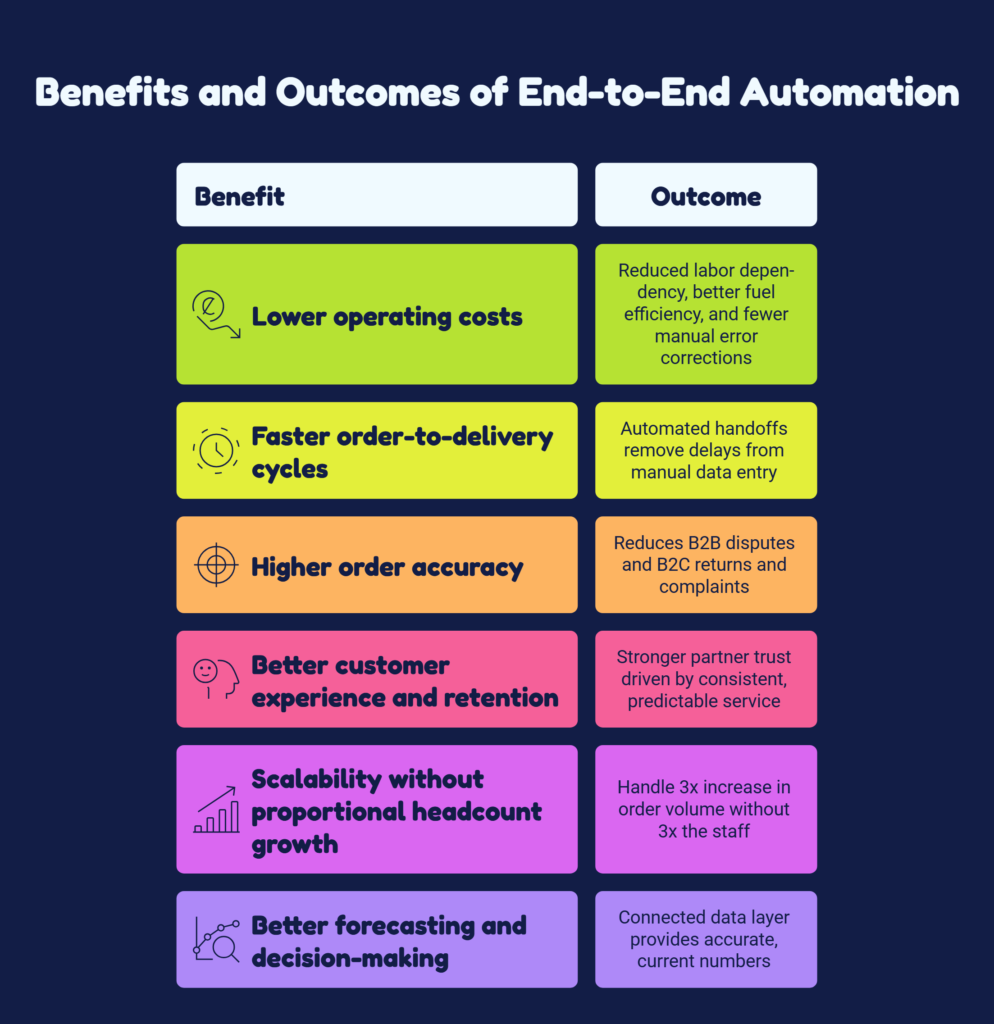
These benefits compound over time. A business that automates order management first, then adds transportation and last-mile automation, tends to see efficiency gains stack rather than plateau.
Challenges to Watch Out For
Automation is not a plug-and-play fix, and it is worth being upfront about the friction points.
Integration complexity with legacy systems. Many established businesses still run older ERP or WMS systems that were not built with modern APIs in mind. Connecting these to newer automation software often requires custom middleware or a phased migration plan.
Change management and workforce reskilling. Automation shifts the nature of warehouse and logistics jobs rather than eliminating them outright in most cases. Teams need training on new dashboards, exception handling processes, and how to work alongside automated systems.
Upfront investment versus long-term ROI. Automation software, robotics, and integration work all carry upfront costs. Businesses need a realistic timeline for when those costs are recovered through efficiency gains, rather than expecting overnight savings.
Being clear-eyed about these challenges is part of doing automation well. Businesses that skip this step often end up with automation projects that stall halfway through.
How to Get Started: A Practical Roadmap
For businesses that are early in their automation journey, a structured approach works better than trying to automate everything at once.
- Assess current process gaps. Map out where manual work is creating delays or errors today, whether that is order entry, carrier selection, or returns processing.
- Prioritize high-impact areas first. Order management and last-mile delivery automation tend to deliver the fastest, most visible returns, which makes them a good starting point.
- Choose modular, API-first platforms. Flexibility matters more than trying to find one tool that claims to do everything on day one. A modular logistics automation platform allows a business to add capabilities as needs grow.
- Pilot, measure, then scale. Run automation on a subset of orders or a single warehouse first, track the results against clear metrics, and expand once the approach is proven.
This roadmap also applies when a business is comparing vendors and asking which platforms provide end-to-end B2B and B2C logistics automation. Starting with a pilot makes it much easier to see whether a platform’s integration claims hold up in practice.
Conclusion: The Future Is Connected, Automated Logistics
End-to-end B2B and B2C logistics automation is not a single tool a business buys once. It is a connected ecosystem of order management, warehouse operations, transportation, last-mile delivery, returns handling, analytics, and integration, all working together instead of in isolated silos. Businesses that treat these building blocks as one connected system, rather than as separate purchases, are the ones that scale without their operations breaking down under pressure.
Looking ahead, the direction is clear. AI-driven forecasting, more autonomous warehouse operations, and increasingly predictive supply chains are becoming standard rather than experimental. The businesses that start building this foundation now, even with a single building block, will be in a far stronger position as order volumes and customer expectations keep climbing.
If your team is mapping out where to start, Best AI Based Logistics Automation Platform: Top 10 Platforms for eCommerce and What Logistics Platform Should I Use for My Growing D2C Brand go deeper into how to evaluate specific platforms against your business needs.
Frequently Asked Questions
- What is end-to-end B2B and B2C logistics automation?
It refers to connecting every stage of the supply chain, from order capture to warehouse management, transportation, last-mile delivery, and returns, into one automated system rather than handling each stage manually or with disconnected tools. - Which platforms provide end-to-end B2B and B2C logistics automation?
Most logistics automation platforms cover a few building blocks natively, such as transportation or warehouse management, and rely on API integrations to connect the rest. When evaluating platforms, look closely at how well they integrate with your existing ERP, OMS, and carrier network, since that determines how “end-to-end” the system really is in practice. - How is B2B logistics automation different from B2C logistics automation?
B2B automation focuses on bulk order handling, contract pricing, and account-based service levels, while B2C automation focuses on speed, real-time tracking, and flexible delivery and return options for individual customers. - How much does logistics automation software cost to implement?
Costs vary widely depending on scope, ranging from lightweight, subscription-based order management and tracking tools to larger investments in warehouse robotics and full TMS deployment. Most businesses see a stronger return by starting with a single high-impact area rather than automating everything at once. - Can small and mid-sized businesses use logistics automation platforms?
Yes. Cloud-based, API-first logistics automation software has made automation accessible to smaller businesses that previously could not justify the cost of legacy, on-premise systems. Modular platforms allow businesses to start small and add capabilities as they grow. - What is the biggest challenge in adopting an end-to-end logistics platform?
Integration with legacy systems is usually the biggest hurdle, followed by change management within warehouse and operations teams who need to adapt to new workflows and dashboards. - How does automation improve the customer experience in logistics?
Automation reduces failed deliveries, gives customers accurate real-time tracking and delivery estimates, and speeds up returns processing, all of which directly improve satisfaction and repeat purchase rates for B2C businesses, while improving reliability and trust for B2B partners.