




What Is a Logistics Control Tower?
A logistics control tower brings shipment information, carrier performance, logistics data, and operational workflows into one system. It gives businesses a clearer view of their supply chain without forcing teams to piece together spreadsheets, carrier portals, manual follow-ups, and late reports. That view helps teams spot where action is needed and manage logistics performance, rather than simply track shipments.
As supply chains grow more complex, visibility gets harder to maintain across warehouses, transportation partners, distribution centres, and delivery networks. One shipment may be on schedule while another is delayed. Others may be awaiting dispatch or need attention after a failed delivery attempt. McKinsey’s 2026 State of Digital Logistics Survey found that nearly 90% of surveyed shippers had adopted at least one transportation AI use case, while 96% had deployed at least one AI or digital use case in warehousing. Those tools don’t necessarily give teams a connected view of the supply chain. A logistics control tower brings the details together so teams can prioritise exceptions and coordinate responses using more consistent information.
A modern logistics control tower platform may connect with transportation management systems (TMS), enterprise resource planning (ERP) software, warehouse management systems (WMS), carrier APIs, order management platforms, and tracking systems. Those connections matter because logistics data often sits in separate applications run by different providers. In McKinsey’s 2024 digital logistics survey of more than 260 shippers and logistics providers, over 85% of respondents said their digital projects had added value to their organisations, although fragmented technology environments remained a challenge. Depending on its capabilities, the platform may also offer automated alerts, performance reports, predictive insights, and workflow management. Teams can then see where shipments are, investigate delays, assess carrier performance, and find opportunities to improve operations.
Better visibility matters for planning, too. Gartner reported in 2025 that only 19% of surveyed organisations fully integrated scenario planning into their supply chain strategies. That leaves a gap between recognising uncertainty and preparing for it systematically. By combining shipment status, carrier performance, and exception data, a logistics control tower can support faster operational decisions. With reliable data and suitable workflows, teams can spot emerging delays, weigh alternatives, and coordinate corrective action instead of depending entirely on manual escalation.
For ecommerce businesses, manufacturers, retailers, and third-party logistics providers, visibility is most useful when it leads to action. DHL’s 2025 research found that 44% of surveyed supply chain professionals identified AI as a leading driver of future logistics transformation, reflecting interest in more intelligent and responsive operations. A well-designed system can help businesses monitor shipments, analyse carrier performance, identify recurring exceptions, and improve communication throughout the delivery journey. Reliable data and appropriate automation make a logistics control tower a practical part of a more connected, responsive supply chain.
Why Do Businesses Need a Logistics Control Tower?
Logistics operations depend on multiple partners, systems, processes, and delivery commitments. As shipment volumes grow, manual tracking can leave information gaps and slow decisions. It also raises the risk of operational errors. Teams need a reliable way to check shipment status, monitor performance, and act when something goes wrong. A logistics control tower brings these activities into one view so teams can spot gaps and coordinate fixes before small issues become larger disruptions.
For businesses working across multiple warehouses, distribution centres, transportation partners, and delivery networks, collecting data isn’t enough: a logistics control tower platform connects information from different sources, and logistics analytics reveals performance trends and recurring problems. A well-designed control tower dashboard helps teams move from reacting to shipment issues toward managing logistics proactively.
| Key challenge | How it affects logistics operations | How a logistics control tower helps |
| Fragmented information across systems | Teams switch between platforms to understand shipment status, orders, and carrier updates. | A logistics visibility platform consolidates relevant information into a central view. |
| Delayed identification of shipment problems | Delays and missed milestones may be discovered only after delivery commitments are affected. | A control tower dashboard highlights exceptions and shipments that require attention. |
| Limited carrier performance insights | Comparing delivery reliability, transit times, and costs across multiple carriers becomes difficult. | Logistics dashboard analytics helps teams compare carrier performance and identify improvement opportunities. |
| Increasing customer expectations | Incomplete tracking information can lead to uncertainty and repeated customer support queries. | Connected tracking and notification workflows help provide timely delivery updates. |
| Growing operational complexity | Higher shipment volumes make manual monitoring and coordination more difficult. | An AI logistics dashboard can help surface unusual patterns, prioritise exceptions, and support faster decisions. |
| Rising logistics costs and service pressure | Inefficient routes, repeated delivery attempts, and unresolved exceptions can increase costs. | Logistics analytics and automation help teams investigate cost drivers and improve operational efficiency. |
Fragmented Information Across Systems:
Many businesses run order management, warehouse operations, transportation, shipment tracking, and financial reporting in separate systems. Each system holds useful information, but teams have to move between platforms to piece together a shipment’s journey. A carrier portal might show tracking updates while a warehouse system holds dispatch details and an order management platform holds customer records. When those records don’t connect, employees spend time gathering information instead of acting on it.
A logistics visibility platform brings relevant shipment information into one interface. Depending on its integrations, a logistics control tower platform can connect transportation management systems (TMS), enterprise resource planning (ERP) software, warehouse management systems (WMS), carrier APIs, and order management systems. Teams can then see where shipments are, which milestones are complete, and which orders need attention. If an order is packed but hasn’t been handed over to the carrier, operations can investigate the dispatch process without searching multiple systems. Customer support, warehouse teams, and logistics managers also get a more consistent view of each shipment.
Delayed Identification of Shipment Problems:
Manual tracking, spreadsheets, and periodic reports can leave teams unaware of a delay until they’ve missed a delivery commitment. A shipment may sit at a transit hub longer than expected or stop receiving tracking updates. It may also hit a delivery exception that needs intervention. Without timely alerts, the problem can go unnoticed until a customer complains or the deadline passes.
A control tower dashboard flags shipments that have exceeded expected timelines, missed important milestones, or need follow-up. Teams can compare shipment events with delivery schedules to spot exceptions sooner and focus on the cases that need immediate attention. That matters when a business handles large shipment volumes across multiple carriers and locations. More advanced systems may flag shipments that look likely to arrive late. An ai logistics dashboard can analyse tracking events, historical transit patterns, and delivery performance data to help teams spot potential problems. It won’t prevent every delay. But earlier warnings give operations teams more time to investigate, contact carriers, adjust plans where possible, and set realistic delivery expectations.
Limited Carrier Performance Insights:
Using multiple carriers gives businesses more options for delivery coverage, service levels, and transportation costs. It also makes performance harder to manage. Reliability, transit times, exception rates, failed delivery attempts, and shipping costs can differ by carrier, route, service type, and location. Without a consistent way to compare them, businesses may keep using underperforming services or miss chances to improve carrier allocation.
Logistics analytics helps businesses measure carriers against agreed service expectations. With logistics dashboard analytics, teams can compare on-time delivery rates, average transit times, delivery exceptions, return-to-origin rates, and other relevant metrics. That makes it easier to tell a one-off incident from a recurring problem. A logistics control tower can reveal patterns across regions, service types, and shipment categories. If a carrier repeatedly runs late on a particular route, the team can investigate why and decide whether another service is a better fit. The goal isn’t simply to rank carriers. It’s to choose services based on quality, cost, delivery requirements, and historical performance.
Increasing Customer Expectations:
Customers expect accurate delivery estimates, easy tracking, and prompt updates when an order is delayed. If shipment information is missing or hard to find, they may contact support repeatedly to ask where an order is and when it will arrive, adding to the team’s workload and eroding confidence in the delivery experience. A logistics control tower connects what’s happening with shipments to what customers hear about them. With tracking events and delivery milestones in one centralised system, businesses can send dispatch notifications and shipment updates based on current information. They can also share estimated delivery information and communicate exceptions. The channels available depend on the capabilities of the connected tools.
Delivery matters especially for ecommerce businesses because it’s a significant part of the post-purchase journey. A logistics control tower for ecommerce can help teams monitor orders across multiple carriers, spot delivery exceptions, and give customer support more consistent information. Connected to branded tracking pages and notification workflows, shipment visibility can make the experience clearer and more convenient for customers.
Growing Operational Complexity and Manual Workloads:
As a business moves into new markets, adds warehouses, works with more carriers, or handles more orders, manual monitoring gets harder. Employees can spend hours checking shipment statuses and reconciling tracking information. They also have to prepare performance reports and pass problems to different teams. That leaves less time to investigate root causes and improve logistics processes.
A logistics control tower platform centralises monitoring and gives teams a consistent way to handle shipment exceptions. Employees don’t need to check every shipment; they can focus on orders that have missed milestones, lack expected updates, or need intervention. Automated alerts and workflows send issues to the right team using predefined rules, cutting down on manual follow-ups. An AI logistics automation dashboard can help teams spot patterns, decide which exceptions need attention first, and make routine decisions. It might flag unusual transit times or show recurring delivery failures that need investigation. How much it can automate depends on the system’s capabilities, data quality, and configured workflows. Critical decisions may still need human review.
Increasing Customer Expectations
Carrier rates, inefficient routes, fuel, failed delivery attempts, returns, detention, and repeated handling all affect logistics costs. Without a consolidated view of shipment performance and spending, businesses struggle to see why costs are rising. Teams may know the final transportation cost but lack the detail needed to trace it back to operational problems. That makes it harder to decide what to fix. A logistics control tower brings shipment events and performance data into one view, giving teams a way to investigate cost and service issues. With logistics analytics, they can spot routes with recurring delays, carriers with higher exception rates, and repeated delivery attempts that add avoidable expense.
Those findings can guide changes to carrier allocation rules, dispatch timing, exception handling, or delivery communication. A control tower dashboard then helps teams track whether those changes improve delivery performance and cost control over time. Collecting shipment data isn’t enough on its own. Businesses need to connect that information, identify exceptions, understand performance, and coordinate action across their logistics networks. A logistics control tower combines centralised visibility, logistics dashboard analytics, and appropriate automation to support that work. It can help organisations build logistics operations that respond faster, measure results, and keep customers in view.
How Does a Logistics Control Tower Work?
A logistics control tower works by collecting information from connected systems, consolidating it into a common operational view, identifying important events, and helping teams take appropriate action. Its effectiveness depends on the quality of the data, the integrations available, and how well the workflows support day-to-day logistics operations.
1. Collecting Data From Multiple Sources
Start by pulling shipment and operational data from ERP, TMS, WMS, carrier platforms, order management systems, and tracking applications. That data can include order details, dispatch records, shipment milestones, estimated delivery dates, carrier assignments, freight charges, and delivery confirmations.
Integrations cut down on manual collection and bring information from different carriers into one view. How often that view updates depends on the connected systems and the data they provide.
2. Consolidating Shipment Information
The platform then organises the data into a consistent view of logistics operations. Teams can check shipment progress and pending dispatches without jumping between applications. They can also review delayed orders and carrier performance in the same place. That makes it easier to spot what needs attention.
A control tower dashboard should let teams filter by shipment status, carrier, destination, warehouse, business unit, or delivery priority. Each team can then find the information it needs for its own work.
3. Monitoring Shipment Milestones
The system tracks available events, including order processing, pickup, dispatch, transit, arrival at a destination hub, out-for-delivery status, and successful delivery. These milestones show whether a shipment is moving according to plan.
If an expected update doesn’t arrive or a shipment runs past its planned timeline, the system may flag it for investigation. That flag is only as reliable as the tracking data behind it, so completeness and accuracy matter.
4. Identifying Exceptions and Potential Risks
A logistics control tower can apply business rules, performance thresholds, and analytical insights to find shipments that need attention. Delayed pickups, missing tracking updates, failed delivery attempts, and shipments at risk of missing their expected delivery dates are all possible exceptions.
More advanced platforms may use historical data and predictive models to flag risks before a delivery commitment is missed. Teams can act on those predictions, but should compare them with actual outcomes and assess the quality of the available data.
5. Supporting Decisions and Follow-Up Actions
Spotting a problem doesn’t resolve it. Teams still need to decide who owns the follow-up and what to do next. A control tower can prioritise exceptions, assign follow-ups, and link shipment events to operational workflows. This helps teams move from an alert to a response.
Depending on the platform, follow-up may mean a manual investigation, an automated notification, or a system-triggered workflow. The goal is to shorten the time between finding an issue and responding to it.
6. Measuring Performance and Improving Operations
Historical shipment data shows recurring delays, carrier performance, transportation costs, and the results of corrective actions. logistics dashboard analytics makes those patterns easier to examine and gives teams a basis for improving operations.
Regular reviews can help businesses adjust carrier allocation rules and improve how they handle exceptions. They can also show where additional automation would be useful.
Key Features of a Logistics Control Tower
What a business needs from a logistics control tower depends on its size, shipment volumes, number of logistics partners, and supply chain complexity. Still, some features are useful for any business that needs better visibility and operational control.
Centralised Shipment Visibility
Teams should be able to see shipment status, carrier information, tracking events, and delivery progress in one place. That means less time spent switching between carrier portals and a clearer view of shipments that need attention. At high shipment volumes, filters and prioritisation matter too. Teams need to spot critical exceptions quickly, not review every shipment by hand.
Control Tower Dashboard
A control tower dashboard should make operational decisions easier. It may show shipment counts, pending pickups, delayed deliveries, exception alerts, carrier performance, and on-time delivery metrics. More data isn’t always more useful. Operations teams may need shipment-level detail, while managers may want summaries of cost, service performance, and recurring problems. The dashboard should give each group information they can act on.
Logistics Dashboard Analytics
Logistics dashboard analytics can show what’s behind changes in operational performance. Delays might cluster in certain regions, one carrier might have more failed delivery attempts, or transportation costs might rise on particular routes. Those patterns give teams a place to start investigating root causes. Analytics is most useful when the metrics point to changes teams can actually make.
Carrier Performance Monitoring
A control tower can bring available carrier performance data together so businesses can compare delivery reliability, transit times, exception rates, and costs. That information can inform carrier reviews, allocation decisions, and service-level discussions. Context matters when comparing carriers. A carrier that performs well on one route may be a poor fit for another destination or shipment type. Price should be weighed against service requirements and historical performance.
Exception Management and Alerts
Exception management flags shipments that miss expected milestones or need intervention. Alerts main point to delays, failed delivery attempts, missed pickups, or gaps in tracking updates. An alert should give teams enough context to understand the problem and choose a next step. Clear priorities and escalation rules help prevent low-value notifications from overwhelming operations teams.
AI Logistics Dashboard and Predictive Insights
An AI logistics dashboard may draw on historical shipment records, current tracking events, carrier performance, and other operational data to find patterns or estimate delivery risks. It might flag routes with frequent delays or shipments whose progress suggests they’ll miss their expected delivery date. Depending on the system, AI may suggest actions for teams to review. These insights are only as useful as the data and models behind them. AI can support operational judgement, but teams still need to validate its findings and maintain oversight.
Integration With Existing Business Systems
The control tower needs to exchange information with systems the business already uses. Those may include ERP, TMS, WMS, order management software, carrier APIs, tracking applications, and customer communication tools. Businesses should check that the necessary systems exchange data reliably and update often enough for day-to-day operations. If critical shipment events are missing or significantly delayed at the source, the dashboard can’t provide dependable visibility.
Cost and Performance Reporting
Cost and performance reporting puts transportation spending alongside delivery outcomes. Useful measures may include cost per shipment, carrier charges, delivery performance, exception rates, and freight cost trends. Looking at these measures together gives teams a fuller picture of each logistics decision. A lower freight rate may cost more overall if it comes with more delivery failures, longer transit times, or higher support costs.
Benefits of a Logistics Control Tower
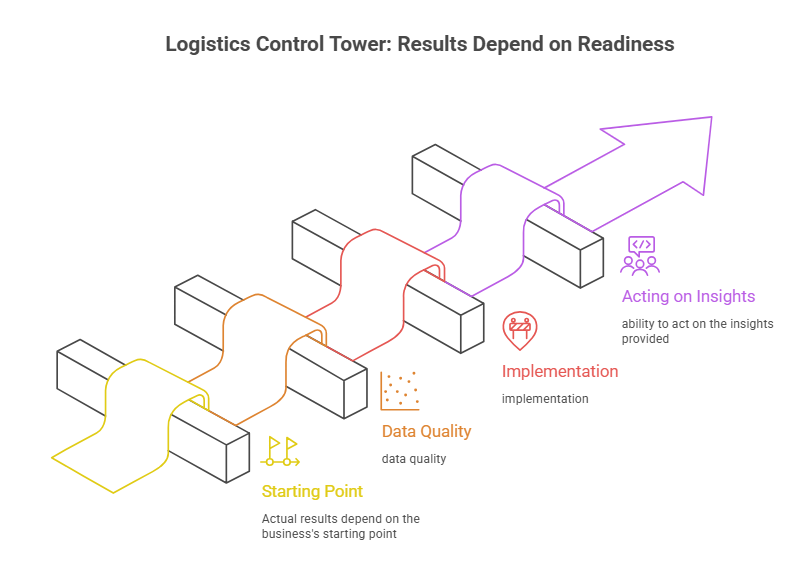
A logistics control tower can help businesses improve operational visibility, coordination, and decision-making. The actual results depend on the business’s starting point, data quality, implementation, and ability to act on the insights provided.
- Improved End-to-End Visibility
A consolidated operational view helps teams understand shipment progress across carriers and connected systems. They can identify delays, investigate missing updates, and see which orders require attention.
Better visibility also supports collaboration between logistics, warehouse, customer support, and management teams. When teams work with consistent shipment information, there is less dependence on repeated manual follow-ups.
- Faster Exception Resolution
A control tower can help identify problems earlier by flagging shipments that have missed expected milestones or are approaching delivery deadlines. This gives teams more time to investigate and coordinate the appropriate response.
Not every disruption can be prevented, but early identification can help businesses reduce avoidable delays in escalation and communication.
- Better Carrier Management
Carrier performance information helps businesses understand which partners meet service expectations and where improvement is needed. Teams can compare performance across routes, destinations, and shipment categories to make more informed allocation decisions.
This supports a more balanced approach to carrier selection, where reliability and service quality are considered alongside transportation costs.
- Better Logistics Cost Management
Logistics analytics can help identify high-cost routes, recurring failed deliveries, inefficient carrier allocation, and other patterns that contribute to unnecessary expenditure.
Once these issues are understood, businesses can evaluate changes to routing, carrier selection, delivery processes, or exception management. Cost improvements should be assessed alongside service performance so that savings do not create new delivery problems.
- Improved Customer Experience
Customers want to know whether their orders have shipped, where they are, and when they are likely to arrive. Reliable shipment information helps customer-facing teams provide clearer updates and respond to delivery questions more efficiently.
When connected with tracking and communication tools, a logistics control tower can support more consistent delivery notifications and help businesses create a smoother post-purchase experience.
- Stronger Operational Planning
Historical data can help businesses understand recurring shipment patterns, delivery timelines, and carrier performance. These insights support capacity planning, peak-season preparation, and decisions about resource allocation.
Instead of relying entirely on reactive problem-solving, teams can use available information to anticipate operational requirements and prepare for predictable challenges.
- Better Cross-Team Coordination
A centralised view provides teams with a shared reference point for shipment status and outstanding exceptions. This can make it easier to assign responsibility, track follow-ups, and coordinate responses when an issue involves several departments.
Clear ownership and workflows are essential to turning this shared visibility into practical operational improvements.
Logistics Control Tower for Ecommerce: Use Cases and Benefits
Ecommerce logistics presents specific challenges because businesses manage large numbers of individual orders, multiple delivery partners, changing customer expectations, and frequent delivery updates. A logistics control tower for ecommerce helps connect shipping information so teams can monitor order progress, identify delivery problems, and evaluate performance across their carrier network.
Managing Multiple Carriers and High Shipment Volumes
Ecommerce businesses often use different carriers depending on destination, serviceability, cost, and delivery requirements. As order volumes grow, tracking each shipment separately becomes increasingly time-consuming.
A centralised view makes it easier to identify delayed shipments, monitor carrier performance, and prioritise follow-ups. When connected with shipping automation, it can also support more consistent shipping workflows.
Identifying Delivery Exceptions Earlier
Failed delivery attempts, delayed shipments, missing tracking events, and address-related issues can create additional work for ecommerce operations teams. Monitoring these exceptions helps teams identify where intervention is needed.
Where suitable integrations and workflows are available, shipment events can trigger internal alerts or customer communication. This helps businesses respond more consistently instead of waiting for customers to report a problem.
Improving the Post-Purchase Experience
The customer experience continues after checkout. Customers expect accessible tracking information, clear delivery estimates, and timely updates when their orders are delayed.
When shipment visibility is connected with customer communication, businesses can provide more relevant information throughout the delivery journey. A branded tracking page can also give customers a familiar destination for checking their orders and accessing support information.
Supporting Returns and Reverse Logistics
Returns introduce additional shipment movements and communication requirements. Businesses need to understand when a return is initiated, when a pickup is scheduled, and how the returned shipment progresses through the reverse logistics process.
A connected operational view can help teams monitor return-related events and identify delays that need attention. This is especially useful for ecommerce businesses managing high return volumes across multiple locations and carriers.
Logistics Control Tower vs Logistics Visibility Platform vs TMS
These terms describe related capabilities, but they are not always interchangeable. The differences depend on the functionality provided by each platform.
| Solution | Primary purpose | Typical capabilities |
| Logistics visibility platform | Show shipment progress across carriers and systems | Tracking, shipment status, delivery estimates, exception visibility |
| Transportation management system (TMS) | Plan and manage transportation activities | Carrier selection, transport planning, dispatch, freight rates and billing |
| Logistics control tower | Connect visibility, performance monitoring and operational decisions | Consolidated dashboards, exception management, analytics and coordinated workflows |
| AI-enabled control tower | Add predictive insights and decision support | Risk estimates, pattern detection and recommendations where supported |
A logistics visibility platform may provide tracking information to a control tower, while a TMS may manage transportation planning and execution. A control tower brings relevant information and workflows together to help teams understand performance and decide where action is needed.
Some platforms combine these capabilities, so businesses should evaluate actual features, integrations, and workflows rather than relying only on product terminology.
How to Implement a Logistics Control Tower
Successful implementation requires more than selecting software. Businesses need to understand their operational problems, connect reliable data sources, define measurable objectives, and establish workflows that turn visibility into action.
Step 1: Identify Existing Visibility Gaps
Start by documenting how shipments are currently monitored and managed. Identify where teams rely on spreadsheets, which systems contain shipment information, how exceptions are escalated, and where manual follow-ups create delays.
Common gaps include limited carrier visibility, missing tracking updates, inconsistent reporting, and difficulty identifying recurring delivery problems. These findings help define what the new system should solve.
Step 2: Set Clear Business Objectives
Define measurable objectives before choosing a platform. These may include improving tracking-data completeness, reducing the time required to identify delayed shipments, improving on-time delivery, or reducing manual effort in carrier follow-ups.
Establish baseline performance using existing operational data. This allows the business to evaluate whether the implementation is delivering meaningful improvements.
Step 3: Map Data Sources and Integrations
Identify the systems that contain the information needed for the control tower. These may include ERP, TMS, WMS, order management platforms, carrier APIs, and tracking systems.
Review whether each source provides reliable data, whether shipment identifiers are consistent, and how frequently updates are received. Resolve critical data gaps before relying on the consolidated view for operational decisions.
Step 4: Choose the Right Logistics Control Tower Platform
Evaluate platforms against actual business requirements. Consider carrier coverage, integration options, shipment volumes, dashboard flexibility, exception management, reporting, scalability, security, and total cost of ownership.
Determine whether the business needs basic visibility, advanced logistics analytics, predictive insights, or more extensive workflow automation. Not every operation requires the same level of complexity from the beginning.
Step 5: Design an Actionable Control Tower Dashboard
The dashboard should help users answer practical questions quickly. Which shipments are delayed? Which exceptions need attention? Which carriers are underperforming? Where are costs increasing?
Prioritise clear metrics and actionable information over decorative visualisations. Different views may be needed for operational teams, logistics managers, and senior leadership because their responsibilities differ.
Step 6: Establish Alerts and Workflows
Define what should happen when the system identifies an exception. A delayed shipment might need to be assigned to an operations team, escalated if it remains unresolved, and communicated to the customer if the delivery estimate changes.
Specify who owns each exception, which actions are permitted, and when human approval is required. This prevents the system from generating alerts without a clear response process.
Step 7: Pilot, Measure, and Expand
Begin with a manageable scope, such as a specific carrier group, warehouse, region, or shipment category. Test data accuracy, dashboard usefulness, alert quality, and the team’s ability to resolve exceptions.
Compare results with the original baseline, gather user feedback, and address problems before expanding the rollout. A phased approach helps businesses learn what works while limiting unnecessary implementation complexity.
Common Challenges in Logistics Control Tower Implementation
Although a logistics control tower can improve visibility and decision-making, businesses should plan for several implementation challenges.
Fragmented and Inconsistent Data
Information may be spread across carrier systems, spreadsheets, warehouse applications, and enterprise software. Different sources may use different status labels, timestamps, and shipment references.
If the underlying data is incomplete or inconsistent, the consolidated view may not accurately reflect operational reality. Businesses should prioritise data validation, standardisation, and integration monitoring.
Integration Complexity
Connecting multiple systems can require API configuration, data mapping, technical coordination, and collaboration with external providers. Some systems may not support frequent updates or may expose only limited shipment information.
A practical rollout should prioritise the most important integrations, test data flows carefully, and document what the system can and cannot capture.
Investment and Unclear ROI
Implementation costs may include software subscriptions, integration work, data preparation, training, and ongoing maintenance. Businesses may struggle to justify the investment if they have not established clear objectives.
Start with a business case and a focused pilot. Measure changes in operational effort, exception response, delivery performance, and cost management before committing to a wider rollout.
Resistance to New Workflows
Teams accustomed to spreadsheets, phone calls, or separate carrier portals may be reluctant to adopt a new system. Adoption can remain low if the dashboard adds complexity without improving everyday work.
Involve users early, provide practical training, and make sure the system simplifies the tasks they perform most often. Clear ownership and management support also help establish consistent usage.
Excessive Alerts and Limited Actionability
A system that generates too many low-priority alerts can overwhelm operations teams. If every deviation is treated as urgent, genuinely important issues may be overlooked.
Use meaningful thresholds, priority levels, and escalation rules. Review alert performance regularly and remove notifications that do not lead to useful action.
Data Security and Governance
A control tower may consolidate commercially sensitive shipment, customer, supplier, and transportation information. Businesses should assess access controls, data-handling practices, auditability, and security requirements during platform selection.
Security and governance should be considered from the beginning rather than addressed only after implementation.
What Metrics Should a Logistics Control Tower Track?
The right metrics depend on the business model, logistics network, and implementation objectives. A balanced set of operational, financial, and customer-related indicators helps businesses evaluate performance without relying on a single measure.
| Metric | What it measures |
| On-time delivery rate | The proportion of shipments delivered within the promised timeframe |
| Average transit time | The time shipments take to move from dispatch to delivery |
| Exception rate | How frequently shipments encounter defined operational problems |
| Exception resolution time | How quickly teams address identified shipment issues |
| Carrier performance | How well individual carriers meet service expectations |
| Cost per shipment | Average transportation cost across a defined shipment group |
| Tracking-data completeness | Whether expected shipment milestones are available |
| Manual follow-up volume | The effort spent chasing shipment updates |
| Delivery-related support queries | How often customers contact support about shipment status |
| Failed delivery rate | The proportion of shipments with unsuccessful delivery attempts |
These indicators should be reviewed together. Faster delivery may come with higher transportation costs, while a low exception rate may reflect incomplete tracking data rather than better performance. Analysing multiple measures gives businesses a more balanced understanding of logistics operations.
How AI and Logistics Analytics Strengthen a Control Tower
Traditional monitoring helps teams understand what is happening across their logistics network. AI and logistics analytics can extend this capability by identifying patterns, estimating risks, and supporting more informed decisions.
Moving From Descriptive to Predictive Insights
Descriptive analytics explains what has already happened, while predictive analytics uses available historical and current data to estimate what may happen next. For example, a system may identify that shipments on a particular route frequently experience delays under certain conditions.
Prediction accuracy depends on the quality and relevance of the underlying data. Businesses should monitor actual outcomes and refine their approach as more information becomes available.
Supporting Better Operational Decisions
More advanced systems may recommend possible responses to a delivery risk, such as investigating an alternative carrier, reviewing a route, escalating an exception, or updating a delivery estimate.
Recommendations should account for real operational constraints, including carrier availability, service requirements, costs, and customer commitments. Human oversight remains important when decisions have significant financial or service implications.
Using an AI Logistics Automation Dashboard
An AI logistics automation dashboard can combine shipment monitoring, analytical insights, and workflow information to help teams prioritise their work. For example, it may highlight a shipment at risk of missing its delivery commitment and direct the issue to the appropriate team. Automation should be introduced selectively. Businesses can begin with repeatable, well-defined workflows, monitor the results, and expand automation when the process is reliable.
Growing businesses often ship through several carriers, and keeping track of every order gets harder as volume rises. Teams need to check shipment progress, compare carrier performance and respond when deliveries go off course. eShipz brings multi-carrier integration, shipping automation, tracking and delivery visibility into connected shipping workflows. With carrier information in one place, teams can follow orders across their delivery network and spot missing updates. They can investigate exceptions without relying entirely on manual follow-ups. What they can see still depends on the integrations available and the data each carrier provides. That’s worth checking before committing to any visibility tool. Shipping automation reduces repetitive work around shipment creation, carrier selection, tracking and delivery management. When those activities connect, teams can handle routine shipping more consistently and spend more time on problems that need a person’s attention.
Customers want to know where an order is after checkout. Updates on dispatch, delivery progress and exceptions give them a clearer picture and reduce uncertainty. A branded tracking page also gives them a familiar place to check shipment status and find relevant information. Consistent shipment data helps teams compare carriers and find delivery problems that keep recurring. It also shows where shipping workflows need work, giving businesses a better basis for investigating gaps and changing their processes.
If you’re evaluating a logistics control tower platform, start with fit. Can it connect to your existing systems, support the workflows you need and help your team act on shipment information? eShipz can address shipping visibility and automation needs within a broader logistics strategy. Logistics control towers are moving beyond basic tracking and reporting toward more connected operations. As integrations, analytics and AI develop, businesses will have more ways to spot emerging risks and understand disruptions. They’ll also have more ways to coordinate responses across their logistics networks. Predictive capabilities may help teams prepare for delivery delays and changing capacity needs. Better logistics dashboard analytics can make carrier and route performance easier to assess. Workflow automation can cut repetitive work, while more advanced platforms may connect recommendations to operational systems so teams can respond faster.
Technology alone won’t make a control tower useful. Businesses also need reliable data, defined processes and clear ownership. Teams must know how to interpret what they see. The strongest control towers turn information into practical decisions and measurable operational improvements. For ecommerce businesses, manufacturers, retailers and logistics providers, the longer-term goal is to replace fragmented shipment monitoring with an operating model that connects visibility, analytics and action.
Future of Logistics Control Tower
A logistics control tower connects shipment monitoring with performance data and operational decisions. By bringing carrier and business-system information together, it can help teams catch exceptions earlier, assess service, manage costs and communicate more clearly about deliveries. Results depend on implementation. Reliable data, suitable integrations and useful dashboard metrics all matter, as do clear workflows and user adoption. AI and logistics analytics can add value, but they need sound operational processes and human judgement behind them.
Start by finding the information gaps and manual tasks that slow your shipping team down, then set a practical plan for fixing them. Connected tracking, carrier integration and shipping automation can help. eShipz offers those capabilities to support stronger shipping operations and more informed logistics decisions. Want better shipment visibility without adding more manual work? Explore how eShipz connects shipping workflows, tracking, carrier management and delivery communication.
FAQ
- What is a logistics control tower in simple terms?
A logistics control tower is a centralised system for shipment information, logistics performance data and operational alerts. It helps teams track shipments, find problems and coordinate responses without relying entirely on separate systems or manual updates.
- What is the difference between a control tower dashboard and a logistics control tower?
A control tower dashboard is the interface where teams see shipment details, performance metrics and exceptions. The logistics control tower is the broader capability. It may also cover data integration, alerts, analytics, workflows and decision support.
- How does a logistics control tower improve supply chain visibility?
It brings available information from carriers and connected business systems into one view. Teams can use that view to follow shipments, spot delays, investigate exceptions and assess performance across the network.
- Can ecommerce businesses use a logistics control tower?
Yes. Ecommerce businesses can use one to track shipments across carriers, find delivery exceptions, analyse performance and improve communication. Smaller businesses can start with basic visibility, then add capabilities as shipment volumes and operational complexity grow.
- Does every logistics control tower use artificial intelligence?
No. Some platforms offer visibility, dashboards and rule-based alerts; others add AI-based predictions and recommendations. Check what a platform actually does rather than assuming it includes advanced AI.
- What should businesses look for in a logistics control tower platform?
Look at integration coverage, shipment visibility, dashboard flexibility and exception management. Carrier performance reporting, data quality, security, scalability and total cost of ownership matter too. The platform should suit existing workflows and support measurable business objectives.
- How long does implementation take?
It depends on the systems and carriers involved, the quality of the data, integration complexity and the rollout’s scope. A limited pilot is usually simpler than a multi-region rollout involving numerous business systems. Set milestones and validate each stage before expanding.
- How can businesses measure the success of a logistics control tower?
Track on-time delivery, exception resolution time, tracking-data completeness and carrier performance. Cost per shipment, manual follow-up volume and delivery-related support queries also matter. Compare the results with a baseline to see whether the implementation is making a meaningful difference.