



A customer taps “Place order” and the clock starts. Behind that tap, one order passes through six to eight handoffs: order sync from the store, courier choice, labelling, pickup, tracking, delivery and, for many orders, a return. Most of these steps are still done by hand or spread across different tools. Order-to-delivery automation replaces that relay of copy-paste and phone calls with rules and AI models that move each order forward on their own.
AI does not have to take over the whole chain to be worth the effort. It pays off at a handful of points where the same decision repeats thousands of times and small errors add up. Capgemini’s research on agentic AI in order-to-delivery operations makes a similar case: fixed rules and RPA cope with predictable tasks, while AI agents are better at exceptions such as delivery delays, order fallouts and pricing mismatches. That split decides where order-to-delivery automation earns its cost.
This guide covers why the order to delivery process needs automation, where the market is heading, the seven stages where AI gives the biggest return, a five-step framework, and a way to start without disrupting dispatch.
Why Order-to-Delivery Automation Is Essential
Manual work stops scaling when orders grow. Every extra order means another copy-paste from the store into a courier portal, another chance of a wrong pincode on a label, and another call to a courier who has not scanned the parcel. Four pressures make this expensive.
Customer expectations have changed. Buyers expect an accurate delivery date, live tracking and an easy return. When they get none of these, they contact support to ask “Where is my order?” (WISMO). Each query costs agent time and lowers the chance of a second purchase.
Revenue leaks in places nobody checks. Failed deliveries turn into RTO. A courier chosen out of habit performs badly in a pincode where another one would have done well. Freight invoices carry charges above the contracted rate. COD cash arrives late and does not match the order list.
Manual effort grows with volume. One careful person can handle ten orders a day. Nobody can handle ten thousand by hand, and the errors show up as misrouted parcels and unhappy customers.
Systems do not talk to each other. Marketplaces, ERP, WMS, OMS and several couriers each hold part of the picture, so a person ends up carrying data between them.
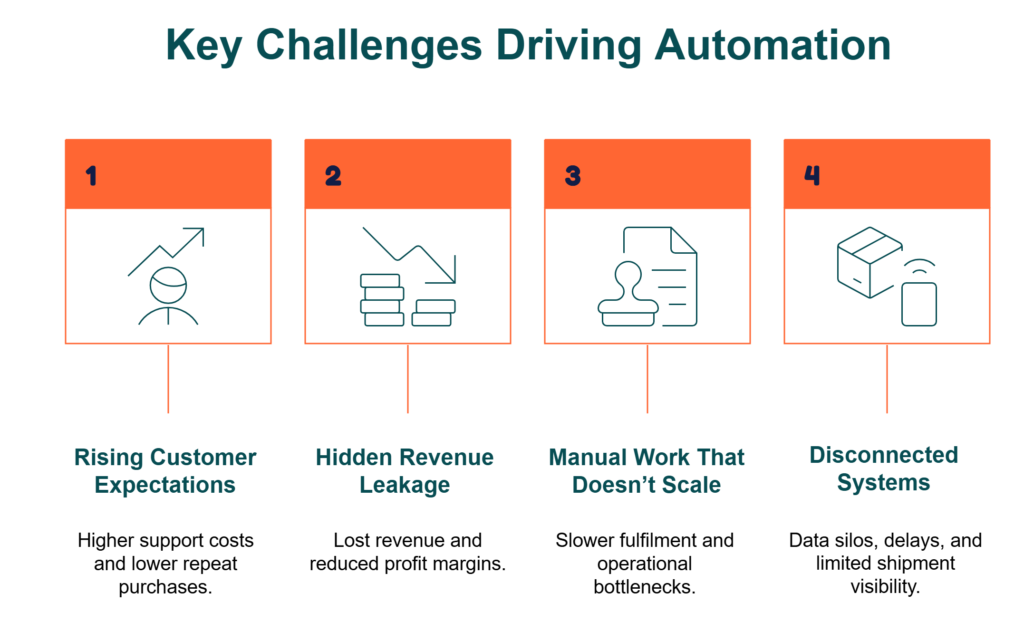
Order-to-delivery automation addresses all four by keeping data in one flow from the first click to the last scan. Speed and accuracy now decide whether a customer buys again.
Market Trend: Where the Industry Is Heading
Globally, MarketsandMarkets values the AI in supply chain market at USD 13.93 billion in 2025 and projects USD 50.41 billion by 2032, a 20.2% CAGR. An earlier edition of the same research put the 2025 figure at USD 14.49 billion, growing to USD 50.01 billion by 2031 at 22.9%. Estimates vary by research firm, but all point to 20%+ annual growth.
India follows the same direction. The India last-mile delivery market is projected to grow from USD 4.75 billion in FY2024 to USD 12.65 billion by FY2032, driven by ecommerce growth. A separate report puts India’s logistics automation market at about USD 1.43 billion in 2024, growing at a 13.6% CAGR through 2029. Demand for order-to-delivery automation follows both curves.
| Market | Starting point | Projection | Growth |
| AI in supply chain (global) | USD 13.93 billion (2025) | USD 50.41 billion (2032) | 20.2% CAGR |
| India last-mile delivery | USD 4.75 billion (FY2024) | USD 12.65 billion (FY2032) | Driven by ecommerce growth |
| India logistics automation | USD 1.43 billion (2024) | Forecast to 2029 | 13.6% CAGR |
Last-mile is where the pressure is highest. Indian addresses often have several street names, houses without numbers, or informal settlements, so a parcel can cross the country on time and still fail on the final stretch. That is why AI-driven courier allocation and delivery prediction matter, and why AI in ecommerce logistics has moved from pilot projects to daily operations.
Four shifts are worth watching:
- From tracking to predictive visibility: the question changes from “where is the parcel?” to “will it arrive late?”
- From a single courier to multi-courier orchestration.
- From reactive NDR calls to automated retries.
- Growing reach into tier-2 and tier-3 cities, where address quality is weaker and courier coverage varies.
For a wider list of applications, see our guide to AI in logistics: 10 use cases for smarter logistics operations.
Where Order-to-Delivery Automation Makes the Biggest Impact
Seven stages carry most of the gain. Stages 1 and 3 are mostly rule-based automation. Stages 2, 4, 5 and 7 need AI to do well, because they depend on predictions and on patterns in past delivery data.
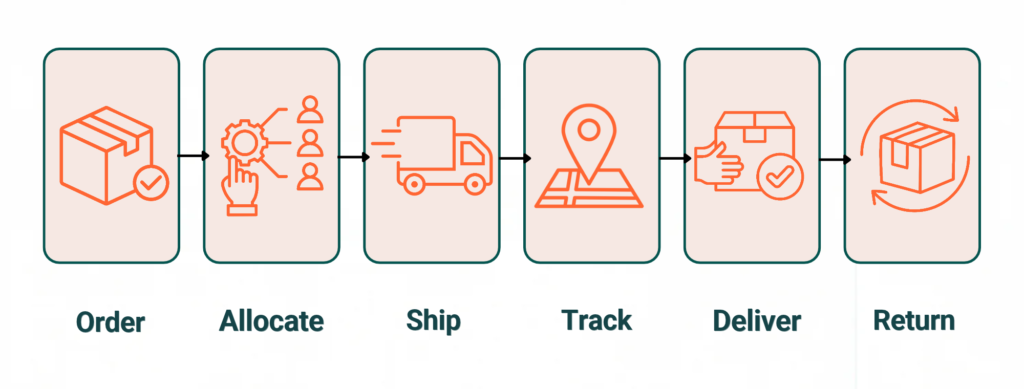
Each stage below follows one pattern: the problem, what automation does, and the outcome.
- Order Capture and Multi-Channel Sync
A brand selling on Shopify, two marketplaces and a B2B portal receives orders in four formats. Someone exports them, fixes the columns and keys them into the ERP or a courier portal. Automatic order ingestion pulls every channel into one workflow and checks the address and pincode before the order moves on. The outcome is no re-keying, fewer wrong addresses and orders that reach the warehouse in minutes. This is the base layer of AI order management, because every later decision depends on clean order data.
- Courier Allocation
Many teams pick couriers by habit or by a rate card. A rate card says nothing about how a courier performs in one specific pincode. AI weighs cost, delivery speed and past delivery performance for every order, then assigns the courier. The outcome is fewer failed deliveries in difficult pincodes and a lower freight cost per order. Artificial intelligence in logistics pays off most clearly here, because the same decision is repeated on every single order.
- Label, Manifest and Pickup Automation
Labels, manifests and pickup requests are often created one at a time, courier by courier, in separate portals. Rule-based automation generates them in bulk. Rules decide the label format, how manifests are grouped and which pickup slot to book, with no portal-hopping. Staff stop logging in to five courier sites each morning, and label errors that cause misrouted parcels drop.
- Real-Time Tracking and Predictive ETA
Customers chase status updates and ops teams chase couriers. One tracking view across all carriers replaces both. The system sends proactive delay alerts and builds delivery estimates from past delivery data instead of a fixed courier promise. Fewer customers have to ask where their order is, and the ones who do get an answer in seconds. Our guide on how to reduce WISMO queries goes deeper on this stage.
- NDR, Redelivery and RTO Prevention
A failed delivery with the reason “customer not available” or “address incomplete” often waits in a courier queue until the parcel is sent back. Automation reads the failure reason, contacts the customer and triggers a retry with a corrected address or a new time slot. The outcome is a lower RTO rate, fewer lost shipments and revenue that would have been written off.
- Proof of Delivery and COD
Delivery disputes, chargebacks and slow cash reconciliation all start with missing evidence. Digital proof of delivery (signature, photo or OTP) is captured at the door and stored against the order. COD tracking matches remittances to delivered orders. Disputes close with evidence on file, and finance can see which COD amounts are still pending.
- Returns and Freight Audit
Returns are clunky when the customer has to email a photo and wait for a reply, and courier invoices are rarely checked line by line. A self-serve return portal lets the customer pick a reason and a pickup slot. Invoices are checked automatically against contracted rates, weights and surcharges. Refunds move faster, and overcharges are found before payment. Capgemini also lists freight cost auditing among its agentic AI use cases for the order-to-delivery process.
Benefits and Outcomes You Can Expect
When order-to-delivery automation is in place, the gains show up in five areas.
| Area | What changes |
| Cost | Less manual effort, fewer RTOs, no overpaid freight |
| Speed | Faster dispatch and shorter processing time per order |
| Accuracy | Fewer label, address and billing errors |
| Customer experience | Reliable delivery dates, fewer support tickets, higher NPS and more repeat orders |
| Visibility and control | One dashboard for every carrier, plus the data to renegotiate rates |
How to Automate Order-to-Delivery: A Practical Framework
A five-step approach keeps order-to-delivery automation manageable for teams of any size.
- Map the journey. Write down every step from order placed to order delivered or returned. Mark where time, money and customer complaints pile up. Two or three steps usually cause most of the pain.
- Connect your systems. Sales channels, ERP, OMS, WMS and couriers should pass data to each other without re-entry. Integration comes before intelligence, because AI needs clean inputs.
- Automate the repeatable work first. Courier allocation, labels, pickups and status updates follow clear rules and are the safest place to begin.
- Add intelligence. Layer in predictive ETA, NDR handling and delay alerts once the basic flow is stable.
- Measure and refine. Track cost per shipment, on-time delivery percentage, NDR resolution rate, RTO percentage, WISMO tickets and freight variance. Review them monthly and adjust the rules. This is where order to delivery optimization becomes a habit.
Where Can You Start?
A big-bang rollout across every channel, warehouse and courier is the quickest way to stall a project. Order-to-delivery automation works best in phases.
A simple “start here” checklist:
- Begin with tracking and courier allocation. They are quick wins with low disruption.
- Pilot on one sales channel, one warehouse or your top five pincode clusters.
- Add NDR and returns in phase two.
- Bring in freight audit once volumes justify it.
Are you ready? Ask yourself four questions:
- How many shipments do you send each month, and is that number growing?
- How many couriers do you use? With two or more, allocation decisions are already being made daily.
- What share of steps (labels, status updates, NDR calls) is still manual?
- What is your RTO rate, and can you name the pincodes that drive it?
If your volume is growing, you use more than one courier, most steps are manual, or you cannot name your RTO rate, a pilot this quarter will pay back quickly.

How eShipz Does It
eShipz is an AI-powered logistics automation platform with 500+ carrier integrations, serving 350+ brands including Fossil, Snitch, Arvind, Savex and Vero Moda. It delivers order-to-delivery automation through modules that map to the stages above.
- AutoShip Hub: label generation and courier sync with no code. The site claims a 50% reduction in manual work.
- CarrierSmart AI: picks the best courier for each order by balancing speed, cost and performance. See courier allocation.
- Track360 and PredictShip ETA: a single tracking dashboard with delay alerts, plus predictive EDD and ETA built on past delivery data.
- ReDelivR: detects failure reasons and triggers smart retries through redelivery automation. The site claims up to a 10% RTO reduction.
- ReturnEase Portal: a branded, self-serve returns experience.
- IntelliProof ePOD and FreightGuard AI: instant proof of delivery, plus automatic freight audit of carrier invoices against contracted rates.
Integrations cover Shopify, ERP (including ERPNext), OMS and WMS, TMS and other sales channels, with APIs for custom setups.
Conclusion
The biggest gains in order-to-delivery automation come from courier allocation, tracking visibility, delivery recovery and returns. Start with one channel, measure the result and expand from there. Automate the repetitive work so your team can handle the exceptions. Ready to see it on your own orders? Book a demo.
Frequently Asked Questions
- What is order-to-delivery automation?
Order-to-delivery automation uses software rules and AI to run the steps between an order being placed and the parcel being delivered or returned. That covers order sync, courier selection, labels, pickup, tracking, failed-delivery recovery, proof of delivery and returns. - Where does AI add the most value in the order to delivery process?
AI adds the most value where decisions repeat often and depend on past data: courier allocation, predictive delivery estimates, failed-delivery handling and freight invoice checks. Label printing and order sync are mostly rule-based and need less intelligence. - How does AI reduce RTO and failed deliveries?
AI picks couriers that perform well in the destination pincode, reads NDR reasons, and triggers a retry with a corrected address or new slot. Fewer parcels sit unattended in courier queues, so fewer return to origin. - Is order-to-delivery automation only for large enterprises?
No. Smaller brands often feel manual work sooner, because one or two people carry the whole dispatch load. Starting with tracking and courier allocation on a single channel keeps the effort and the risk low. - Which KPIs should I track after automating?
Track cost per shipment, on-time delivery percentage, NDR resolution rate, RTO percentage, WISMO tickets and freight variance. Compare each against your numbers from before the pilot. - How long does order fulfillment automation take to roll out?
It depends on how many systems need connecting and how many couriers you use. A pilot on one channel or warehouse is much faster than a company-wide rollout, which is why a phased start is recommended. - What is the difference between logistics automation and AI in logistics?
Logistics automation runs fixed rules, such as generating a label when an order is confirmed. AI in logistics learns from data to make decisions, such as choosing the courier most likely to deliver on time in a given pincode. Most platforms combine both.