









Multi-carrier shipping software is the tool that lets an online store book, label and track parcels across many couriers from one screen, and in 2027 it is the first system worth getting right if shipping is eating your margin. This guide explores which features to compare in a multi-carrier shipping platform, how multi-carrier shipping solutions differ from one another, and what to ask a vendor before you sign.
Most Indian sellers hit the same wall. One courier is cheap but slow in the north east. Another is quick in metros but charges heavily for cash on delivery. A third loses parcels in the week you can least afford it. Shipping software for ecommerce that talks to only one courier cannot fix any of that, which is why brands adopt multi-carrier shipping software once they pass a few hundred orders a day.
The numbers show how big the wall is. One industry report puts India’s express parcel market at roughly 10 to 11 billion shipments in FY25, with e-commerce accounting for more than half, and projects 24 to 29 billion shipments by FY30. Failed deliveries hurt just as much. Razorpay puts return to origin (RTO) at 25 to 30 percent for cash on delivery orders in India, against 2 to 3 percent for prepaid ones. Base estimates that cutting RTO by five percentage points on 1,000 daily COD orders saves about ₹75,000 to ₹1,20,000 a month in reverse logistics alone.
Under the hood, every good multi-carrier shipping platform runs on a carrier integration platform and bundles shipping management software, shipping automation software and carrier allocation software. Those are the pieces you are actually comparing, even when vendors give them different names.
Here is what we will explore: what multi-carrier shipping software does, which features of shipping software for ecommerce matter most, how the main approaches compare in a table, which mistakes buyers make, and how to choose step by step. FAQs and a short note on eShipz close the guide.
What Multi-Carrier Shipping Software Does and Why It Matters in 2027
Multi-carrier shipping software connects your store to several courier companies and lets you compare rates, print labels and track parcels from one dashboard. You enter an order once. The software shows price, speed and service level from every carrier you have switched on, and you pick the one that suits that parcel.
Think of it as a booking site for parcels. A single-courier tool shows you one option, while multi-carrier shipping software shows all of them side by side.
Why does this matter more in 2027? Courier rates keep moving, customers expect fast delivery in metros, and marketplaces penalise late dispatch. A multi-carrier shipping platform gives you room to react. When one partner slows down in a region, you shift volume to another the same day.
Small sellers sometimes think multi-carrier shipping solutions are meant for big brands. They gain the most, though, because a small seller has the least negotiating power. Even entry level multi-carrier shipping solutions bring rate comparison and tracking into one place.
The right shipping software for ecommerce also pulls orders from Shopify, WooCommerce, Amazon and your own site, then sends tracking numbers back to the customer. Good multi-carrier shipping software does this without copy and paste.
How a Multi-Carrier Shipping Platform Works From Order to Delivery
A multi-carrier shipping platform follows one loop: order in, rules applied, courier chosen, label printed, parcel tracked. In more detail:
- Order sync. The multi-carrier shipping software pulls orders from your store and cleans addresses before a rider ever sees the parcel.
- Rate comparison. The carrier integration platform asks each courier for price and speed, and the shipping management software shows the answers side by side.
- Selection. Carrier allocation software applies your rules, such as cheapest for prepaid orders or fastest for premium customers.
- Execution. Shipping automation software prints the label, books the pickup and sends the tracking message.
- Tracking. The multi-carrier shipping platform watches every status update and flags delays, failed deliveries and returns.
- Analytics. Strong multi-carrier shipping solutions report cost per order, delivery success by carrier and transit time by pincode.
If any of those six steps still happens by hand in your current setup, that is where multi-carrier shipping software will give you time back first.
Multi-Carrier Shipping Solutions: What Is Changing in 2027
Multi-carrier shipping solutions used to mean one dashboard and a rate table. In 2027 buyers expect more: routing that learns from past deliveries, branded tracking pages, return portals, and cash on delivery reconciliation inside the shipping management software instead of a spreadsheet.
The best multi-carrier shipping solutions now treat each parcel as a decision. Carrier allocation software predicts which courier will perform for a pincode, shipping automation software acts on that prediction, and shipping management software shows the result.
Cross-border selling is growing too. A multi-carrier shipping platform with international couriers now also covers customs documents and duty estimates, which matters if you plan to sell abroad. A carrier integration platform that supports granular events, from out for delivery to rider calls, is becoming the baseline.
Sustainability is a smaller trend but a real one. Some multi-carrier shipping solutions show estimated emissions per shipment, so a brand can pick the greener option when cost and speed are equal.
None of this works on bad data. Whichever multi-carrier shipping software you pick, wrong weights and sloppy pincodes will still produce wrong rates.
Shipping Software for Ecommerce: Features to Compare First
Not all shipping software for ecommerce is equal. Some tools wrap a single courier, while a real multi-carrier shipping platform connects dozens. These are the features worth checking:
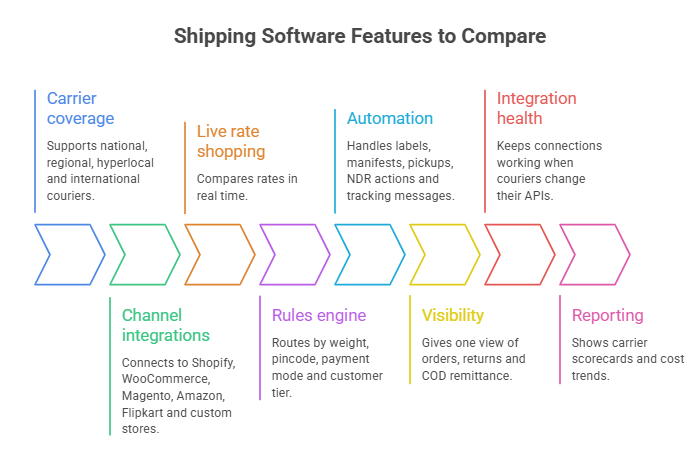
- Carrier coverage: look for multi-carrier shipping software that supports national, regional, hyperlocal and international couriers.
- Channel integrations: strong shipping software for ecommerce connects to Shopify, WooCommerce, Magento, Amazon, Flipkart and custom stores through APIs.
- Live rate shopping: the multi-carrier shipping platform should compare rates in real time, not from a stale table.
- Rules engine: quality carrier allocation software lets you route by weight, pincode, payment mode and customer tier.
- Automation: dependable shipping automation software handles labels, manifests, pickups, NDR actions and tracking messages.
- Visibility: good shipping management software gives one view of orders, returns and COD remittance.
- Integration health: a stable carrier integration platform keeps connections working when couriers change their APIs.
- Reporting: the best multi-carrier shipping solutions show carrier scorecards and cost trends.
Also ask about support. When a courier API breaks at midnight in sale season, you want a vendor who picks up the phone. The right multi-carrier shipping software comes with people behind it.
Carrier Integration Platform: The Feature Buyers Skip
A carrier integration platform is the technical layer that connects your shipping tool to courier APIs. It translates one booking request into each carrier’s format, so a single click can reach many partners.
Without a solid carrier integration platform, every new courier means weeks of developer work. With one, adding a carrier can take days.
This matters for multi-carrier shipping software because integration quality decides how accurate your rates, labels and tracking updates are. A weak link means wrong charges and missing scans.
Ask any vendor three things about the carrier integration platform: whether tracking statuses are standardised, whether the system retries when a courier API is slow, and whether new carriers can be tested in a sandbox first.
Every multi-carrier shipping platform depends on this layer, and the best multi-carrier shipping solutions monitor it around the clock.
If you run shipping software for ecommerce on your own stack, building a carrier integration platform in house is possible but costly. Most brands buy ready-made multi-carrier shipping software and let the vendor maintain the connections.
Shipping Management Software: Features That Keep Every Order Visible
Shipping management software is the control room of your logistics. It shows where each parcel is, which carrier holds it and what is going wrong.
Inside a multi-carrier shipping platform, shipping management software handles order queues, bulk label printing, pickup scheduling, returns and COD reconciliation.
Teams often find that shipping management software saves more time on exceptions than on labels. Failed deliveries, address problems and customer calls pile up fast, and one view makes them manageable.
Pairing shipping management software with multi-carrier shipping software also helps customer service. Agents see live tracking and can answer “where is my order” in seconds.
Look for branded tracking pages, role based access for warehouse and support staff, and carrier scorecards. The better multi-carrier shipping solutions add proactive alerts so customers stop asking and start trusting.
Shipping Automation Software: Features That Save Hours Every Day
Shipping automation software removes repetitive work. Orders flow in, rules run, labels print and customers get messages without anyone touching a button.
Take a store with 300 orders a day. At two minutes per order by hand, that is ten hours of work. Shipping automation software can cut it to a few minutes of review.
Typical tasks include auto-assigning couriers, generating labels and manifests, booking pickups, sending email and WhatsApp updates, and triggering NDR follow-ups. Ask whether the shipping automation software allows human overrides, because some parcels need a person’s judgement.
When shipping automation software lives inside a multi-carrier shipping platform, the gains multiply, since automation can use live rates and carrier performance data.
That is why many multi-carrier shipping solutions lead with automation, and why shipping software for ecommerce without it feels slow.
Even basic multi-carrier shipping software can automate labels. Advanced shipping automation software adds conditions, such as holding fragile items for a safer carrier.
Carrier Allocation Software: Features That Cut Cost per Parcel
Carrier allocation software decides which courier carries which parcel. It looks at price, speed, past delivery success, pincode serviceability and your own business rules.
A basic version picks the cheapest rate. Smarter carrier allocation software balances cost against delivery performance, because a cheap courier with high returns is not actually cheap.
Here are rules worth testing. Prepaid orders under 500 grams go to the lowest cost partner. Cash on delivery in tier 3 towns goes to the courier with the best COD success rate. High value orders go to the most secure carrier. Good carrier allocation software lets you write these in plain language.
You can also split volume by percentage. For example, carrier allocation software can send 50 percent to one courier, 30 to a second and 20 to a third, then shift the weights as performance changes.
Inside a multi-carrier shipping platform, carrier allocation software works hand in hand with shipping automation software, because rules only help if they run on their own.
Over time, carrier allocation software turns your shipping data into a smarter network, and multi-carrier shipping solutions with strong allocation logic tend to improve delivery rates month after month.
It also helps at the negotiating table. When your multi-carrier shipping software shows volume going to several partners, each courier has a reason to keep rates sharp.
Multi-Carrier Shipping Software Comparison Table: Manual vs Single Courier vs Generic Tool vs eShipz
eShipz has its own column below. The eShipz details are kept general, so confirm current features on its website before you decide.
| Feature | Manual shipping | Single-courier tool | Generic multi-carrier tool | eShipz |
| Multi-carrier shipping software | Separate portals | One courier only | Several couriers | Many couriers, one dashboard |
| Multi-carrier shipping platform | None | None | Basic | Built for scale |
| Multi-carrier shipping solutions | None | Limited | Partial | Full set in one place |
| Shipping software for ecommerce | Copy and paste orders | Limited store sync | Common store sync | Store, marketplace and API sync |
| Carrier integration platform | Not applicable | One API | A few APIs | Wide, maintained integrations |
| Shipping management software | Spreadsheets | Basic tracking | Standard dashboard | Orders, returns and COD in one view |
| Shipping automation software | None | Label printing only | Some automation | Labels, pickups and alerts automated |
| Carrier allocation software | Gut feeling | Not available | Simple rules | Rule based allocation |
A manual setup struggles on every row. Multi-carrier shipping software with built in allocation and automation covers all eight, and a multi-carrier shipping platform like eShipz is designed around that full set.
How to Choose a Multi-Carrier Shipping Platform: Step by Step
- Audit current shipping. List carriers, rates, delivery times and return rates. Even a spreadsheet shows where multi-carrier shipping software can help.
- Rank your must-haves. Decide which of shipping management software, shipping automation software and carrier allocation software you need first.
- Check integrations. Confirm the shipping software for ecommerce supports your store, marketplace and ERP.
- Test the carrier integration platform. Ask how many carriers are live, how fast new ones are added and how failures are handled.
- Run a pilot. Send ten percent of orders through the new multi-carrier shipping platform for two weeks and compare against your old setup.
- Scale gradually. Move more volume once results hold and tune your carrier allocation software rules.
- Review monthly. The best multi-carrier shipping solutions give you scorecards, so use them to rebalance and renegotiate.
Common Mistakes When Buying Multi-Carrier Shipping Solutions
- Choosing on price alone. The cheapest multi-carrier shipping solutions can hide weak support or thin carrier coverage.
- Ignoring data quality. Even great carrier allocation software fails when pincodes and weights are wrong.
- Automating too early. Shipping automation software needs sensible rules, so start simple.
- Skipping training. Shipping management software only helps if the team opens it.
- Treating integration as a one-off. A carrier integration platform needs monitoring because courier APIs change.
- Forgetting the customer. The best shipping software for ecommerce improves tracking and delivery messages along with back office speed.
- Staying loyal to one courier. A multi-carrier shipping platform only pays off if you actually use more than one carrier.
- Overbuying. Smaller stores rarely need every module of a large multi-carrier shipping software suite on day one.
An Illustrative Example: One Fashion Brand and Multi-Carrier Shipping Software
This is a made up scenario, not a customer case. Picture a mid-size fashion brand that ships 400 orders a day across India using shipping software for ecommerce that supports a single courier. Returns run high in remote pincodes, and metro deliveries sometimes take four days.
The brand moves to a multi-carrier shipping platform and connects three couriers through a carrier integration platform. It then writes carrier allocation software rules: express for metros, economy for prepaid orders in tier 2 towns, and a COD strong courier for the rest.
Shipping automation software prints labels and sends tracking updates, which frees two people from manual work. Shipping management software gives support one view, and reports from the multi-carrier shipping solutions show which courier performs best by pincode.
Within a quarter the team can see how shipping software for ecommerce, set up with several carriers, changes both cost and customer experience. Multi-carrier shipping software rewards teams that treat shipping as a system.
Who Benefits Most From a Multi-Carrier Shipping Platform?
- Small sellers. A lightweight multi-carrier shipping platform gives startups rates they could never negotiate alone.
- Growing brands. At a few hundred orders a day, carrier allocation software and shipping automation software become essential because manual choices stop scaling.
- D2C brands. Shipping software for ecommerce with branded tracking and returns protects reputation.
- Marketplaces and 3PLs. A robust carrier integration platform and flexible shipping management software are essential when every client has different carrier contracts.
- Enterprises. Large shippers need multi-carrier shipping software with audit trails, role based access and ERP links.
Shipping Software for Ecommerce: What to Prioritise at Each Stage of Growth
Under 100 orders a day: pick shipping software for ecommerce with live rate shopping and clean store sync. A basic multi-carrier shipping platform is enough, and carrier allocation software can wait.
100 to 500 orders a day: add shipping automation software and a rules engine. This is where multi-carrier shipping solutions start paying back the subscription, since manual courier choices stop scaling and shipping management software becomes the daily workspace. Choose shipping software for ecommerce whose pricing grows gently with volume.
500 to 2,000 orders a day: stress test the carrier integration platform. Volume exposes slow APIs and weak retries, and carrier allocation software needs enough history to split volume by performance.
Above 2,000 orders a day: look for audit trails, open APIs and a vendor team that treats your carrier integration platform as a live account with real service levels.
A 30-Day Rollout Plan for Your New Multi-Carrier Shipping Platform
Week one: connect your store and your existing couriers. Ask the vendor to confirm every carrier integration platform connection with a test shipment, and check that the shipping software for ecommerce syncs your catalog and orders. Clean your pincode and weight data before the first live order.
Week two: switch on shipping management software for returns, COD and NDR queues, and train warehouse and support teams on it. Keep carrier allocation software on a simple cheapest-first rule for now.
Week three: turn on shipping automation software for labels and tracking messages, then compare carrier scorecards in the shipping management software. Move a slice of volume to the best performer.
Week four: review cost per order, delivery success and support tickets, then refine your carrier allocation software rules. If the multi-carrier shipping solutions you chose are saving money, expand to more pincodes and more carriers.
Buyer’s Checklist: Questions to Ask Before Choosing Shipping Software for Ecommerce
- Does the carrier integration platform support the couriers I use now and the ones I want next?
- How does the carrier integration platform handle API downtime?
- Does the carrier integration platform expose open APIs for my developers?
- Does the shipping management software show returns, COD and NDR in one view?
- Can the shipping management software give warehouse and support teams separate permissions?
- Can I view carrier scorecards in the shipping management software?
- How flexible is the carrier allocation software for pincode, weight and payment rules?
- How does the carrier allocation software learn from past performance?
- Can the shipping automation software trigger WhatsApp, SMS and email updates?
- Does the shipping automation software allow human overrides?
- Is this shipping software for ecommerce proven with stores like mine?
- Does the shipping software for ecommerce sync with my storefront in real time?
- Will this multi-carrier shipping software scale when my volume doubles?
- Which multi-carrier shipping solutions come with onboarding and support?
- How is the multi-carrier shipping platform priced at my volume?
Feature Recap: What to Compare in a Multi-Carrier Shipping Platform
Strip away the marketing and every multi-carrier shipping platform comes down to the same short list. Score each vendor on it and the choice gets easier.
Start with the carrier integration platform, because rates and tracking are only as good as the connections. Then check whether the shipping management software gives your team one clear view, whether the shipping automation software removes manual steps, and whether the carrier allocation software lets you set rules in plain language. Finally, confirm that the shipping software for ecommerce on your shortlist syncs with your storefront. Compare shipping software for ecommerce over a full twelve months of use, since the first invoice hides integration and support costs.
Vendors that sell multi-carrier shipping solutions will each lead with a different strength. Some push carrier count, others push automation. Weigh those claims against your own order mix.
Frequently Asked Questions About Multi-Carrier Shipping Solutions
What is multi-carrier shipping software?
It is a tool that connects your store to many couriers so you can compare rates, print labels and track parcels in one place. A typical multi-carrier shipping platform adds rules, automation and reports on top.
What is a multi-carrier shipping platform?
It is the full system: the dashboard, the carrier integration platform and the rules engine. It is the product that delivers multi-carrier shipping solutions to your team.
What are multi-carrier shipping solutions?
They are services that help brands ship with several couriers at once. They usually include shipping management software, shipping automation software and carrier allocation software.
What is shipping software for ecommerce?
It connects your online store to couriers so orders turn into labels automatically. The best shipping software for ecommerce supports many carriers, which makes it a multi-carrier shipping platform by another name.
What is a carrier integration platform?
It is the technical layer linking your tools to courier APIs. A reliable carrier integration platform keeps rates, labels and tracking accurate.
What is shipping management software?
It gives one view of orders, shipments, returns and costs. Strong shipping management software helps support teams answer tracking questions fast.
What is shipping automation software?
It runs repeat tasks such as label printing, pickup booking and tracking alerts. Good shipping automation software saves hours every day.
What is carrier allocation software?
It picks the best courier for each parcel using rules and performance data. Smart carrier allocation software balances cost, speed and delivery success.
How much do multi-carrier shipping solutions cost?
Pricing varies. Some multi-carrier shipping solutions charge per shipment, others a monthly plan, and some both. Compare total cost, including any carrier integration platform fees, against the savings from rate shopping in your shipping software for ecommerce.
Can shipping automation software work with carrier allocation software?
Yes. In a good multi-carrier shipping platform, shipping automation software applies the rules set in carrier allocation software the moment an order arrives.
How do I choose multi-carrier shipping software?
Compare carrier coverage, integrations, rule flexibility and support. Test the carrier integration platform, check the shipping management software dashboard and ask for a pilot.
Which features should shipping software for ecommerce have in 2027?
Live rate shopping, store integrations, a rules engine, automation, tracking pages and reporting. Shipping software for ecommerce that lacks two or more of those will limit you quickly.

Conclusion: Multi-Carrier Shipping Solutions Built for Growth, Powered by eShipz
Multi-carrier shipping software gives you control over a cost most brands just put up with. In this guide we compared the features that matter: a carrier integration platform that keeps connections healthy, shipping management software that keeps every order visible, shipping automation software that removes manual work, and carrier allocation software that sends each parcel to the right courier. Together they make multi-carrier shipping solutions worth the switch.
If you want to see these features working, look at eShipz. eShipz brings a carrier integration platform, shipping management software and shipping automation software together, so your team can ship smarter from the first week. Whichever vendor you choose, insist on shipping software for ecommerce that connects many couriers and reports carrier performance.
Ready to try it? Book a demo with eShipz and see what multi-carrier shipping solutions should feel like day to day. Start with a small pilot, test one carrier integration platform connection, read the shipping management software reports, and then switch on more shipping automation software.
Pick shipping software for ecommerce that makes shipping management software easy for your whole team, and that keeps shipping automation software and your carrier integration platform working quietly in the background.