









Which is the best shipping rate comparison tool for Indian sellers? The short answer is that it depends on whether you need a quick quote or a system that picks couriers for you. This guide covers the top five options for the best shipping rate comparison tool for Indian sellers, shows how courier charges are built, and gives a repeatable way to compare rates before you ship. eShipz is listed first because this guide is published by eShipz, with an honest note on who it suits.
Best Shipping Rate Comparison Tool for Indian Sellers: The Top 5 Shortlist
eShipz suits brands with volume and rules that want courier choice automated, and it is listed first because this guide is published by eShipz. Shiprocket’s free calculator is the easiest quick quote, NimbusPost suits sellers who want automatic courier choice, Delhivery gives the most detailed single-carrier quote, and DTDC fits specific services.
| Tool | Type | Best for | Not for |
|---|---|---|---|
| eShipz | Shipping automation platform | Brands that need rules, allocation and tracking | Sellers who want only a free public calculator |
| Shiprocket | Aggregator | A free quote across couriers, air and surface | Sellers who want a custom rules engine |
| NimbusPost | Aggregator | Sellers who want AI-based courier choice | Sellers who only want a one-off quote |
| Delhivery | Courier | Detailed single-carrier quote with COD and RTO costs | Sellers who need to compare many carriers |
| DTDC | Courier | Sellers who need its express or air services | Sellers who want a multi-carrier comparison |
To shortlist the best shipping rate comparison tool for Indian sellers, we asked one question: how well does the tool help a seller compare more than one courier before shipping? The order above is not a verdict on quality. eShipz is listed first because it publishes this guide. Descriptions rely on what each brand states on its own public pages as of November 11, 2026. Rates and features change, so check each tool before you commit.
What is a shipping rate comparison tool and how does it work?
A shipping rate comparison tool takes your pickup pincode, delivery pincode, parcel weight and size, and returns estimated charges from more than one courier. Some also factor in payment mode, delivery speed and zone. The result is a side-by-side view, so you pick a courier with facts instead of habit.
Two types of tool exist. The first is a calculator, which gives a quote and nothing more. The second is a platform that also books the shipment, prints the label and tracks the parcel. The best shipping rate comparison tool for Indian sellers is the one that matches how many orders you ship and how much control you want.
For a seller shipping a handful of parcels a week, a calculator is enough. For a brand shipping hundreds of orders a day, the quote is only the first step. The real savings come from choosing the right carrier for every order, automatically, every day.
How is shipping cost calculated in India: volumetric weight vs dead weight?
Couriers in India charge on the higher of two weights: dead weight, which is what the parcel weighs on a scale, and volumetric weight, which is calculated from the box size. Delhivery, for example, states a formula of length times breadth times height divided by 5000, using centimeters.
Take a box that is 60 × 25 × 40 cm with a dead weight of 6 kg. Its volumetric weight is 12 kg, so the courier bills for 12 kg. Delhivery’s own help page uses this exact example. A light but bulky parcel can cost double what you expected.
| Box size (cm) | Dead weight | Volumetric weight (L × B × H ÷ 5000) | Weight the courier uses |
|---|---|---|---|
| 30 × 20 × 10 | 1 kg | 1.2 kg | 1.2 kg |
| 40 × 30 × 25 | 2 kg | 6 kg | 6 kg |
| 30 × 25 × 15 | 2 kg | 2.25 kg | 2.25 kg |
The examples above use the 5000 divisor stated by Delhivery. Other couriers may use a different divisor, so always confirm it before you compare quotes.
Weight is where many surprise charges start, so test it first with whichever shipping rate comparison tool you choose. RedSeer, in its outlook on logistics in India by 2030, expects shipment volumes to grow 6 to 8 times by 2030 and lists weight-related disputes among the open challenges for the industry. Measuring and packing correctly keeps those disputes off your books.
The chart below shows how much packing alone can change a bill, whichever tool you pick as the best shipping rate comparison tool for Indian sellers. The numbers are illustrative: they assume a hypothetical charge of ₹40 per 500 g slab and rounding up to the next slab. They are not a quote from any courier.
Before you compare couriers, fix your box size. A smaller box lowers the volumetric weight for every courier at once.
How do I compare courier rates across carriers in India?
Enter the same pickup pincode, delivery pincode, weight, box size and payment mode into each tool, then compare the total landed cost, not only the freight line. Add COD fees, return charges and expected delivery time before you pick. Repeat the check for your top five lanes.
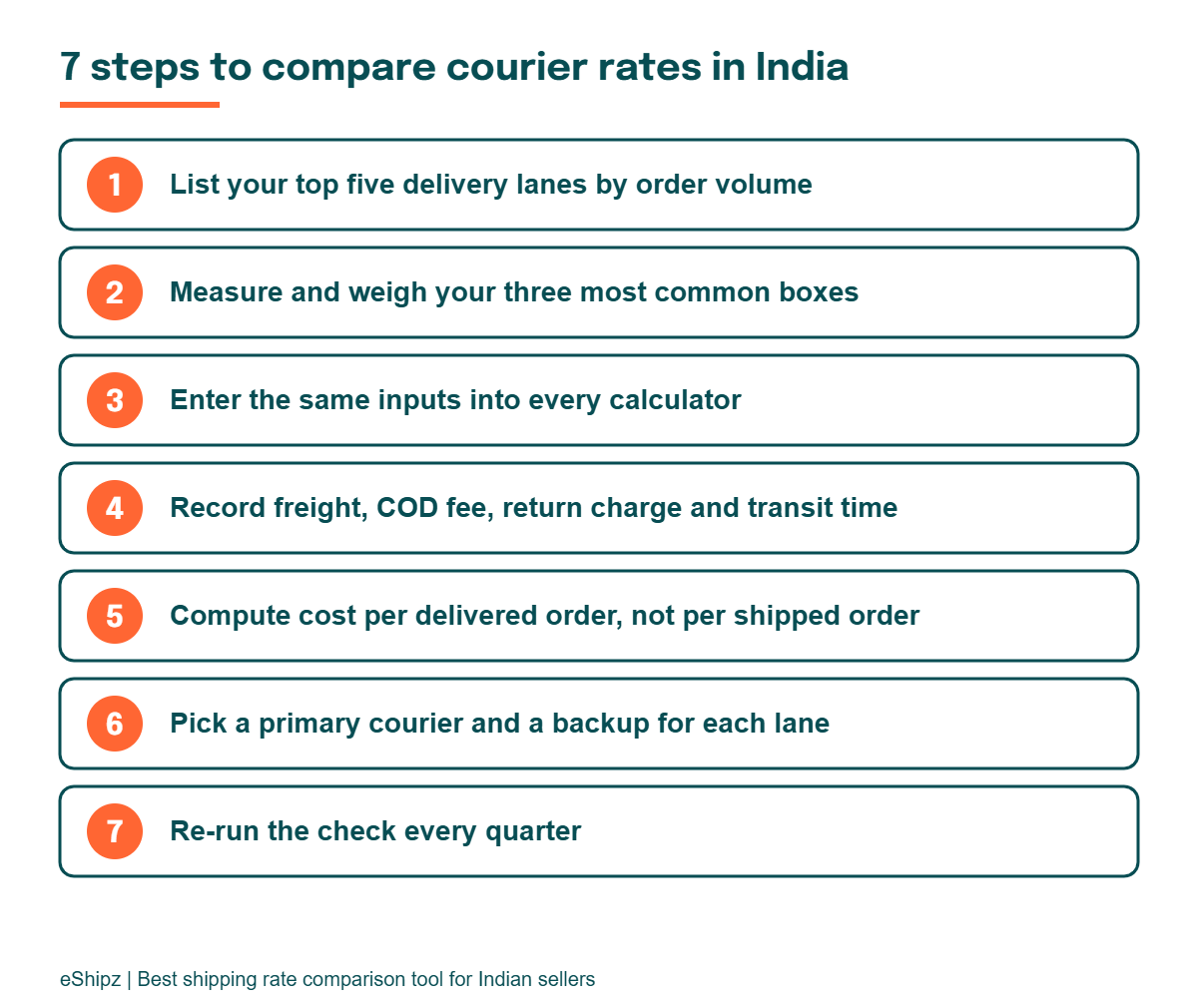
Here is a repeatable workflow you can run in under an hour with any shipping rate comparison tool.
- List your top five delivery lanes by order volume, such as Delhi to Mumbai or Bengaluru to Kolkata.
- Measure your three most common box sizes and weigh each packed parcel.
- Enter the same inputs into each calculator you are testing.
- Record freight, COD fee, return charge and transit time in one sheet.
- Compute the total cost per delivered order, not per shipped order.
- Pick a primary courier and a backup for each lane.
- Re-run the check every quarter, or when a courier changes its rates.
Step five matters most. A cheap courier that delivers late or returns more parcels can cost more than a pricier one that delivers first time. If you track failed deliveries, our guide on weight discrepancy in shipping shows how to catch billing gaps that a quote never reveals.
Which courier is cheapest for a 500g parcel?
No single courier is cheapest for every 500 g parcel. The lowest rate depends on the pickup and delivery pincodes, the zone, the shipping mode, your plan and your volume. The only reliable way to find the cheapest option is to run your own lanes through a calculator.
What you can do is narrow the field. Check air and surface separately, since the cheapest surface option may be slower than you can accept. Check metro-to-metro lanes and metro-to-remote lanes as separate tests, because the winner often changes.
NimbusPost lists a starting price of ₹19 per 500 g for B2C shipping on its own website, with terms attached. Treat any such starting price as the best case, not your average. Your actual rate depends on the lane and plan you choose.
How do COD charges affect the total shipping cost?
COD adds a collection fee on top of freight, and a failed COD delivery adds a return charge too. A cheap freight rate with a high COD fee or a high return rate can cost more than a pricier carrier. Always compare the full cost of a COD order, not only the base rate.
Delhivery’s calculator takes the payment mode and COD amount as inputs, and it also shows RTO and reverse costs next to the shipping estimate.
Not every tool is the best shipping rate comparison tool for Indian sellers on COD. Shiprocket’s calculator, as described on its page, takes pincodes, weight and dimensions, and does not list COD as an input. If you ship a lot of COD, add the fee to your sheet by hand.
| Cost item | Where it appears | Why it matters |
|---|---|---|
| Freight | Base quote | Depends on zone, weight and mode |
| COD fee | Added for COD orders | Can outweigh a small freight saving |
| Return (RTO) charge | Added when a parcel is returned | Failed COD orders pay it twice |
| Reverse pickup | Added for customer returns | Often priced differently from forward |
| Weight adjustment | Added after pickup | Triggered when the billed weight is higher |
Is there a free shipping rate calculator for India?
Yes. Shiprocket offers a free shipping rate calculator on its website, and Delhivery offers a rate calculator inside its Delhivery One portal. Both ask for pincodes, weight and size. A free calculator gives a quote, but it does not book shipments, apply your rules or audit invoices.
Shiprocket states that its calculator covers more than 19,000 pincodes across India for domestic shipping. It shows the zone and lets you view air and surface rates together. It also has a separate international calculator.
Delhivery’s calculator shows Surface and Express options with transit time in days and an estimated cost. Its page says rates vary with shipping volume and asks you to sign up on Delhivery One to know your rate.
A free calculator is a good start for any seller still searching for the best shipping rate comparison tool for Indian sellers. Its limit is that it answers one question at a time. When you ship every day, you need the answer applied automatically to each order, which is where a platform earns its place.
How do the top shipping rate comparison tools compare side by side?
Shiprocket and NimbusPost compare several couriers, Delhivery and DTDC quote their own services, and eShipz applies rules to pick a carrier per order. The table lists only facts each brand states on its own public pages. Where we could not verify an attribute, we left it out.
| Tool | What it is | Verified detail from its own pages |
|---|---|---|
| eShipz | Shipping automation platform | States 500+ carrier integrations; AI-driven allocation across speed, cost and performance; no standalone public rate calculator found |
| Shiprocket | Aggregator with a free calculator | Takes pickup and delivery pincodes, weight and dimensions; shows zone and air and surface rates; states 19,000+ domestic pincodes |
| NimbusPost | Aggregator | States 25+ eCommerce couriers; AI-based courier allocation; lists a B2C starting price of ₹19 per 500 g |
| Delhivery | Courier | Calculator takes payment mode and COD amount; shows Surface and Express with transit days and cost; shows RTO and reverse costs; volumetric divisor of 5000 |
| DTDC | Courier | States Express Parcel, AirMax, Express Premium and Raftaar services; international delivery to 220+ destinations |
Here is how each one fits as a shipping rate comparison tool for Indian sellers, starting with eShipz.
eShipz. It does not offer a public rate calculator that we could find. It compares carriers inside its courier allocation, on delivery speed, shipping cost and performance, and applies rules you set. It suits brands with steady volume across many lanes. It is not for sellers who want only a free, quick calculator.
Shiprocket. It is the easiest way to see several couriers and both air and surface rates in one calculator. It is a strong first stop for a new seller. It is less suited to sellers who want to build detailed allocation rules.
NimbusPost. It states AI-based courier selection and a list of more than 25 couriers, which suits sellers who want the platform to choose. It is less suited to sellers who only need a quote once in a while.
Delhivery. Its calculator is the most detailed single-carrier quote of the group, because it includes COD amount, RTO and reverse costs. The limit is obvious: it only quotes Delhivery.
DTDC. It offers express, air and rapid delivery services, plus international reach. We could not verify a public rate calculator on its homepage, so we cannot say how well it supports multi-courier comparison.
We have left Pickrr out of the table because its website could not be read for verification, and we do not publish facts we cannot check. Add it to your own test if it serves your lanes.
What should the best shipping rate comparison tool for Indian sellers include?
The best shipping rate comparison tool for Indian sellers does five things well: it compares many carriers, accepts the right inputs, shows the full cost including COD and returns, applies the choice automatically, and checks invoices afterward. A tool that does only the first step leaves most of the savings on the table.
Use this checklist when you test any option.
| What to check | Why it matters | Ask |
|---|---|---|
| Carrier coverage | More carriers mean more choice per lane | How many couriers does it compare? |
| Inputs | Better inputs give a truer quote | Does it take weight, size, pincodes and payment mode? |
| Full cost view | Freight alone misleads | Does it show COD, RTO and reverse costs? |
| Automation | Quotes help only if applied | Can rules pick the courier per order? |
| Audit | Invoices drift from quotes | Does it flag weight and rate mismatches? |
| Tracking and NDR | Delivery rate drives total cost | Does it connect to tracking and failed delivery handling? |
Be honest about your stage when you shortlist the best shipping rate comparison tool for Indian sellers. A seller with ten orders a week does not need an automation platform. A brand with thousands of orders a month does, because even a small saving per order adds up quickly.
What mistakes make rate comparison misleading?
When you search for the best shipping rate comparison tool for Indian sellers, the most common mistakes are comparing quotes with different weights, ignoring COD and return charges, trusting a public starting price, and comparing once and never again. Each one makes a courier look cheaper than it is.
Mistake one is ignoring the box. Volumetric weight can double a bill, as the chart earlier shows. Review packaging before you negotiate with any courier.
Mistake two is treating a headline price as your price. Starting prices describe the best case. Your lane, plan and volume decide the real number.
Mistake three is comparing on freight alone. A low rate with a high return rate costs more per delivered order. Track delivered orders, not shipped ones.
Mistake four is never repeating the check. Courier rates and service levels shift. A quarterly review keeps your choices current without much effort.
How does eShipz fit into shipping rate comparison?
eShipz is a shipping automation platform, so it works after the quote: it evaluates carriers on serviceability, delivery timelines, shipping cost and historical performance, applies the rules you configure, and assigns a courier. It is built for brands that want the comparison to run automatically on every order.
On its own site, eShipz states 500+ carrier integrations, AI-driven courier allocation, real-time tracking through Track360, and a returns portal. Its courier allocation page says the system balances delivery performance, cost efficiency and customer expectations, rather than simply choosing the cheapest option.
That distinction matters when you pick the best shipping rate comparison tool for Indian sellers. The cheapest quote is not always the cheapest delivered order. A platform that weighs speed and performance alongside cost can lower the true cost per delivered parcel, though results depend on your lanes and carriers.
We should be plain about the fit. If you want a free, one-time quote, start with a public calculator. If you ship at volume across many lanes and want rules, allocation, tracking and audits in one place, eShipz is worth a look. You can see the full platform on the eShipz homepage.
So which tool should you choose?
The best shipping rate comparison tool for Indian sellers is the one that fits your volume: a free calculator for a quick quote, an aggregator for easy courier choice, or a platform like eShipz when rules and automation matter. Whatever you pick, fix your inputs, count COD and returns, and measure cost per delivered order.
Start small this week with the shortlist above. Pick your top five lanes, run them through two calculators with the same inputs, and put the results in one sheet. Repeat it every quarter. If you want to see how automatic carrier selection would handle your lanes, take a look at eShipz and test it on your own data.
Frequently asked questions
How do I compare courier rates across carriers in India?
Enter the same pickup pincode, delivery pincode, weight and box size into each calculator, then record freight, COD and return charges in one sheet. Compare the total cost per delivered order. Repeat the test for your top lanes every quarter.
How is shipping cost calculated, volumetric vs dead weight?
Couriers bill the higher of dead weight and volumetric weight. Delhivery states volumetric weight as length times breadth times height divided by 5000, in centimeters. Other couriers may use another divisor, so confirm it first.
Which courier is cheapest for a 500g parcel?
It depends on the lane, zone, mode and your plan, so no courier wins everywhere. Run your own pincodes through a calculator and compare air and surface separately. Treat any published starting price as a best case.
Is there a free shipping rate calculator for India?
Yes. Shiprocket and Delhivery both offer a rate calculator on their own sites. Shiprocket covers more than 19,000 domestic pincodes, and Delhivery asks you to sign up to know your exact rate.
How do COD charges affect the total shipping cost?
COD adds a collection fee, and a failed COD delivery adds a return charge. Together they can outweigh a small saving on freight. Compare the full cost of a COD order, not the base rate alone.
Can a rate comparison tool also assign couriers automatically?
Some can. The best shipping rate comparison tool for Indian sellers with volume also assigns the courier: a calculator only gives a quote, while eShipz and NimbusPost state automatic courier allocation. Check what rules you can set and whether the tool balances cost with delivery performance.
How often should I re-compare courier rates?
Review your top lanes every quarter, and again whenever a courier changes its rates or your volume shifts. A short, repeatable test with fixed inputs takes less than an hour and keeps your courier choices current.