






Document Management tools and digitalization tools for eCommerce have become a foundational part of modern commerce operations, where speed, accuracy, and compliance define business success. In today’s digital-first environment, documents are no longer static files stored for reference, they function as real-time operational assets that directly influence fulfillment speed, regulatory compliance, and overall customer experience.
From invoices and shipping labels to customs declarations, return authorizations, and carrier contracts, every document plays a critical role in ensuring the smooth functioning of the supply chain. These elements are deeply interconnected with order processing, logistics execution, and post-purchase operations, making document flow an essential layer of eCommerce infrastructure rather than just administrative support. In fact, industry research indicates that nearly 60 – 70% of operational delays in eCommerce logistics are linked to document errors, missing paperwork, or manual processing gaps, while businesses handling large-scale operations often process thousands to millions of documents monthly across fragmented systems, significantly increasing inefficiencies. Additionally, companies using manual documentation workflows report up to 30- 40% higher operational costs, while close to 25% of customer delivery escalations originate from documentation or labeling issues, and organizations that digitize document flows early achieve up to 50% faster order processing cycles compared to manual systems.
However, as order volumes continue to scale and businesses expand across multiple regions and sales channels, document complexity increases exponentially. What was once a manageable manual process quickly turns into a fragmented system spread across spreadsheets, email threads, ERP exports, and courier dashboards. This fragmentation leads to operational delays, higher error rates, and increased compliance risks.
This is precisely where document management and digitalization tools for eCommerce become essential, helping businesses centralize, automate, and intelligently manage document workflows across the entire order lifecycle.
Why Document Digitalization Is Becoming Critical in eCommerce Operations
The eCommerce ecosystem in 2026 is defined by three dominant forces: speed, fragmentation, and cross-border complexity. As consumer expectations continue to rise and delivery timelines shrink, the operational backbone of eCommerce has become significantly more document-intensive than ever before.
Unlike traditional retail, where documentation was largely limited to invoices and purchase orders, modern eCommerce operates across multiple sales channels, marketplaces, warehouses, and international borders simultaneously. This has led to the creation of thousands of micro-documents every single day, generated across disconnected systems and platforms.
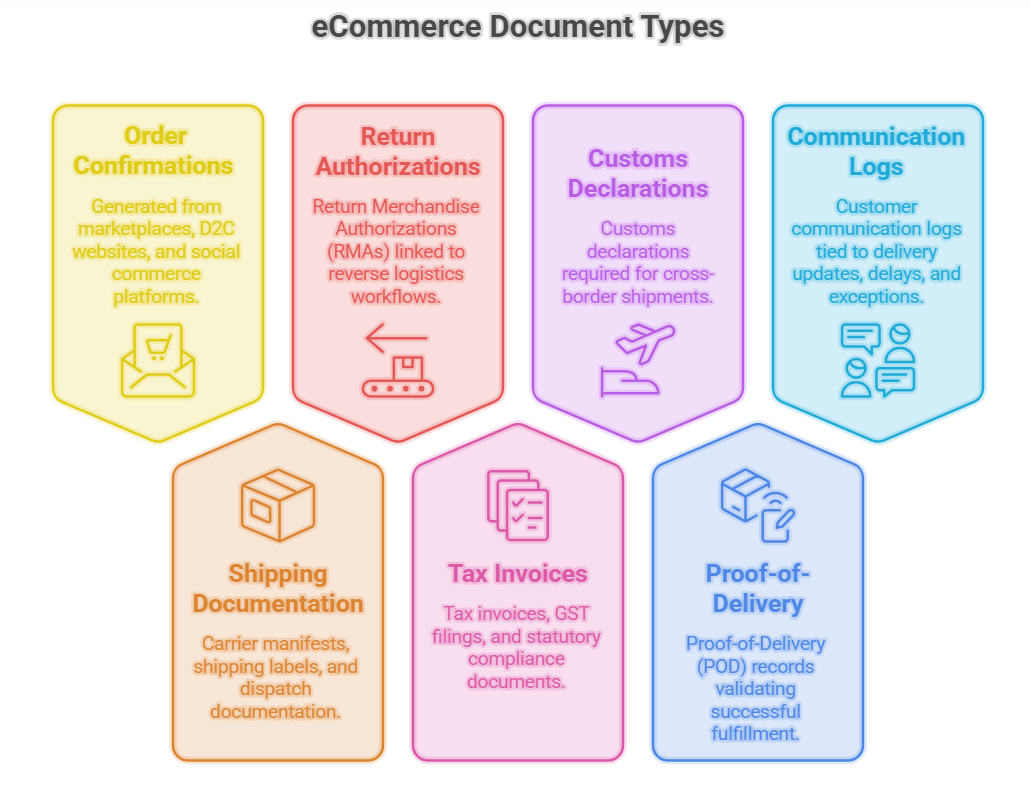
These documents span across the entire order lifecycle and include:
- Order confirmations generated from marketplaces, D2C websites, and social commerce platforms
- Carrier manifests, shipping labels, and dispatch documentation
- Return Merchandise Authorizations (RMAs) linked to reverse logistics workflows
- Tax invoices, GST filings, and statutory compliance documents
- Customs declarations required for cross-border shipments
- Proof-of-Delivery (POD) records validating successful fulfillment
- Customer communication logs tied to delivery updates, delays, and exceptions
Individually, each document may seem operationally simple. However, at scale, they form a highly interconnected system that directly impacts fulfillment accuracy, delivery speed, and customer experience.
The operational problem beneath the surface:
Despite widespread digital adoption across eCommerce platforms, many businesses still operate with fragmented document ecosystems. Critical data is scattered across spreadsheets, ERP systems, courier dashboards, email threads, and cloud storage tools that are not integrated with each other.
This fragmentation creates a hidden operational bottleneck that intensifies as order volumes increase.
It leads to three major structural challenges:
1. Operational inefficiency:
Teams spend a disproportionate amount of time searching, validating, and manually transferring documents between systems. In high-volume logistics environments, this directly slows down dispatch cycles, warehouse operations, and order fulfillment SLAs. Instead of focusing on execution, teams are often stuck in administrative coordination loops.
2. Compliance risks:
Modern eCommerce is governed by strict regulatory frameworks, including GST compliance, export-import documentation rules, and data retention requirements. These require accurate, structured, and traceable document management. Missing invoices, mismatched shipment records, or incorrectly stored compliance files can lead to penalties, shipment delays, or even customs holds in cross-border trade.
3. Lack of operational visibility:
Without a centralized document system, businesses lose end-to-end visibility across order journeys. Teams cannot easily track shipment status, identify return reasons, or resolve customer disputes in real time. This lack of visibility creates delays in decision-making and reduces overall operational responsiveness.
Industry shift: From static storage to intelligent systems
Historically, document systems were designed primarily as storage repositories, built to store, retrieve, and archive files. However, the role of document infrastructure in eCommerce has fundamentally evolved.
Modern systems are now expected to act as intelligent operational layers, enabling real-time decision-making across logistics workflows.
This transformation is being driven by several macro shifts:
- Rapid rise of omnichannel commerce ecosystems (Amazon, Flipkart, Shopify, and D2C platforms)
- Significant expansion of cross-border eCommerce and international fulfillment networks
- Increasing demand for audit-ready and compliance-driven logistics workflows
- Integration of AI, machine learning, and OCR-based automation into document processing systems
As a result, document management is no longer a passive function. It is becoming an active enabler of logistics intelligence and operational efficiency.
Industry reports indicate that over 65% of eCommerce enterprises globally are actively investing in document automation and digitalization tools to reduce operational delays, improve accuracy, and streamline fulfillment workflows.
Document digitalization is no longer about simply organizing or storing files, it has become a critical enabler of faster, automated, and error-free logistics execution across the entire eCommerce ecosystem.
In a market where speed defines competitiveness, businesses that continue relying on fragmented and manual document workflows risk facing slower fulfillment cycles, reduced operational visibility, and increasing compliance exposure.
Key Capabilities to Evaluate in Document Management Tools
Not all document management systems are built for the demands of eCommerce logistics. While many tools still focus primarily on basic storage, file sharing, and team collaboration, modern eCommerce operations require far more than that. The real operational challenge lies in managing high-volume, time-sensitive, and multi-system document flows that are directly tied to orders, shipments, returns, and compliance processes.
In 2026, document systems are no longer evaluated on how well they store files, but on how effectively they support end-to-end workflow intelligence, automation, and system integration across the entire logistics ecosystem. eCommerce businesses need platforms that can not only organize documents but also actively trigger actions, reduce manual effort, and synchronize data across multiple operational layers.
Below are the core capabilities that matter most when evaluating document management and digitalization tools in this evolving landscape.
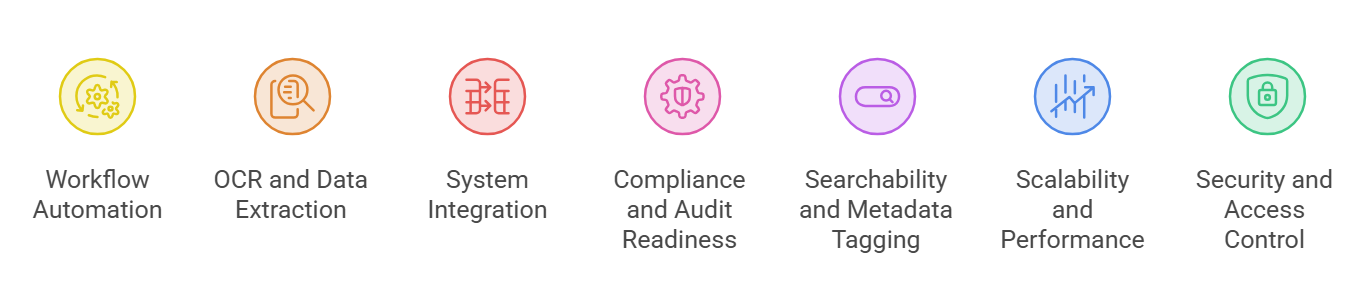
- Workflow automation capabilities
Modern systems must go beyond file storage. They should automate document flows such as:
- Auto-generation of shipping labels
- Invoice creation triggered by order placement
- Return document workflows linked with NDR events
- Auto-routing of compliance documents
Automation reduces manual dependency and ensures consistency across high-volume operations.
- OCR and data extraction
Optical Character Recognition (OCR) is critical for converting scanned or unstructured documents into structured data.
Advanced tools now extract:
- Order IDs
- SKU-level details
- Customer information
- Address validation data
This enables seamless integration with ERP and shipping systems.
- Integration withlogisticsand eCommerce systems
A document system in isolation is ineffective. It must integrate with:
- eCommerce platforms (Shopify, Magento, WooCommerce)
- ERP systems
- Carrier aggregation platforms
- Warehouse management systems (WMS)
Integration ensures real-time synchronization of operational documents.
- Compliance and audit readiness
In eCommerce, compliance is not optional. Tools must provide:
- Secure document storage with access control
- Audit logs for every document change
- Region-specific compliance formatting (GST, VAT, customs)
- Data retention policies aligned with legal requirements
- Searchability and metadata tagging
A scalable document system must allow:
- Keyword-based search
- Metadata tagging (order ID, customer, shipment ID)
- Advanced filtering across document types
This drastically reduces time spent retrieving operational records.
- Scalability and performance
As order volumes grow, systems must handle:
- Millions of documents
- Real-time uploads and retrievals
- Multi-location access
- High concurrency during peak seasons
- Security and access control
Security is critical, especially for financial and customer data. Look for:
- Role-based access control (RBAC)
- Encryption at rest and in transit
- Multi-factor authentication
- Data breach protection mechanisms
A strong document management tool in eCommerce is not defined by storage capacity, it is defined by how intelligently it connects, processes, and automates document flows across logistics operations.

Top Document Management & Digitalization Tools for eCommerce (Comparative Overview)
The document management ecosystem in 2026 is highly diverse, shaped by varying business needs across scale, geography, and operational complexity. While some platforms are designed for simple collaboration and storage, others are built for enterprise-grade workflows with deep automation and compliance capabilities.
In practice, most eCommerce businesses use a combination of tools rather than relying on a single system. The choice typically depends on operational scale, integration needs with logistics systems, and the level of automation required across document workflows.
Google Workspace
Google Workspace is one of the most widely adopted document ecosystems for small and mid-sized eCommerce businesses, primarily due to its simplicity and accessibility. It enables teams to collaborate in real time, access documents from the cloud, and integrate easily with a wide range of third-party applications, making it a practical starting point for growing businesses.
However, while it works well for collaboration and basic document handling, it offers limited support for logistics-specific automation. Businesses often need additional tools to manage workflows such as shipping documentation, compliance tracking, or order-linked document generation.
Microsoft OneDrive & SharePoint
Microsoft’s document ecosystem is widely used in enterprise eCommerce environments where governance, security, and structured access control are critical. It integrates deeply with enterprise systems such as ERPs and internal business applications, making it suitable for large-scale organizations with complex workflows.
That said, the platform comes with a higher operational learning curve. Setup and optimization often require technical expertise, especially when aligning it with logistics or supply chain processes that demand real-time document orchestration.
Dropbox Business
Dropbox Business is often preferred for its simplicity and smooth cross-device experience. It allows teams to share and synchronize files quickly, making it useful for distributed teams working across different geographies or departments.
However, its capabilities remain largely centered around storage and sharing. It lacks advanced workflow automation, which limits its effectiveness in logistics-heavy environments where document flows need to be tightly integrated with order and shipment systems.
Adobe Acrobat
Adobe Acrobat continues to be a standard tool for PDF creation, editing, and document signing workflows. It is widely used across eCommerce operations for handling invoices, contracts, and formal documentation that requires standard formatting and e-signature capabilities.
Despite its strength in document formatting, it is not designed to manage the full lifecycle of logistics documents. Its integration with supply chain systems is limited, making it more of a supporting tool rather than a central document management platform.
Zoho WorkDrive
Zoho WorkDrive is positioned as part of a broader business suite, making it attractive for SMEs looking for an integrated and cost-effective solution. It supports collaboration across teams and connects with other Zoho applications, which helps streamline basic business operations.
However, when it comes to advanced logistics automation, its capabilities are relatively limited. Businesses with complex supply chain requirements often need customization or additional integrations to meet enterprise-scale document workflows.
DocuWare
DocuWare is an enterprise-focused document management platform designed specifically around workflow automation and compliance. It is well-suited for organizations that require structured document control, audit readiness, and scalable automation across departments.
While it delivers strong enterprise-grade capabilities, it comes with higher implementation complexity and cost. Businesses typically require structured onboarding and configuration to fully leverage its automation potential in logistics environments.
M-Files
M-Files takes a metadata-driven approach to document management, focusing on intelligent organization rather than traditional folder-based storage. This allows businesses to classify and retrieve documents based on context, improving operational efficiency and searchability.
It also offers strong automation and security features, making it suitable for enterprise environments. However, its implementation can be complex, and it is generally better suited for large organizations with dedicated IT and operations teams managing document ecosystems.
Comparative Insight
| Tool | Best For | Automation Level | Scalability | Logistics Fit |
|---|---|---|---|---|
| Google Workspace | SMBs | Low | Medium | Medium |
| Microsoft SharePoint | Enterprises | High | High | High |
| Dropbox | Collaboration | Low | Medium | Low |
| Adobe Acrobat | PDF workflows | Medium | Medium | Low |
| Zoho WorkDrive | SMB ecosystems | Medium | Medium | Medium |
| DocuWare | Enterprises | High | High | High |
| M-Files | Metadata-driven ops | High | High | High |
No single tool fully solves eCommerce document complexity. Most businesses now adopt a hybrid stack approach, combining storage tools with automation platforms and logistics systems.
Trends & Future of Document Digitalization in eCommerce Logistics
The next phase of document management is moving beyond storage and toward intelligent automation that is deeply embedded within logistics workflows. As eCommerce continues to scale in complexity and geography, document systems are evolving into real-time operational layers that actively support decision-making, execution, and compliance.
Several key trends are shaping this transformation in 2026:
AI-driven document processing is becoming a core capability, with artificial intelligence enabling automatic classification of shipping documents, intelligent extraction of shipment data, fraud detection in invoices and returns, and predictive routing of documents based on workflows. This reduces manual effort while improving accuracy and speed across high-volume operations.
Real-time logistics document orchestration is replacing static storage models. Document systems are now connecting directly with order management systems, carrier APIs, warehouse execution systems, and customer communication platforms. This ensures that documents move in sync with shipments, improving coordination and reducing delays.
API-first document ecosystems are also gaining traction, allowing seamless integration with broader eCommerce tech stacks. Businesses can now build custom workflows and generate documents directly within applications, making document management a more flexible and scalable part of logistics automation.
Cloud-native compliance frameworks are addressing growing regulatory complexity. These systems support automated compliance updates, region-specific document formatting, and real-time audit tracking, which is especially important for cross-border eCommerce operations.
Finally, unified commerce document layers are emerging as an alternative to fragmented tools. Instead of managing documents across multiple systems, businesses are consolidating order data, shipping documents, return workflows, and customer communication logs into a single layer, improving visibility and operational clarity across the entire order lifecycle.
The Future of Document Management in eCommerce
Document management in eCommerce is steadily evolving from a traditional back-office function into a core layer of logistics intelligence. It now plays a direct role in determining how fast orders move, how accurately they are fulfilled, and how efficiently businesses scale across markets. As operations become more complex and multi-channel in nature, document systems are increasingly expected to support real-time decision-making rather than just storage and retrieval.
Businesses that adopt digital-first document systems early are already seeing measurable improvements in operational efficiency, compliance readiness, and customer experience. These systems reduce dependency on manual coordination and help create a more connected and automated supply chain environment.
On the other hand, fragmented and manual document processes are becoming harder to sustain as order volumes grow. They introduce delays, increase operational overhead, and create scalability bottlenecks that directly impact fulfillment performance and customer satisfaction.
The direction is clear: automation-driven, digital document ecosystems are becoming the backbone of modern eCommerce logistics. Platforms like eShipz are helping businesses move toward this shift by enabling more integrated, automated, and visibility-driven logistics document workflows across the entire order lifecycle.