





An eCommerce flash sale can turn a quiet week into your best sales day of the quarter, but only if it is planned with the same care as a product launch. Shoppers love the thrill of a limited-time deal, and brands love the spike in orders, yet many sales fall apart because of stockouts, slow websites, or shipping delays that leave customers frustrated instead of delighted. A peer-reviewed study published in the journal Quality & Quantity found that the urgency and exclusivity built into flash sales directly shape how likely a shopper is to buy on impulse, which explains why this tactic keeps working across markets and product categories. This guide breaks down what makes a flash sale succeed, the prep work most brands skip, and ten practical tips you can apply to your next campaign.
Why eCommerce Flash Sales Continue to Drive Revenue Growth
A flash sale is a short, time-bound promotion where products are offered at a steep discount, usually for a few hours to a couple of days. Unlike a seasonal sale that runs for weeks, a flash sale works because it is short. The shorter the window, the stronger the pressure to act now instead of later.
Consumers respond to limited-time offers because of a simple psychological trigger: the fear of missing out. When a shopper sees a countdown timer or a low-stock warning, the decision shifts from “should I buy this” to “will I miss this if I wait.” That shift is what pushes browsers into buyers. It also explains why flash sales tend to produce higher click-through rates on emails and ads compared to standard promotions.
For online retailers, a well-run flash sale delivers several benefits at once. It clears aging inventory that has been sitting in a warehouse, it introduces new shoppers to the brand at a lower entry price, and it rewards existing customers with early access or bigger discounts. Many brands also use flash sales to test demand for a new product line before committing to a full-scale launch.
Common objectives for a flash sale usually fall into a few buckets:
- Inventory clearance, especially for seasonal or slow-moving stock
- Customer acquisition, using a low price to bring in first-time buyers
- Seasonal or festival campaigns tied to a specific date or holiday
- Loyalty rewards, giving existing customers first access to a deal
Where brands go wrong is usually in the execution, not the idea. The most common mistakes include underestimating demand and running out of stock within minutes, launching a sale on a website that cannot handle the traffic spike, promoting the sale without checking if fulfillment teams and courier partners are ready, and discounting so often that the sale no longer feels special. A flash sale that is announced too late, priced without a clear margin plan, or unsupported by adequate shipping capacity often does more harm to the brand than good.
Recent Market Trends in Flash Sales
Flash sales have grown from a once-in-a-while marketing tactic into a core part of the eCommerce calendar. According to Statista’s market forecast, global eCommerce revenue is on a steady upward trajectory with a compound annual growth rate of nearly 7% projected through 2030, and a growing share of that spending is concentrated around short promotional windows like festive sales, mega sale days, and single-day drops rather than being spread evenly across the year.
Preparing for a Successful eCommerce Flash Sale
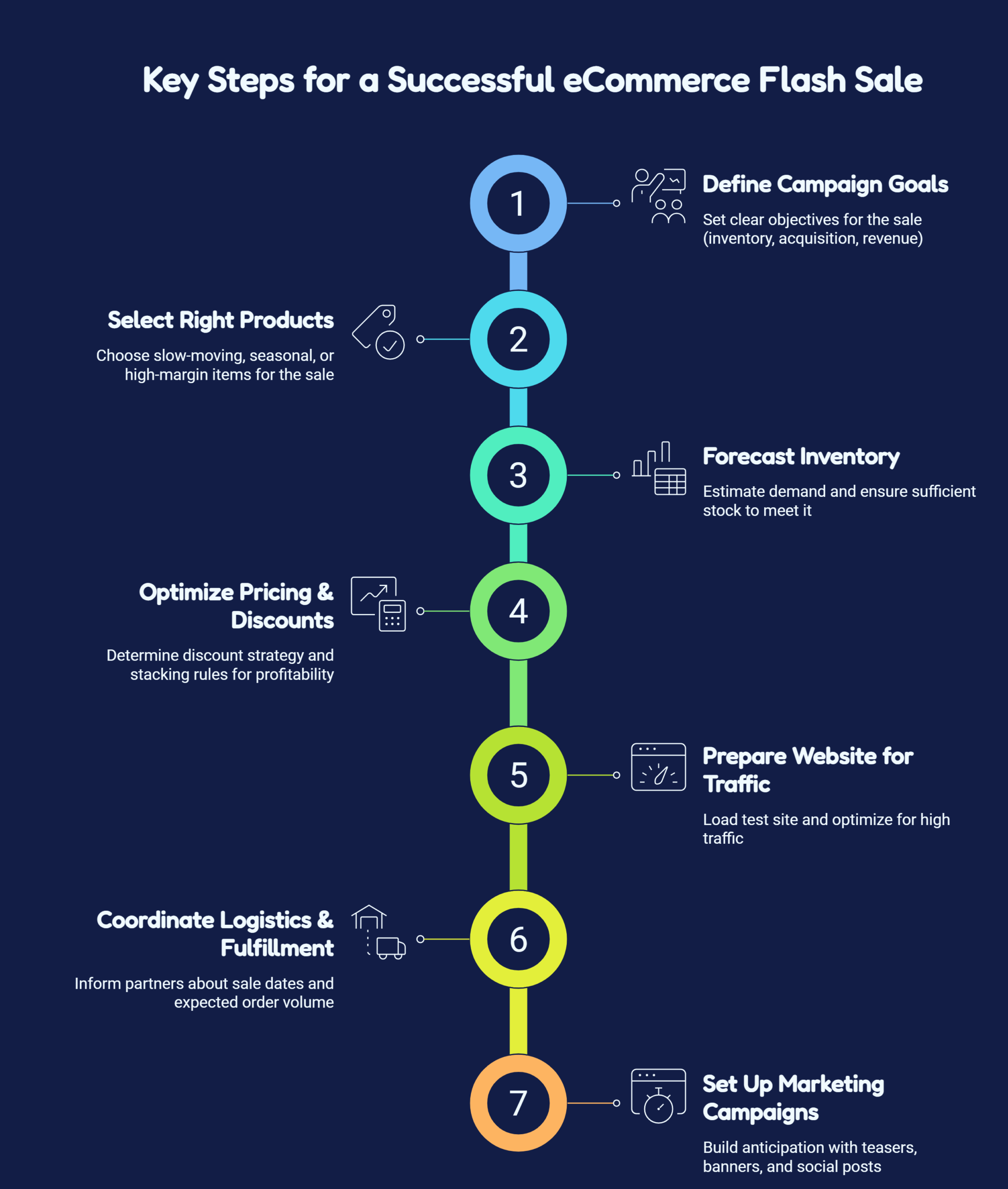
A flash sale that looks effortless from the outside is usually the result of weeks of preparation behind the scenes. Before you set a date, work through the following steps.
Define campaign goals. Decide upfront whether the sale is meant to clear inventory, acquire new customers, or boost revenue during a festive period. Your goal shapes everything else, from which products go on sale to how you price the discount.
Select the right products. Not every item belongs in a flash sale. Look at slow-moving SKUs, seasonal stock, and products with healthy margins that can absorb a discount without hurting profitability.
Forecast inventory. Use past sales data to estimate demand and make sure you have enough stock to meet it. Running out of a headline product in the first few minutes creates disappointment that can outweigh the goodwill the sale was meant to build.
Optimize pricing and discounts. A discount needs to feel meaningful without wiping out your margin. Test how you frame the offer, since a flat amount off can feel more appealing than a percentage on lower-priced items, and vice versa for higher-priced products. Also decide in advance whether the discount will stack with other offers like loyalty points or referral credits, so your margin calculations stay accurate once the sale goes live.
Prepare your website for traffic spikes. Load test your site ahead of the sale, especially the product and checkout pages. A slow or crashing site during a flash sale is one of the fastest ways to lose customer trust.
Coordinate with logistics and fulfillment partners. Let your warehouse, delivery partners, and customer support team know the sale dates in advance so they can plan for higher order volumes. A surge in orders with no matching surge in fulfillment capacity leads to delayed shipments and unhappy customers.
Set up marketing campaigns before launch. Build anticipation with teaser emails, countdown banners, and social posts in the days leading up to the sale. Early promotion helps you gauge interest and gives your audience time to plan their purchase.
10 Proven Tips to Maximize Your Flash Sale Performance
Set clear campaign objectives
Every decision in your flash sale, from product selection to discount depth, should trace back to a specific goal. If the objective is customer acquisition, you might accept a thinner margin in exchange for new email sign-ups. If it is inventory clearance, your discount can be steeper since the goal is to move stock, not protect margin. Write the objective down before you plan anything else.
Create urgency withlimited-timeoffers
Urgency is the engine behind every successful flash sale. Countdown timers on product pages, “ends tonight” messaging in emails, and visible stock counters all reinforce that the window is closing. Keep the sale short, generally between a few hours and 48 hours, since a longer window dilutes the sense of urgency that makes flash sales work in the first place. If you run recurring sales, vary the timing and duration slightly each time so shoppers do not start waiting for the next predictable drop instead of buying now.
Choose products strategically
Pick products based on data, not guesswork. Items with strong page views but low conversion, seasonal stock nearing its shelf life, and products your competitors are struggling to keep in stock are all good candidates. Avoid discounting your best-selling, thin-margin items unless the goal is pure customer acquisition.
Personalize promotions
Segment your audience and tailor the offer to each group. Existing customers might get early access or a slightly better discount as a loyalty reward, while new visitors see a first-purchase incentive. Personalized offers, based on browsing history or past purchases, tend to convert better than a one-size-fits-all discount blasted to your entire list.
Optimizeyour website speed
A flash sale can bring in ten times your normal traffic in a short burst. If your site is not built to handle that load, pages will time out right when customers are ready to buy. Compress images, use a content delivery network, and run load tests before the sale so your servers do not buckle under demand.
Simplify the checkout experience
Every extra field or step in checkout is a chance for a shopper to abandon their cart, and that risk is even higher during a flash sale when customers are competing for limited stock. Offer guest checkout, save payment details for returning customers, and reduce the number of clicks between adding an item to the cart and completing the order.
Promote across multiple channels
Relying on a single channel limits your reach. Combine email, SMS, push notifications, and social media to spread the word before and during the sale. Each channel reaches shoppers at a different moment, an email might build anticipation days in advance while an SMS reminder an hour before the sale ends can recover a hesitant buyer. Paid ads and influencer shoutouts can extend your reach further, but keep the messaging consistent across every channel so shoppers see the same offer and deadline no matter where they encounter it.
Ensure fast and reliable shipping
Customers who buy during a flash sale expect the same delivery speed they get on a regular order, sometimes even faster given the excitement of the purchase. Delayed or unreliable shipping is one of the quickest ways to turn a successful sale into a wave of support tickets and negative reviews. Work with your logistics partners ahead of time to confirm they can handle the order surge, and communicate realistic delivery timelines clearly at checkout.
Use real-time inventory visibility
Nothing frustrates a shopper more than adding an item to their cart only to find it is out of stock at checkout. Real-time inventory tracking across your warehouse and sales channels prevents overselling and lets you update stock counts instantly as items sell out. This also gives your operations team accurate data to prioritize picking and packing for the highest-demand products first.
Analyze campaign performance continuously
Do not wait until the sale ends to check how it is performing. Monitor conversion rates, cart abandonment, and stock levels in real time so you can adjust messaging, restock a fast-selling item if possible, or extend a specific product’s availability while the sale is live. The insights you gather during the sale are just as valuable for making quick decisions as they are for planning your next one.

Common Flash Sale Challenges and How to Overcome Them
Even well-planned flash sales run into friction. Here are the challenges that come up most often, and how to reduce their impact.
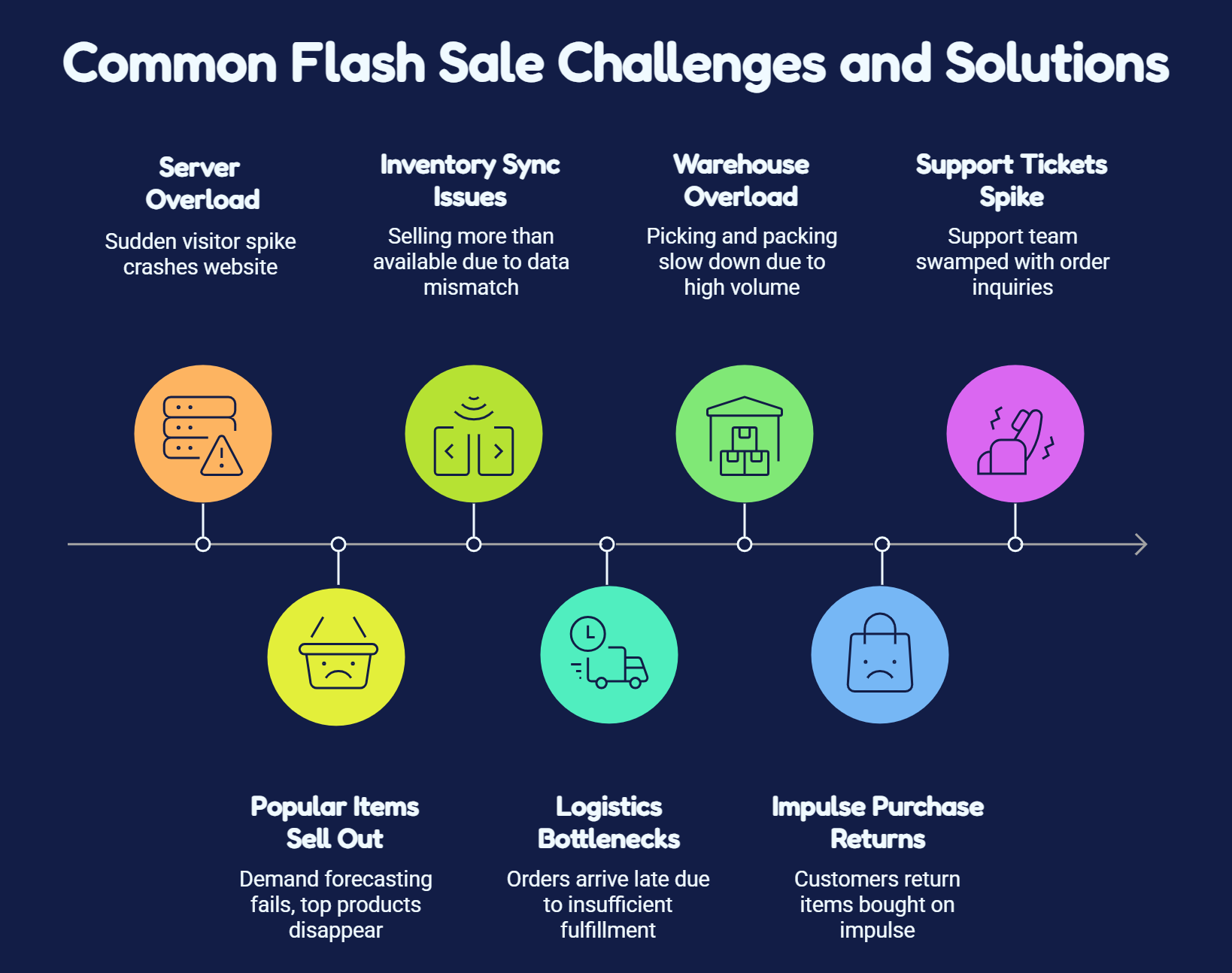
Website downtime. A sudden spike in visitors can overwhelm servers that are sized for normal traffic. Load testing, scalable cloud hosting, and a simplified sale page (fewer scripts and heavy images) all reduce the risk of a crash at the worst possible moment.
Inventory stockouts. Poor demand forecasting leads to popular items selling out within minutes. Pulling historical data from past sales and setting realistic stock allocations per product helps you plan buffer stock for your top sellers.
Overselling. When inventory data across your website, marketplace listings, and warehouse are not in sync, you risk selling more units than you actually have. Centralized, real-time inventory visibility across every sales channel is the most reliable fix.
Shipping delays. A surge in orders without a matching surge in fulfillment capacity leads to late deliveries. Notify your logistics and delivery partners well before the sale so they can allocate extra resources, and consider spreading order pickups across multiple courier partners to avoid bottlenecks with a single carrier.
Order fulfillment bottlenecks. Warehouses that are not prepared for a sudden increase in order volume can fall behind on picking and packing. Pre-sorting high-demand SKUs closer to packing stations and briefing your warehouse team in advance helps orders move faster.
High return rates. Impulse purchases made during a flash sale sometimes lead to buyer’s remorse. Clear product descriptions, accurate sizing charts, and honest imagery reduce the gap between expectation and reality that drives returns.
Customer support overload. A spike in orders usually brings a spike in questions about order status, shipping times, and returns. Proactive order tracking updates and self-service tracking pages reduce the volume of “where is my order” tickets your support team has to handle manually.
Logistics automation and shipping technology help address several of these challenges at once. Automated order routing, real-time tracking updates, and multi-carrier shipping options reduce the manual work needed to manage a sudden order surge, which means fewer delays, fewer stockout surprises, and a smoother post-purchase experience for the customer. Automating repetitive tasks like label generation, courier allocation, and delivery status updates also frees up your operations team to focus on exceptions, like a stuck shipment or a delayed handover, rather than manually tracking every order during the busiest hours of the sale.
Measuring Success and Improving Future Flash Sales
A flash sale does not end when the countdown hits zero. The real value comes from what you learn afterward and how you apply it to the next campaign. Track these key performance indicators to get a full picture of how your sale actually performed:
- Conversion rate – the percentage of visitors who completed a purchase during the sale
- Average order value (AOV) – whether customers bought just the discounted item or added more to their cart
- Revenue per visitor – a broader measure of how much each visitor contributed, discount included
- Cart abandonment rate – how many shoppers added items to their cart but did not check out
- Customer acquisition cost (CAC) – how much you spent to acquire each new customer through the sale
- Delivery performance – how many orders shipped and arrived within the promised window
- Return rate – the percentage of flash sale orders that were returned or exchanged
- Customer retention – whether flash sale buyers came back for a second purchase in the following months
Reviewing these numbers after every sale tells you more than whether the campaign was profitable. A high cart abandonment rate might point to checkout friction, a spike in returns could mean product pages need clearer descriptions, and slow delivery performance signals that your logistics setup needs more capacity before the next big sale. Treat every flash sale as a data point, not a one-off event, and use those lessons to refine your product selection, discount depth, and operational readiness the next time around.
It also helps to document what went right and wrong immediately after the sale, while the details are still fresh. Note which products sold out too quickly, which marketing channel drove the most conversions, and where customer complaints clustered, whether that was shipping delays, sizing issues, or a confusing checkout step. Building this into a simple post-sale report means your next flash sale starts from a stronger baseline instead of repeating the same guesswork.
Running a successful eCommerce flash sale comes down to balancing excitement with execution. The urgency and discount get shoppers to your site, but it is the preparation behind the scenes, from inventory accuracy to fast, reliable shipping, that turns a burst of traffic into repeat customers. Plan early, track everything, and treat each sale as a chance to improve the next one, and flash sales can become one of the most reliable growth levers in your marketing calendar.
Platforms like eShipz are built specifically to handle this kind of order surge, giving teams a single view of inventory, courier performance, and delivery status during high-traffic sales.
If manual tracking across couriers and warehouses is what’s slowing your team down during high-volume sales, it may be worth exploring a shipping automation platform like eShipz to handle order routing, tracking, and delivery visibility in one place. Book a demo to see how it fits into your flash sale workflow.