





Returns have become one of the biggest profitability challenges for online retailers. As India’s e-retail market continues to expand, brands are facing increasing pressure to control reverse logistics costs while maintaining a positive customer experience. According to GS1 India, Indian eCommerce businesses lose nearly ₹5,000 crore annually due to poor product data quality, with return-related costs accounting for a significant portion of those losses. Fashion and apparel brands are particularly affected, as sizing issues, expectation mismatches, and incomplete product information continue to drive high return volumes.
For businesses looking to Reduce eCommerce returns, addressing the root causes of returns has become a strategic priority rather than simply an operational concern.
Beyond refund processing, returns create additional expenses across reverse shipping, inventory handling, quality checks, warehouse operations, customer support, and inventory restocking. These hidden costs can quickly erode already thin profit margins. In many cases, returned products remain unsold for extended periods, creating inventory disruptions and affecting cash flow.
Returns also influence customer loyalty. A poor product experience often results in negative reviews, reduced repeat purchases, and higher customer acquisition costs. At the same time, managing large volumes of returns places significant pressure on logistics and customer support teams.
Certain categories face greater challenges than others. Fashion and apparel brands frequently experience return rates between 20% and 40%, largely due to sizing and fit issues. Electronics retailers encounter returns because of compatibility concerns, unmet expectations, and product defects. As order volumes continue to increase, the financial impact of returns becomes even more significant.
Reducing returns is no longer just about cutting costs. It is about protecting margins, improving customer satisfaction, and creating a more efficient supply chain.
To reduce returns effectively, businesses must first understand why customers return products.
Recent Market Trends: Why Return Reduction Is a Growing Priority in India
India’s eCommerce ecosystem has witnessed rapid growth over the past decade. According to Bain & Company, India’s e-retail market has grown into one of the fastest-growing digital commerce markets globally, driven by increasing internet penetration, mobile commerce adoption, and rising consumer demand.
However, this growth has also increased return volumes. Customers today expect flexible return policies, faster refunds, and seamless post-purchase experiences. While these expectations improve conversion rates, they also contribute to rising reverse logistics costs.
One unique challenge in the Indian market is the prevalence of Cash-on-Delivery (COD) orders, which often lead to Return-to-Origin (RTO) shipments. Unlike customer-initiated returns, RTO orders occur when deliveries cannot be completed and products are sent back to the seller. Industry reports suggest that RTO rates in India can range from 15% to 25% depending on the category and geography.
Fashion and lifestyle categories continue to experience some of the highest return volumes due to size-related issues, product expectation mismatches, and changing customer preferences. As competition intensifies, brands must focus on reducing avoidable returns while creating a frictionless customer experience.
The good news is that most returns are preventable when businesses understand the underlying causes and implement the right corrective measures.
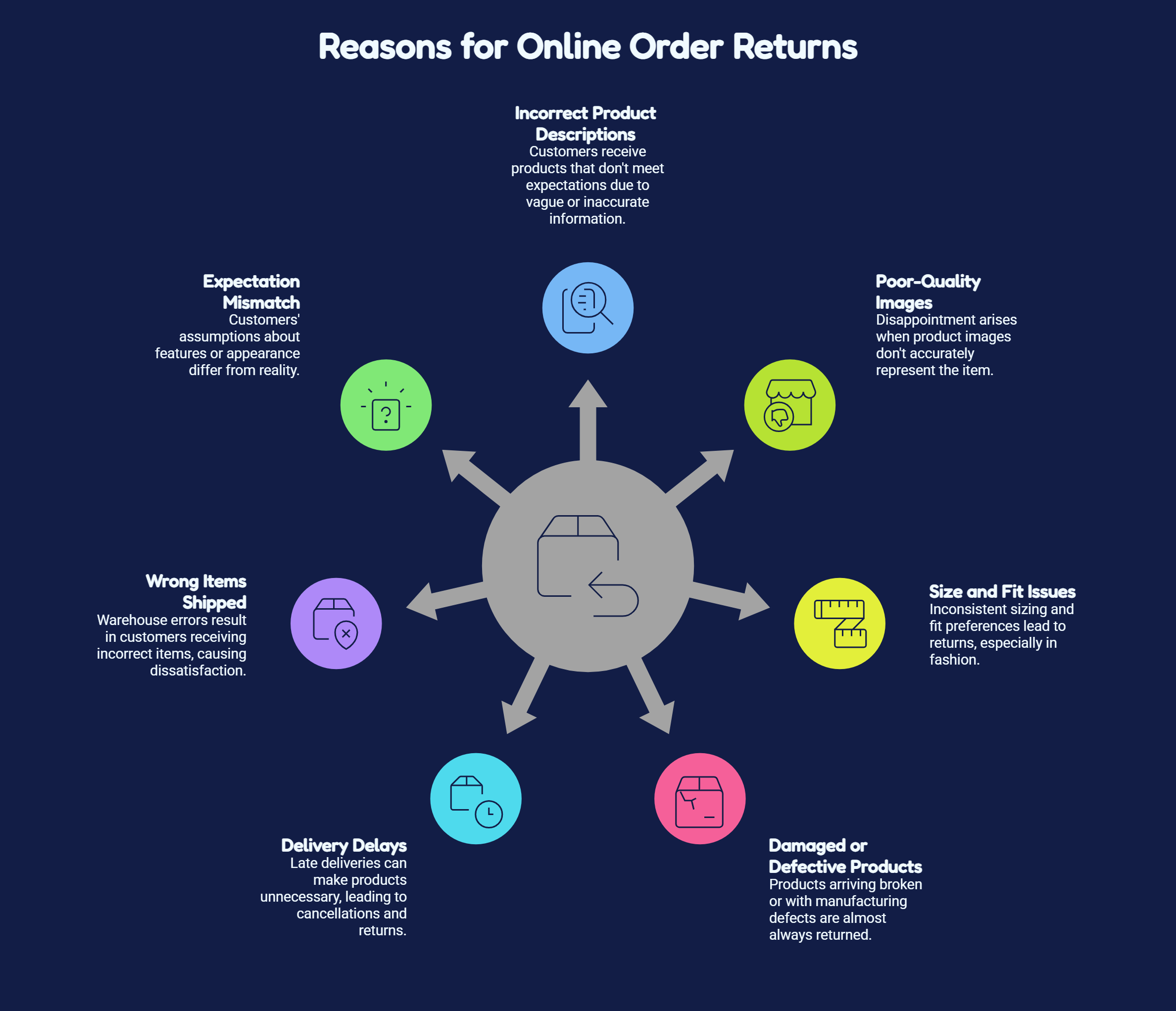
The Top Reasons Customers Return Online Orders
Understanding the reasons behind returns is the first step toward reducing them. While every business faces unique challenges, several common factors consistently contribute to high return rates.
Incorrect Product Descriptions
Customers rely entirely on product information when shopping online. If descriptions are incomplete, inaccurate, or misleading, customers may receive products that do not meet their expectations.
For example, a customer purchasing a power bank may assume compatibility with a specific device based on vague product specifications. If the product fails to meet the expected requirements, a return becomes likely.
Detailed product descriptions help customers make informed decisions and reduce expectation gaps.
Poor-Quality Product Images
Visual content significantly influences purchasing decisions.
When product images fail to accurately represent color, size, texture, or functionality, customers often feel disappointed upon receiving the product.
Imagine a shopper ordering a home décor item based on heavily edited images. If the actual product appears significantly different, the likelihood of a return increases dramatically.
High-quality visual content helps set realistic expectations and improves purchase confidence.
Size and Fit Issues
Size-related returns remain one of the most common challenges in fashion and footwear categories.
Customers frequently encounter inconsistencies between brand sizing standards. Even when size charts are available, fit preferences vary among individuals.
A customer ordering a dress based on a standard size chart may find that the actual fit differs from expectations, resulting in a return request.
Providing detailed measurements, fit recommendations, and size guidance can significantly reduce these returns.
Damaged or Defective Products
Products that arrive damaged or defective are almost certain to be returned.
Common examples include:
- Broken electronics
- Damaged packaging
- Missing components
- Manufacturing defects
- Scratches or visible wear
These issues not only increase return rates but also negatively impact customer trust and brand perception.
Delivery Delays
Modern consumers expect timely deliveries.
When products arrive later than expected, customers may no longer need them, especially when purchases are tied to specific occasions or events.
Delayed deliveries often lead to cancellations, return requests, and negative customer feedback.
Wrong Items Shipped
Warehouse errors remain a significant source of returns.
Receiving the wrong size, color, variant, or product creates immediate customer dissatisfaction and generates unnecessary reverse logistics costs.
Improving order accuracy can directly reduce return volumes.
Customer Expectation Mismatch
Not all returns result from defects or errors.
Many occur because customers expected something different from what they received.
Examples include:
- Electronics with unsupported features
- Products appearing larger or smaller than expected
- Materials feeling different from expectations
- Features assumed but not included
Clear communication and transparent product information help reduce these misunderstandings.
Proven Strategies to Reduce eCommerce Returns Before They Happen
The most cost-effective return is the one that never happens. By focusing on prevention, businesses can reduce costs while enhancing customer satisfaction.
Accurate Product Information
Every product page should answer potential customer questions before purchase.
Businesses should include:
- Detailed product descriptions
- Technical specifications
- Material information
- Product dimensions
- Compatibility details
- Frequently asked questions
The more informed customers are, the less likely they are to make unsuitable purchases.
Better Product Visualization
Customers cannot physically inspect products online, making visual content essential.
- Multiple Product Images- Display products from different angles and perspectives.
- Product Videos- Videos provide better insight into product functionality, appearance, and usage.
- 360-Degree Product Views- Interactive views allow customers to explore products in greater detail before purchasing.
Enhanced visualization reduces uncertainty and improves buying confidence.
Smart Sizing and Recommendation Tools
Sizing remains one of the largest drivers of returns.
Businesses can reduce sizing-related issues through:
- Comprehensive size charts
- Measurement guides
- Fit recommendations
- Customer reviews with sizing feedback
- AI-powered size recommendation tools
Helping customers select the correct size during checkout significantly reduces return rates.
Strong Quality Control Processes
Quality issues should be identified before products leave the warehouse.
Key practices include:
- Pre-Shipment Inspections- Inspect products before packaging to identify defects.
- Packaging Audits- Ensure packaging protects products during transit.
- Supplier Quality Monitoring- Track supplier performance to identify recurring quality concerns.
Investing in quality control reduces returns while strengthening customer trust.
Proactive Customer Communication
Customers appreciate transparency throughout the order journey.
Businesses should provide:
- Order confirmations
- Shipping updates
- Delivery notifications
- Product setup instructions
- User guides and FAQs
For electronics and technical products, educational content can prevent unnecessary returns caused by setup or usability issues.
Encourage Exchanges Instead of Refunds
In many cases, customers need a different size or variation rather than a refund.
Offering convenient exchange options helps:
- Retain revenue
- Improve customer satisfaction
- Reduce customer churn
- Strengthen brand loyalty
A well-designed exchange process benefits both businesses and customers.
How eShipz Helps Businesses Reduce eCommerce Returns and Reverse Logistics Costs
Even with preventive measures in place, some returns are inevitable. The key is managing them efficiently while uncovering insights that help reduce future return volumes.
This is where a technology-driven returns management solution becomes valuable.
AI-Powered Returns Management
Manual return processes often create delays, inconsistencies, and operational inefficiencies.
An AI-powered returns management system helps automate return workflows, standardize processes, and improve overall efficiency.
This reduces administrative effort while enhancing the customer experience.
Branded Self-Service Return Portal
Today’s customers expect convenience.
A self-service return portal enables customers to:
- Initiate returns independently
- Select return reasons
- Request exchanges
- Track return progress
This creates a more transparent and customer-friendly experience while reducing support workloads.
Real-Time Return Tracking
Visibility plays a critical role in customer satisfaction.
Real-time tracking allows both businesses and customers to monitor return shipments throughout the reverse logistics process.
This reduces uncertainty and minimizes return-related inquiries.
Automated Return Approvals
Manual review processes often slow down return resolution.
Automated workflows help businesses:
- Standardize return policies
- Accelerate approvals
- Improve processing efficiency
- Reduce operational overhead
Faster processing leads to a better customer experience.
Exchange and Store Credit Options
Refunds are not always the best outcome for businesses.
Providing alternatives such as:
- Product exchanges
- Store credits
- Replacement orders
can help preserve revenue while addressing customer concerns.
Return Analytics to Identify High-Return SKUs
One of the most effective ways to reduce future returns is by understanding why products are being returned.
Advanced return analytics can identify:
- Frequently returned products
- Size-related complaints
- Quality issues
- Product description gaps
- Supplier performance concerns
Imagine noticing that a particular SKU is generating repeated returns due to sizing complaints. With return analytics, businesses can identify the issue quickly, update sizing information, and reduce future return volumes.
Product Issue and Quality Insights
Returns data often reveals operational inefficiencies that would otherwise go unnoticed.
For example:
- A supplier may consistently generate quality-related returns.
- A specific product category may face recurring compatibility concerns.
- Certain fulfillment locations may exhibit higher error rates.
These insights support continuous improvement initiatives.
Automated Refund Workflows
Customers expect quick resolutions.
Automated refund workflows help businesses process refunds faster while reducing manual effort and administrative complexity.
This creates a smoother post-purchase experience.
Reverse Logistics Optimization
Returns logistics can become costly when managed manually.
An optimized reverse logistics framework helps businesses:
- Improve carrier selection
- Reduce transportation costs
- Accelerate return processing
- Increase inventory recovery rates
The result is a more efficient and cost-effective returns operation.

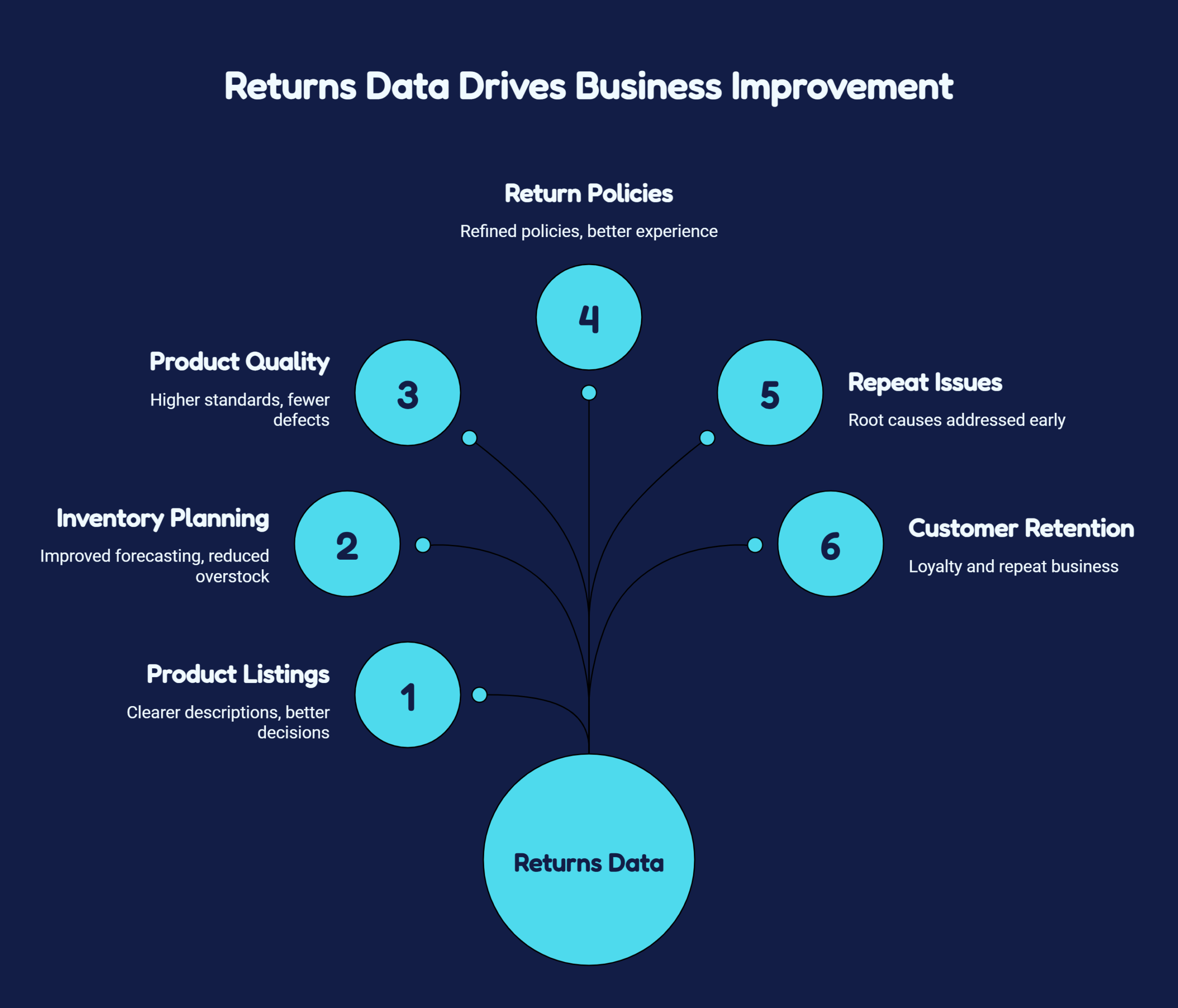
Turning Returns Data into a Competitive Advantage
Many businesses treat returns solely as an operational expense. However, leading brands recognize that returns provide valuable business intelligence.
Every return tells a story about customer expectations, product quality, and operational performance.
Improve Product Listings
Return reasons often highlight missing or unclear information.
Businesses can use this feedback to:
- Refine product descriptions
- Add specifications
- Improve imagery
- Address recurring customer questions
Better listings lead to better purchasing decisions.
Optimize Inventory Planning
Returns data provides insights into demand patterns and product performance.
These insights help businesses:
- Improve forecasting accuracy
- Reduce overstocking
- Optimize replenishment strategies
- Improve assortment planning
Enhance Product Quality
Tracking return reasons helps identify recurring product issues.
This allows businesses to:
- Improve quality standards
- Address supplier issues
- Reduce defect-related returns
- Improve customer satisfaction
Refine Return Policies
Return analytics can reveal opportunities to improve return policies without negatively affecting the customer experience.
Businesses can better understand:
- Return behavior by category
- Customer preferences
- Exchange versus refund trends
- Policy effectiveness
Reduce Repeat Return Issues
When businesses continuously analyze return data, they can address root causes before they become larger operational challenges.
Over time, this leads to lower return rates and improved profitability.
Increase Customer Retention
Customers are more likely to return when:
- Products meet expectations
- Returns are hassle-free
- Exchanges are convenient
- Issues are resolved quickly
A positive post-purchase experience directly contributes to customer loyalty and repeat business.
Returns should not only be viewed as a cost center but also as a valuable source of customer feedback.
Reduce Returns While Improving Customer Experience
Returns cannot be eliminated entirely. They are an unavoidable part of eCommerce. However, businesses that focus on prevention, quality control, customer education, and data-driven decision-making can significantly reduce return volumes while improving customer satisfaction.
The most successful brands combine accurate product information, enhanced product visualization, smart sizing recommendations, proactive communication, and efficient returns management processes to minimize avoidable returns.
Most importantly, returns data should be used as a strategic asset. By identifying recurring issues and acting on customer feedback, businesses can improve products, optimize operations, and strengthen customer relationships.
If your business is looking to reduce eCommerce returns while simplifying reverse logistics, solutions like eShipz Returns Management can help automate returns workflows, provide actionable return insights, and create a smoother post-purchase experience for customers.