





Picture this: a shopper adds a jacket to their cart, then pauses at checkout because the return policy is buried three pages deep and vague about who pays for shipping. They close the tab. This scene plays out thousands of times a day across online stores, and it is rarely about the product. It is about the fear of what happens if the product does not work out. A self-serve returns portal removes that fear by letting customers start, track, and complete a return on their own, without waiting on hold or digging through email threads. According to the National Retail Federation’s 2025 Retail Returns Landscape report, an estimated 19.3% of online sales are expected to be returned this year, and 82% of consumers say free, easy returns are a major factor in their decision to buy. Returns are no longer a back-office inconvenience; they are a visible part of the shopping experience, and brands that treat them that way tend to win repeat customers.
This blog looks at why this kind of self-service returns experience has become essential for online sellers, what the current market trends say about returns automation, who actually benefits from a well-built portal, and how to design and roll one out without the common mistakes that trip up most brands.
What Is a Self-Serve Returns Portal?
A self-serve returns portal is a customer-facing tool that lets shoppers initiate, track, and complete a return or exchange entirely on their own, no phone call, no support ticket, no waiting for a human to respond. The shopper typically enters their order number and email address, selects the item and a reason for returning it, and the portal handles the rest: checking whether the item qualifies under the return policy, generating a prepaid shipping label, and scheduling a pickup or drop-off.
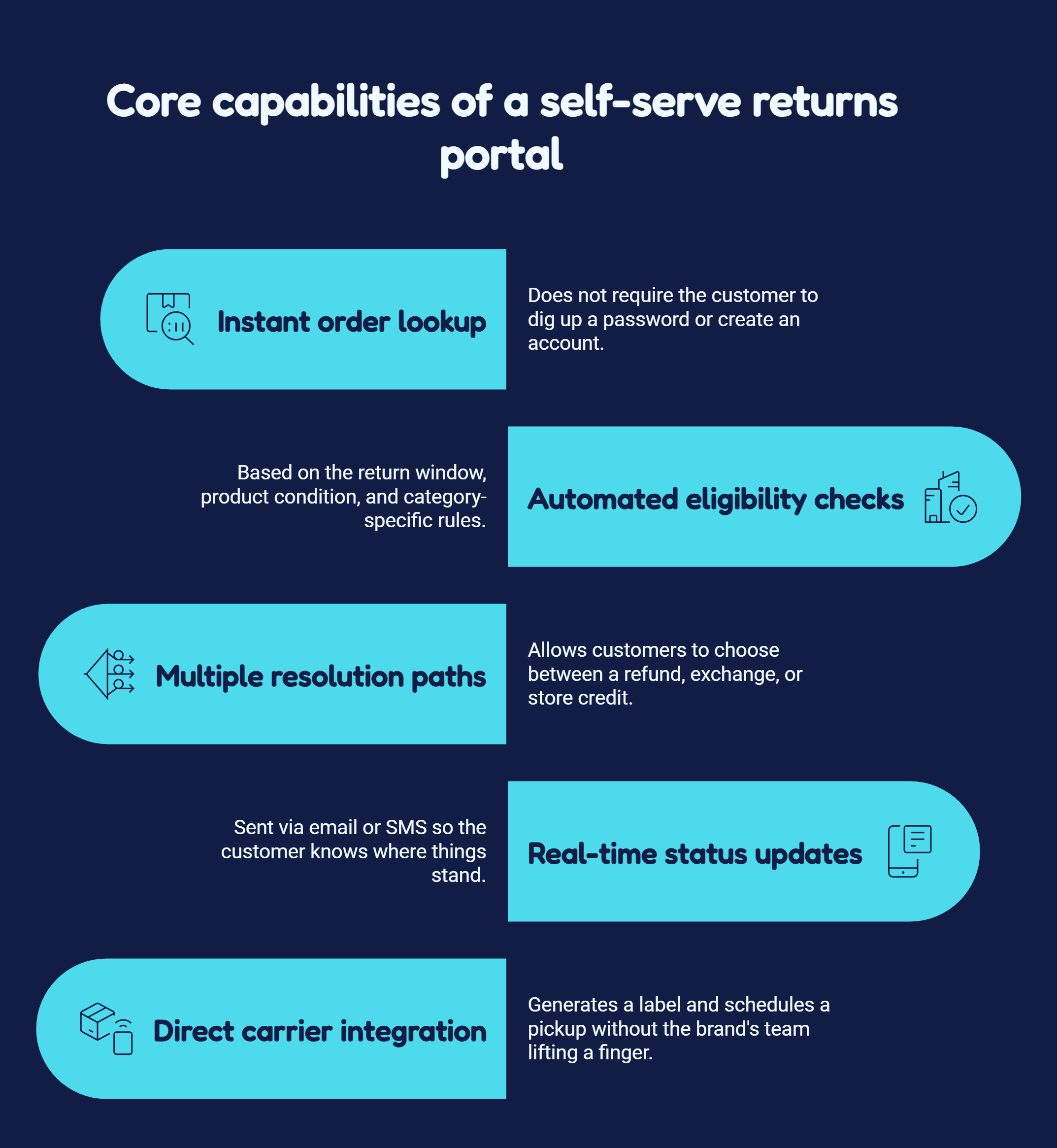
What separates a genuinely seamless portal from a bare-bones one usually comes down to a handful of core capabilities:
- Instant order lookup that doesn’t require the customer to dig up a password or create an account
- Automated eligibility checks based on the return window, product condition, and category-specific rules (final-sale items, for instance, might be excluded automatically)
- Multiple resolution paths, so the customer isn’t funneled into a refund by default when an exchange or store credit might suit them better
- Real-time status updates, sent via email or SMS, so the customer always knows where things stand
- Direct carrier integration, so a label can be generated and a pickup scheduled without the brand’s team lifting a finger
Done well, the whole interaction can take a customer under two minutes from start to finish.
Why Is It Essential?
Shoppers today measure every brand against the fastest, easiest experience they’ve ever had online, and returns are no exception to that standard. A clunky, back-and-forth returns process doesn’t just cause friction in one transaction, it quietly chips away at the odds that customer ever buys from the brand again.
A few reasons this has moved from optional to essential:
It removes hesitation at the point of purchase. A visible, easy-to-understand return policy, backed by a self-serve portal, reassures shoppers before they buy, particularly for categories like apparel, footwear, and beauty, where fit and quality can’t be judged until the product is in hand. Buyers who trust that returning something will be painless are more willing to complete the purchase in the first place.
It takes real weight off support teams. Every return that gets handled through self-service is one less ticket sitting in a queue. That doesn’t just save money on staffing; it frees up agents to spend their time on the complex, high-value conversations that actually need a human, the kind that build loyalty rather than just resolve a transaction.
It’s one of the strongest levers for retention. Study after study on post-purchase behavior points to the same conclusion: how a brand handles a return often matters as much to whether a customer comes back as how the original order was fulfilled. A frustrating returns experience is one of the most commonly cited reasons shoppers say they won’t order from a brand again.
It generates data brands actually need. When returns flow through a centralized portal instead of scattered emails and calls, brands get clean, structured data on why products are coming back. That data feeds directly into decisions about sizing charts, product descriptions, quality control, and even which SKUs to discontinue.
Taken together, a self-serve returns portal isn’t just a support convenience. It’s a retention and revenue tool that happens to live under the support umbrella.
What Does the Current Market Trend Say About This?
The shape of ecommerce returns is shifting quickly, and a few clear patterns are emerging across the industry.
Return volumes are still climbing. As online shopping continues to grow, especially in categories like apparel, footwear, and home goods, return rates climb alongside it. Products that can’t be tried on or tested before purchase will always carry higher return risk, and that pressure isn’t going away.
AI is doing more of the heavy lifting. Rather than treating every return the same way, modern platforms increasingly use automation to flag suspicious return patterns, predict which resolution a customer is most likely to accept, and personalize the return flow based on order history, all without a person reviewing each case manually.
Returnless refunds are becoming more common for low-value items. For inexpensive products, the cost of shipping something back to a warehouse, inspecting it, and restocking it often exceeds the item’s resale value. A growing number of brands now let customers keep low-cost items and issue a refund anyway, simply because it’s cheaper and faster than processing a physical return.
Brands are steering customers toward exchanges and store credit. Rather than defaulting every return to a cash refund, more portals now present exchanges or credit as the first option. This protects revenue that would otherwise leave the business entirely, and it also cuts down on the environmental footprint of reverse shipping, a factor an increasing number of brands are being asked to account for.
Portals are becoming more deeply connected to backend systems. A returns portal that operates in isolation from inventory and warehouse systems creates blind spots. The trend now is toward real-time integration with WMS, ERP, and CRM platforms, so a return doesn’t just get processed on the customer-facing side, it’s immediately reflected in stock levels, customer records, and fulfillment planning.
The thread connecting all of this: returns management has stopped being a quiet, back-office function. It’s increasingly treated as a genuine point of competitive differentiation, on par with shipping speed or checkout experience.
Who Does This Benefit and How?
Customers get speed, transparency, and control. Instead of waiting on hold or refreshing an inbox, they can check eligibility, choose how they want the issue resolved, and generate a label in minutes, on their own schedule, without needing to explain themselves to a support agent.
Ecommerce brands see the benefit on multiple fronts at once. Support costs drop because fewer returns require manual intervention. Fraud and abuse become easier to catch because automated rules can flag suspicious patterns that a human reviewing tickets one at a time might miss. And because every return now flows through one system, brands get a steady, structured stream of data on why products are coming back, insight that’s difficult to gather when returns are scattered across emails, calls, and chat messages.
Support and operations teams get their time back. Routine, low-complexity returns no longer need to pass through a human at all, which means agents can focus on situations that genuinely require judgment, damaged goods, disputes, or unusual edge cases, rather than repeatedly walking customers through the same basic steps.
Warehouse and logistics teams gain better visibility into what’s coming back and when. Rather than being caught off guard by a wave of returned inventory, teams can forecast restocking needs, plan warehouse capacity, and reduce the processing errors that tend to happen when returns show up unannounced.
Key Features of a Seamless Self-Serve Returns Portal
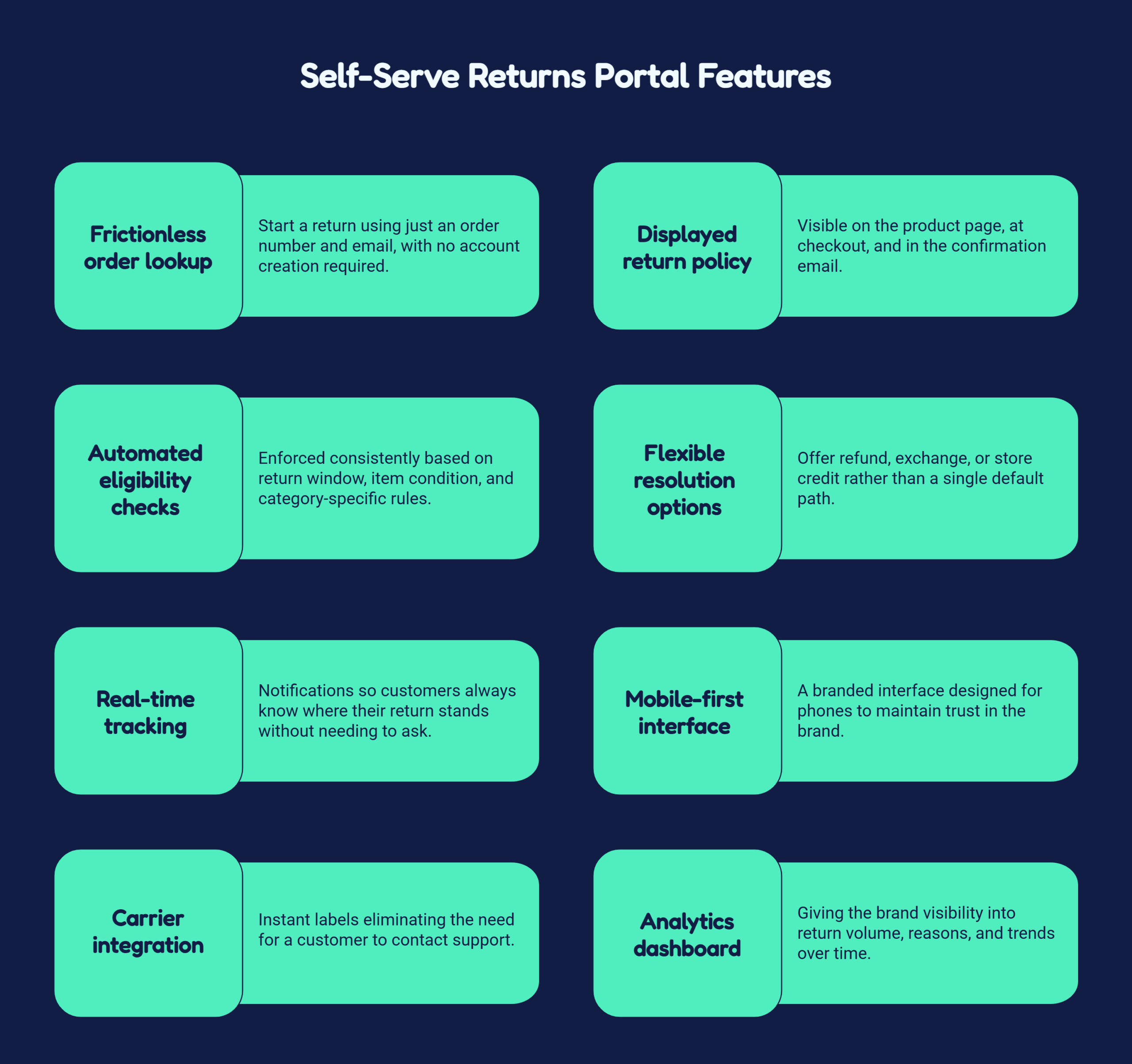
A genuinely well-built portal tends to share a common set of features:
- Frictionless order lookup – customers should be able to start a return using just an order number and email, with no account creation required
- A clearly displayed return policy – visible on the product page, at checkout, and in the confirmation email, not buried in a footer link no one clicks
- Automated eligibility checks – enforced consistently, based on return window, item condition, and category-specific rules
- Flexible resolution options – refund, exchange, or store credit, rather than a single default path
- Real-time tracking and notifications – so customers always know where their return stands, without needing to ask
- A mobile-first, branded interface – since a large share of return requests now start on a phone, and a generic third-party-looking portal can undercut trust in the brand
- Carrier integration for instant labels – eliminating the need for a customer to contact support just to get a shipping label
- An analytics dashboard – giving the brand visibility into return volume, reasons, and trends over time
Best Practices for Implementation
Getting the portal itself right is only half the job, how a brand rolls it out and maintains it matters just as much.
- Put the policy where customers will actually see it. Product pages, checkout, and order confirmation emails are all better places for the return policy than a link at the bottom of the homepage.
- Default to flexibility, not just refunds. Present exchanges and store credit alongside refunds rather than making customers dig for those options.
- Use automation carefully. Fraud and abuse detection should run quietly in the background, flagging genuinely suspicious patterns without slowing down or frustrating honest customers.
- Test the flow regularly. Watch where customers drop off mid-return and treat that as a signal something in the process is too confusing or too slow.
- Treat return-reason data as product feedback. Recurring return reasons – sizing issues, quality complaints, inaccurate descriptions are often the clearest signal a brand gets about where a product needs improvement.
Common Mistakes Brands Should Avoid
Even well-intentioned returns programs tend to run into the same handful of pitfalls:
- Hiding the return policy, forcing customers to search for information that should be immediately visible
- Requiring an email or phone call for routine, low-complexity returns that a portal could easily handle
- Offering refunds only, with no path to an exchange, even when the customer would rather trade the item than get their money back
- Neglecting the mobile experience, despite a growing share of returns now being initiated from a phone rather than a desktop
Returns are no longer just a customer service checkbox, they’re a strategic lever for retention and trust. If you want a deeper dive into building this foundation right, check out our Beginner’s Guide to E-commerce Returns Management, which breaks down the entire returns process step by step. And if you’re in the fashion or apparel space, where return rates run especially high, our guide on Return Management for Fashion and Apparel is worth a read too.
Conclusion
A seamless self-serve returns portal has moved from a nice-to-have feature to a genuine competitive necessity. As more of ecommerce competes on experience rather than price alone, how a brand handles the moment a customer wants to send something back will increasingly decide whether that customer ever orders again.
If your current returns process still routes through email or a call center, it’s worth taking a hard look at what a self-service model could do for retention, operational cost, and customer trust — because for a growing number of shoppers, the returns experience isn’t a footnote to the brand relationship. It’s part of it.