






WhatsApp order update solutions are becoming a core part of the ecommerce experience in India. A 2025 Kantar study cited by Meta found that 91% of online adults in India chat with businesses every week, while more than 60% of WhatsApp users in India message a business account. Meta’s 2026 India retail research also found that 72% of product discovery now happens on WhatsApp.
For ecommerce brands, WhatsApp now fits naturally into the customer journey. Shoppers use it to discover products, ask questions, make purchases and receive whatsApp ecommerce notifications. After checkout, customers want clear answers: when will the order ship, where is it now, and when will it arrive? ecommerce shipment notifications, post purchase WhatsApp notifications and automated shipment notifications help brands keep customers informed without sending manual updates.
With real-time shipment updates WhatsApp messages, customers can receive delivery milestones directly in WhatsApp instead of repeatedly visiting a courier website. whatsApp shipment tracking also makes it easier to follow an order without hunting for tracking details. The value goes beyond delivery alerts. These updates can support a broader ecommerce post purchase engagement strategy, tying together order confirmations, shipment tracking, delivery updates, exceptions and post-delivery communication.
This guide covers 10 whatsApp order update solutions for Indian ecommerce businesses, what each option suits best, and how brands can create a smoother post-purchase experience on WhatsApp.
Top 10 WhatsApp Order Update Solutions for Indian Ecommerce
WhatsApp platforms are everywhere, but they don’t all solve the same business need. Some are built mainly for customer support and one-to-one conversations. Others focus on WhatsApp marketing, automation, or commerce. Enterprise messaging platforms give businesses the infrastructure to create their own workflows.
Logistics-focused solutions work differently. They connect WhatsApp order updates directly to shipment tracking and delivery events, which matters for ecommerce brands. Sending a WhatsApp message is easy. Sending it at the right moment is what makes it useful. An ecommerce shipment notification should reflect something that actually happened to the order: it was picked up, reached the next location, is out for delivery, has a revised delivery date, or had a failed delivery attempt.
That’s why automated shipment notifications are more valuable than regular messages sent on a schedule. Before selecting a platform, ecommerce businesses need to look past the WhatsApp interface and check what powers the communication. Can it connect to the order or shipping system? Can real shipment events trigger post purchase WhatsApp notifications? Does it support multiple carriers? Can customers get real-time shipment updates on WhatsApp? Can it notify them about delivery delays, exceptions, NDR, and failed deliveries? After delivery, can the same journey continue into ecommerce post purchase engagement? With those questions in mind, here are 10 solutions and approaches Indian ecommerce businesses can consider.
1. eShipz,For Shipment Tracking and Post-Purchase Engagement
WhatsApp becomes far more useful for ecommerce businesses when it connects directly to the shipment journey. eShipz takes a different route than a standalone messaging platform. It connects shipment visibility, carrier data, and customer communication, so brands can keep buyers informed throughout delivery.
A typical order journey looks like this:
Shipment created → Picked up → In transit → Out for delivery → Delivered
Instead of writing a separate message for every step, brands can use shipment events to trigger relevant updates. When an order is dispatched, the customer receives a WhatsApp message confirming it’s on the way. At the final-mile stage, another update can tell them the order is out for delivery. This matters even more when delivery doesn’t go as planned. If a shipment is delayed, customers can be told what’s happening instead of wondering why the expected delivery date has passed. If there’s a delivery exception or NDR, the message can explain the issue and tell the customer what to do next.
WhatsApp shipment tracking is more than sending a tracking link. It puts the information customers need in front of them, rather than making them search for it repeatedly. eShipz also supports a broader ecommerce post purchase engagement strategy. After delivery, brands can continue the conversation with feedback requests, reviews, support, and other relevant post-delivery messages. WhatsApp isn’t treated as a separate marketing channel. It becomes part of the logistics and post-purchase workflow. For ecommerce businesses working with multiple carriers, that connection keeps the customer experience consistent, regardless of which courier handles the shipment.
Quick review
- Best for: Ecommerce businesses connecting shipment tracking with customer communication
- Strong on: Shipment visibility, automated communication, delivery updates and post-purchase workflows
- Ideal use case: D2C brands, retailers and enterprises managing multiple carriers
- Consider it if: You want WhatsApp updates to be connected to actual shipment events rather than sent as standalone campaigns
2. WATI,For WhatsApp-Centric Customer Communication
WATI focuses on WhatsApp Business communication, giving businesses one place to manage customer conversations and automated WhatsApp workflows. For ecommerce brands, that includes pre- and post-purchase messages, customer questions, automated replies, and transactional updates. It suits brands that already use WhatsApp as a core customer communication channel. A D2C brand, for example, can confirm orders, respond to common questions, keep customers informed, and organise conversations in one inbox. The bigger question for ecommerce businesses is how those communications connect to logistics.
A WhatsApp platform can send a notification, but shipment data still has to come from the ecommerce, order management, or logistics system. That matters for businesses working with multiple carriers that need real-time shipment updates WhatsApp communication instead of generic messages.
Quick review
- Best for: WhatsApp-first customer communication
- Strong on: Customer conversations and WhatsApp automation
- Ideal use case: D2C and SMB ecommerce brands
- Consider it if: WhatsApp is one of your main channels for customer engagement and support
3. Interakt,For D2C WhatsApp Engagement

Interakt focuses on WhatsApp-based business communication and ecommerce engagement. For D2C brands, WhatsApp supports the customer journey from product discovery and customer questions to order communication and post-purchase engagement.
It suits brands that want a stronger WhatsApp presence without turning every interaction into a support ticket. A customer might find a product, ask a question on WhatsApp, make a purchase, and keep talking to the brand in the same chat.
For post purchase WhatsApp notifications, brands need to check how closely the platform connects with shipping and logistics systems. If customer communication is the main need, a WhatsApp-focused platform can be a good fit. But if the bigger issue is tracking orders across multiple carriers and responding automatically to shipment events, the logistics layer matters just as much.
Quick review
- Best for: D2C WhatsApp engagement
- Strong on: Customer communication and ecommerce engagement
- Ideal use case: Consumer brands building WhatsApp into their customer journey
- Consider it if: Your focus is bringing customer interactions closer to the ecommerce experience
4. AiSensy, For WhatsApp Marketing and Automation
AiSensy focuses on WhatsApp Business communication, automation, and customer engagement.
For ecommerce businesses, WhatsApp can support both marketing and transactional communication throughout the buying journey. The journey may look like this:
Product discovery → Purchase → Order update → Delivery → Feedback → Re-engagement
WhatsApp can be more than an order notification channel.
Brands can use it to speak with customers before and after a purchase, while automation reduces repetitive communication. But ecommerce brands need to separate two connected needs: WhatsApp automation and shipment automation. A platform can automate a message, but the business still needs accurate shipment data to know when an ecommerce shipment notification should be sent. For brands considering automated shipment notifications, the link between the messaging layer and the logistics layer matters.
Quick review
- Best for: WhatsApp marketing and customer engagement
- Strong on: Automation and WhatsApp campaigns
- Ideal use case: D2C brands using WhatsApp throughout the customer journey
- Consider it if: WhatsApp marketing and engagement are major parts of your ecommerce strategy
5. Gupshup,For Enterprise Messaging
Gupshup provides messaging infrastructure that businesses can use to build conversational and customer communication experiences.
For larger ecommerce organisations, this can be useful when WhatsApp needs to work alongside existing business systems such as a CRM, ecommerce platform, order management system or customer support platform. The advantage of this type of setup is flexibility. A business can design its own communication logic around different customer and operational events.
For example:
Order confirmed → WhatsApp confirmation
Shipment dispatched → WhatsApp shipment update
Delivery delayed → Delay notification
Order delivered → Delivery confirmation
The complexity comes from building and maintaining the logic behind these workflows.
The business needs to determine which events should trigger WhatsApp ecommerce notifications, what information should be included and what should happen when the shipment moves outside the expected journey.
Quick review
- Best for: Enterprise messaging requirements
- Strong on: Messaging infrastructure and integrations
- Ideal use case: Larger businesses with technical integration requirements
- Consider it if: WhatsApp needs to be connected to a broader technology ecosystem
6. Meta WhatsApp Business Platform,For Custom WhatsApp Infrastructure
The Meta WhatsApp Business Platform provides the messaging layer for businesses building their own WhatsApp communication infrastructure. It can work well for enterprises with established technology and engineering teams. But it doesn’t provide the full post-purchase experience on its own. Businesses still have to connect the pieces:
Ecommerce platform → Order → Shipping system → Carrier → Tracking event → WhatsApp
That means handling integrations, templates, triggers, customer data, workflows, and exception handling.
A simple use case may be manageable in-house. But a complex ecommerce operation with multiple carriers and high volumes of shipment events can take significant technical work to build and maintain. This matters most for real-time shipment updates WhatsApp communication, since the messaging system needs reliable, current shipment data.
Quick review
- Best for: Custom WhatsApp infrastructure
- Strong on: Flexibility and control
- Ideal use case: Enterprises with internal engineering teams
- Consider it if: You want to build WhatsApp deeply into your own technology stack
7. Twilio,For Developer-Led Communication
Twilio gives businesses communication infrastructure for building messaging workflows through APIs. Ecommerce teams with in-house developers can decide how WhatsApp communication connects with internal applications.
They can create workflows for order confirmations, shipment dispatch, delivery updates, estimated delivery changes, delays, customer support, and delivery confirmation.
The benefit is control. The trade-off is that the business must build and maintain the workflow logic itself. The technology team needs to ensure the correct ecommerce shipment notifications fire for each event, while preventing customers from receiving outdated or irrelevant messages. For developer-led organisations with highly specific requirements, Twilio can fit neatly into an existing technology stack.
Quick review
- Best for: Developer-led communication
- Strong on: APIs and custom workflows
- Ideal use case: Businesses with dedicated engineering resources
- Consider it if: You want to build your own WhatsApp communication workflows
8. Zoko, For WhatsApp Commerce
Zoko focuses on WhatsApp as a commerce and customer engagement channel. It suits ecommerce brands that want customers to discover products, engage with the brand, and complete parts of their shopping journey in WhatsApp. That’s different from a logistics-first use case.
There’s a clear difference between asking:
“How can we sell through WhatsApp?”
and asking:
“How can we automatically tell customers where their shipment is?”
The first is a commerce and engagement question. The second depends on shipment visibility and logistics data. For brands comparing whatsApp order update solutions, that distinction makes the choice clearer. A commerce platform can support customer conversations, while a logistics platform handles the shipment events behind whatsApp shipment tracking and delivery communication.
Quick review
- Best for: WhatsApp commerce
- Strong on: Customer engagement and commerce workflows
- Ideal use case: Brands using WhatsApp as part of their selling journey
- Consider it if: You want WhatsApp to support both commerce and customer interaction
9. DelightChat,For Ecommerce Customer Support
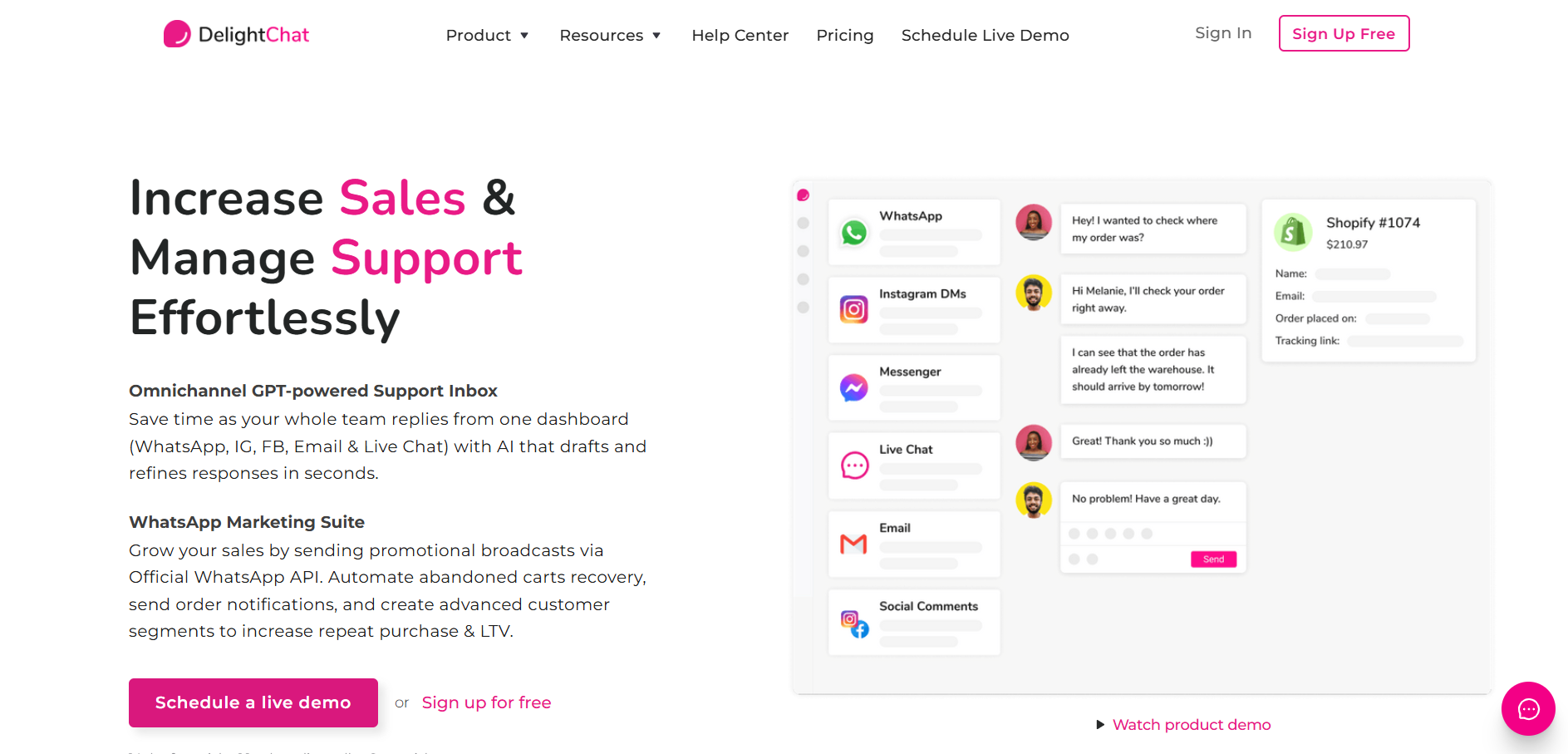
Post-purchase communication isn’t always one-way. Sometimes customers reply with a simple question: “Where is my order?”
Customer support is part of the post-purchase experience. DelightChat focuses on ecommerce customer support and customer conversations, which makes it relevant for D2C brands handling a growing volume of customer messages.
Bringing those conversations into an organised support workflow makes it easier to manage questions after an order is placed. But support teams also need accurate shipment information when customers ask for an update. That’s why WhatsApp shipment tracking, customer support, and logistics visibility need to work together instead of sitting in separate systems.
Quick review
- Best for: Ecommerce customer support
- Strong on: Customer conversations and support workflows
- Ideal use case: D2C brands with growing support requirements
- Consider it if: Post-purchase customer queries are taking up significant support bandwidth
10. Custom WhatsApp + Logistics Stack, For Enterprise Requirements
For large ecommerce businesses with complex technology environments, building a custom WhatsApp and logistics stack can also be an option. A typical architecture could connect:
OMS
↓
Shipping platform
↓
Carrier APIs
↓
Tracking engine
↓
Notification system
↓
The advantage is complete control over the customer communication experience. A business can decide exactly which shipment events trigger automated shipment notifications, what information customers receive and how different exceptions are handled.
For example, a brand could create separate workflows for:
- Delayed shipments
- Failed delivery attempts
- NDR
- RTO risk
- Out-for-delivery updates
- Delivery confirmation
- Post-delivery engagement
But this approach also comes with more responsibility.
The business has to build and maintain integrations, manage changes across carrier APIs, monitor workflows and ensure that customer communication remains accurate.
For smaller and growing ecommerce businesses, an existing logistics or communication platform may therefore be a simpler way to bring these capabilities together.
Quick review
- Best for: Large enterprises with highly specific requirements
- Strong on: Customisation and control
- Ideal use case: Businesses with dedicated technology and engineering teams
- Consider it if: You want to own the complete communication and logistics workflow
How These WhatsApp Order Update Solutions Compare
These platforms solve different problems. Some focus on customer communication, while others are built for ecommerce, WhatsApp marketing, support, or logistics. That distinction matters when you’re choosing the right WhatsApp order update solutions for your business.
Your choice should reflect what needs fixing. Some brands need post purchase WhatsApp notifications to keep shoppers informed after checkout. Others need ecommerce shipment notifications that share delivery milestones without sending customers back to a tracking page.
| Solution | Primary Use Case | WhatsApp Automation | Shipment Visibility | Post-Purchase Engagement | Ecommerce Focus |
| eShipz | Shipment + post-purchase experience | Yes | Strong | Strong | Strong |
| WATI | WhatsApp communication | Yes | Integration dependent | Strong | Strong |
| Interakt | D2C engagement | Yes | Integration dependent | Strong | Strong |
| AiSensy | WhatsApp marketing & automation | Yes | Integration dependent | Strong | Strong |
| Gupshup | Enterprise messaging | Yes | Integration dependent | Flexible | Flexible |
| Meta WhatsApp Business Platform | Custom infrastructure | Yes | Requires integration | Requires integration | Flexible |
| Twilio | Developer-led communication | Yes | Requires integration | Flexible | Flexible |
| Zoko | WhatsApp commerce | Yes | Integration dependent | Strong | Strong |
| DelightChat | Ecommerce support | Yes | Integration dependent | Strong | Strong |
| Custom stack | Enterprise-specific workflows | Custom | Custom | Custom | Custom |
Brands looking for more connected WhatsApp shipment tracking may need a platform that can work with their shipping and carrier systems. This makes it possible to send real-time shipment updates WhatsApp messages when an order is picked up, reaches a new location, goes out for delivery or faces a delay.
At the same time, automated shipment notifications can become part of a larger ecommerce post purchase engagement strategy. Instead of using WhatsApp only to say that an order has been shipped, brands can use WhatsApp ecommerce notifications across the customer journey, from order confirmation and dispatch to delivery, feedback, returns and re-engagement.
So, the best fit comes down to the kind of experience you want to build. If you mainly need customer conversations, a WhatsApp communication platform may be enough. If shipment visibility is the priority, look for stronger logistics integrations and real-time shipment updates WhatsApp capabilities. And if you want to connect delivery communication with the wider post-purchase journey, look for a solution that brings WhatsApp order updates, shipment tracking and ecommerce post purchase engagement together.
How WhatsApp Shipment Tracking Improves the Post-Purchase Experience
Customers want a simple answer after they buy: Where is my order? They need to know whether their package has shipped, where it is now, and when it’s expected to arrive. A tracking ID alone often isn’t enough, especially if they have to visit a courier website and check the status themselves.
Real-time shipment updates WhatsApp make this easier by sending important delivery details directly to the customer.
Keeping Customers Updated at Every Shipment Milestone
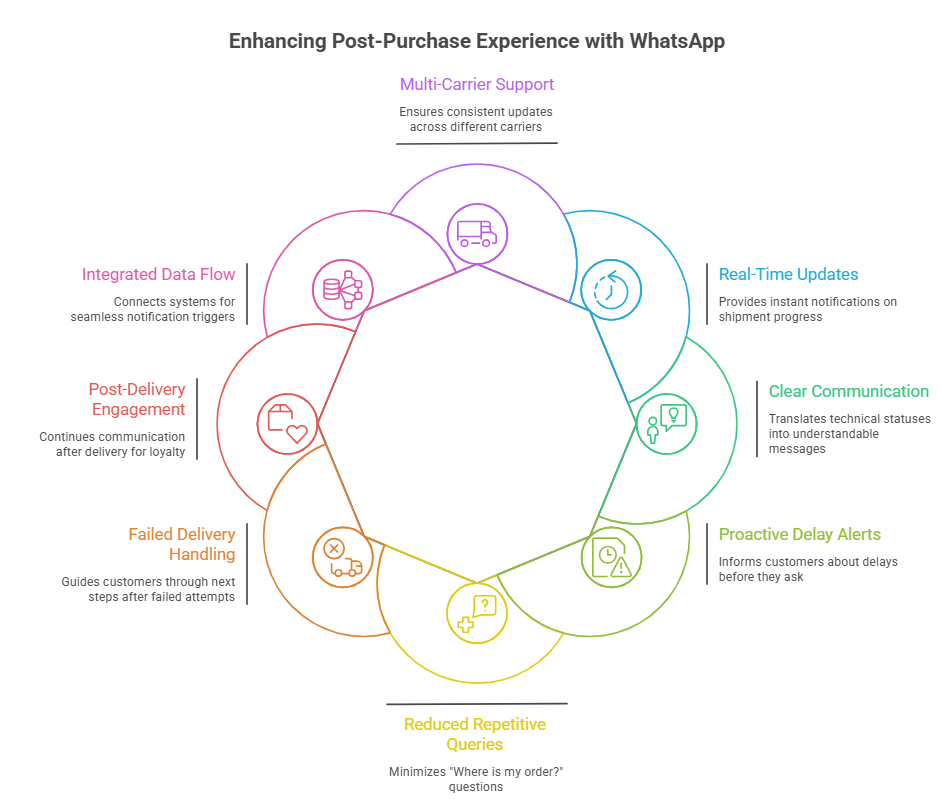
The best whatsApp order update solutions keep customers informed throughout delivery, not only when an order is dispatched. Updates should cover order confirmation, packing, shipment pickup, transit, out-for-delivery status, and final delivery.
A customer might first get confirmation that the order was placed. They can then receive ecommerce shipment notifications when the shipment is picked up and again when it reaches the final-mile stage. This gives customers a clear view of their delivery without making them repeatedly check a tracking page.
Making Shipment Information Easier to Understand
Customers don’t need more tracking details. They need updates they can understand. Courier tracking pages often use technical statuses or carrier-specific terms that leave customers guessing. post purchase WhatsApp notifications turn those shipment events into short, useful messages.
Instead of showing only a tracking number, a brand can say, “Your order is on the way. Your shipment has been picked up and is now in transit. Expected delivery: September 23.” Customers get the details that matter without decoding a complicated tracking status.
Giving Customers Real-Time Delivery Updates
Delivery timelines often shift as orders move through the logistics network. A shipment might arrive earlier than expected, face a delay, or enter the final-mile stage sooner than planned. With real-time shipment updates WhatsApp, brands can share those changes as they happen.
For example, once an order is out for delivery, the customer can get a simple message confirming that the delivery partner is on the way and the order is expected that day. automated shipment notifications work best when they’re triggered by actual shipment events instead of generic reminders.
Communicating Delays Before Customers Have to Ask
Not every shipment follows the original delivery plan. Weather conditions, operational issues, carrier delays, address problems and other exceptions can affect the expected delivery date. For customers, the frustration often comes from not knowing what is happening rather than the delay itself. Sending a timely ecommerce shipment notification when the delivery timeline changes can make the experience more transparent. A simple message explaining that there is a delay, along with the updated expected delivery date, can reassure the customer that the order is still being tracked. This kind of proactive communication also makes WhatsApp ecommerce notifications more useful because the information is based on the current shipment status.
Reducing Repetitive “Where Is My Order?” Questions
One of the most common questions customers have after placing an order is, “Where is my order?” When tracking information is difficult to find, customers may reach out through WhatsApp, email, phone calls or social media just to understand the latest status. WhatsApp shipment tracking can help address many of these basic queries by putting shipment information directly in front of the customer. They can see whether the order has been picked up, whether it is still in transit, whether it is out for delivery, what the expected delivery date is and whether there has been a delay. This does not eliminate the need for customer support, but it can make the overall ecommerce post purchase engagement experience more transparent and reduce some repetitive tracking-related conversations.
Handling Failed Deliveries and NDR Communication
The delivery journey does not always move directly from shipment to successful delivery. A customer may be unavailable, an address may be difficult to locate or a delivery attempt may fail for another reason. This is where WhatsApp order updates can become more useful than simple status notifications. Instead of leaving the customer wondering why the order has not arrived, brands can send a message explaining that the delivery attempt was unsuccessful and guide the customer towards the next available action. When automated shipment notifications are connected to delivery exceptions and NDR workflows, these updates can become part of the wider post purchase WhatsApp notifications journey rather than being handled manually each time.
Connecting WhatsApp With the Wider Post-Purchase Journey
The role of WhatsApp ecommerce notifications does not have to end once the package is delivered. WhatsApp can also become part of a broader ecommerce post purchase engagement strategy, where communication continues after delivery. The journey could move from order confirmation and shipment updates to delivery confirmation, product feedback, reviews, support, returns, reorders or future recommendations. The important point is that each message has a clear purpose. Early updates provide reassurance, tracking messages create visibility, delivery notifications confirm completion, and post-delivery communication can help brands continue the customer relationship.
Connecting Shipment Data With Customer Communication
The technology behind the notification is just as important as the message itself. Sending a WhatsApp message is one part of the process; knowing when to send it and what information to include is another. A useful workflow connects the order system, shipping platform, carrier, shipment event and customer notification layer. When a carrier confirms that a shipment has been picked up, the system can trigger a dispatch update. When the shipment reaches the final-mile stage, an out-for-delivery message can be sent. If the expected delivery date changes, the customer can receive an updated notification. This connection is what makes real-time shipment updates WhatsApp communication more relevant because the message reflects what is actually happening with the order.
Supporting Multi-Carrier Shipment Visibility
For ecommerce brands working with multiple carriers, maintaining consistent customer communication can be more challenging. Different carriers may use different tracking systems, status names and delivery events, while customers still expect a simple and consistent experience. Bringing these shipment events together can help brands create more consistent ecommerce shipment notifications regardless of which carrier is handling the order. This is particularly useful for D2C brands, retailers and larger ecommerce businesses that select carriers based on destination, serviceability, delivery speed or other operational requirements. In such cases, WhatsApp shipment tracking becomes part of a wider shipment visibility strategy rather than a standalone messaging feature.
Where eShipz Fits In
eShipz takes a logistics-led approach by connecting shipment visibility with customer communication. Its real-time tracking capabilities support multi-carrier shipment visibility and automated communication through WhatsApp, SMS and email. The important part is the connection between the shipment event and the customer update. When an order is dispatched, the customer can receive a relevant update; when it moves through the logistics network, the status can be communicated; when the expected delivery date changes, the customer can be informed; and when the order reaches the out-for-delivery stage, another update can be triggered. This makes WhatsApp order updates more useful than simply sending a tracking link because the communication is connected to the actual shipment journey and can contribute to a broader ecommerce post purchase engagement strategy.

NDRs and Failed Deliveries: The Role of Post Purchase WhatsApp Notifications
Another important part of the post-purchase experience is what happens when a delivery does not go as planned. A carrier may attempt delivery when the customer is unavailable, the address may be difficult to locate, or the delivery may fail for another operational reason. When this happens, simply recording an NDR (non-delivery report) in the system is not enough. The customer also needs to know what happened and what they can do next.
For example, if a delivery attempt fails because the customer was unavailable, a post purchase WhatsApp notification can be sent soon after the event is recorded. Instead of leaving the customer to discover the failed attempt themselves, the brand could send a simple message such as: “We couldn’t deliver your order today. Would you like to reschedule the delivery?” This gives the customer immediate context and, more importantly, a clear next step.
This is where WhatsApp order update solutions can become more useful than basic status notifications. When WhatsApp is connected to shipment and delivery data, automated shipment notifications can be triggered by actual events throughout the delivery journey. That can include shipment delays, failed delivery attempts, NDRs and other exceptions, rather than limiting communication to order confirmation and successful delivery.
The same approach can also support better WhatsApp shipment tracking. Customers do not just need to know where their package is when everything is going smoothly. They also need visibility when something changes. If a shipment is delayed, a delivery attempt fails or the expected delivery date changes, timely real-time shipment updates WhatsApp communication can help set the right expectation.
For ecommerce teams, this can also reduce some of the repetitive customer questions that appear after failed deliveries. Instead of customers having to ask, “Why wasn’t my order delivered?” or “When will you try again?”, the WhatsApp ecommerce notifications can explain the latest status and direct them towards the next available action.
The goal is to move the communication from “Something went wrong” to “Here is what happened, and here is what you can do next.” That small difference can make the post-purchase experience feel much more proactive and customer-friendly.
eShipz highlights proactive alerts and workflows around delays, NDR and RTO risk as part of its shipment management capabilities. By connecting these operational events with customer communication, brands can make ecommerce shipment notifications part of the delivery workflow rather than treating customer communication as an afterthought.
For businesses managing high shipment volumes or multiple carriers, this connection becomes even more useful. Instead of manually identifying failed deliveries and deciding when to contact each customer, the communication can be linked to shipment events and handled through an automated workflow. This allows post purchase WhatsApp notifications to support not just routine delivery updates, but also the exceptions that can have a bigger impact on the overall customer experience.
Why WhatsApp Becomes More Important During Peak Ecommerce Seasons
Peak ecommerce seasons can change the pace of an operation very quickly. During periods such as Diwali, Dussehra, Christmas and New Year, along with end-of-season sales and major marketplace events, brands may see a sharp increase in orders and shipment volumes. At the same time, customers still expect the same level of visibility they receive during quieter periods. They want to know when their order has been packed, when it has been shipped, where it is currently in transit and when it is likely to arrive.
As order volumes grow, one question can start appearing again and again across support channels: “Where is my order?” A customer may simply want to know whether the package has been dispatched or whether it is still on the way, but when hundreds or thousands of customers are asking similar questions, the workload can quickly add up for support teams. This is where WhatsApp order update solutions can help brands communicate important information before customers need to reach out.
Instead of relying entirely on support agents to provide individual updates, brands can use automated shipment notifications to keep customers informed throughout the delivery journey. An order confirmation can be followed by a dispatch message, a transit update, an out-for-delivery notification and a final delivery confirmation. These ecommerce shipment notifications give customers visibility without requiring them to repeatedly check a courier website or contact the brand for basic tracking information.
The value becomes even clearer when something does not go according to plan. If a shipment is delayed during a busy festive period, a post purchase WhatsApp notification can inform the customer about the change instead of leaving them wondering why the order has not arrived. If the delivery attempt fails, the customer can receive a WhatsApp ecommerce notification explaining what happened and, where supported, guiding them towards the next step. If the shipment reaches the final-mile stage, real-time shipment updates WhatsApp communication can let the customer know that the package is out for delivery.
For brands, this makes WhatsApp shipment tracking more than a convenient way to share a tracking link. It becomes a way to keep customers connected to the shipment as it moves through different stages. During peak periods, when multiple orders may be moving through different carriers and fulfilment locations at the same time, having these updates triggered by actual shipment events can make communication more consistent.
Peak seasons also make ecommerce post purchase engagement more important. A customer who has just placed an order during Diwali or a major sale may be buying a gift, preparing for an event or working around a specific date. A delay or unclear delivery timeline can therefore create more uncertainty than it would during a normal shopping period. Clear post purchase WhatsApp notifications can help set expectations by sharing the latest shipment status and updated delivery information when it matters.
There is also a practical benefit for customer support teams. When customers can already see that their order has been dispatched, is in transit or is out for delivery, they may not need to contact support for every routine update. That allows support teams to spend more time on conversations that actually need human attention, such as address issues, returns, exchanges, delivery exceptions or product-related questions.
This does not mean automated shipment notifications solve every challenge that comes with peak ecommerce demand. Carrier delays, warehouse capacity, inventory issues and last-mile constraints still need to be managed operationally. What WhatsApp can improve is the communication around those events. When customers know what is happening and what to expect next, the experience becomes clearer even when the underlying delivery situation is more complicated.
For Indian ecommerce brands, this makes WhatsApp ecommerce notifications particularly useful during high-volume periods. The channel can support everything from routine ecommerce shipment notifications to delay alerts, NDR communication, delivery confirmations and post-delivery engagement. Instead of treating WhatsApp as just another messaging channel, brands can connect it with their shipment and customer communication workflows to create a more consistent post-purchase experience.
Ultimately, peak season is not only about getting more orders out of the warehouse. It is also about keeping customers informed while those orders move through the delivery network. Real-time shipment updates WhatsApp communication, when connected to accurate shipment data, can help brands stay proactive and give customers the information they need at each stage of the journey.
How to Choose the Right WhatsApp Order Update Solution
Choosing the right WhatsApp order update solution is less about finding the platform with the longest list of features and more about understanding what your business actually needs. A D2C brand looking to answer customer questions on WhatsApp will have very different requirements from an ecommerce business trying to automate ecommerce shipment notifications across multiple carriers. Before comparing platforms, it helps to look at where WhatsApp fits into your customer journey and what you want it to improve.
If You Mainly Need WhatsApp Conversations
If most of your customer interactions happen through WhatsApp, a communication-focused platform may be enough. These solutions can help brands manage customer questions, support conversations and general engagement from a single channel. They can also support WhatsApp ecommerce notifications for order-related communication, depending on the platform and the integrations available.
This can work well for brands where the main goal is to make WhatsApp a convenient place for customers to interact with the business. However, if shipment tracking is also a major requirement, it is worth checking how closely the platform can connect with your ecommerce, order management or logistics systems.
If WhatsApp Is Part of Your Sales Strategy
Some brands use WhatsApp well beyond post-purchase communication. It can be part of the buying journey itself, helping customers discover products, ask questions, receive recommendations and complete purchases.
For these businesses, a WhatsApp commerce platform may be more relevant. The focus is less on post purchase WhatsApp notifications and more on creating a conversation around the product and purchase. If your goal is to use WhatsApp for both commerce and customer engagement, look at how well the platform supports the complete journey rather than only its messaging capabilities.
If Customer Support Is Your Biggest Challenge
For brands receiving a high volume of customer questions, the priority may be managing conversations rather than sending more notifications. In that case, look for a platform that gives support teams better visibility into WhatsApp conversations and makes it easier to respond to customers.
It is also worth considering what happens when a customer asks a shipment-related question. If someone messages, “Where is my order?”, the support team should ideally have access to accurate shipment information instead of having to check another system manually. Connecting WhatsApp shipment tracking with customer support can make these conversations much easier to handle.
If Shipment Visibility Is the Main Requirement
If your biggest requirement is keeping customers informed about their deliveries, then logistics capabilities should be high on your checklist. Look for multi-carrier tracking, access to real-time shipment data and the ability to trigger automated shipment notifications based on actual delivery events.
The platform should ideally support important milestones such as order dispatch, shipment pickup, in-transit updates, out-for-delivery notifications and delivery confirmation. It should also be able to communicate when something changes. Real-time shipment updates WhatsApp can be particularly useful for delivery delays, updated estimated delivery dates and other exceptions because customers receive the information without having to repeatedly check a tracking page.
NDR and failed-delivery workflows are another area worth checking. A platform that supports post purchase WhatsApp notifications for NDRs, delivery exceptions and potential RTO situations can help brands communicate with customers when an order needs their attention. This is different from simply sending a tracking link; the communication is connected to what is actually happening with the shipment.
If You Want an End-to-End Post-Purchase Experience
For some ecommerce businesses, WhatsApp is only one part of a much bigger post-purchase strategy. In that case, the evaluation needs to go beyond messaging. You may want a solution that connects shipment tracking, WhatsApp communication, SMS and email, branded tracking pages, exception management and post-delivery engagement within the same customer journey.
For example, the experience could begin with an order confirmation, followed by ecommerce shipment notifications when the order is dispatched and picked up. Customers could then receive WhatsApp ecommerce notifications as the shipment moves through the network, along with alerts if there is a delay or failed delivery attempt. After delivery, the same journey could continue with feedback requests, review messages, product guidance or relevant reorder communication.
This is where ecommerce post purchase engagement becomes broader than shipment tracking. The goal is not simply to tell customers where their order is, but to keep the communication useful before, during and after delivery.
Look at How the Different Systems Connect
One of the most important things to check is what sits behind the WhatsApp message. A good customer-facing experience depends on accurate information coming from the ecommerce platform, order management system, shipping platform and carrier network.
Ideally, the flow should look something like this: Order → Shipment → Carrier → Tracking Event → WhatsApp Update. When these systems are connected, a message can be triggered by an actual event instead of relying on someone to manually identify which customers need an update.
This is especially important for automated shipment notifications. Automation is only useful when the information being automated is accurate. If the shipment status changes, the customer communication should change with it. That could mean sending an out-for-delivery update, communicating a delay, sharing a revised delivery date or notifying the customer after a successful delivery.
Consider What Happens After Delivery
Another useful question is what happens once the shipment reaches the customer. If your goal is stronger ecommerce post purchase engagement, look for a solution that can support communication beyond delivery notifications.
A customer who has just received an order may need product information, installation guidance or support. A few days later, they may be ready to provide feedback or leave a review. For certain products, a reorder reminder may make sense later. These interactions can become part of the same post purchase WhatsApp notifications journey instead of being treated as completely separate campaigns.
Where a Logistics-Led Platform Fits
For businesses that want customer communication to stay closely connected to the shipment lifecycle, a logistics-led platform such as eShipz can be relevant. The idea is to connect shipment visibility, carrier information and customer communication rather than treating WhatsApp as a completely separate channel.
This approach can support WhatsApp order updates, WhatsApp shipment tracking, automated shipment notifications and ecommerce shipment notifications around actual delivery events. It can also extend into broader ecommerce post purchase engagement, where communication continues from dispatch and delivery to exceptions, feedback and post-delivery interactions.
Ultimately, the right WhatsApp order update solution depends on the problem you are trying to solve. If you mainly need conversations, look at communication and support capabilities. If WhatsApp is part of your sales journey, focus on commerce features. If shipment visibility is the priority, pay close attention to carrier integrations, real-time tracking and automated shipment notifications. And if you want a connected post-purchase journey, look for a solution that can bring WhatsApp ecommerce notifications, shipment tracking, delivery communication and post purchase WhatsApp notifications together.
Why eShipz Fits the Post-Purchase Use Case
From the customer’s point of view, the technology behind an order does not really matter. They simply want to know “Where is my order?” and when it will arrive. That is why customer communication needs to stay connected to the logistics journey.
Shipment Tracking + Customer Communication
eShipz brings shipment tracking, carrier connectivity and customer communication into one broader logistics workflow. This allows brands to connect WhatsApp order updates and ecommerce shipment notifications with actual shipment events, rather than sending messages separately.
Real-Time Updates Across the Journey
With WhatsApp shipment tracking and real-time shipment updates WhatsApp communication, customers can receive relevant updates as their order moves from dispatch to transit, out-for-delivery and delivery. eShipz also supports automated communication through WhatsApp, SMS and email.
Handling Delays and Exceptions
The journey does not always go as planned. Delays, NDRs and failed delivery attempts can also trigger automated shipment notifications and post purchase WhatsApp notifications, helping customers understand what happened and what they can do next.
Beyond Delivery
The post-purchase journey can continue after delivery through feedback, reviews, support and future engagement. This makes WhatsApp ecommerce notifications part of a wider ecommerce post purchase engagement strategy, rather than just a way to share tracking information. Overall, eShipz connects tracking → notification → delivery → engagement, giving brands a more connected way to manage the post-purchase experience.
What’s Next for WhatsApp in Ecommerce?
The post-purchase experience is becoming an increasingly important part of ecommerce. Customers do not want to place an order and spend the next few days wondering where it is. They want clear updates, realistic delivery expectations and quick communication when something changes.
That is why WhatsApp order update solutions are becoming more relevant for Indian ecommerce businesses. But WhatsApp alone is not the answer. The real value comes from connecting WhatsApp communication with accurate shipment information and the wider logistics workflow.
With WhatsApp shipment tracking, customers can stay updated without repeatedly checking a tracking page. Automated shipment notifications can keep communication moving as the order progresses, while WhatsApp ecommerce notifications can extend beyond delivery into support, feedback and other post-purchase interactions.
Looking ahead, the opportunity is not about sending more messages. It is about sending better, more relevant messages at the right time, whether that is a dispatch update, a delivery delay, an NDR alert or a simple delivery confirmation. For brands looking to bring shipment visibility, customer communication and ecommerce post purchase engagement closer together, eShipz offers a logistics-led approach to the post-purchase journey. Want to see how eShipz can help simplify shipment tracking and customer communication