




Returns in ecommerce can get expensive fast for a growing brand. Every returned order can involve reverse shipping, inspection, repackaging, inventory updates, customer support, and refunds. That’s why ecommerce returns management is essential for brands looking to reduce avoidable returns while keeping operating costs under control. For shoppers, returns are also an important part of the buying experience, with an estimated 19.3% of online sales returned in 2025, compared with 15.8% across total retail sales.
A flexible return policy can affect where people buy. Around 82% of consumers see free returns as an important factor when shopping online, and 76% are more likely to pick a return option with an instant refund or exchange. Returns also affect customer retention. About 71% of consumers say they’re less likely to shop with a retailer again after a poor returns experience.
The issue isn’t limited to customer expectations. Return fraud accounts for an estimated 9% of all returns, and 45% of shoppers say it’s acceptable to “bend the rules” when returning items. Ecommerce brands need to strike the right balance. The aim isn’t to eliminate returns altogether. It’s to reduce ecommerce returns while making valid returns quicker and easier through stronger returns management in ecommerce, ecommerce returns automation, and efficient ecommerce reverse logistics.
That means reviewing the full customer journey, from product discovery and checkout through delivery, return pickup, refunds, exchanges, and inventory recovery. This guide covers 15 practical ecommerce return reduction strategies. It also explains how ecommerce returns software, ecommerce returns solutions and returns management software for ecommerce can help brands create a more efficient returns management process.
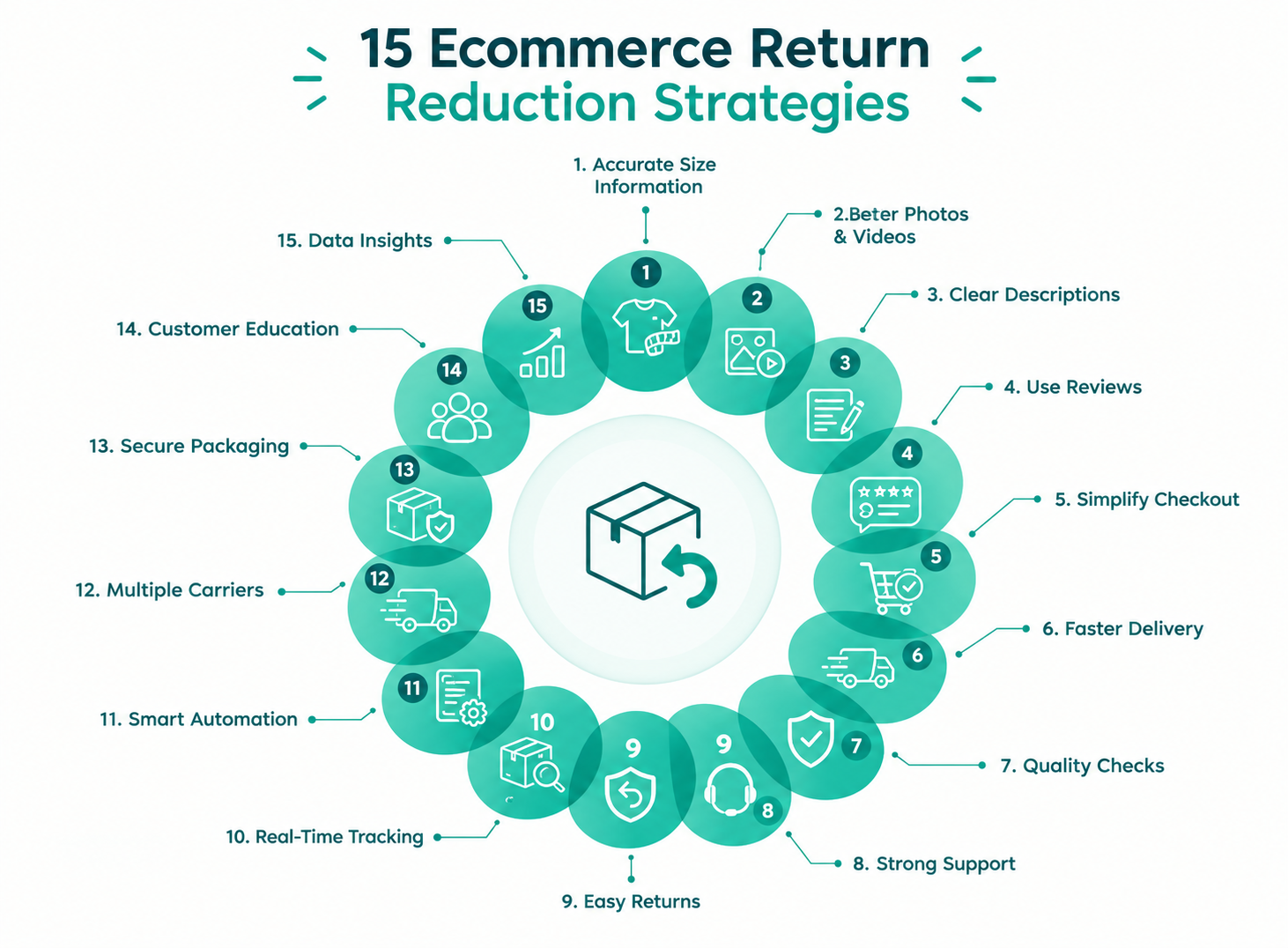
15 Ecommerce Return Reduction Strategies
To reduce ecommerce returns, brands need to look beyond the return process. The full customer journey matters, from product discovery and purchase through fulfilment, delivery, and post-purchase support. This ecommerce return reduction strategies help prevent avoidable returns and make necessary returns easier to manage.
 1. Give Customers Accurate Size and Fit Information
To reduce ecommerce returns, brands need to look beyond the return process. The full customer journey matters, from product discovery and purchase through fulfilment, delivery, and post-purchase support.
This ecommerce return reduction strategies help prevent avoidable returns and make necessary returns easier to manage.
What to Include
Brands can provide:
- Product measurements
- Body measurements
- Fit type
- Model height and size
- Fabric stretch information
- Comparison between sizes
- Category-specific sizing guidance
For example, instead of simply saying “available in sizes S to XL”, explain whether the product has a relaxed, regular, slim, or oversized fit.
The more accurately customers can judge fit before purchase, the easier it becomes to reduce ecommerce returns and improve returns management in ecommerce. For fashion brands, accurate fit information can also reduce repeat returns caused by customers ordering multiple sizes.
2. Improve Product Photography and Video
Product photography is central to ecommerce returns management because customers can’t inspect products in person before buying. If images don’t show the product accurately, customers may receive something that doesn’t match their expectations, leading to avoidable returns.
Images shape much of the online product experience. Clear, detailed visuals support ecommerce return reduction strategies by helping shoppers understand what they’re buying before they place an order.
Poor photography creates confusion about colour, texture, size, shape, and material. Brands that invest in accurate product images can reduce ecommerce returns and give customers more confidence at checkout.
Make Product Visuals More Informative
Consider using:
- Multiple product angles
- Close-up images
- Scale references
- Lifestyle images
- Product videos
- 360-degree views where useful
- Images showing the product in use
For products where appearance strongly influences purchasing decisions, better visuals can reduce the gap between customer expectations and the actual product.
This also gives ecommerce returns software more useful context when brands analyse return reasons. If a particular product repeatedly comes back because customers say it looks different from the listing, the product images can be reviewed and improved.
3. Write Accurate Product Descriptions
Customers can’t physically inspect a product before buying online, so product photography is important for ecommerce returns management. If images don’t show the product accurately, customers may receive something that differs from what they expected. That gap between expectation and reality often leads to avoidable returns. Clear photos give shoppers a better understanding of what they’re buying before they place an order.
Product images are part of the buying experience. Accurate visuals support ecommerce return reduction strategies by showing customers the product in detail before purchase.
Poor photography can create false expectations about colour, texture, size, shape, or material. Clearer visuals help brands reduce ecommerce returns and give customers more confidence while buying.
Include Specific Information
Depending on the product category, provide:
- Dimensions
- Materials
- Weight
- Colour information
- Features
- Compatibility
- Care instructions
- What’s included
- Product limitations
Clear product information helps customers make better decisions and lowers the risk of receiving something that doesn’t match their expectations.
It’s one of the most practical ecommerce return reduction strategies because it removes uncertainty before checkout. Better descriptions also support returns management in ecommerce by preventing returns linked to missing or confusing product details.
Brands using returns management software for ecommerce can review return reasons to identify products with frequent expectation-related returns. They can use those findings to improve product descriptions and build a continuous ecommerce returns management process.
4. Use Customer Reviews to Set Better Expectations
Clear product information helps customers make better decisions and lowers the chance of receiving something that doesn’t meet their expectations.
It’s one of the most practical ecommerce return reduction strategies because it removes uncertainty before checkout. It also improves returns management in ecommerce by preventing returns caused by vague or incomplete product details.
Brands using returns management software for ecommerce can use return reasons to identify products with the most expectation-related returns. They can then update product descriptions and build a more consistent ecommerce returns management process.
Use Reviews as Product Intelligence
Brands should monitor reviews for recurring comments about:
- Sizing
- Quality
- Colour
- Packaging
- Product performance
- Missing components
- Durability
If several customers report the same issue, update the product listing to reflect it. Repeated feedback that an item runs small, for instance, should lead to clearer sizing guidance.
Reviews are a practical part of ecommerce return reduction strategies. They do more than build trust. Brands can use them to spot why products are returned and make the buying experience more accurate.
That gives ecommerce returns software and returns management software for ecommerce better data for analysing return reasons.
5. Answer Customer Questions Before Checkout
Customers often have questions that are not answered on the product page. If they cannot find the answer, they may either abandon the purchase or buy the product without enough information, which can increase the likelihood of a return.
Answering these questions before checkout is a practical way to reduce returns and improve the overall ecommerce returns management process.
Build Pre-Purchase Support
Brands can use:
- FAQs
- Product Q&A
- Chat support
- AI assistants
- Comparison tools
- Buying guides
Someone buying a laptop may need to confirm whether a specific model supports the software they use. A furniture shopper might ask if an item will fit through a standard doorway.
Answering these questions before checkout helps customers buy with clearer expectations and can reduce ecommerce returns linked to avoidable mistakes. At larger ecommerce businesses, these conversations also support ecommerce returns management India. Brands can spot recurring pre-purchase questions that later show up as return reasons.
6. Use AR and Virtual Try-On Where It Makes Sense
Augmented reality can help customers understand how certain products may look or fit in their environment. For some categories, this can reduce uncertainty before purchase and support ecommerce return reduction.
It is particularly useful for categories such as:
- Eyewear
- Furniture
- Home décor
- Beauty
- Fashion
- Accessories
AR should not be treated as a requirement for every ecommerce business. The objective is to use technology where it can help customers make a better purchasing decision.
When used effectively, virtual try-on and visualisation tools can complement other ecommerce return solutions by giving customers a better understanding of the product before they place an order.
7. Improve Order Accuracy Before Shipping
Not every return is caused by the customer. Some happen because the brand ships the wrong item.
An incorrect SKU, colour, size, quantity, or variant can immediately create an avoidable return. Preventing these errors before dispatch is therefore an important part of ecommerce returns management.
Add Fulfilment Checks
Before dispatch, brands should validate:
- SKU
- Variant
- Quantity
- Shipping address
- Customer details
- Packaging requirements
- Order status
Barcode scanning and automated order validation reduce manual errors and improve order accuracy. They’re also central to ecommerce returns automation. Connecting fulfilment checks to the broader shipping workflow helps brands catch mistakes before an order leaves the warehouse.
Stopping an incorrect shipment costs less than processing a return after delivery. It avoids unnecessary reverse logistics, customer support work, and refund or exchange activity. Well-connected ecommerce returns software brings these processes into one view, so teams can track both forward and reverse shipments more clearly.
8. Improve Packaging to Prevent Damage
A product can be correct when it leaves the warehouse and still become a return because it arrives damaged. Strong packaging is therefore an important part of ecommerce return reduction and can help brands reduce ecommerce returns caused by preventable transit damage.
Packaging should be designed according to the product’s physical characteristics and expected handling conditions.
Consider
- Product fragility
- Cushioning
- Moisture protection
- Box strength
- Internal movement
- Tamper protection
- Package dimensions
Brands should also track whether certain SKUs, warehouses, carriers, or packaging types have higher damage-related return rates. This information can connect return analytics with fulfilment and logistics decisions and help ecommerce returns management teams identify where improvements are needed.
9. Set Realistic Delivery Expectations
Customers may initiate returns or refuse deliveries when an order takes significantly longer than expected. Setting realistic delivery expectations can therefore support ecommerce return reduction while improving the overall customer experience.
Providing an estimated delivery date at checkout is more useful than simply showing a generic shipping promise. Accurate delivery information also gives customers a clearer understanding of when they can expect their order.
Improve Delivery Communication
Customers should receive relevant updates such as:
- Order confirmation
- Shipment confirmation
- Expected delivery date
- Delay notifications
- Out-for-delivery updates
- Delivery completion
Accurate delivery communication can reduce uncertainty and prevent some delivery-related returns and RTOs. For ecommerce returns management India, this becomes particularly important when orders move across different regions and carrier networks.
10. Improve Post-Purchase Communication
The customer journey does not end after checkout. Good post-purchase communication can reduce confusion around delivery, order status, exchanges, and returns.
Clear communication is also an important part of returns management in ecommerce because customers are less likely to contact support repeatedly when they can see what is happening with their order or return.
Useful Communication
Automated notifications can cover:
- Order status
- Shipment tracking
- Delivery updates
- Delivery delays
- Return eligibility
- Return pickup
- Refund status
- Exchange status
The objective is not to send more messages. It is to provide the right information at the right stage of the customer journey.
Ecommerce returns automation can help brands trigger these updates automatically, reducing repetitive manual communication for support teams.
11. Make Exchanges Easier Than Refunds
A customer asking for a return does not always mean they want to stop buying from the brand. Sometimes the customer simply needs a different size, colour, or variant.
An easy exchange process can therefore preserve the original purchase instead of turning it into a complete refund. This makes exchange management an important part of ecommerce return solutions.
Make Exchanges Simple
Brands can offer:
- Size exchanges
- Variant exchanges
- Colour exchanges
- Store credit
- Product swaps
The exchange workflow should be as simple as the refund workflow. When customers can easily choose an alternative product, brands have a better opportunity to retain revenue while solving the customer’s original problem.
Returns management software for ecommerce can help automate exchange requests, inventory checks, replacement shipments, and customer notifications.
12. Use Returnless Refunds Selectively
For low-value products, the cost of shipping a product back can sometimes exceed the value that can be recovered. In such cases, a returnless refund may make operational sense.
However, this should not be applied universally. Brands need to consider product value, recovery potential, customer behaviour, and the cost of ecommerce reverse logistics before deciding when to use this approach.
When It May Make Sense
Returnless refunds can be considered when:
- Product value is low
- Reverse shipping is expensive
- Product cannot be economically resold
- Handling costs exceed recovery value
Brands should also establish controls to prevent repeated misuse.
Returnless refunds are therefore one possible ecommerce return solution, not a replacement for proper ecommerce returns management.
13. Create a Clear Return Policy
A complicated return policy can create frustration before and after purchase. Customers should be able to understand the rules without reading lengthy legal language.
A clear policy can also support ecommerce return reduction by setting realistic expectations before the customer places an order.
Clearly Explain
The policy should cover:
- Return window
- Eligible products
- Non-returnable products
- Product condition requirements
- Exchange rules
- Refund timelines
- Pickup process
- Return shipping charges
- Cancellation rules
The policy should also be visible before purchase.
Clear expectations can reduce disputes and make returns management in ecommerce more predictable. Brands can also use ecommerce returns software to apply return eligibility rules consistently across different products and orders.
14. Use Return Data to Find the Root Cause
One of the biggest opportunities in ecommerce returns management is learning from the returns that are already happening.
A return reason such as “product not as expected” is not detailed enough to support meaningful action. Brands need to understand exactly why customers are returning products and identify patterns across orders.
Categorise Return Reasons
Brands can analyse returns by:
- SKU
- Product category
- Size
- Variant
- Warehouse
- Geography
- Carrier
- Customer segment
- Return reason
- Return value
- Delivery time
For example, if a particular product receives a high number of returns because of sizing, changing the size guide may have a bigger impact than changing the return policy.
Return analytics should therefore lead to operational action. With the right ecommerce returns software, brands can identify recurring problems and use those insights to improve products, fulfilment, packaging, delivery, and customer communication.
This creates a continuous ecommerce return reduction process rather than treating every return as an isolated transaction.
15. Improve Ecommerce Reverse LogisticsWithAutomation
Once a return is initiated, the operational work starts. The product must be picked up, transported, received, inspected, and processed.
ecommerce reverse logistics is important at this stage. Poor reverse logistics can raise shipping costs, extend processing times, cause inventory losses, and frustrate customers. Manual coordination between customers, warehouses, carriers, finance teams, and support teams often leads to delays. ecommerce returns automation connects these steps through predefined workflows.
Automate the Return Workflow
Ecommerce returns automation can help with:
- Return request creation
- Eligibility validation
- Pickup scheduling
- Carrier assignment
- Return tracking
- Customer notifications
- Exchange workflows
- Refund triggers
- Return status updates
- Exception handling
Don’t automate every decision. Automate repetitive tasks but make sure the right team can still see and handle important exceptions.
For brands processing high return volumes, returns management software for ecommerce connects return requests with carrier operations, tracking, exchanges, refunds, and inventory workflows. It gives ecommerce returns management a clearer structure, cuts manual work, and makes the returns experience easier for customers and teams.
Ecommerce Returns Management at a Glance
Ecommerce returns management starts well before a customer requests a return. A return can be caused by a product description, sizing issue, fulfilment error, damaged package, delivery problem, or a complicated return process. Looking at the complete customer journey helps brands identify where they can reduce ecommerce returns and where better ecommerce return solutions can improve the experience.
The table below shows the key stages of returns management in ecommerce, the problems brands commonly face, and the areas they can improve.
| Stage | Common Problem | What Brands Can Improve |
| Product discovery | Customer does not understand the product | Product descriptions, images and videos |
| Product selection | Wrong size or variant | Size guides, fit information and Q&A |
| Checkout | Customer uncertainty | Clear policies and delivery estimates |
| Fulfilment | Wrong item shipped | SKU validation and quality checks |
| Packaging | Product damaged in transit | Better packaging and handling |
| Delivery | Late or failed delivery | Accurate ETAs and proactive communication |
| Return request | Complicated return process | Self-service returns |
| Reverse movement | Delayed return pickup | Carrier allocation and tracking |
| Resolution | Refund instead of exchange | Exchange and store-credit options |
| Post-return | Same problem happens again | Return analytics and root-cause analysis |
Each stage provides an opportunity to reduce avoidable returns. Product information and sizing can prevent problems before checkout, while accurate fulfilment and packaging can prevent operational errors. Once a return is initiated, ecommerce returns software and ecommerce returns automation can help manage pickup, tracking, exchanges, and refunds more efficiently.
This approach makes ecommerce returns management more than just processing returned orders. It turns return data and customer feedback into insights that can help brands improve the entire ecommerce journey.
What Causes Ecommerce Returns? 10 Common Reasons
Ecommerce returns can happen for many reasons, and not all of them are related to the product itself. A customer may choose the wrong size, misunderstand the product description, receive a damaged package, or simply change their mind after placing an order.
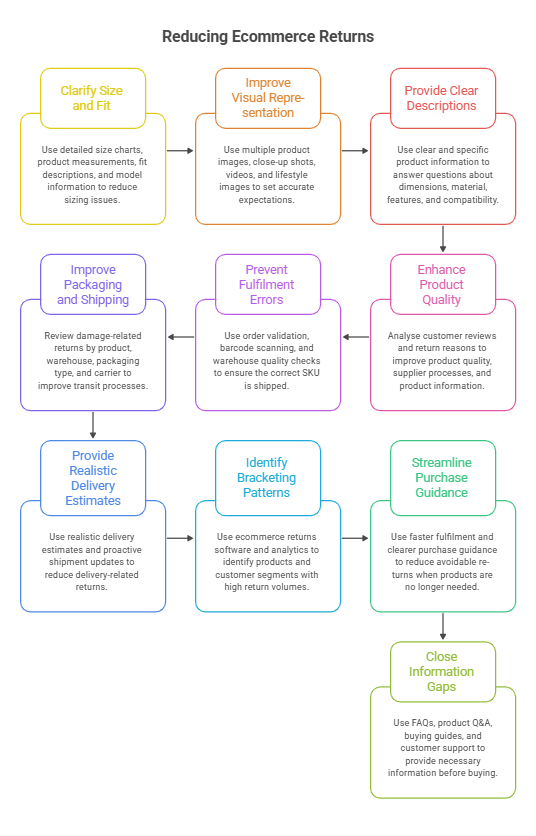
For brands looking to reduce returns, it is important to understand what is happening at each stage of the customer journey. These return reasons can also help businesses improve their ecommerce returns management and identify where better ecommerce return solutions are needed.
1. Wrong Size or Fit
Customers may order the wrong size when measurements or fit information are unclear. This is especially common in fashion, footwear, and accessories.
Detailed size charts, product measurements, fit descriptions, and model information can help customers make more confident decisions and reduce ecommerce returns caused by sizing issues.
2. Product Looks Different From the Listing
Customers cannot physically examine a product before buying it online. If the colour, texture, shape, or overall appearance looks different when the product arrives, they may decide to return it.
Using multiple product images, close-up shots, videos, and lifestyle images can help set more accurate expectations.
3. Product Description Is Unclear
A short or vague product description may leave important questions unanswered. Customers may not know the exact dimensions, material, features, compatibility, or what is included with the product.
Clear and specific product information is one of the practical ecommerce return reduction strategies brands can use before an order is placed.
4. Product Quality Does Not Meet Expectations
A customer may return a product because its quality, finish, durability, or performance does not match what they expected.
Brands can analyse customer reviews and return reasons to identify recurring quality issues. These insights can then be used to improve product quality, supplier processes, and product information.
5. Wrong Product or Variant Was Shipped
Returns can also happen because of fulfilment errors. A customer may receive the wrong SKU, colour, size, quantity, or product variant.
Order validation, barcode scanning, and warehouse quality checks can help prevent these mistakes. In returns management in ecommerce, preventing an incorrect shipment is usually better than managing the return afterward.
6. Product Was Damaged During Delivery
Even when the correct product is shipped, poor packaging or rough handling during transit can result in damage.
Brands can review damage-related returns by product, warehouse, packaging type, and carrier. This helps identify where packaging or shipping processes need to be improved.
7. Delivery Took Longer Than Expected
A delayed order can lead to customer dissatisfaction, cancellation, refusal, or a return, particularly when the product is needed for a specific occasion.
Providing realistic delivery estimates and proactive shipment updates can help customers understand when their order will arrive and reduce delivery-related returns.
8. Customers Order Multiple Options
Some shoppers order several sizes, colours, or variants and return the ones they do not want. This is commonly known as bracketing.
While it may not be possible to eliminate this behaviour, ecommerce returns software and return analytics can help brands identify which products and customer segments generate unusually high return volumes.
9. The Product Is No Longer Needed
Customers sometimes change their minds after placing an order. They may have purchased the product elsewhere, no longer need it, or decide that it does not fit their current requirements.
These returns cannot always be prevented, but faster fulfilment, better product information, and clearer purchase guidance can reduce some avoidable cases.
10. Customers Do Not Have Enough Information Before Buying
Sometimes the customer simply does not have enough information to make the right purchase decision.
Questions about size, compatibility, materials, dimensions, usage, installation, or product features can influence whether an order is ultimately returned. FAQs, product Q&A, buying guides, and customer support can help close these information gaps.
Understanding these reasons gives brands a starting point for ecommerce return reduction. Instead of treating every return as a separate customer service issue, businesses can look for patterns and address the underlying causes through better product information, fulfilment, delivery, and returns management.
The Three Layers of Ecommerce Returns Management
A useful ecommerce returns management strategy should not begin when a customer clicks the return button. It should cover the entire journey, from preventing unnecessary returns to managing the return request and recovering value from returned products.
The process can be divided into three connected layers: prevention, management, and recovery. Together, these layers help brands reduce ecommerce returns, improve returns management in ecommerce, and build a more efficient return workflow.
- Prevention
The first layer focuses on preventing avoidable returns before an order is placed or shipped. This is where ecommerce return reduction strategies can have the biggest impact because the most cost-effective return is often the one that never happens.
Brands can reduce ecommerce returns by giving customers enough information to make the right purchase decision and by preventing fulfilment errors before an order leaves the warehouse.
This includes:
- Better product information
- Accurate size and fit guides
- High-quality product images and videos
- Detailed customer reviews
- Pre-purchase questions and FAQs
- Product recommendations
- Accurate delivery estimates
- Order and SKU validation
- Better packaging
These measures form an important part of ecommerce return solutions because they address the reasons behind returns before reverse logistics is required.
- Management
The second layer begins when a customer decides to return an order. At this stage, the objective is to make returns management in ecommerce simple, transparent, and predictable for both the customer and the operations team.
Ecommerce returns software can help automate repetitive steps while giving teams better visibility into the status of each return.
This includes:
- Easy return initiation
- Automated eligibility checks
- Return request approval
- Pickup scheduling
- Reverse shipment tracking
- Customer notifications
- Exchange management
- Refund workflows
- Return status updates
- Exception handling
For businesses handling higher order volumes, returns management software for ecommerce can connect these activities into a single workflow. This reduces manual coordination and makes ecommerce returns automation more practical across customer service, logistics, and warehouse teams.
- Recovery
The final layer focuses on recovering as much value as possible from returned inventory. A returned product does not always have to become a complete loss. Depending on its condition, it may be restocked, exchanged, resold, refurbished, or routed through another recovery process.
This is where ecommerce reverse logistics and reverse logistics management become important.
Recovery can involve:
- Product inspection
- Quality checks
- Restocking
- Reselling
- Refurbishment
- Exchanges
- Store credit
- Returnless refunds where appropriate
- Inventory redistribution
- Disposal or write-off when recovery is not viable
A well-designed recovery process helps brands understand the actual cost of returns, improve inventory recovery, and make better decisions about reverse shipments.
How the Three Layers Work Together
The three layers should not operate independently. Prevention helps reduce unnecessary returns, management makes legitimate returns easier to process, and recovery helps minimise the financial impact of products that do come back.
This creates a more complete ecommerce returns management process:
|
Layer |
Primary Goal |
Key Focus |
| Prevention | Reduce avoidable returns | Product information, fulfilment, delivery |
| Management | Process returns efficiently | Return workflows, pickups, exchanges, refunds |
| Recovery | Recover product value | Inspection, restocking, resale, reverse logistics |
Together, these layers create a stronger ecommerce return solution than simply having a return policy or a returns portal. They allow brands to combine ecommerce return reduction strategies with ecommerce returns automation and better ecommerce reverse logistics.
The result is a returns process that is designed not only to manage returns, but also to understand why they happen, reduce unnecessary returns, and recover more value from the returns that remain.
Ecommerce Returns Management India: Why the Logistics Layer Matters
Ecommerce returns management India has additional operational considerations because brands may serve customers across large geographic areas with different delivery conditions.
Returns can involve multiple carriers, pickup locations, warehouses, serviceable pin codes, and transit routes.
For D2C and ecommerce brands operating across India, this makes reverse logistics an important part of the overall customer experience.
Indian Ecommerce Return Challenges
Brands may need to manage:
- Different carrier networks
- Remote and tier-2 or tier-3 locations
- COD-related orders
- Multiple warehouses
- Different return pickup capabilities
- Longer reverse transit times
- RTO and customer refusal
- Inventory redistribution
A returns management process therefore needs to account for both the customer experience and the physical movement of products.
How to Build a Return Reduction Feedback Loop
A strong ecommerce returns management process should learn from every return. Instead of treating returns as individual transactions, brands can use return data to identify recurring problems, improve the customer journey, and reduce ecommerce returns.
- Collect
Capture return reasons along with product, SKU, size, location, carrier, and customer data. Ecommerce returns software can help centralise this information for easier tracking.
- Analyse
Use return analytics to identify patterns across products, categories, locations, and carriers. This helps brands understand what is driving their ecommerce return rate.
- Find the Root Cause
Identify whether returns are linked to sizing, product information, product quality, fulfilment errors, packaging, delivery issues, or customer expectations.
- Make Improvements
Use these insights to update product pages, improve packaging, fix fulfilment issues, change carrier strategies, or improve customer communication. These actions can become practical ecommerce return reduction strategies.
- Measure and Repeat
Track the impact through return rate, processing time, exchange rate, refund turnaround, and reverse logistics costs. Continue refining the process based on the results.
With ecommerce returns automation and returns management software for ecommerce, brands can connect these steps into a continuous feedback loop. This helps improve returns management in ecommerce while making ecommerce reverse logistics more efficient.
Common Ecommerce Return Problems Brands Should Monitor
To reduce ecommerce returns, brands need to look beyond product pages and a simple return process. Customer behaviour and operational gaps often cause avoidable returns.
Tracking only the overall ecommerce return rate can hide costly patterns. Bracketing, wardrobing, return abuse, and Return to Origin increase costs and add pressure to ecommerce returns management, ecommerce reverse logistics, and support teams.
Return analytics and ecommerce returns software show where returns originate. That gives brands a clearer basis for choosing ecommerce return reduction strategies that address the real issues.
Bracketing
Bracketing happens when customers order multiple versions of the same product with the intention of keeping one and returning the rest. For example, a customer may purchase the same dress in three sizes or order the same pair of shoes in different colours.
This behaviour is particularly common in categories such as fashion, footwear, and accessories, where customers may be uncertain about size, fit, or appearance.
Bracketing can increase the number of return shipments and add pressure to ecommerce reverse logistics operations. Even when the returned products are in perfect condition, brands still need to manage pickup, transportation, inspection, restocking, and refunds or exchanges.
Brands can use returns management software for ecommerce to identify patterns such as multiple sizes or variants being purchased in the same order and returned together. If bracketing is concentrated around particular products, improving size guides, fit information, reviews, and product recommendations can become useful ecommerce return reduction strategies.
Wardrobing
Wardrobing occurs when a customer uses a product and then returns it as though it were unused. This can be particularly challenging for products such as clothing, footwear, electronics, and other items where condition affects resale value.
The problem is not limited to the return itself. Once the product reaches the warehouse, teams need to determine whether it can be resold, restocked, refurbished, or written off.
This makes inspection an important part of ecommerce returns management. Brands should have clear return-condition requirements and consistent inspection processes so that returned products are assessed before they are added back to inventory.
Ecommerce returns software can also help record return conditions and reasons, giving brands better visibility into repeated patterns. When combined with ecommerce reverse logistics, this can help businesses improve inventory recovery and reduce unnecessary losses from returned products.
Return Abuse
Return abuse occurs when customers repeatedly take advantage of a brand’s return policy. This may include excessive returns, repeated use-and-return behaviour, false return reasons, or attempts to return products outside the permitted conditions.
For brands, the challenge is to identify suspicious behaviour without making the return experience difficult for genuine customers. A restrictive return policy may reduce some returns, but it can also create unnecessary friction for customers who have legitimate reasons to return a product.
Return analytics can help brands identify unusual patterns across customer accounts, order values, products, return frequency, and return reasons. Ecommerce returns management teams can then use these insights to review individual cases and apply appropriate controls.
This is where ecommerce returns automation can be useful. Automated rules can flag unusual activity for review while allowing normal return requests to continue through the standard workflow.
Return to Origin
Return to Origin, commonly called RTO, occurs when an order cannot be successfully delivered to the customer and is sent back to the seller. This is different from a customer-initiated return because the customer may never have received the product.
However, RTO still creates additional logistics costs. The business may pay for forward shipping, failed delivery attempts, and the movement of the shipment back to the warehouse. The returned inventory may then require inspection and restocking.
For ecommerce returns management India, monitoring RTO alongside customer-initiated returns is particularly important. Brands operating across different regions and carrier networks may experience RTO because of incorrect addresses, customer unavailability, failed delivery attempts, or other delivery-related issues.
A connected ecommerce returns management process can help brands analyse RTO and customer returns together. This gives businesses a clearer view of where avoidable logistics costs are coming from and whether improvements are needed in address validation, delivery communication, carrier selection, or post-purchase support.
These return patterns show why ecommerce returns management should go beyond simply processing refund requests. A brand needs to understand why products are coming back, who is returning them, which products are affected, and what happens after the return reaches the warehouse.
Using ecommerce returns software and returns management software for ecommerce, brands can connect return reasons with customer behaviour, product information, fulfilment, delivery, and reverse logistics data.
This creates a more complete approach to reduce ecommerce returns. Instead of treating every return as an isolated transaction, brands can identify recurring problems and use those insights to improve their ecommerce return solutions, return policies, product experience, and overall return workflow.
How eShipz Can Help With Ecommerce Returns Management
A return process depends heavily on the logistics layer.
eShipz can help ecommerce businesses manage shipping and reverse logistics workflows across multiple carriers while providing visibility into shipments and operational exceptions.
For returns, this can support areas such as:
- Reverse shipment management
- Carrier coordination
- Pickup tracking
- Shipment visibility
- Automated notifications
- Exception monitoring
- Multi-carrier logistics workflows
- Operational reporting
For businesses managing high order volumes, connecting forward and reverse logistics can make ecommerce returns management more structured and easier to monitor.
The larger objective is to create a connected workflow where return information can move between customers, carriers, warehouses, and internal teams without relying on repetitive manual coordination.
The Best Way to Reduce Returns Is to Understand Them
The goal of ecommerce return reduction is not to make returns difficult, but to understand why they happen and prevent avoidable ones. Better product information, accurate sizing, reliable fulfilment, stronger packaging, and clear communication can all help reduce unnecessary returns.
For returns that do happen, ecommerce returns software and ecommerce returns automation can simplify pickups, tracking, exchanges, refunds, and reverse logistics. eShipz helps ecommerce businesses manage forward and reverse shipping across multiple carriers, with shipment visibility, tracking, and connected logistics workflows that can make returns management more organised and efficient.
Ultimately, effective returns management combines prevention, efficient processing, and better recovery to create a smoother experience for both businesses and customers.
FAQs About Reducing Ecommerce Returns
How can I reduce returns in ecommerce?
Start by identifying the biggest reasons customers return products. Then address those causes through better product information, accurate sizing, improved fulfilment, better packaging, clearer delivery expectations, and return analytics.
The most effective ecommerce return reduction strategies are usually specific to the product category and customer behaviour.
What is the best way to reduce ecommerce returns?
There is no single solution for every ecommerce business.
Brands should combine prevention strategies with better returns management. Improving product information can reduce avoidable returns, while automation can make necessary returns easier and less expensive to process.
What is ecommerce returns management?
Ecommerce returns management is the process of managing customer returns from the initial request through pickup, reverse transportation, inspection, refund or exchange, and inventory recovery.
Why is ecommerce reverse logistics important?
Ecommerce reverse logistics determines how efficiently returned products move back through the supply chain.
Poor reverse logistics can increase shipping costs, processing time, inventory losses, and customer dissatisfaction.
What is ecommerce returns automation?
Ecommerce returns automation uses software and predefined workflows to automate repetitive return activities such as eligibility checks, pickup creation, tracking, customer notifications, exchange workflows, and refund triggers.
Is returns management software for ecommerce useful for small businesses?
It can be useful when return volumes or operational complexity become difficult to manage manually.
The right system should reduce repetitive work without adding unnecessary complexity to the business.
How can brands improve ecommerce returns management India?
Indian ecommerce businesses should focus on carrier coverage, reverse pickup availability, multiple warehouse locations, COD-related issues, RTO, tracking, and return processing time.
A connected logistics workflow can help businesses manage these challenges more effectively.