




A customer places an order. The courier reaches the address, but no one is home, or the pin doesn’t match, or the buyer suddenly decides they don’t want to pay on delivery. The parcel travels all the way back to the warehouse, and the sale that looked confirmed a week ago is gone. This is the story behind every RTO (Return to Origin), and if you run an ecommerce business in India, you already know how often it repeats itself.
For years, this has been treated as a cost of doing business online. Every seller expects some percentage of orders to bounce back, budgets for it, and moves on. But that mindset is changing. Businesses are learning to reduce RTO with AI, turning what used to be an unpredictable expense into a metric they can actually forecast, manage, and bring down month after month.
This guide walks through why failed deliveries and RTO matter so much right now, what’s actually causing them, how AI tackles each of those causes, and how you can start applying this in your own operations, whether you’re shipping 50 orders a day or 50,000.
Why Reducing RTO and Failed Deliveries Is Essential
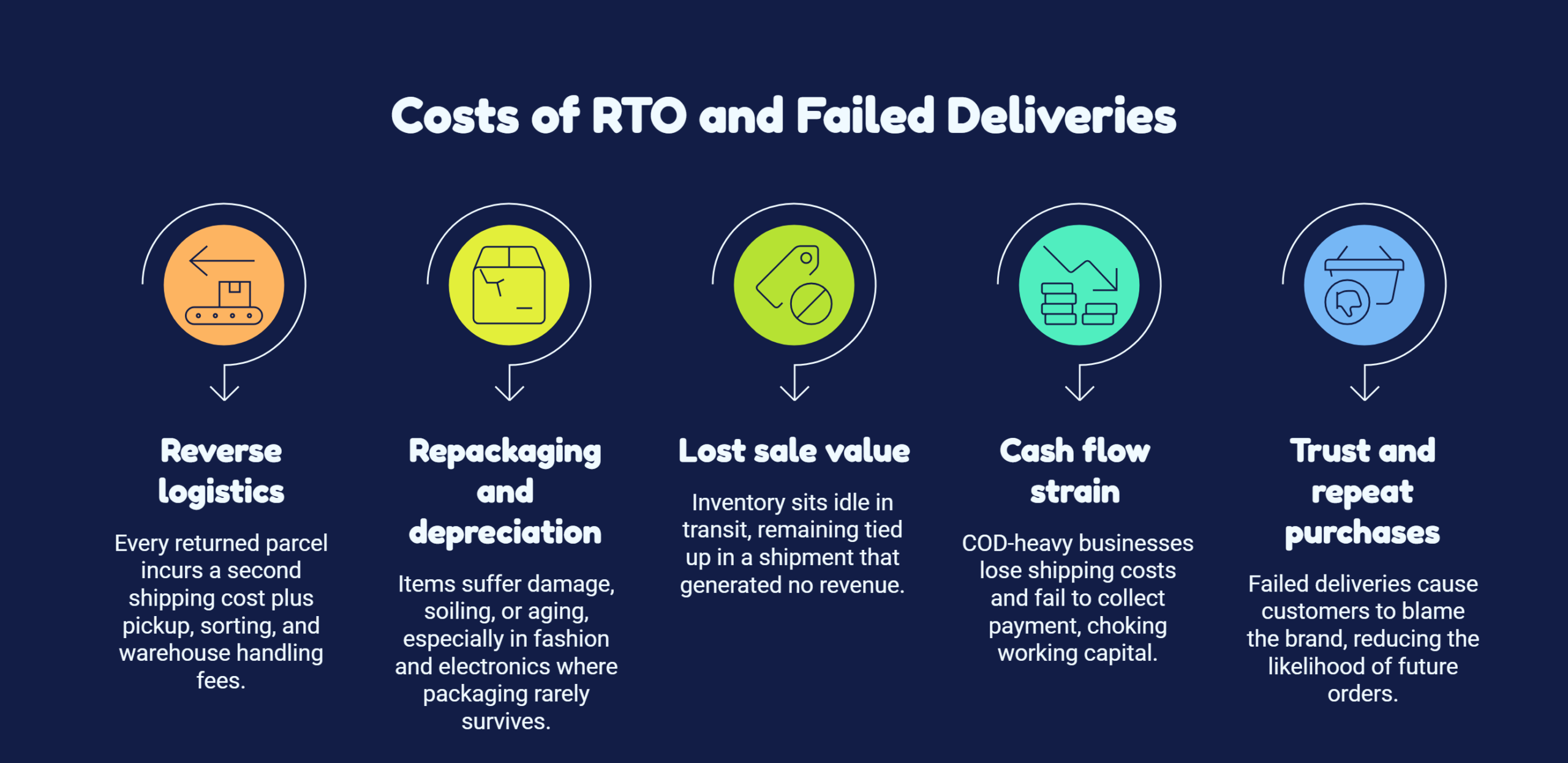
RTO rarely shows up as a single line item in your books, which is exactly why it’s so easy to underestimate. The real cost is spread across several places:
Reverse logistics. Every returned parcel means a second shipping cost, on top of the one you already paid to send it out. Add pickup, sorting, and warehouse handling, and the numbers stack up fast.
Repackaging and depreciation. Items that travel back and forth get damaged, soiled, or simply age out of season. Fashion and electronics take the biggest hit here since packaging rarely survives two trips intact.
Lost sale value. An RTO isn’t a return you can quickly resell. Inventory sits idle, tied up in a shipment that generated no revenue.
Cash flow strain. This one hits COD-heavy businesses hardest. When a customer refuses a cash-on-delivery order, you don’t just lose the shipping cost, you never collected the payment either. For brands where COD makes up a large share of orders, this can choke working capital during peak season.
Trust and repeat purchases. A customer who experiences a failed delivery, whether it’s their fault or the courier’s, often blames the brand. That single bad experience quietly reduces the odds they order from you again.
To put a number on it, industry estimates place India’s ecommerce RTO rates somewhere around 20 to 30 percent for prepaid orders and 30 to 40 percent for COD orders, with wide swings depending on category, courier, and geography. According to RazorPay Research, ET Prime states, 25 to 30 percent of COD orders in India result in RTO, compared to just 2 to 3 percent for prepaid orders, which explains why COD-heavy categories struggle the most. Fashion and footwear typically carry the heaviest RTO burden of all, largely because of size uncertainty and heavy reliance on COD in Tier 2 and Tier 3 cities.
Run the math on your own volume and the upside becomes obvious. A brand processing 1,000 COD orders a day that manages to cut its RTO rate by even 5 percentage points can save somewhere in the range of ₹75,000 to ₹1,20,000 a month in reverse logistics costs alone, without touching pricing, marketing, or product.
The Market Trend: Why AI Is Becoming the Default Approach
Indian ecommerce isn’t slowing down, and that’s exactly what’s forcing this shift. As D2C and marketplace volumes keep climbing, the old way of managing failed deliveries, agents manually calling customers after a delivery attempt fails, simply doesn’t scale. A team that can handle 200 NDR calls a day cannot handle 2,000 without hiring aggressively or automating the process.
That’s pushing brands toward a different posture entirely: reactive to predictive. Instead of finding out an order is going to bounce back after the courier has already tried and failed, machine learning models flag the risk before the shipment even leaves the warehouse. That single shift, catching the problem before dispatch instead of after, is the foundation of most modern RTO prevention software.
Alongside that, two other trends are reshaping how brands operate:
Automated voice and WhatsApp agents are replacing the manual, one-by-one call center approach to NDR follow-up. A voice bot can call a customer the moment a delivery attempt fails, confirm availability, and reschedule, all without a human agent picking up the phone.
Brands are also consolidating away from fragmented, courier-by-courier tracking toward centralized dashboards that show every shipment, across every carrier, in one place. This alone removes hours of manual reconciliation every week.
Common Reasons for RTO and Failed Deliveries
Before looking at solutions, it helps to be clear on what’s actually causing the problem. Most RTOs trace back to a handful of recurring issues:
- The customer is unavailable or unreachable at the time of delivery
- The address is incorrect, incomplete, or missing a proper pin code
- The customer refuses COD, either due to a change of mind or a fraudulent order
- The pin code isn’t properly serviceable by the assigned courier
- Delivery attempts get delayed repeatedly, and the customer loses patience and cancels
Each of these causes has a fairly specific technical fix, which is exactly what AI-powered RTO reduction is built around.
How to Reduce RTO with AI and Failed Deliveries
This is the part most guides skim over. So how can I reduce RTO and failed deliveries using AI in a way that actually maps to the causes above? Here’s how each capability lines up against a specific failure point.
Predictive Risk Scoring
Before an order ships, AI models look at the address quality, pin code history, customer’s past order and delivery behavior, and payment method to assign a risk score. High-risk orders can then be flagged for manual verification, converted from COD to prepaid, or held back until the address is confirmed. This single step catches a large share of RTOs before a courier is ever involved.
Automated Address and Pin Code Validation
A huge portion of failed deliveries trace back to bad address data entered at checkout. AI-driven validation tools catch incomplete addresses, flag unserviceable pin codes, and prompt customers to correct details at the point of order, rather than after the courier has already made a wasted trip.
AI-Driven Customer Communication
Automated voice calls, WhatsApp messages, or SMS nudges reach out to the customer before the courier even attempts delivery, confirming they’ll be available or letting them reschedule proactively. This is one of the most effective forms of failed delivery prevention because it fixes the “customer not available” problem before it costs a delivery attempt.
Smart Courier Allocation
Not every courier performs equally well in every pin code. AI courier allocation routes each order to whichever partner has the best track record of delivery success for that specific area, rather than defaulting to whichever courier is cheapest or fastest to book.
Centralized NDR Dashboards With Real-Time Alerts
Instead of logging into five different courier portals to check on failed deliveries, a centralized dashboard pulls every non-delivery report into a single view. Real-time alerts mean your team can act on a failed attempt within minutes, not days.
Bulk and Automated Re-Attempt Workflows
Rather than an agent manually re-entering a corrected address or rescheduling one shipment at a time, automated NDR management tools let teams process address corrections and re-attempt requests in bulk, or trigger them automatically based on preset rules.
Put together, this is what AI-powered delivery management actually looks like in practice: a system that catches risk early, fixes bad data before it causes a failure, talks to the customer before the courier shows up, and routes shipments intelligently from the start.
Where to Start: A Practical Roadmap
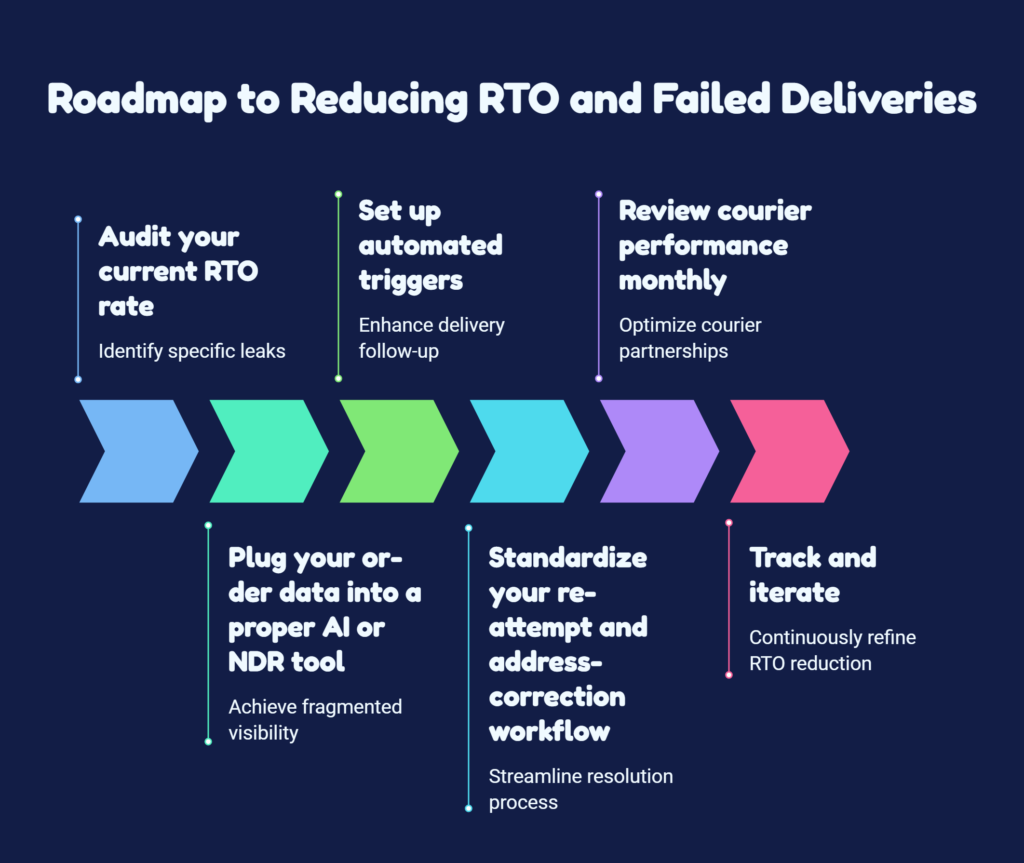
Knowing the theory is one thing. Actually implementing it is another. Here’s a realistic sequence for getting started:
- Audit your current RTO rate. Break it down by product category, courier partner, and pin code. This is where you’ll find the specific leaks, maybe it’s one courier underperforming in a particular zone, or one category with unusually high COD refusals.
- Plug your order data into a proper AI or NDR tool rather than relying on individual courier apps. Fragmented visibility is one of the biggest reasons RTO stays unmanaged.
- Set up automated triggers. For example, an automatic call or WhatsApp message the moment the first delivery attempt fails, instead of waiting for a human agent to notice and follow up manually.
- Standardize your re-attempt and address-correction workflow so that whether it’s an agent or an automated system acting, it can be resolved in one click rather than a multi-step manual process.
- Review courier performance monthly and shift volume toward partners with better delivery success rates in each zone. Courier performance isn’t static, so this needs to be an ongoing review, not a one-time decision.
- Track and iterate. RTO reduction isn’t a project with an end date. It’s an ongoing metric you keep refining as your order volume, categories, and geography evolve.
How eShipz Approaches This
It helps to see what this playbook looks like when it’s actually built into a platform rather than assembled from scratch. eShipz’s NDR management tools are built around the exact workflow described above.
At the center is a centralized NDR dashboard that pulls every non-delivered shipment into one view, giving teams complete visibility into exception shipments so they can view failed delivery attempts, take corrective action, and track pending versus completed NDR requests without switching between courier portals. For deeper operational detail, our guide on NDR management strategies to cut RTO costs breaks down exactly how this dashboard-first approach reduces manual effort.
For teams handling high shipment volumes, eShipz supports both single and bulk NDR actions. Agents can resolve one shipment at a time, or download a pre-filled file with AWB and carrier details, specify updated re-attempt times, addresses, or phone numbers for multiple shipments at once, and upload it to process everything in a single step. Users can also directly trigger a re-attempt with a preferred date and time, or correct a customer’s address and contact number before the next attempt is made.
On the communication side, eShipz has extended this into voice automation through an AI voice agent that automates customer follow-ups for failed deliveries, calling customers to confirm availability or capture updated instructions and feeding those responses straight back into the workflow. Our deeper look at AI-powered NDR management covers how this voice layer works alongside the dashboard to catch failures before they turn into RTOs.
All of this sits inside a broader platform that also includes AI-powered courier recommendation and multi-carrier integration, so the courier allocation piece described earlier isn’t a separate tool bolted on, it’s part of the same system making the delivery decision in the first place.
This is essentially what applying the AI playbook above looks like when it’s built into a single, connected workflow rather than stitched together from five different tools.
Benefits and Outcomes You Can Expect
When these pieces come together, the results tend to show up in a few consistent places:
- A measurably lower RTO percentage, which translates directly into reverse logistics savings
- A higher first-attempt delivery success rate, which improves customer experience and encourages repeat orders
- Less manual workload for your operations team, freeing them up for higher-value work instead of chasing NDRs one by one
- Better courier accountability, since performance data makes it obvious which partners are actually delivering and which aren’t
- Improved cash flow, particularly valuable for COD-dependent categories where a failed delivery means a lost payment, not just a lost shipment

Conclusion
RTO doesn’t have to be treated as a fixed tax on doing business online. It’s a measurable, addressable problem, and the businesses making real progress on it aren’t relying on luck or manual effort alone. They’re using AI to catch risk early, fix bad data before it causes a failure, and reach customers before a courier ever knocks on the wrong door.
If you’re ready to see what this looks like for your own shipment volume, take a look at how eShipz’s NDR management tools and AI voice agent work together to bring RTO rates down in practice.
Frequently Asked Questions
- How can I reduce RTO and failed deliveries using AI?
Start by using predictive risk scoring to flag high-risk orders before they ship, validate addresses and pin codes automatically at checkout, and set up automated voice or WhatsApp outreach to confirm customer availability before the courier’s first attempt. Combined with smart courier allocation and a centralized NDR dashboard, these steps address the root causes of most RTOs rather than reacting after a delivery has already failed.
- What is RTO in ecommerce, and how is it different from an NDR?
RTO (Return to Origin) is when a shipment that couldn’t be delivered is sent back to the seller. An NDR (Non-Delivery Report) is generated after each failed delivery attempt, before the shipment officially becomes an RTO. Multiple unresolved NDRs typically lead to an RTO.
- What is a good RTO rate for an ecommerce business?
This varies significantly by category and payment mix, but a rate below 10 to 15 percent is generally considered healthy. COD-heavy categories like fashion and footwear often run much higher, even after optimization, simply due to the nature of the products.
- Does converting COD orders to prepaid actually reduce RTO?
Yes, meaningfully. Prepaid orders in India see RTO rates in the low single digits, compared to 25 to 30 percent for COD orders, since a customer who has already paid has far less incentive to refuse the delivery.
- Can AI completely eliminate RTO?
No tool can bring RTO to zero, since some failures come from circumstances outside anyone’s control, like a customer being genuinely unavailable due to an emergency. What AI can do is catch the preventable causes, bad addresses, unreachable customers, unserviceable pin codes, before they turn into a failed delivery.
- How does an AI voice agent help with NDR management?
An AI voice agent automatically calls customers when a delivery attempt fails, asks whether they’d like to reschedule, update their address, or confirm availability, and feeds that response directly back into the courier’s workflow. This replaces manual call center effort and gets a resolution in place faster, often within minutes of the failed attempt.
- What data should I look at first when trying to reduce RTO?
Break your RTO rate down by product category, courier partner, and pin code. This usually reveals specific patterns, for example, one courier consistently underperforming in a particular region, or one product category driving a disproportionate share of failures, that a single blended RTO number would hide.