





For years, shipping software did one job well: get a parcel from a warehouse to a customer’s doorstep. Courier selection, tracking, delivery updates, and returns handling were treated as the full scope of the problem. That definition no longer holds up.
As order volumes have grown and cash-on-delivery remains dominant across much of India’s ecommerce market, businesses have discovered that moving a parcel is the easy part. The harder question is which orders are worth shipping in the first place. Which ones look fraudulent. Which COD orders are likely to bounce back as a return to origin (RTO) before the shipment even leaves the warehouse. This is exactly why shipping platforms with fraud and RTO prediction have moved from a nice-to-have feature to a core requirement for any serious ecommerce operation.
The scale of the problem is well documented. Amazon Shipping’s analysis of Indian SMB logistics, citing Shipway’s FY25 ShipNotes data, notes that non-prepaid orders see dramatically higher return rates than prepaid ones, with some cities and cohorts running far above the national average. When a large share of your order book is cash-on-delivery, a chunk of your “sales” were never real sales to begin with.
This is where the idea of predictive shipping comes in. Instead of reacting to a failed delivery after the fact, modern platforms try to answer a more useful question before dispatch: is this order likely to succeed, and if not, what should we do about it? The future of shipping isn’t only about delivering faster. It’s about making smarter decisions before a parcel ever leaves the shelf.
What Are Predictive Shipping Platforms?
A predictive shipping platform is a system that layers risk intelligence on top of the usual shipping workflow. Rather than treating every order the same way, it pulls together multiple data points to estimate how likely an order is to be delivered successfully, and flags the ones that need a second look.
The signals that typically feed into this kind of scoring include:
- Customer and order history
- COD versus prepaid status
- Delivery address and pincode-level delivery performance
- Past RTO or return behaviour for that customer
- Order value
- Product or category type
- Historical delivery success rates for that route
- General customer behaviour patterns
- Courier-level performance data
- Historical shipment records across the business
Taken together, these signals let a platform assign a risk score to each order and decide how it should move forward: ship it as usual, verify it first, nudge the buyer toward prepaid, or hold it for manual review. This is the essence of what people mean when they talk about shipping platforms with fraud and RTO prediction: the shipping decision itself becomes informed by risk, not just by logistics.
Why Are Fraud Detection and RTO Prediction Essential?
It’s worth spelling out why this matters, because the cost of a bad order rarely shows up as a single line item. It compounds across the entire order lifecycle:
Order placed → shipped → delivery fails → parcel returns → inventory sits idle → revenue is gone.
For COD-heavy businesses, this problem is magnified. Cash on delivery still makes up a large share of Indian ecommerce orders, and a buyer who hasn’t paid anything upfront has little reason to follow through if they change their mind.
Financial impact
- Forward shipping cost, paid regardless of whether the order is delivered
- Reverse shipping cost once the parcel is sent back
- COD handling charges levied by courier partners
- Lost sales on an order that never converts into real revenue
- Inventory stuck in transit or in a returns queue instead of being available for a genuine buyer
Operational impact
- Extra warehouse workload for repackaging and restocking
- Reverse logistics adding friction to an already stretched fulfilment team
- Customer-service teams fielding avoidable queries about failed deliveries
Customer impact
- A poor delivery experience for buyers whose orders get caught in the noise
- Delayed refunds or replacements
- Erosion of trust in the brand over time, even for customers who did nothing wrong
None of this is theoretical. Cashfree’s RTO Intelligence system, for instance, is built specifically to reduce this compounding cost by combining customer phone numbers, shipping addresses, cart contents, and merchant transaction history with over ten additional parameters to score COD orders before a shipment is even created. That’s a fairly direct signal of where the industry believes the highest-leverage intervention point is: before dispatch, not after.
What Does the Current Market Trend Say?
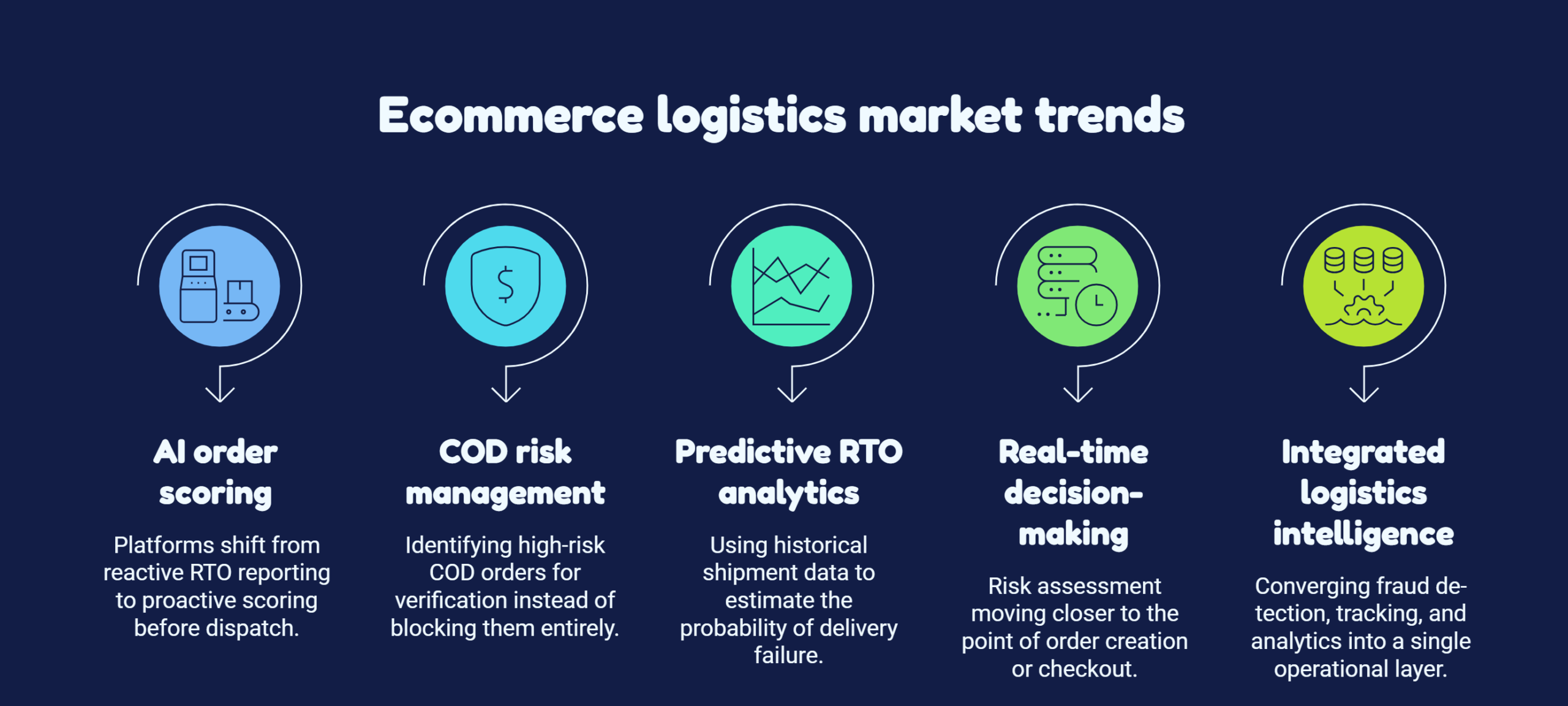
The broader direction across ecommerce logistics is unmistakably toward AI-driven risk intelligence, and a few specific trends stand out.
AI-based order risk scoring. Platforms are shifting from reactive RTO reporting to proactive scoring, where every order gets evaluated before it’s dispatched rather than analysed after it bounces back.
COD risk management, not COD elimination. Very few businesses can or should drop cash-on-delivery altogether, since it remains a trust-building payment method for a large share of Indian buyers. The more practical approach is identifying which COD orders are high-risk and applying extra verification, a partial payment requirement, or a nudge toward prepaid, rather than blocking COD entirely.
Predictive RTO analytics. Historical shipment data is increasingly used to estimate the probability that a given order will fail delivery, factoring in everything from pincode-level performance to order value bands.
Real-time decision-making. Risk assessment is moving closer to the point of order creation, sometimes even into the checkout flow itself, rather than being applied only after a shipment has already run into trouble.
Integrated logistics intelligence. Fraud detection, courier allocation, tracking, non-delivery report (NDR) management, and RTO analytics are converging into a single operational layer rather than living in separate tools that don’t talk to each other.
India’s logistics sector has leaned hard into technology-led approaches to manage exactly this kind of risk, and the direction is consistent across vendors: catch the problem before the parcel moves, not after it comes back.
How Do Advanced Fraud & RTO Prediction Systems Work?
Stripped down to its basics, the process looks like this:
Order placed → data collected → risk signals analysed → fraud/RTO score generated → order classified as low, medium, or high risk → automated action taken → shipment dispatched.
What happens at each risk tier tends to follow a fairly consistent pattern across platforms:
- Low risk: Ship the order normally, with no added friction for the buyer.
- Medium risk: Trigger a verification step, such as an OTP confirmation or a WhatsApp message asking the customer to confirm the order and address.
- High risk: Ask for prepaid payment before dispatch, hold the shipment for manual review, or flag it for the operations team to check directly.
This is also where courier selection and pincode-level intelligence become part of the risk equation, not just an afterthought. A business asking how to choose a courier based on pincode serviceability is really asking a risk question: which courier has historically performed well for this exact delivery zone, and does that change how confident we should be in this order? Platforms that combine fraud scoring with pincode-level courier data are able to answer that question automatically, rather than leaving it to guesswork. eShipz has covered this topic in more depth in its guide on pincode serviceability and choosing the right courier, which is a useful companion read if you want to understand the mechanics behind courier-side risk scoring.
Key Features to Look for in a Predictive Shipping Platform
Prediction on its own isn’t enough. A platform needs to combine the ability to score risk with the ability to act on that score. When evaluating an ecommerce shipping platform, look for:
- AI-based fraud detection
- RTO prediction built on historical shipment data
- COD risk scoring at the order or checkout level
- Pincode-level risk analysis, since delivery performance varies enormously by location
- Customer history analysis, including repeat RTO behaviour
- Address verification tools
- Automated order verification workflows (OTP, WhatsApp, IVR)
- NDR management with automated follow-up
- Multi-courier integration, so risky orders can be routed to the best-performing partner for that zone
- Real-time shipment tracking
- Courier performance analytics
- Custom risk rules that reflect your specific category and customer base
- A dashboard that makes risk visible, not buried in a report nobody reads
- Automated alerts and actions tied directly to the risk score
The businesses that get the most value from these tools are the ones that treat prediction as the first half of the equation and automated action as the second.
Who Benefits from Predictive Shipping Platforms?
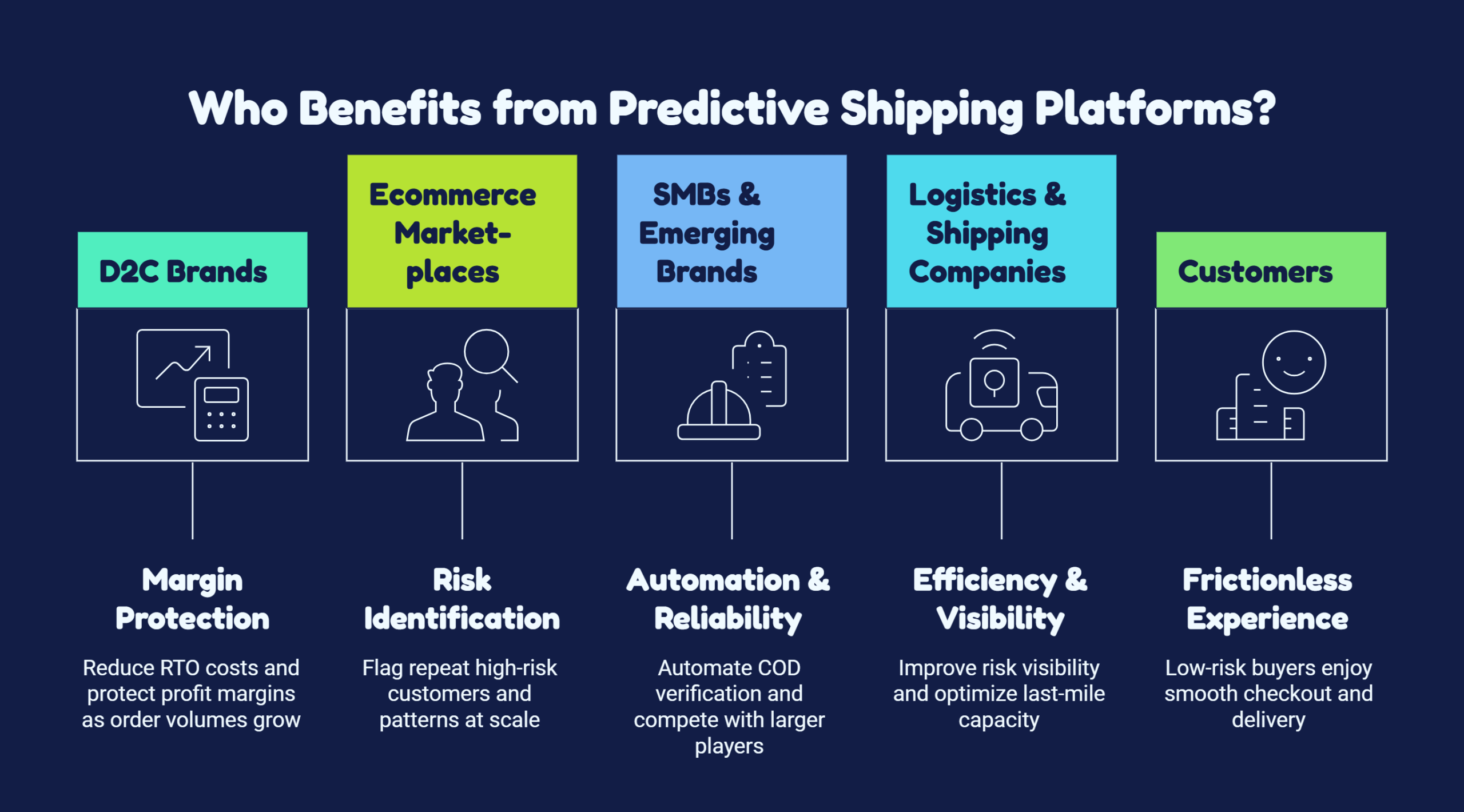
D2C brands get the clearest win here. As order volumes scale, avoidable RTO costs eat directly into margin, and predictive tools give brands a way to protect that margin without slowing growth.
Ecommerce marketplaces deal with a much larger and more anonymous buyer base, which makes it harder to spot suspicious orders manually. Risk scoring at scale helps flag repeat high-risk customers and patterns that would otherwise go unnoticed.
SMBs and emerging brands often don’t have the headcount for manual COD verification. Automation takes that burden off a small team and lets them compete with larger players on delivery reliability.
Logistics and shipping companies benefit from better risk visibility across their network, which translates into fewer failed shipments and more efficient use of last-mile capacity.
Customers benefit too, in a way that’s easy to overlook. Low-risk buyers get a frictionless checkout and delivery experience, while additional verification is reserved for the orders that genuinely need it, rather than being applied uniformly to everyone.
How Does It Benefit Businesses?
| Benefit | How it helps |
| Lower RTO | Identifies risky orders before dispatch instead of after failure |
| Reduced fraud | Flags suspicious order and customer patterns early |
| Lower logistics costs | Prevents unnecessary forward and reverse shipping spend |
| Better COD management | Enables selective verification or restriction instead of blanket policies |
| Higher operational efficiency | Cuts down on manual order-checking workload |
| Better inventory utilisation | Reduces stock stuck in failed-delivery loops |
| Improved customer experience | Avoids unnecessary friction for trustworthy buyers |
| Data-driven decisions | Gives businesses ongoing visibility into where risk actually comes from |
This is really the core promise of a well-implemented ecommerce shipping platform: it turns RTO and fraud from a recurring surprise into a manageable, measurable part of ecommerce risk management.
Challenges and Limitations
It’s worth being honest about where prediction falls short, because no system gets this perfectly right.
- False positives happen. A genuine customer can get flagged as high-risk and asked for unnecessary verification, which creates friction where none was needed.
- Too much verification hurts conversion. If every order gets an extra step, checkout completion rates suffer, even if RTO improves.
- Models need enough historical data. A newer brand with limited order history won’t get the same accuracy as one with years of shipment records to draw from.
- Customer behaviour shifts over time. A model trained on last year’s patterns may not catch this year’s new fraud tactics or buying habits.
- Categories behave differently. Apparel and fashion see very different RTO drivers, mostly around size and fit, compared with electronics, where address accuracy and delivery attempts matter more.
- Data privacy matters. Collecting and scoring customer data responsibly isn’t optional, and businesses need to be transparent about how that data is used.
- Balance matters more than blocking. The goal isn’t to reject every order that carries some risk. It’s to make better probability-based decisions with the data available, while keeping the buying experience smooth for the vast majority of honest customers.
The Future of Shipping: From Logistics to Predictive Commerce
The underlying shift here is a change in the question shipping platforms are built to answer. It used to be simple: “where should I ship this order?” That question is being replaced by a more layered one: “should I ship this order, through which courier, using which payment method, and what’s the actual probability it gets delivered?”
That’s a meaningfully different job. It moves shipping software from being a purely operational tool into something closer to an intelligence layer sitting underneath ecommerce operations, informing decisions that used to be made on gut instinct or blanket policy. Businesses that get comfortable asking this more detailed question tend to see it pay off directly in lower reverse-logistics volume, which is a topic explored further in eShipz’s guide to reverse logistics software for D2C brands in India.

Conclusion: Smarter Shipping Means Smarter Risk Management
Fraud and RTO shouldn’t be treated as problems you deal with after a parcel comes back. The real opportunity sits earlier in the process: identifying risk before the order ever enters the logistics network.
The next generation of shipping platforms with fraud and RTO prediction won’t just help businesses deliver orders faster. They’ll help businesses decide which orders are worth shipping in the first place, how those orders should move, and how to minimise loss before a single parcel leaves the warehouse. That’s a fundamentally different, and more useful, definition of what good shipping software software should do.
Frequently Asked Questions
- What is RTO prediction in ecommerce shipping?
RTO prediction is the use of historical and real-time data, such as customer history, address quality, COD status, and past delivery outcomes, to estimate the likelihood that a specific order will fail delivery and return to the seller. Orders with a high predicted RTO risk can then be verified, converted to prepaid, or held for review beforethey’re shipped. - How is fraud detection different from RTO prediction?
Fraud detection focuses onidentifying orders that are likely fake, malicious, or placed with no intent to accept delivery, often using signals like device data, repeat abandoned orders, or suspicious address patterns. RTO prediction is broader and includes genuine orders that are simply likely to fail for logistical reasons, such as address issues or COD refusal. In practice, the two often use overlapping data and are handled by the same shipping platform. - Can predictive shipping platformscompletely eliminateRTO?
No system eliminates RTO entirely, since some failures come from factors outside anyone’s control, like a customer being unavailable at the time of delivery. What predictive platforms do is reduce avoidable RTO by catching high-risk orders early and applying the right intervention, which meaningfully lowers the overall rate over time. - Is cash-on-delivery the main driver of RTO in India?
COD is consistently the largest single driver of RTO in Indian ecommerce, since buyers whohaven’t paid upfront face little cost in refusing delivery. That said, address inaccuracy, poor NDR follow-up, and slow delivery attempts also contribute meaningfully, which is why prediction systems look at more than just payment type. - How to choose a courier based onpincodeserviceability?
Choosing a courier based on pincode serviceability means checking which courier partners have the strongest historical delivery performance for a specific pincode, rather than defaulting to a single preferred courier for every order. Platforms that combine multi-courier integration with pincode-level performance data can automate this choice, routing each order to whichever partner is statistically most likely to deliver it successfully. This is covered in more detail in eShipz’s dedicated guide on how to choose a courier based on pincode serviceability. - Do small ecommerce businesses need fraud and RTO prediction, or is it only for large brands?
Smaller businesses often benefit the most, since they typically lack the manual bandwidth to verify every COD order individually. Automated risk scoring lets a lean team apply the same level of scrutiny a much larger operation would, without adding headcount. - What data does an ecommerce shipping platform typically use to predict RTO risk?
Most platforms combine order-level data (value, category,COD or prepaid status), customer-level data (order history, past RTO behaviour), and location-level data (pincode delivery performance, courier success rates for that zone) to generate a risk score. Some also factor in device or checkout behaviour when fraud detection is part of the same system.