




NDR management is now a core part of ecommerce logistics. Businesses need to cut failed deliveries, improve delivery accuracy, and keep return-to-origin (RTO) costs under control. Industry estimates commonly place ecommerce RTO rates in India between 15–25%, while COD orders often see higher return rates than prepaid orders. Even a small rise in first-attempt delivery success can reduce logistics costs and improve the customer experience.
A delivery journey doesn’t end when an order leaves the warehouse. It depends on accurate address details, carrier selection, route planning, customer availability, real-time tracking, communication, and a successful doorstep handover. If any part of that process fails, businesses may receive a non delivery report. For large ecommerce operations handling thousands of shipments each day, even a 5% NDR rate can create hundreds of exceptions that need attention.
Traditional NDR management relies heavily on manual work. Operations teams must identify failed deliveries, determine why they failed, contact customers, collect updated details, coordinate with carriers, and schedule another delivery attempt. As order volumes rise, this process becomes harder to manage and more inconsistent. India’s ecommerce market is also expanding beyond major metropolitan cities into Tier 2 and Tier 3 markets, where businesses face wider differences in addresses, delivery conditions, customer availability, and carrier performance.
AI in logistics is changing how businesses identify and resolve delivery exceptions. With AI ndr management, teams can review large volumes of shipment, customer, address, carrier, and delivery data to spot likely issues earlier. AI can predict delivery failures, automate customer communication, recommend the next best action, improve route decisions, and flag shipments that need immediate attention. Combined with NDR automation, these capabilities shift exception handling from a reactive process to proactive delivery management.
Modern NDR management software can connect order management, tracking, carrier systems, communication platforms, and customer data. Rather than treating every failed delivery attempt the same way, AI NDR can identify the reason behind the failure and trigger the right resolution. AI NDR automation software becomes especially useful for businesses managing multiple carriers, sales channels, fulfilment locations, and rising shipment volumes.
This article explores how AI is changing NDR management, how businesses can apply AI across the delivery lifecycle, what to look for in NDR management software, and how technology can improve delivery accuracy while supporting RTO reduction.
How AI Is Transforming NDR Management and Delivery Accuracy
One of the biggest advantages of AI in logistics is its ability to analyze large volumes of data and identify patterns quickly. A manual operations team may review individual shipments one by one, whereas an AI-powered system can evaluate historical delivery outcomes, customer behavior, address information, carrier performance, shipment characteristics, and real-time signals together. This creates an opportunity to identify delivery risks before they turn into actual NDRs.
Predictive identification of delivery failures
Predictive analytics can identify shipments with a higher chance of delivery failure. Historical delivery outcomes often reveal patterns behind unsuccessful attempts, such as previous failures, incomplete addresses, customer response behaviour, location details, carrier performance, and delivery timing.
For example, deliveries to a certain location may repeatedly fail because customers aren’t available during standard delivery hours. An intelligent system can spot that pattern and prompt the business to contact customers early or offer alternative delivery slots. AI NDR then helps prevent exceptions instead of only responding after a delivery has failed.
Smarter address validation
Address quality is another important factor in delivery accuracy. A missing apartment number, incorrect locality, incomplete landmark, or inconsistent address format can make a shipment difficult to deliver even when the customer’s phone number is correct. AI can examine address information and identify patterns that may indicate an incomplete or potentially problematic address. Instead of waiting for a delivery executive to report that the location could not be found, businesses can flag suspicious information earlier in the fulfilment process. Address validation does not guarantee that every shipment will be delivered successfully, but it can reduce avoidable errors by giving businesses an opportunity to verify information before the parcel reaches the last mile.
Understanding customer availability
Customer availability is one of the most common variables affecting last-mile delivery. A customer may place an order during working hours but may not be available at home when the delivery executive arrives. AI can analyze historical interactions and delivery outcomes to identify customer availability patterns. This information can support better delivery communication and scheduling. Instead of simply informing a customer that a delivery attempt is coming, businesses can give customers more control over the delivery experience by allowing them to confirm availability or request another suitable time.
Automated NDR communication
Communication is one of the most important areas where NDR automation can reduce manual workload. When a delivery fails, an automated system can immediately send a relevant message to the customer instead of waiting for an operations employee to initiate contact. The communication can be based on the reason for the failed delivery. A customer who was unavailable may receive a rescheduling option, while a customer whose address requires clarification may receive a request to confirm the address.
This approach is more useful than sending the same generic message for every exception because the customer receives an action that directly relates to the problem.
Conversational AI for NDR resolution
AI-powered chatbots and voice agents can take customer communication a step further. Natural language processing allows conversational systems to understand customer responses and capture relevant information without requiring customers to follow complicated workflows. For example, after an unsuccessful delivery attempt, an AI voice agent could contact the customer, explain that the delivery could not be completed, ask whether the customer would like another attempt, and capture an appropriate delivery preference. Similarly, a chatbot could allow the customer to confirm an address or select a new delivery slot through a messaging interface. This can reduce the amount of repetitive work handled by customer service teams while giving customers a faster way to resolve delivery issues.
Intelligent rescheduling
Rescheduling is particularly useful when the customer is willing to receive the shipment but was unavailable during the original attempt. In a manual process, an employee may need to contact the customer, record the preferred time, update the relevant system, and coordinate with the carrier. With NDR automation software, these steps can be connected into one workflow. Once the customer confirms a new preference, the information can be passed into the delivery process without requiring multiple manual handoffs.
The system can also prioritize cases where customer responses indicate a strong likelihood of successful redelivery.
Dynamic route optimization
AI can improve delivery accuracy before an NDR by making route planning more responsive. Last-mile routes change with traffic, weather, road conditions, delivery density, vehicle capacity, and shifting delivery priorities. AI-powered routing reviews these factors and updates route recommendations as conditions change. That helps delivery teams use time better and can improve ETA accuracy.
If traffic suddenly builds up on a planned route, the system can suggest another option. It can also reorder delivery stops based on current conditions or customer availability. Better route planning reduces delays and improves the likelihood of completing deliveries within the expected delivery window.
Intelligent carrier allocation
Carrier selection can also influence NDR rates. Different carriers may have different levels of performance across pin codes, shipment types, service levels, and customer locations. AI can analyze historical carrier performance and combine it with shipment-level information to support more informed allocation decisions. A carrier that performs strongly in one geography may not necessarily produce the same results in another. This makes carrier intelligence an important part of modern NDR management. Rather than selecting carriers based only on price or broad service coverage, businesses can consider delivery outcomes and exception patterns.
Proactive tracking and alerts
Real-time tracking can provide another layer of intelligence. Shipment movement, delays, delivery attempts, and changes in expected arrival time can be analyzed to identify shipments that may be at risk. If a shipment is significantly delayed, the customer can be informed before the expected delivery window is missed. Proactive communication can help set realistic expectations and reduce situations where customers are surprised by delivery changes.
Prioritizing high-risk shipments
Not every NDR requires the same level of intervention. AI can help classify exceptions based on factors such as the reason for failure, shipment value, number of previous attempts, customer response history, location, and likelihood of successful resolution. High-risk cases can be escalated to operations teams, while routine cases can continue through automated workflows. This allows human teams to focus their time where it can have the greatest operational value instead of manually processing every exception.
Supporting RTO reduction
RTO is often the result of unresolved delivery exceptions. When an NDR remains unresolved after multiple attempts, the shipment may eventually move back to the origin location. AI can support RTO reduction by identifying potential problems earlier and initiating suitable interventions. Address verification, customer communication, intelligent rescheduling, and exception prioritization can all create additional opportunities to complete delivery successfully. The objective is not simply to reduce the number of NDRs shown in a dashboard. The larger objective is to increase successful deliveries while reducing unnecessary operational effort and returns.
Understanding NDR Management and Why Delivery Accuracy Matters
A non delivery report is generated when a shipment cannot be successfully delivered to the customer during an attempted delivery. The reason can vary considerably, making effective NDR management important for identifying the issue and choosing the right resolution.
- Common reasons for NDRs:
A customer may not be available at the address, the address may be incomplete, the phone number may be unreachable, or the recipient may request delivery on another date. Delivery executives may also face incorrect routing, restricted access, unexpected delays, or other carrier-related issues that prevent successful delivery.
- Why every NDR requires a different resolution:
NDR management is not simply about tracking failed shipments. Each failed delivery can have a different cause and therefore require a different response. An unavailable customer may need a rescheduled delivery, while an incomplete address may require additional information. Understanding the specific NDR reason helps businesses take a more relevant and timely action.
- Business impact of failed deliveries:
An NDR can lead to repeated delivery attempts, additional transportation costs, increased customer service workload, longer delivery cycles, and eventually an RTO. For ecommerce businesses, these additional costs can affect order profitability, while unclear updates and repeated delivery failures can negatively affect the customer experience.
- Why NDR management becomes difficult at scale:
As businesses expand across metropolitan cities, Tier 2 and Tier 3 markets, remote locations, and multiple carrier networks, delivery exceptions become more complex. Different regions can have different address formats, customer availability patterns, delivery conditions, and carrier performance, making manual management increasingly difficult.
- The importance of quick resolution:
Once a delivery attempt fails, businesses need to understand the reason and respond quickly. Contacting the customer, verifying the address, confirming availability, or arranging another delivery slot can create a better opportunity for successful redelivery. Delayed action can increase the possibility of the shipment moving toward RTO.
- Limitations of manual processes:
Traditional NDR management often involves spreadsheets, carrier portals, phone calls, emails, and manual status updates. Operations teams may need to identify the NDR reason, contact the customer, record the response, update the system, and coordinate with the carrier. At higher shipment volumes, this can become time-consuming and increase the possibility of missed follow-ups or human error.
- Role of NDR management software:
Dedicated NDR management software can centralize delivery exceptions and bring different resolution activities into one workflow. It can collect NDR information from multiple carriers, standardize exception reasons, trigger automated actions, monitor customer responses, and track subsequent delivery attempts. With AI capabilities, the system can also identify patterns that may indicate a higher risk of delivery failure.
- Improving delivery accuracy with data:
Delivery accuracy means more than moving a parcel to the correct location. The shipment needs to reach the right customer, at the right address, within the expected delivery window. AI can analyze historical shipment and delivery data to identify patterns that may help businesses improve these outcomes.
- Identifying recurring delivery patterns:
Historical data may show that certain address formats result in more failed deliveries, customers in a particular location are often unavailable during specific hours, or a carrier performs differently across certain pin codes. Identifying these patterns can help businesses take preventive action before another delivery failure occurs.
- NDR management as part of delivery optimization:
NDR management should not begin only after a shipment fails. NDR data can provide valuable insights into customer communication, carrier allocation, address quality, route planning, and fulfilment operations. By using these insights, businesses can move beyond resolving individual failed deliveries and build a more proactive and accurate delivery process.
NDR Automation Software: Features, Benefits and Use Cases
NDR automation software brings the different stages of failed-delivery resolution into a connected workflow. Instead of relying on separate carrier portals, spreadsheets, customer service tools, and manual follow-ups, businesses can centralize delivery exceptions and automate appropriate actions.
A modern platform can receive NDR information from multiple carriers, identify the reason for the failed attempt, initiate customer communication, capture customer responses, update delivery preferences, and monitor whether the next attempt succeeds.
AI adds another layer by helping the system identify patterns, prioritize exceptions, predict risks, and recommend appropriate actions.
| Area | Manual NDR Management | AI-Powered NDR Management |
| NDR identification | Teams manually review failed deliveries | Exceptions can be detected and categorized automatically |
| Customer communication | Calls, emails, or messages handled manually | Automated communication based on NDR reason |
| Address issues | Manually investigated | AI can flag incomplete or unusual address patterns |
| Customer availability | Usually addressed after failure | Historical patterns can help predict availability risks |
| Rescheduling | Requires manual coordination | Customer responses can trigger automated workflows |
| Carrier decisions | Often based on fixed rules or experience | Historical carrier and location performance can be considered |
| Route planning | Often relies on predefined routes | Routes can respond to changing delivery conditions |
| Prioritization | Teams manually review exceptions | AI can prioritize higher-risk shipments |
| Analytics | Periodic reporting | Continuous analysis of NDR and delivery patterns |
| RTO reduction | Primarily reactive | Proactive interventions can support earlier resolution |
For D2C brands, NDR management software becomes essential as order volumes rise across carriers and regions. Instead of managing delivery failures through calls and spreadsheets, teams can use NDR automation to set clear workflows for each issue. Customer unavailability may call for rescheduling, while an incomplete address needs verification. Enterprise retailers and marketplace sellers can also review NDR data for recurring problems by carrier, location, shipment type, or sales channel.
Analytics and AI improve these workflows by learning from past delivery outcomes. Businesses can track NDR rates, first-attempt delivery rates, resolution times, RTO rates, customer responses, and carrier performance to spot issues early. NDR automation software must also integrate with ecommerce platforms, order management systems, carrier APIs, tracking tools, and customer communication channels. It needs to support higher shipment volumes without disrupting existing operations.
Connected logistics platforms such as eShipz support a broader approach to AI NDR management by combining shipping, carrier connectivity, tracking, analytics, and post-shipping workflows. Reliable shipment and NDR data give businesses a solid base for automated notifications, rescheduling, analytics, and predictive risk identification. This moves NDR management beyond manual exception handling and toward a structured, proactive delivery process.
The Future of AI-Powered NDR Management
The future of NDR management is moving toward prevention rather than simply reacting after a delivery fails. AI can help businesses identify potential delivery risks earlier by analyzing address information, customer behavior, carrier performance, delivery locations, route conditions, and historical shipment outcomes. This allows businesses to take action before an issue turns into a failed delivery or RTO.
Predictive NDR Prevention
Predictive analytics can become an important part of future NDR management. Before a shipment reaches the last mile, AI can assess whether it shares characteristics with previous failed deliveries. If a shipment appears to have a higher delivery risk, businesses can verify the address, confirm customer availability, communicate delivery expectations, or consider a more suitable carrier before the delivery attempt. This changes the role of NDR management from simply resolving failed deliveries to identifying and preventing potential failures earlier in the shipment journey.
Conversational AI for Customer Communication
Conversational AI is also expected to play a larger role in delivery communication. AI-powered chat and voice systems can contact customers after a failed attempt, explain the issue, confirm availability, collect a preferred delivery time, and pass the response into the relevant logistics workflow. This can reduce repetitive manual follow-ups while giving customers a faster and more convenient way to resolve delivery issues. Instead of requiring an employee to handle every interaction, AI can manage routine conversations while escalating more complex cases to human teams.
Smarter Carrier Intelligence
As businesses work with multiple logistics providers, understanding carrier performance will become increasingly important. AI can analyze performance at a more detailed level, including pin code, shipment type, product category, service level, delivery attempt, and NDR reason. This can help businesses identify where delivery problems are concentrated and understand whether certain carriers, locations, or shipment types are associated with higher exception rates. These insights can then support more informed carrier allocation and delivery planning.
Continuous Learning from Delivery Data
Every shipment creates valuable data. Successful deliveries, failed attempts, customer responses, carrier performance, route outcomes, and RTOs can all contribute to future decision-making. AI-powered systems can use these outcomes to continuously refine predictions and improve recommendations. For example, if a particular resolution approach consistently results in successful redelivery for a specific customer or shipment segment, that outcome can become part of the data used to improve future workflows. This creates a continuous feedback loop where each delivery outcome can contribute to better decision-making.
AI and Human Oversight
Greater automation does not mean removing people from the process completely. Some delivery exceptions will always require human judgment, particularly high-value shipments, repeated delivery failures, unusual address situations, customer disputes, and complex cases. The practical approach is therefore to combine AI with human oversight. Automation can handle repetitive, high-volume activities, while operations and customer service teams can focus on exceptions that require investigation, judgment, or direct intervention.
For ecommerce businesses, the future of NDR automation software will therefore depend on how effectively it combines prediction, customer communication, automation, analytics, carrier intelligence, and human decision-making. The goal is not simply to automate an existing manual process, but to build a delivery operation that can identify risks earlier, respond faster, learn from outcomes, and continuously improve delivery performance.
How eShipz Helps Strengthen NDR Management
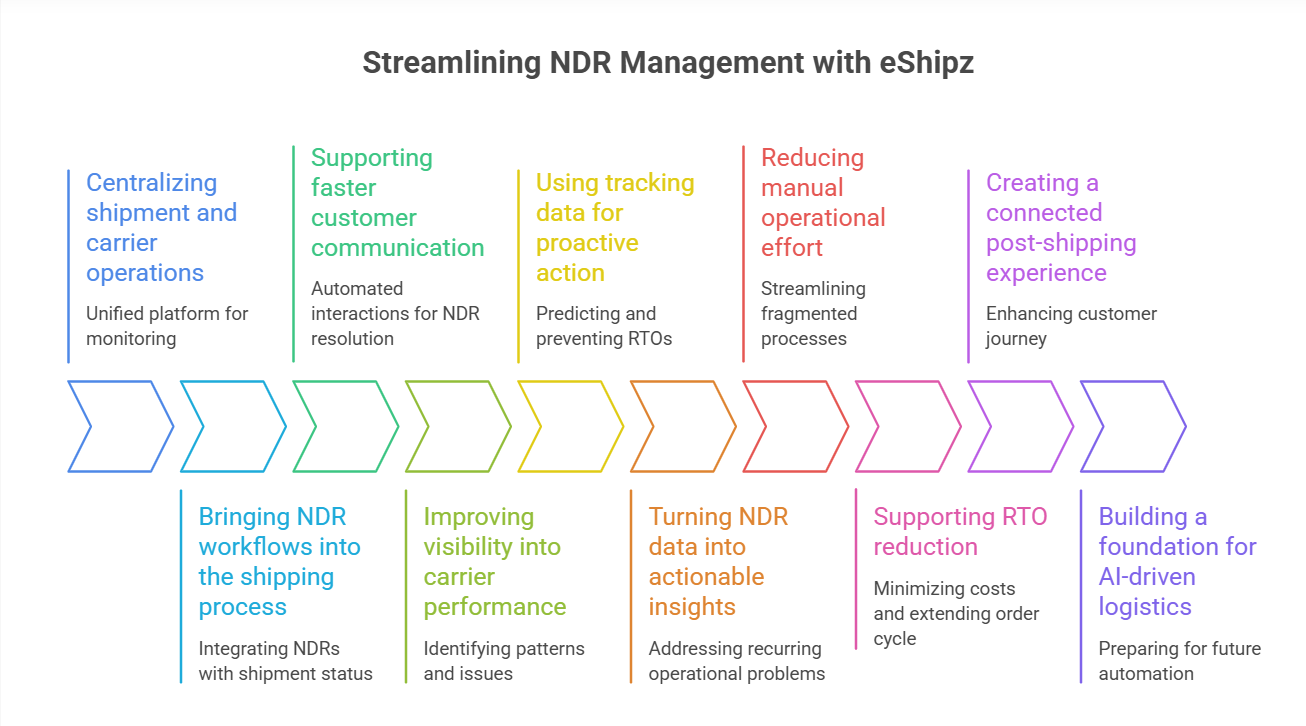
A connected logistics platform can help businesses bring different parts of the delivery journey into a more unified workflow. Instead of treating NDRs as an isolated post-shipping issue, businesses can connect carrier management, shipment tracking, customer communication, analytics, and exception handling to create greater visibility across delivery operations.
- Centralizing shipment and carrier operations:
Managing shipments across multiple carriers can make it difficult for operations teams to maintain a consistent view of delivery performance. A connected platform can bring carrier and shipment information into a centralized environment, making it easier to monitor orders, identify exceptions, and understand where delivery issues are occurring.
- Bringing NDR workflows into the shipping process:
NDR management does not have to operate as a separate activity after a failed delivery. By connecting post-shipping workflows with the broader shipping process, businesses can track NDRs alongside shipment status, carrier information, delivery attempts, and other relevant data. This creates a more complete view of each shipment.
- Supporting faster customer communication:
A failed delivery often requires quick communication with the customer. Businesses may need to confirm an address, check availability, or arrange another delivery attempt. Automated workflows can help initiate these interactions faster, reducing the need for teams to manually manage every individual NDR case.
- Improving visibility into carrier performance:
Different carriers may perform differently across locations, pin codes, shipment types, and service levels. By bringing carrier data together with delivery and NDR information, businesses can identify recurring patterns and better understand which operational factors may be contributing to failed deliveries.
- Using tracking data for proactive action:
Shipment tracking provides more than a delivery status. When tracking information is analyzed alongside delivery exceptions, businesses can identify delays, repeated attempts, and other signals that may require intervention. This can help teams act before a shipment progresses further toward an RTO.
- Turning NDR data into actionable insights:
Repeated NDRs can reveal underlying operational issues. For example, a high number of failures in a particular location may indicate address-quality problems, customer availability challenges, carrier performance issues, or delivery timing concerns. Bringing these insights together through analytics can help businesses address recurring problems instead of resolving each NDR individually.
- Reducing manual operational effort:
Without automation, teams may need to move between carrier portals, spreadsheets, communication tools, and internal systems to manage failed deliveries. A connected logistics workflow can reduce this fragmented process by bringing relevant information and actions into a more structured environment.
- Supporting RTO reduction:
An unresolved NDR can eventually result in a return-to-origin shipment, creating additional transportation costs and extending the order cycle. Faster communication, better visibility, and structured exception workflows can give businesses more opportunities to resolve delivery issues before they result in an RTO.
- Creating a connected post-shipping experience:
The customer journey does not end when an order is handed over to the carrier. Tracking, delivery communication, NDR resolution, rescheduling, and returns all form part of the post-purchase experience. A connected logistics platform can help businesses manage these activities as part of one broader workflow rather than treating them as separate processes.
- Building a foundation for AI-driven logistics:
AI works most effectively when it has access to relevant and consistent data. By connecting shipment, carrier, tracking, customer communication, and NDR information, businesses can create a stronger data foundation for predictive analytics and intelligent automation. Over time, this can support more proactive approaches to delivery management.
For brands using solutions such as eShipz, the broader objective is to connect shipping automation with post-shipping operations so that NDR management becomes part of the overall logistics strategy. Rather than focusing only on resolving a failed delivery after it happens, businesses can use connected data and automation to understand delivery performance, improve operational visibility, and create more consistent customer experiences.
The Next Step in Smarter Delivery Management
AI helps businesses shift from reactive NDR management to a more proactive approach to delivery operations. Predictive analytics can flag potential risks before they become larger issues, while automation speeds up resolutions and conversational AI improves customer interactions. Smarter carrier selection and routing can also lead to more accurate deliveries. Shipment redirection offers another option for handling delivery exceptions when the original route or address no longer works.
Platforms such as eShipz support this approach by bringing shipping automation, carrier management, tracking, NDR workflows, analytics, and post-shipping operations into one connected logistics environment. Businesses can respond to delivery exceptions faster, improve shipment visibility, and spot recurring problems that contribute to failed deliveries and RTOs. No business can eliminate every delivery exception. Still, AI and connected logistics technology help teams understand why failures happen, act quickly, and improve future deliveries. As shipment volumes grow, combining AI NDR management, automation, and tools such as redirection makes NDR management more measurable, efficient, and proactive across the customer delivery experience.