






India’s logistics industry is undergoing a massive digital transformation. The rapid growth of eCommerce, omnichannel retail, direct-to-consumer (D2C) brands, quick commerce platforms, and B2B distribution networks has significantly increased the complexity of shipping operations. Businesses are no longer shipping a few hundred orders each month. Many brands today process thousands of shipments daily across multiple sales channels, warehouses, and delivery partners.
As a result, Logistics API Platforms in India have become an essential part of modern supply chain infrastructure. These platforms help businesses automate shipment creation, courier allocation, tracking updates, returns management, delivery notifications, and logistics analytics through seamless integrations with eCommerce platforms, ERP systems, warehouse management systems (WMS), and order management systems (OMS).
Consider a growing D2C brand processing 2,000 orders every day. The business works with multiple courier partners to ensure nationwide coverage and competitive shipping rates. Without automation, the operations team would need to manually assign couriers, generate shipping labels, monitor tracking updates, handle delivery exceptions, and manage returns across multiple systems. This not only consumes valuable time but also increases the likelihood of delays, errors, and higher return-to-origin (RTO) rates.
Logistics APIs eliminate these inefficiencies by creating a unified shipping infrastructure. Businesses can automatically allocate shipments to the most suitable courier partner, provide real-time shipment visibility to customers, automate reverse logistics workflows, and gain actionable insights into delivery performance.
The market momentum behind logistics technology is strong. According to research from IMARC Group, India’s logistics market continues to expand due to infrastructure investments, increasing online commerce, and growing demand for efficient supply chain solutions. At the same time, customer expectations around delivery speed, tracking accuracy, and hassle-free returns continue to rise.
Modern businesses increasingly recognize logistics as a competitive differentiator. Faster deliveries, lower shipping costs, reduced RTO rates, and better customer experiences often depend on the quality of the logistics technology stack supporting operations.
In this guide, we explore the top logistics API platforms operating in India in 2026, the key factors businesses should consider when evaluating providers, and how to choose the right platform based on operational requirements and growth goals.
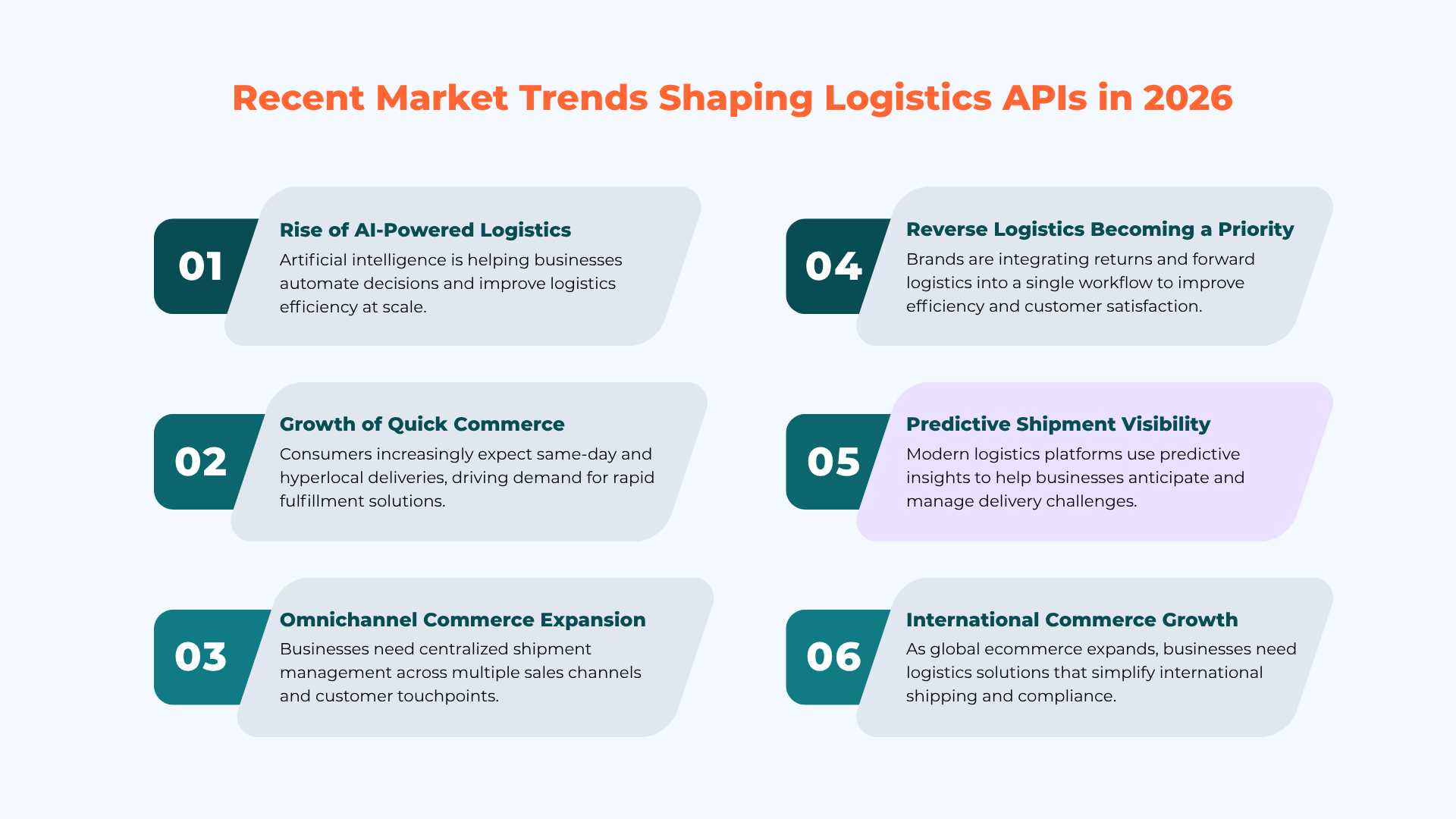
Recent Market Trends Shaping Logistics APIs in 2026
Several trends are driving the adoption of logistics APIs across India.
Rise of AI-Powered Logistics
Artificial intelligence is becoming a core component of logistics operations. Businesses are using AI-driven systems to automate courier allocation, predict delivery delays, identify high-risk shipments, and optimize shipping costs.
Growth of Quick Commerce
The demand for same-day and hyperlocal deliveries continues to grow. Consumers increasingly expect products to be delivered within hours rather than days. Logistics APIs help businesses connect with hyperlocal delivery networks and automate rapid fulfillment workflows.
Omnichannel Commerce Expansion
Brands now sell through websites, marketplaces, social commerce channels, mobile applications, and offline stores. Logistics APIs enable centralized shipment management across all these channels.
Reverse Logistics Becoming a Priority
Returns are a major challenge for eCommerce businesses. Modern logistics platforms now integrate forward and reverse logistics within a single ecosystem, helping brands improve customer experience while reducing operational complexity.
Predictive Shipment Visibility
Instead of simply reporting shipment status, logistics platforms are increasingly providing predictive insights that help businesses proactively manage delays and delivery exceptions.
International Commerce Growth
Cross-border eCommerce continues to create opportunities for Indian businesses. Logistics APIs that support customs documentation, international carrier integrations, and global tracking are becoming increasingly valuable.
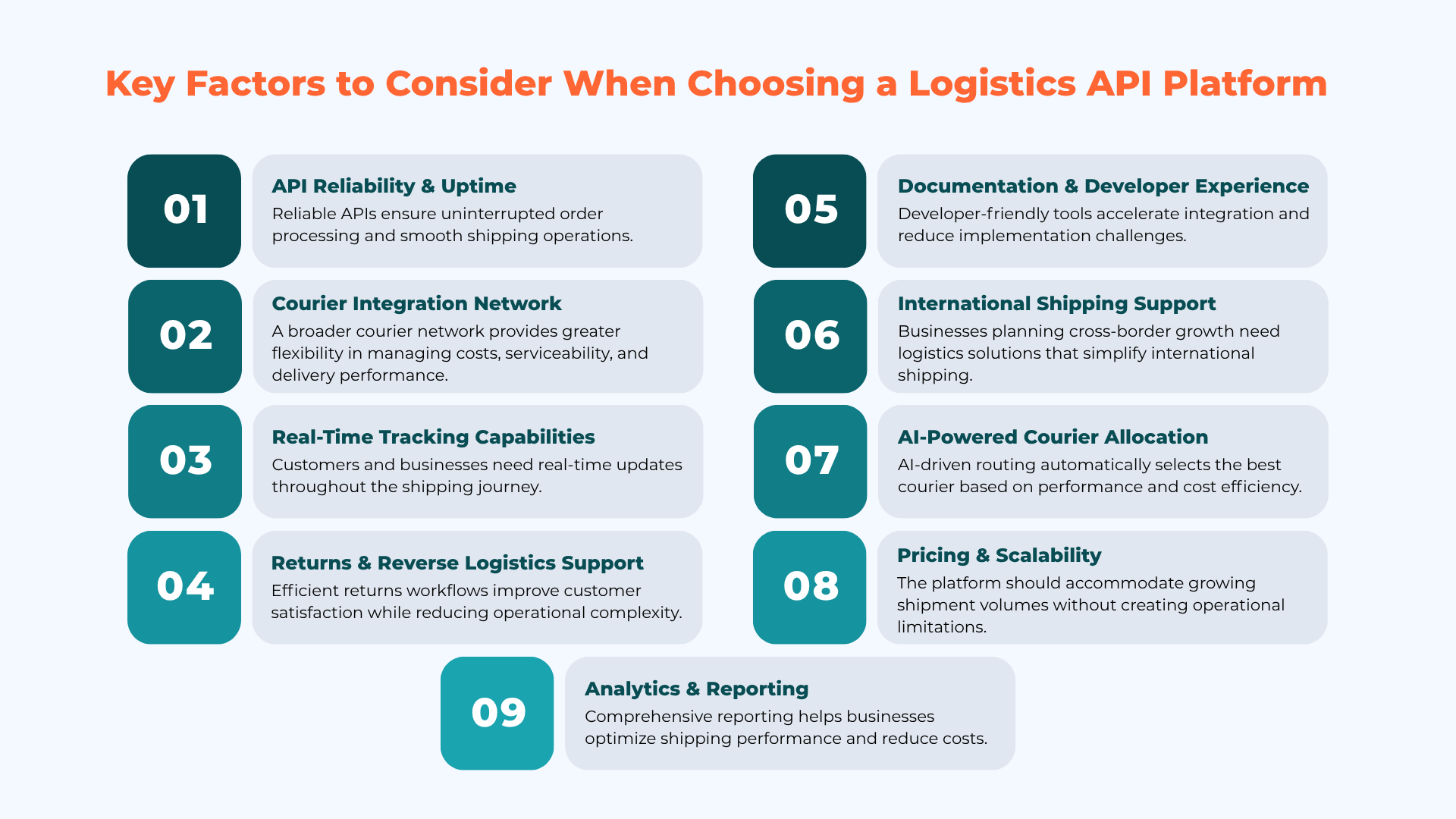
Key Factors to Consider When Choosing a Logistics API Platform
Not every logistics platform is built for the same use case. While startups often prioritize affordability and ease of implementation, larger enterprises focus on scalability, automation, visibility, and integration capabilities.
Before selecting a platform, consider the following evaluation criteria.
API Reliability and Uptime
Shipping operations depend heavily on API availability. Even brief outages can disrupt order processing and affect customer satisfaction.
Look for platforms that offer:
- High uptime commitments
- Enterprise-grade infrastructure
- Scalability during peak seasons
- Fast API response times
Number of Courier Integrations
The more carrier options available, the greater the flexibility businesses have in optimizing delivery performance and costs.
An ideal platform should support:
- National courier providers
- Regional logistics companies
- Hyperlocal delivery services
- International shipping partners
Real-Time Tracking Capabilities
Shipment visibility has become a critical customer experience requirement.
Key features include:
- Real-time tracking APIs
- Delivery milestone updates
- Branded tracking pages
- Automated notifications
Returns and Reverse Logistics Support
Returns can significantly impact profitability and customer loyalty.
Businesses should evaluate:
- Return request automation
- Pickup scheduling
- Reverse shipment tracking
- Refund workflow integrations
Documentation and Developer Experience
A powerful API is only valuable if developers can implement it efficiently.
Consider:
- API documentation quality
- Sandbox environments
- SDK availability
- Technical support responsiveness
International Shipping Support
For businesses planning global expansion, international logistics capabilities are important.
Evaluate:
- Customs documentation support
- International carrier integrations
- Cross-border visibility
- Duty and tax management
AI-Powered Courier Allocation
AI-driven courier selection helps businesses automatically choose the best shipping partner based on:
- Delivery performance
- Serviceability
- Historical success rates
- Cost optimization
Pricing and Scalability
The platform should grow with the business.
Important considerations include:
- Flexible pricing models
- Volume discounts
- API usage limits
- Enterprise support options
Analytics and Reporting
Data-driven logistics management requires comprehensive reporting.
Look for visibility into:
- Courier performance
- Delivery success rates
- RTO trends
- Shipping costs
- Return rates
Over the last few years, logistics has evolved from an operational function into a strategic growth driver. Businesses today are under constant pressure to reduce shipping costs, improve delivery timelines, and provide better customer experiences. Managing these objectives manually becomes increasingly difficult as order volumes grow.
Logistics API platforms address these challenges by creating a centralized shipping infrastructure that connects carriers, warehouses, marketplaces, ERP systems, and customer communication channels through a single interface. Instead of switching between multiple courier dashboards, operations teams can manage the entire shipping lifecycle from one platform.
For eCommerce brands, this translates into faster order processing, improved delivery visibility, reduced manual effort, and better courier performance management. For enterprises and 3PL providers, APIs provide the flexibility required to scale operations without increasing operational complexity.
Another major driver behind API adoption is the growing focus on customer experience. Consumers now expect accurate delivery estimates, proactive shipment notifications, and seamless returns. Logistics APIs help businesses meet these expectations while maintaining operational efficiency.
As shipping volumes continue to increase across India, logistics APIs are becoming a foundational technology layer that enables businesses to build scalable, data-driven supply chains.
Top 15 Logistics API Platforms in India 2026
As shipping volumes grow, businesses often outgrow basic courier aggregation tools and seek platforms capable of automating courier allocation, shipment tracking, returns management, and logistics workflows through a unified API ecosystem. Modern logistics API platforms increasingly function as operational control towers, providing visibility and automation across the entire shipping lifecycle.
eShipz
Company Overview
eShipz is a logistics automation platform that helps businesses manage multi-carrier shipping operations through a unified technology framework. The platform focuses on automating shipping workflows, improving delivery performance, and providing centralized logistics visibility.
Key API Features
- Multi-carrier shipping APIs
- AI-powered courier allocation
- Tracking APIs
- Returns management
- NDR management
- Shipping analytics
- OMS and WMS integrations
Best Suited For
- D2C brands
- Enterprise retailers
- Omnichannel businesses
Strengths
Strong automation capabilities, centralized logistics management, and intelligent courier allocation.
ClickPost
Company Overview
ClickPost focuses on post-purchase logistics management and customer experience. It is widely used by enterprises seeking better shipment visibility and delivery management.
Key API Features
- Shipment tracking APIs
- Returns automation
- Carrier integrations
- Delivery analytics
- Customer notifications
Best Suited For
Mid-sized and enterprise businesses.
Strengths
Strong tracking capabilities and post-purchase customer engagement.
Shiprocket
Company Overview
Shiprocket is one of India’s most popular shipping platforms for SMBs and online merchants. It provides access to multiple courier partners through a single integration.
Key API Features
- Shipping APIs
- Tracking APIs
- Courier aggregation
- International shipping
- Label generation
Best Suited For
Small and medium-sized eCommerce businesses.
Strengths
Easy onboarding and extensive carrier network.
Shipway
Company Overview
Shipway specializes in shipping automation, tracking, and customer communication workflows.
Key API Features
- Tracking APIs
- Shipping management
- Returns workflows
- Customer notifications
Best Suited For
Growing D2C businesses.
Strengths
Simple implementation and strong customer communication tools.
NimbusPost
Company Overview
NimbusPost provides courier aggregation and shipping automation solutions for online sellers.
Key API Features
- Shipping APIs
- Tracking APIs
- Courier selection
- Rate comparison
Best Suited For
Small and growing eCommerce businesses.
Strengths
Competitive shipping rates and broad carrier coverage.
Pickrr
Company Overview
Pickrr focuses on shipping automation and intelligent courier management.
Key API Features
- Multi-carrier integration
- Tracking APIs
- Returns management
- Courier allocation
Best Suited For
D2C brands and online retailers.
Strengths
Automation-focused shipping infrastructure.
Easyship
Company Overview
Easyship provides global shipping infrastructure for businesses involved in international commerce.
Key API Features
- International shipping APIs
- Duty and tax calculations
- Tracking APIs
- Global carrier integrations
Best Suited For
Cross-border sellers.
Strengths
Strong international shipping network.
AfterShip
Company Overview
AfterShip is primarily known for shipment tracking and post-purchase customer experience management.
Key API Features
- Tracking APIs
- Returns management
- Delivery notifications
- Customer engagement tools
Best Suited For
Brands prioritizing customer experience.
Strengths
Excellent shipment visibility and branded tracking experiences.
FarEye
Company Overview
FarEye is an enterprise logistics platform focused on last-mile delivery optimization and visibility.
Key API Features
- Delivery orchestration
- Route optimization
- Tracking APIs
- Fleet visibility
Best Suited For
Large enterprises and logistics-intensive organizations.
Strengths
Enterprise-grade scalability and automation.
Locus
Company Overview
Locus leverages AI and machine learning to optimize logistics operations.
Key API Features
- Route optimization
- Dispatch planning
- Tracking APIs
- Logistics intelligence
Best Suited For
Businesses focused on delivery efficiency.
Strengths
Advanced optimization capabilities.
Unicommerce
Company Overview
Unicommerce provides order management, warehouse management, and logistics integration capabilities.
Key API Features
- OMS APIs
- Warehouse integrations
- Courier connectivity
- Inventory synchronization
Best Suited For
Omnichannel retailers.
Strengths
Strong commerce ecosystem integration.
ShipStation
Company Overview
ShipStation is a globally recognized shipping platform used by online retailers.
Key API Features
- Shipping APIs
- Tracking APIs
- Label generation
- Carrier integrations
Best Suited For
Businesses selling internationally.
Strengths
Mature platform and global ecosystem.
EasyPost
Company Overview
EasyPost offers developer-friendly shipping APIs designed for custom logistics implementations.
Key API Features
- Shipment creation APIs
- Address verification
- Tracking APIs
- Carrier integrations
Best Suited For
Technology-driven businesses.
Strengths
Flexible API architecture.
Delhivery
Company Overview
Delhivery is one of India’s largest logistics companies offering API-based shipping capabilities.
Key API Features
- Shipping APIs
- Tracking APIs
- Freight APIs
- Warehouse services
Best Suited For
Large-scale shippers.
Strengths
Extensive logistics network.
Xpressbees
Company Overview
Xpressbees is a technology-enabled logistics provider serving eCommerce and enterprise customers across India.
Key API Features
- Shipment creation
- Tracking APIs
- Delivery management
- Logistics visibility
Best Suited For
High-volume eCommerce operations.
Strengths
Strong nationwide reach.
Which Logistics API Platform Is Right for Your Business?
| Business Type | Recommended API Features |
| D2C Brands | Multi-carrier shipping, tracking, NDR management |
| Marketplaces | Bulk shipment processing, carrier management |
| Enterprises | ERP integration, automation, analytics |
| 3PL Providers | Carrier orchestration, visibility |
| B2B Logistics | Freight visibility and reporting |
If You’re a Startup Shipping Under 500 Orders Per Month
Focus on simplicity, affordable pricing, and easy implementation. Platforms with straightforward integrations and strong courier coverage are often sufficient during the early stages.
If You’re Scaling Across Multiple Warehouses
Prioritize automation, inventory synchronization, and warehouse integrations. Managing fulfillment across multiple locations requires centralized visibility and workflow orchestration.
If You’re Managing Domestic and International Shipments
Choose a platform that supports customs documentation, international carriers, and cross-border tracking.
If You’re Looking to Reduce RTO and Delivery Failures
Look for solutions offering AI-powered courier allocation, NDR management, delivery analytics, and predictive shipping intelligence.

The Future of Logistics APIs: From Connectivity to Intelligent Logistics
The next phase of logistics technology will focus on intelligence rather than connectivity alone.
AI-powered courier allocation will become more sophisticated, helping businesses automatically select the most efficient carrier based on cost, delivery performance, geography, and customer behavior.
Predictive ETA engines will provide more accurate delivery estimates by incorporating traffic conditions, weather data, carrier performance, and regional disruptions.
Automated exception management will proactively identify shipment risks and initiate corrective actions before customer experience is affected.
Real-time supply chain visibility will continue to improve as logistics platforms integrate warehouse, transportation, and delivery data into unified dashboards.
Businesses are increasingly moving toward integrated logistics ecosystems that combine shipping automation, tracking, courier intelligence, returns management, and analytics within a single platform. This shift is reducing reliance on disconnected tools and enabling more efficient logistics operations.
As shipping complexity increases and customer expectations continue to rise, logistics APIs will become a strategic component of business growth, helping organizations improve efficiency, reduce costs, and enhance delivery performance.
The Rise of Unified Logistics Control Towers
One of the most significant developments in logistics technology is the emergence of unified logistics control towers. These platforms aggregate data from carriers, warehouses, transportation providers, and customer channels into a single dashboard.
By providing real-time operational visibility, businesses can quickly identify bottlenecks, monitor courier performance, and make proactive decisions to improve delivery outcomes. Control towers are particularly valuable for enterprises managing large shipment volumes across multiple locations.
As AI capabilities continue to improve, these systems will become increasingly predictive, helping businesses identify risks before they impact customers and recommending corrective actions automatically.
Looking Beyond APIs? Here’s How Modern Logistics Automation Platforms Are Changing Operations
Choosing the right logistics API platform is only the first step. As businesses scale, they often discover that managing shipments, tracking exceptions, handling returns, monitoring courier performance, and optimizing delivery costs requires more than API connectivity alone.
This is where logistics automation platforms become increasingly valuable. Solutions such as eShipz combine multi-courier shipping API, shipment automation, real-time tracking, returns management, courier allocation, and analytics into a unified ecosystem.
Rather than relying on multiple disconnected tools, businesses can centralize logistics operations, gain better visibility into delivery performance, improve customer experience, and create a foundation for scalable growth.
In 2026 and beyond, organizations that invest in intelligent logistics infrastructure will be better positioned to meet evolving customer expectations while maintaining operational efficiency and profitability.