




Modern third-party logistics providers are no longer operating in a simple shipping environment. Today’s logistics ecosystem demands faster fulfillment, broader carrier coverage, real-time visibility, and higher service consistency across multiple client accounts. This is where a Unified SaaS Platform for 3PLs becomes critical.
A growing 3PL may simultaneously manage eCommerce deliveries, B2B shipments, retail replenishment, and cross-border logistics. Each client often comes with different service level agreements, preferred carrier networks, delivery timelines, and reporting expectations. Managing these requirements using spreadsheets, manually stitched APIs, or multiple dashboards quickly becomes unsustainable.
According to a report by IBM, supply chain visibility and intelligent workflow automation are becoming key priorities for logistics organizations looking to improve agility, reduce disruptions, and optimize operational performance.
As shipment volumes rise, disconnected systems often create operational blind spots. Carrier updates get delayed, billing errors increase, and teams spend more time switching between tools than solving customer issues.
Consider a 3PL handling eCommerce, retail, and B2B shipments simultaneously. It may rely on different carriers for express deliveries, freight movements, and regional coverage. Without centralized visibility, operations teams struggle to monitor exceptions, shipment delays, and invoice accuracy.
The challenge is no longer about adding more carrier partners. It is about managing them efficiently at scale.
Why Disconnected Logistics Systems Slow Down 3PL Growth
Many logistics providers adopt software incrementally. One tool is used for dispatch, another for tracking, a separate system for invoicing, and often spreadsheets for reconciliation.
This fragmented approach may work in the early stages, but it creates serious inefficiencies as operations grow.
Common issues caused by disconnected systems include:
- Duplicate data entry across multiple platforms
- Manual shipment allocation based on team judgment
- Delayed carrier status updates
- SLA failures due to lack of real-time sync
- Slow onboarding of new carrier partners
When systems do not communicate seamlessly, operations teams are forced to manually coordinate shipment workflows. This slows decision-making and increases dependency on human intervention.
For example, when a new enterprise client requests same-day or next-day delivery capabilities, operations teams often spend weeks integrating new courier APIs, testing workflows, and mapping carrier rules across platforms.
Instead of improving service agility, disconnected systems introduce complexity.
This also impacts financial workflows. Billing reconciliation becomes slower because shipment records, delivery confirmations, and carrier invoices are stored separately. Even small mismatches can create revenue leakage.
A 3PL trying to scale carrier operations cannot rely on more software layers. It needs operational centralization.
Market Trend: Logistics Technology Consolidation Is Accelerating
The logistics industry is shifting from point solutions to integrated platforms.
As customer expectations rise, logistics providers are under pressure to deliver:
- Faster shipping promises
- Better shipment visibility
- Lower operational costs
- Higher SLA compliance
This shift is happening because fragmented logistics technology stacks limit growth. Organizations now prefer unified systems that combine carrier management, shipment visibility, automation, and analytics within one platform.
For 3PLs, platform consolidation is becoming a growth requirement, not just a technology upgrade.
How Unified SaaS Platform for 3PLs Improve Carrier Allocation and Shipment Visibility
A unified logistics platform acts as a centralized control tower for carrier operations.
Instead of relying on manual carrier selection, operations teams can automate allocation based on predefined business logic such as:
- Cost optimization
- SLA commitments
- Delivery region
- Historical carrier performance
- Shipment type
For example, a unified system can automatically assign the most suitable carrier based on price, promised delivery timeline, and success rate in a particular pin code or geography.
This improves both operational efficiency and service reliability.
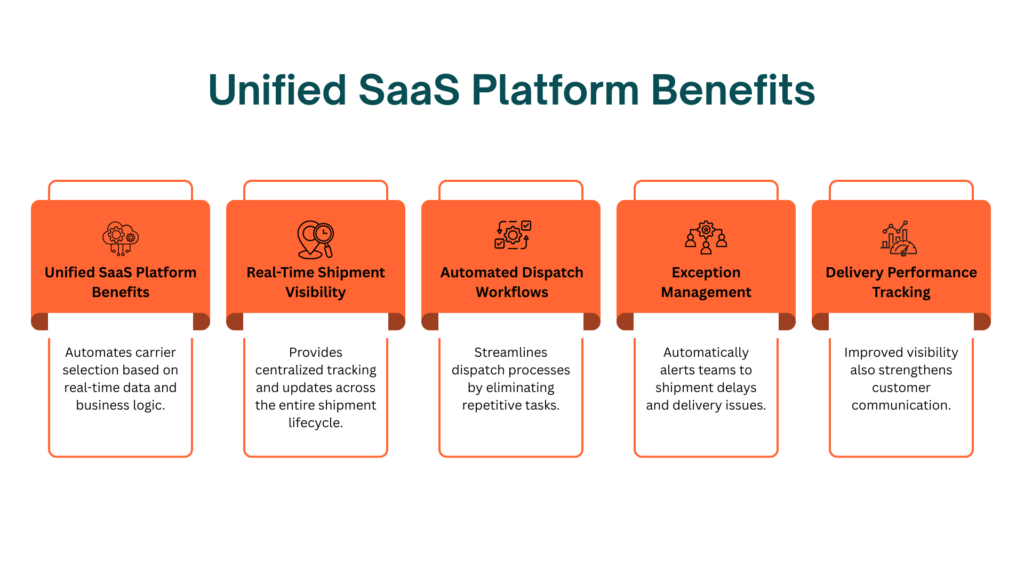
Core benefits of unified SaaS platforms include:
AI-Driven Carrier Allocation
Manual carrier selection is inefficient at scale.
A platform can automatically route shipments to the most efficient carrier using real-time rules and performance data. This reduces dispatch delays and improves delivery outcomes.
Real-Time Shipment Visibility
Unified dashboards allow teams to track shipments, carrier updates, delays, and delivery exceptions in one place.
Instead of checking multiple portals, operations teams get centralized visibility across the entire shipment lifecycle.
This makes exception management faster and more proactive.
Automated Dispatch Workflows
Order data can move automatically from order management or warehouse systems into dispatch workflows.
This eliminates repetitive tasks such as:
- Shipment creation
- Label generation
- Carrier assignment
- Manifest generation
Automation reduces processing time and minimizes operational errors.
Exception Management
A delayed shipment, failed pickup, or delivery exception can trigger alerts automatically.
Teams can respond faster to disruptions instead of discovering issues after customer escalation.
Delivery Performance Tracking
A unified platform tracks metrics such as:
- On-time delivery rate
- Carrier SLA adherence
- Delivery attempt success rate
- Return rates
These insights help logistics teams optimize carrier strategy continuously.
Improved visibility also strengthens customer communication. With centralized tracking data, teams can proactively update customers and reduce WISMO queries, or “Where is my order?” requests.
This directly improves customer satisfaction while reducing support workload.
Scaling 3PL Operations Requires Automation, Not More Manual Processes
As shipment volumes increase, many 3PLs attempt to solve operational challenges by expanding headcount.
This approach has limitations.
Hiring more people may temporarily ease workload, but it does not fix process inefficiencies.
A rapidly growing 3PL may process thousands of shipments daily across multiple warehouses. Without workflow automation, operational delays become inevitable.
Common scalability challenges include:
- Peak season shipment surges
- Multi-warehouse coordination complexity
- Carrier onboarding bottlenecks
- Manual billing reconciliation delays
- Inconsistent processes across teams
During peak periods, even small inefficiencies become expensive.
For example, if warehouse teams manually allocate shipments or reconcile invoices, processing delays multiply quickly under high volumes.
Automation enables standardization.
With workflow automation, 3PLs can create repeatable processes for:
- Shipping workflows
- Billing reconciliation
- SLA monitoring
- Carrier onboarding
- Exception handling
This ensures operational consistency across warehouses, clients, and carrier networks.
A unified platform also reduces dependency on tribal knowledge. Teams no longer need specific individuals to manage exceptions manually or remember client-specific workflows.
Instead, processes are system-driven.
Unified logistics platforms such as eShipz 3PL Automation Solutions support:
- Automated shipping workflows
- Billing reconciliation
- SLA monitoring
- Multi-warehouse scalability
- Carrier network management from one dashboard
This operational model is significantly more scalable than manual coordination.

The Future of 3PL Logistics Is Built on Unified, Data-Driven Platforms
Logistics expectations are evolving rapidly.
Customers now expect:
- Real-time tracking updates
- Faster delivery timelines
- Transparent shipping communication
- Consistent service quality across regions
At the same time, logistics ecosystems are becoming more complex.
Carrier networks are expanding. Delivery models are diversifying. Cross-border shipping is increasing. Client expectations are becoming more specialized.
To stay competitive, 3PL providers need more than operational software. They need infrastructure that supports long-term growth.
This is where unified, data-driven platforms create strategic advantage.
Key future capabilities include:
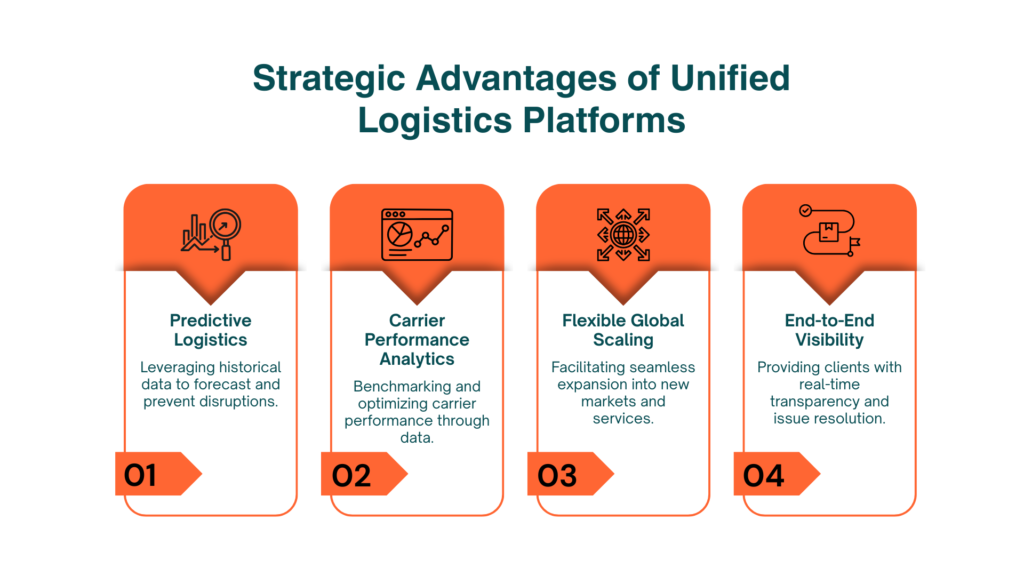
Predictive Logistics
Historical shipment data can help forecast delays, optimize routing decisions, and improve planning.
Instead of reacting to disruptions, logistics teams can prevent them proactively.
Carrier Performance Analytics
Data-driven platforms enable deeper carrier benchmarking across metrics such as:
- Cost efficiency
- Delivery accuracy
- SLA adherence
- Geographic performance
This improves network optimization over time.
Flexible Global Scaling
As 3PLs expand into new regions or service categories, unified platforms make it easier to onboard carriers, configure workflows, and standardize reporting.
This supports faster business expansion without operational chaos.
End-to-End Visibility as a Competitive Advantage
Visibility is no longer optional.
Clients increasingly expect shipment transparency, operational reporting, and real-time issue resolution.
3PLs that offer better visibility are more likely to retain enterprise customers and win larger accounts.
A provider still relying on fragmented systems may struggle to maintain SLA consistency, customer satisfaction, and profitability as delivery ecosystems become more demanding.
Unified SaaS platforms are becoming foundational growth infrastructure.
They are no longer just tools for shipping operations.
They are operating systems for scalable logistics businesses.
Conclusion
Carrier network complexity is increasing faster than most 3PL operating models can handle.
Managing multiple carriers, client SLAs, warehouse workflows, billing systems, and shipment visibility through disconnected tools creates operational bottlenecks that limit growth.
A Unified SaaS Platform for 3PLs helps solve this challenge by centralizing carrier operations, automating workflows, improving visibility, and enabling data-driven decision-making.
For 3PL providers aiming to scale efficiently, the question is no longer whether logistics operations should be unified.
The real question is how quickly they can transition from fragmented workflows to platform-driven logistics infrastructure.
Businesses exploring scalable logistics automation can evaluate solutions like eShipz to streamline shipping workflows, carrier management, billing reconciliation, and multi-warehouse operations from a single platform.