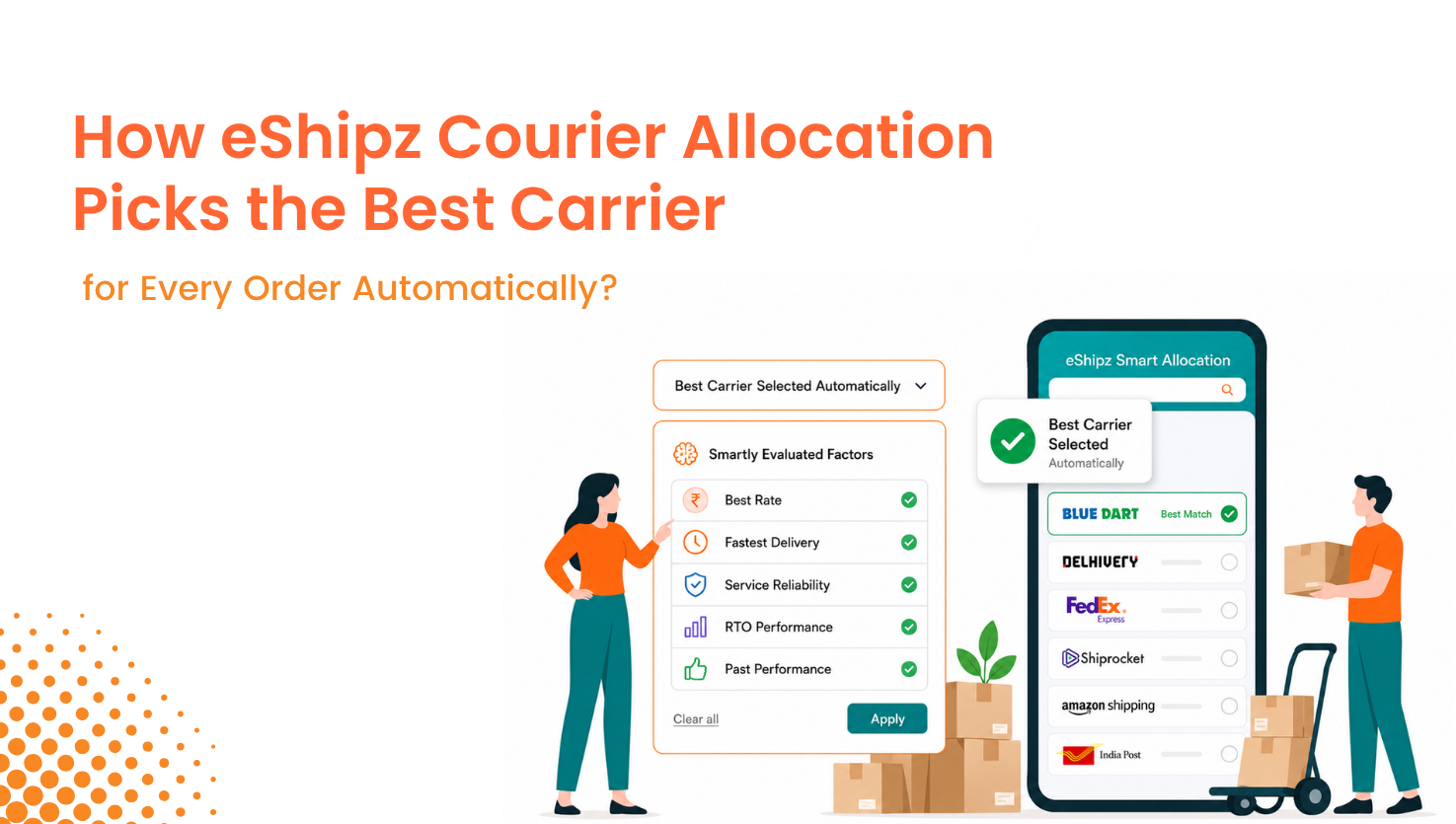





Most shipping teams still choose carriers the way they did five years ago. A rate card lives in a spreadsheet, a handful of pin-code rules live in the dashboard, and someone from operations overrides both whenever a carrier has a bad week. That works at 100 orders a day. At 2,000 orders a day across metros, Tier 3 towns and COD-heavy regions, it starts costing real money. AI carrier allocation fixes this by choosing the carrier for each shipment from data, instead of applying one fixed rule to every order.
Traditional allocation depends on a fixed rule, a manual call, or a short list of variables such as price and serviceability. Those inputs matter, but they leave out most of what decides whether a parcel arrives. The best carrier for a prepaid order going to Pune can be the wrong one for a COD order going to a small town in Bihar. Destination, SLA, shipment type, payment mode and each carrier’s recent history all change the answer.
AI and machine learning make allocation adaptive. The system learns how each carrier performs under each condition and updates its choice as new deliveries come in. McKinsey’s research on AI in supply chain management found that early adopters improved logistics costs by 15 percent and service levels by 65 percent compared with slower-moving competitors. That study covers supply chains broadly, not carrier allocation alone, but it shows what happens when decisions are made with more data.
This guide covers why allocation quality matters, how AI powered carrier allocation works, where to start, and how post-dispatch data such as NDRs can sharpen future decisions.
Why Is Efficient Carrier Allocation Essential Today?
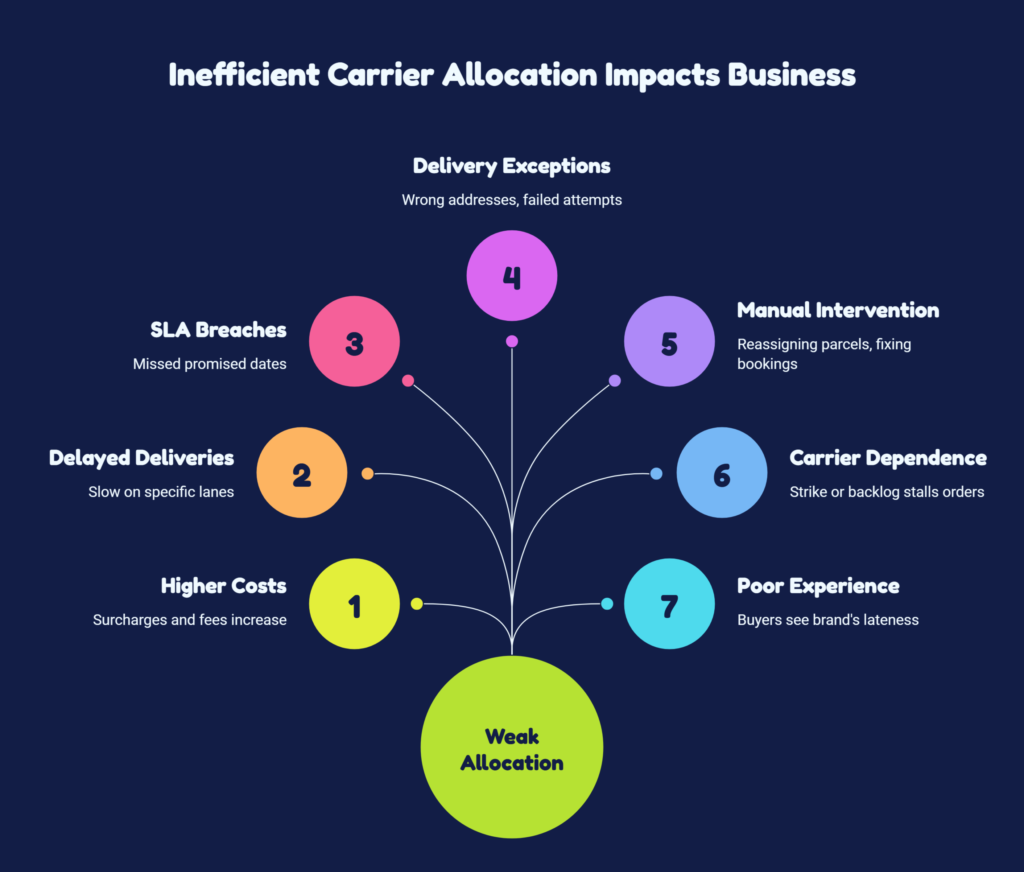
Every shipment carries a carrier decision, and every poor decision lands somewhere in the P&L. When allocation is weak, teams usually see:
- Higher shipping costs. A carrier picked for its rate card can still add weight-slab differences, ODA surcharges or COD fees.
- Delayed deliveries. A carrier with a strong national reputation can be slow on one specific lane.
- SLA breaches. Promised dates get missed, and marketplace penalties or refund requests follow.
- More delivery exceptions. Wrong-address cases, unreachable customers and failed attempts rise wherever the carrier is weak.
- More manual intervention. Ops teams reassign parcels, chase carriers and fix bookings by hand.
- Dependence on one or two carriers. If a single carrier handles 70 percent of volume, a strike or a festive backlog stalls most of your orders.
- Poor customer experience. Buyers do not see the carrier’s name in their complaint. They see a late parcel from your brand.
Good carrier management starts with accepting that no carrier is best everywhere. A carrier can be excellent between Delhi and Mumbai and poor on a route into the North East. Allocation has to reflect that.
Price is one input. The decision itself is which carrier suits this specific shipment, at this destination, with this payment mode.
Here is an illustration with made-up numbers. Carrier A charges ₹6 less per parcel to a certain pin code. But its parcels there come back as RTO 7 percentage points more often than Carrier B’s. If each RTO costs ₹50 in return freight and ₹200 in lost margin, that extra 7 percent adds about ₹17.50 per order. Carrier A saves ₹6 and loses ₹17.50, so it ends up ₹11.50 more expensive per order. The lowest-cost carrier turned out to be the more expensive one.
How Is AI Changing Carrier Allocation in 2026?
Logistics automation has moved past running fixed instructions. Newer systems use large volumes of operational data for planning and for decisions made while shipments are moving. Shipping aggregators started this change by putting many carriers behind one dashboard, as covered in our guide to multi-carrier shipping software and carrier allocation. Carrier allocation software then became the layer that decides among those carriers.
Allocation itself has gone through four stages:
- Manual allocation. Someone picks a carrier from memory or habit. It works at low volume and stops working the week that person is on leave.
- Rule-based allocation. Rules like “orders under 500 g go to Carrier A” or “COD goes to Carrier C” run automatically. This is fast and consistent, but rules only change when someone edits them.
- Data-driven allocation. Reports on delivery rate, TAT and RTO by carrier guide the rules. The rules get better, yet a person still has to read the report and update them.
- AI and ML assisted dynamic allocation. Models score every carrier for every shipment, and the scores move as performance moves.
The last stage is where automated carrier allocation becomes adaptive. Instead of sorting carriers by cost or serviceability alone, an AI powered carrier allocation system weighs several signals together: price, transit time, pin-code coverage, past delivery success, RTO history and current load. This is the direction most AI logistics tools are taking in 2026.
How Do AI and Machine Learning Improve Carrier Allocation?
AI carrier allocation works through four connected parts. Each one answers a different question.
Analyze Historical Carrier Performance
Every delivered, delayed or failed parcel is a data point. Grouped by carrier, region, lane, weight band and shipment type, those points show patterns that nobody spots by scanning a tracking sheet. For example, Carrier B might deliver 96 percent of prepaid parcels on time in the South and only 84 percent of COD parcels in the East (illustrative figures). A model trained on months of this history learns such gaps. For a new shipment, it estimates the chance of on-time delivery, first-attempt success and RTO for each carrier.
Score Carriers for Individual Shipments
Instead of assigning one carrier to thousands of similar orders, intelligent carrier allocation evaluates every available option for each shipment. Each carrier gets a score built from cost, speed, predicted delivery success and RTO risk, and the shipment goes to the highest score. You set the weights. A brand shipping high-value electronics can weight delivery success at 50 percent and cost at 20 percent. A brand shipping low-priced accessories can reverse that. eShipz describes its smart allocation as scoring shipments across cost, speed and carrier performance, with ML based courier scoring behind it.
Adapt Allocation to Location and Serviceability
Performance depends on geography. A carrier that does well in Bengaluru may struggle in a small town three hours outside Patna. Zonal intelligence looks at origin, destination and past performance together, so the same carrier can win one lane and lose another on the same day. eShipz, for example, describes zonal intelligence in its allocation platform that works this way. Serviceability checks sit alongside it and remove carriers that cannot reach the pin code or that add out-of-delivery-area charges.
Combine AI with Business Rules
AI does not take control away from you. Most businesses have constraints that must always hold: COD orders go to carriers with reliable cash remittance, fragile items go to carriers with careful handling, bulky items need freight capability, and priority orders need express service within a stated SLA. The rules set the boundary, and the model picks the best carrier inside it. eShipz’s allocation offering follows this pattern by combining custom rules with automated carrier selection. Our post on rule-based shipment allocation explains how to set these rules up, and the two approaches work well together.
Where Should You Start with AI-Based Carrier Allocation?
You do not have to replace your shipping process to adopt AI carrier allocation. Start with the data and add intelligence in stages.
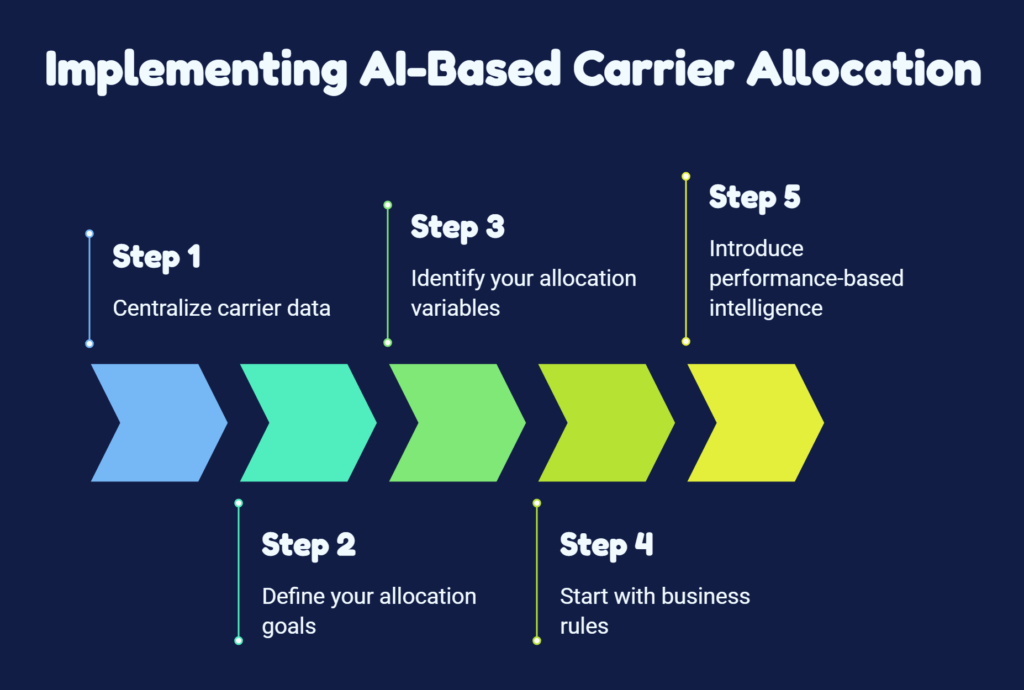
Step 1: Centralize carrier data. Bring carrier rates, serviceability, SLAs and shipment outcomes into one view. If that information sits in five carrier portals and two spreadsheets, no rule or model can use it well. This is the base of any carrier management effort.
Step 2: Define your allocation goals. Decide what you are optimizing for: cost, speed, delivery success, SLA adherence, or a mix. A D2C brand with a high COD share may put RTO reduction first. A B2B shipper may put SLA adherence first.
Step 3: Identify your allocation variables. List what should influence the choice: destination, weight, shipment type, payment mode, priority, serviceability and carrier performance. Add anything specific to your business, such as a fragile flag or a customer tier.
Step 4: Start with business rules. Automate the repetitive decisions first, such as routing by weight slab or payment mode. This gives quick wins and builds a clean record of which carrier handled which order.
Step 5: Introduce performance-based intelligence. Once you have a few months of outcomes, let historical and ongoing performance shape courier allocation. Keep manual override available for exceptions and review results every week.
Following these steps, the business never has to pause dispatch to switch systems.
What Happens After the Carrier Is Allocated?
Allocation should not stop when the AWB is generated. Once parcels are moving, they produce signals about how each carrier performs across locations and shipment conditions. A parcel is delivered, delayed, raised as an NDR (Non-Delivery Report), reattempted, or sent back as an RTO. Each outcome says something about the carrier that was chosen.
Those outcomes complete a loop: allocate, track, detect exceptions, resolve, learn, then improve the next allocation. Most teams already run the first four steps because tracking and NDR handling are part of daily work. The gap is in the last two, where outcome data should flow back into the allocation decision. Without that, a carrier keeps receiving the same lanes it keeps failing on.
How NDR Data Can Improve Future Carrier Decisions
NDR records show where deliveries break down. Reviewed by carrier, pin code and reason, they can reveal:
- Carrier-specific failure patterns, such as one carrier logging most of its NDRs as “customer not available”
- High-failure delivery zones where every carrier struggles
- Repeated address-related failures that point to poor address data
- Customer unavailability patterns, such as failures bunching on weekday mornings
- Poor reattempt performance, where a second attempt is booked but rarely succeeds
- Higher RTO tendencies in particular regions or with particular carriers
Separating carrier faults from address faults matters here. If every carrier fails at the same pin code, the fix is address verification. If only one carrier fails there, the fix is allocation.
As a conceptual example, suppose Carrier A produces more delivery exceptions in one region while Carrier B performs better there. That history becomes input for the next carrier selection: move that region’s volume toward Carrier B and keep Carrier A where it does well. Your own carrier-level data should set the actual thresholds.
eShipz’s NDR solution provides views into courier performance, region-wise failures and product-level patterns, which helps operations teams find these recurring problems.
How eShipz Brings Carrier Allocation and NDR Automation Together
Carrier allocation and NDR handling are often bought and run as separate tools. eShipz puts both in one shipping automation platform, so performance data can move from one to the other.
Before dispatch: smarter carrier allocation. eShipz supports automated carrier selection using custom business rules, zonal intelligence, shipment details and carrier performance data. Its AI/ML courier allocation platform covers smart allocation, custom rules, zonal intelligence, warehouse routing and continuous optimization, and teams can override any assignment manually. eShipz states that its smart allocation approach can reduce shipping costs by up to 22 percent. Treat that as eShipz’s own figure, since results depend on your lanes and carrier mix.
After a delivery failure: intelligent NDR management. eShipz’s NDR management detects and categorizes NDRs automatically, triggers customer communication, lets customers reschedule or update the address, and shows NDR insights on a unified dashboard. An AI voice layer can also call customers after a failed delivery, capture their delivery intent and update the workflow.
With both in one place, businesses can use shipment outcomes to refine how AI powered carrier allocation behaves, instead of running allocation and failed-delivery management as separate processes.

What Are the Benefits of AI-Driven Carrier Allocation?
Each capability below translates into a specific business result.
| Capability | Business outcome |
| Automated carrier selection | Less manual decision-making |
| Performance-based allocation | More reliable carrier choices |
| Zonal intelligence | Better location-specific decisions |
| Multi-variable scoring | Balance between cost, speed and performance |
| Automated NDR workflows | Faster exception resolution |
| NDR analytics | Recurring carrier issues become visible |
| Dynamic reallocation | Lower dependence on one carrier |
| Continuous performance data | Better allocation decisions over time |
From Static Rules to Continuous Carrier Optimization
Carrier allocation should not be a one-time decision based on rate cards or fixed rules. AI and machine learning let businesses weigh more operational signals, automate repetitive selections, learn from carrier performance and adjust as delivery outcomes change. Teams that begin with clean carrier data and simple rules, then add performance-based scoring, can get there without disrupting dispatch. AI carrier allocation improves with every shipment it sees, as long as outcomes such as NDRs and RTOs feed back into the decision.
Want to make every carrier decision count? Explore how eShipz combines intelligent carrier allocation, shipment visibility and NDR automation to help businesses improve shipping performance from dispatch to delivery.
Frequently Asked Questions
- What is AI powered carrier allocation?
It is a system that uses machine learning and business rules to choose the best carrier for each shipment. It looks at cost, speed, serviceability and past performance instead of sending every order to one default carrier. - How is machine learning different from rule-based carrier selection?
Rules follow instructions someone wrote and stay the same until edited. Machine learning studies past shipment outcomes, predicts which carrier is likely to deliver best for a given shipment, and adjusts as performance changes. - What data do I need to start?
Shipment history with carrier, pin code, weight, payment mode and delivery outcome, plus your rates, serviceability and SLAs. Several months of history gives a useful starting point for spotting carrier patterns. - Can I still control which carrier is used?
Yes. You set the rules for COD, fragile, bulky, express and priority shipments, and the model chooses within those limits. Manual override stays available for special cases. - Will the cheapest carrier still get chosen?
Cost stays an input, but it is weighed against speed, delivery success and RTO risk. When the cheapest carrier is also reliable on that lane, it usually wins. - How do NDRs and RTOs improve allocation?
They show where each carrier fails, by region, reason and reattempt result. Feeding that back lets the system send fewer shipments to carriers that repeatedly fail on a given lane. - Is automated carrier allocation only for large businesses?
No. Any business shipping through more than one carrier can use carrier allocation software. The usual trigger is when manual choices start causing missed SLAs, rising RTOs or too much time spent reassigning parcels.