





Shipping Automation Software is becoming a critical component of modern logistics operations as businesses face increasing pressure from ecommerce growth, omnichannel fulfillment, and rising customer expectations. Today’s supply chains are handling significantly higher shipment volumes across multiple sales channels, warehouses, and carrier networks. While demand has increased, many organizations continue to rely on legacy logistics systems that were never designed to manage this level of complexity.
The rapid rise of ecommerce, omnichannel retail, and customer expectations for faster deliveries has fundamentally changed how logistics operations function. Businesses today are managing significantly higher shipment volumes across multiple sales channels, warehouses, and delivery partners. While demand has increased, many organizations continue to rely on legacy logistics systems that were never designed for this level of complexity.
Manual shipping processes, fragmented carrier management, limited shipment visibility, and disconnected systems often create operational bottlenecks. Teams spend valuable time generating shipping labels, assigning carriers, updating tracking information, and resolving delivery issues manually. At the same time, rising transportation costs and growing customer expectations leave little room for inefficiencies.
The challenge becomes even greater when enterprise systems such as ERP, WMS, and shipping platforms operate independently rather than as part of a connected ecosystem. Data silos slow decision-making, increase errors, and reduce operational agility.
As logistics networks become more complex, businesses need a modern infrastructure that can automate workflows, improve visibility, and support future growth. This is where Shipping Automation Software plays a critical role.
Industry trends further reinforce this shift. According to research from Grand View Research, the global logistics automation market was valued at approximately USD 44 billion in 2025 and is projected to reach nearly USD 149 billion by 2033, growing at a CAGR of 16.8%. The growth is being driven by ecommerce expansion, rising delivery expectations, and increasing investments in automation technologies.
Recent Market Trends Driving Logistics Transformation
Several market developments are accelerating the adoption of logistics automation:
Growing Ecommerce Volumes
Online retailers are processing significantly higher order volumes than ever before. Seasonal peaks, flash sales, and omnichannel fulfillment require systems that can scale without adding operational complexity.
Multi-Carrier Shipping Strategies
Businesses are increasingly diversifying their carrier networks to optimize delivery speed, cost, and geographic coverage. Managing multiple courier partners manually has become impractical.
Demand for Real-Time Visibility
Customers expect accurate shipment updates from checkout to delivery. Businesses also need complete visibility into carrier performance, delivery exceptions, and fulfillment operations.
Automation Becoming a Competitive Advantage
Organizations are moving beyond isolated automation projects and investing in connected logistics ecosystems that improve efficiency across the supply chain.
AI-Powered Logistics Operations
Artificial intelligence is increasingly being used for carrier selection, demand forecasting, route optimization, and predictive delivery management, helping businesses make faster and more informed decisions.
These trends highlight a clear reality: logistics technology is no longer just a support function. It has become a strategic growth enabler.
What Does a Future-Ready Logistics Stack with Shipping Automation Software Look Like?
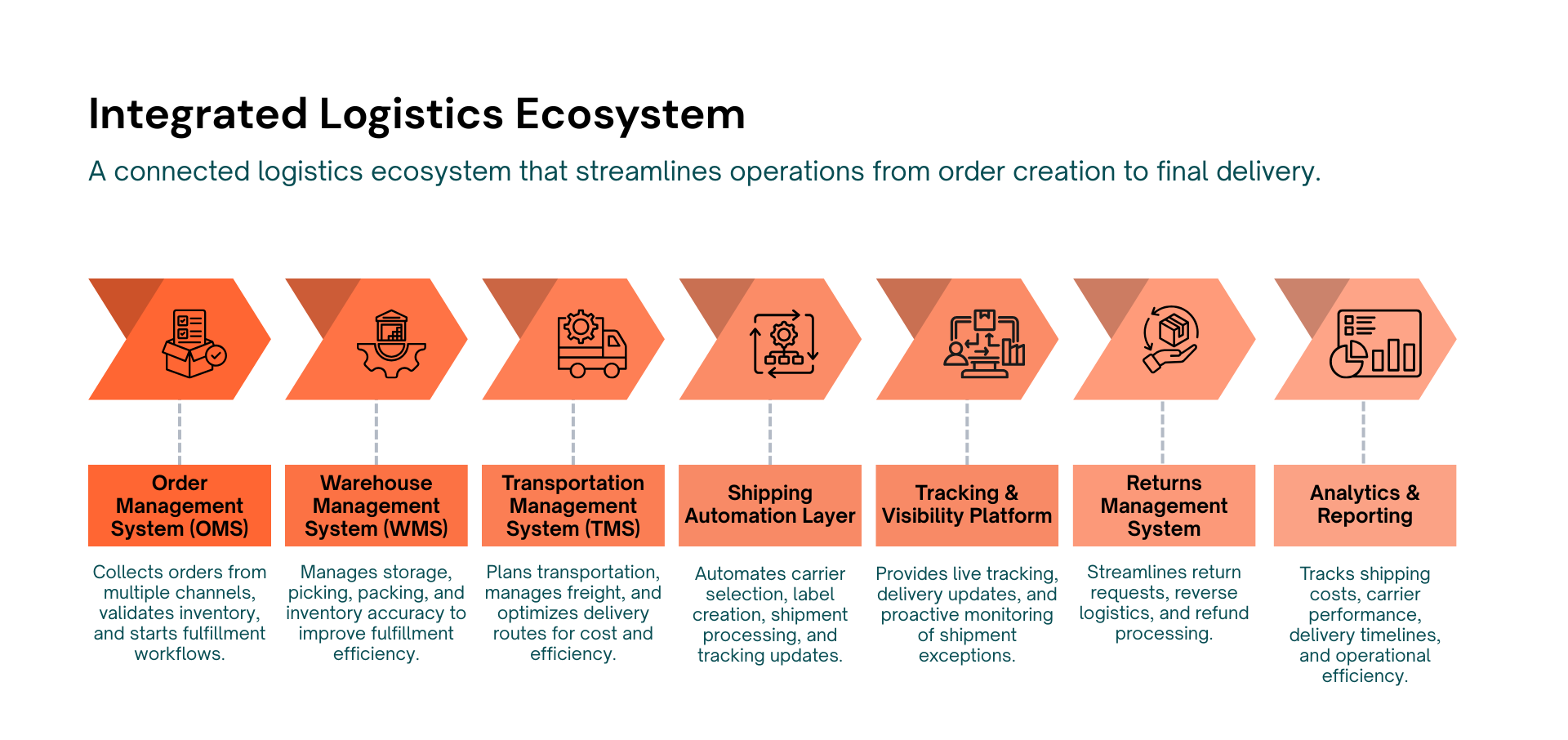
A future-ready logistics stack is an integrated ecosystem of technologies that work together to manage the movement of goods efficiently from order creation to final delivery.
Rather than operating as separate tools, each component shares data and supports end-to-end operational visibility.
Order Management System (OMS)
The order management system acts as the starting point of the logistics journey. It captures orders from multiple sales channels, validates inventory availability, and initiates fulfillment workflows.
Warehouse Management System (WMS)
The warehouse management system manages inventory storage, picking, packing, and warehouse operations. It helps improve inventory accuracy and optimize fulfillment efficiency.
Transportation Management System (TMS)
The transportation management system focuses on carrier planning, route optimization, freight management, and transportation execution.
Shipping Automation Layer
This layer connects fulfillment operations with shipping execution. It automates carrier selection, label generation, shipment processing, and tracking updates.
Tracking and Visibility Platform
Visibility systems provide real-time shipment tracking, delivery status updates, and proactive exception monitoring.
Returns Management System
Returns have become a critical component of customer experience. Modern returns management solutions simplify return initiation, reverse logistics, and refund processing.
Analytics and Reporting
Data-driven decision-making requires comprehensive reporting capabilities. Analytics platforms provide insights into shipping costs, carrier performance, delivery timelines, and operational efficiency.
When these systems operate together, businesses gain a unified view of logistics operations. Instead of managing isolated processes, they can orchestrate fulfillment and delivery activities through a connected technology stack.
The Role of Shipping Automation Software in Connecting the Logistics Ecosystem
Many organizations invest in warehouse systems, transportation platforms, and analytics tools. However, the real operational value comes from connecting these systems effectively.
This is where Shipping Automation Software serves as the operational bridge across the logistics ecosystem.
It streamlines shipping workflows while ensuring information flows seamlessly between different logistics functions.
Automated Carrier Allocation
Selecting the right carrier manually for every shipment becomes impossible as order volumes grow.
Shipping automation platforms can automatically assign carriers based on predefined rules such as:
- Delivery location
- Service levels
- Shipping cost
- Transit time
- Carrier performance
This reduces decision-making time while improving delivery efficiency.
Automated Label Generation
Generating shipping labels manually is time-consuming and prone to errors.
Automation platforms instantly create carrier-compliant labels, reducing fulfillment delays and ensuring consistency across operations.
Intelligent Order Routing
Orders can be automatically routed to the most suitable warehouse or fulfillment center based on inventory availability, customer location, and shipping costs.
This improves delivery speed while minimizing transportation expenses.
Courier Integrations
Modern logistics operations often involve multiple courier partners. Managing each carrier separately creates unnecessary complexity.
Shipping automation solutions provide centralized integrations that allow businesses to manage multiple carriers through a single interface.
Real-Time Shipment Tracking
Customers increasingly expect visibility throughout the delivery journey.
Automated tracking systems collect shipment updates from carriers and provide real-time status information for both internal teams and customers.
Exception Management
Delivery exceptions are inevitable. Weather disruptions, failed delivery attempts, and transportation delays can impact customer satisfaction.
Automation platforms help identify potential issues early, enabling teams to take corrective action before they escalate.
Consider a growing ecommerce brand processing thousands of orders every day across multiple courier partners. Without automation, operations teams would spend countless hours managing labels, tracking updates, carrier assignments, and delivery exceptions manually.
With automation, these processes occur automatically, allowing teams to focus on strategic growth initiatives rather than repetitive operational tasks.

Key Benefits of Building an Integrated Logistics Stack
The value of logistics automation is ultimately measured by business outcomes rather than technology adoption.
An integrated logistics stack delivers several measurable benefits.
Faster Order Processing
Automated workflows reduce the time required to process orders, generate labels, assign carriers, and dispatch shipments.
This leads to faster fulfillment and shorter delivery cycles.
Improved Delivery Performance
Data-driven carrier selection and real-time shipment monitoring help improve on-time delivery rates and reduce delays.
Lower Operational Costs
Automation minimizes manual effort, reduces processing errors, and improves resource utilization.
Businesses can manage larger shipment volumes without proportionally increasing operational headcount.
Better Customer Experience
Customers benefit from accurate delivery estimates, proactive shipment updates, and faster issue resolution.
These improvements directly contribute to customer satisfaction and retention.
Real-Time Visibility
Connected systems provide a centralized view of inventory, shipments, carrier performance, and delivery status.
Decision-makers gain greater control over logistics operations.
Reduced Shipping Errors
Manual data entry often results in incorrect addresses, carrier assignments, or shipment details.
Automation significantly reduces these errors while improving operational accuracy.
Easier Scalability
One of the biggest advantages of an integrated logistics stack is scalability.
Businesses can expand into new regions, onboard additional warehouses, launch new sales channels, or add carrier partners without dramatically increasing operational complexity.
For example, a retailer expanding from one warehouse to five fulfillment centers can continue managing operations through a centralized logistics ecosystem rather than creating separate processes for each location.
Preparing Your Business for the Next Phase of Logistics Growth
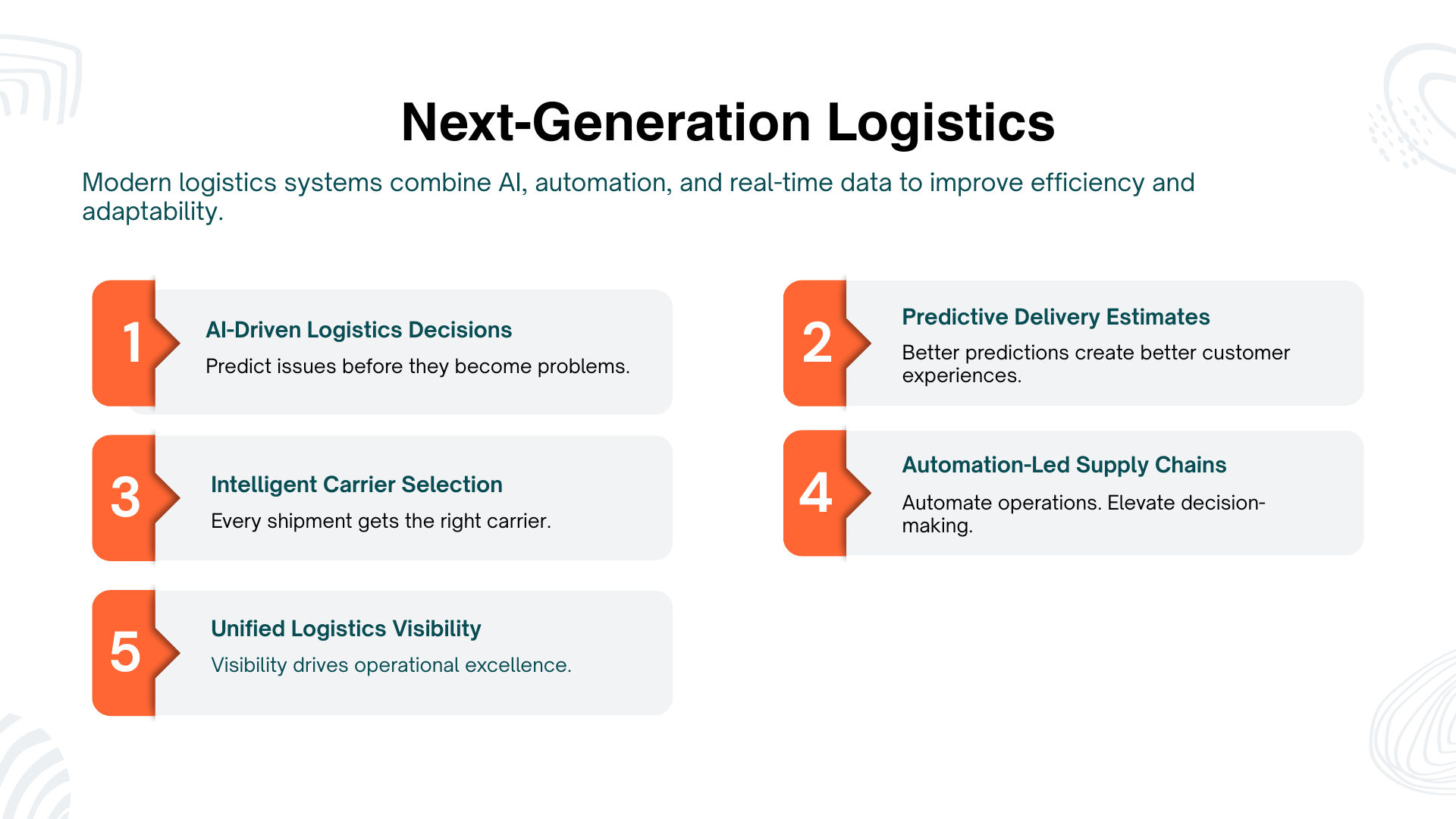
Logistics transformation is no longer limited to automation alone. The next generation of logistics technology is focused on intelligence, adaptability, and predictive decision-making.
AI-Driven Logistics Decisions
Artificial intelligence is helping businesses optimize carrier selection, forecast shipping demand, and identify operational inefficiencies before they impact performance.
Predictive Delivery Estimates
Instead of relying solely on historical transit times, future logistics systems will use real-time data to provide more accurate delivery predictions.
Intelligent Carrier Selection
Advanced algorithms can continuously evaluate carrier performance and automatically select the best delivery partner for each shipment.
Automation-Led Supply Chains
Supply chains are evolving from reactive operations into proactive ecosystems where automation handles routine tasks while teams focus on strategic planning.
Unified Logistics Visibility
Future logistics operations will require complete visibility across fulfillment, transportation, delivery, and returns. Organizations that centralize logistics data will gain significant operational advantages.
The goal is not simply to automate existing processes. It is to create flexible logistics systems that can adapt to changing customer expectations, market conditions, and business requirements.
From Automation to Complete Logistics Orchestration
As businesses scale, shipping automation delivers the greatest value when it becomes part of a broader logistics ecosystem.
Instead of managing carriers, tracking systems, returns processes, delivery exceptions, and reporting tools separately, organizations are increasingly adopting unified logistics platforms that bring these capabilities together within a single environment.
For example, platforms such as eShipz combine shipping automation, multi-carrier management, real-time tracking, delivery intelligence, returns management, and logistics analytics in one platform. This allows businesses to build a future-ready logistics stack without disrupting existing carrier relationships or operational workflows.
As logistics complexity continues to grow, organizations that invest in connected, scalable, and automation-driven ecosystems will be better positioned to improve efficiency, control costs, and deliver superior customer experiences.
Explore how a unified logistics automation platform can help you streamline shipping operations, improve visibility, and scale logistics with confidence.