






In today’s highly competitive online retail environment, Fake delivery attempts in eCommerce have become a growing concern for brands, logistics providers, and customers alike. A fake delivery attempt occurs when a shipment is marked as “delivery attempted,” “customer unavailable,” or “door locked” without the delivery executive actually making a genuine effort to deliver the package.
These incidents can happen for several reasons, including excessive delivery workloads, unrealistic route targets, operational inefficiencies, address-related challenges, or communication breakdowns between customers and delivery partners. As eCommerce volumes continue to rise, last-mile delivery networks often face pressure to maintain delivery metrics, which can sometimes lead to inaccurate delivery status updates.
The consequences extend far beyond a single missed delivery. Customers experience frustration and lose trust in the brand. Sellers face higher Return-to-Origin (RTO) costs and lost revenue. Logistics providers deal with increased operational complexity and customer complaints.
According to an analysis cited by Money Control, failed deliveries and Return-to-Origin (RTO) shipments can result in revenue losses of 25-30% for digital-first brands during peak sales periods, highlighting the financial impact of delivery failures on eCommerce businesses.
As eCommerce businesses focus on improving delivery success rates and reducing operational costs, identifying and addressing fake delivery attempts has become a critical part of modern logistics management.
Recent Market Trends: Why Fake Delivery Attempts Are Under Greater Scrutiny
The rapid growth of D2C brands, quick commerce, and Cash-on-Delivery (COD) orders has increased pressure on last-mile delivery operations. At the same time, customers now expect real-time tracking, proactive communication, and transparent delivery experiences.
Many businesses are investing in advanced delivery monitoring systems, GPS-based validation, automated notifications, and Non-Delivery Report (NDR) management solutions to improve accountability. Industry discussions also indicate that delivery exceptions marked as “customer unavailable” continue to be a major contributor to avoidable RTOs and customer dissatisfaction.
As a result, brands are increasingly analyzing delivery data to identify suspicious delivery patterns and improve first-attempt delivery success.
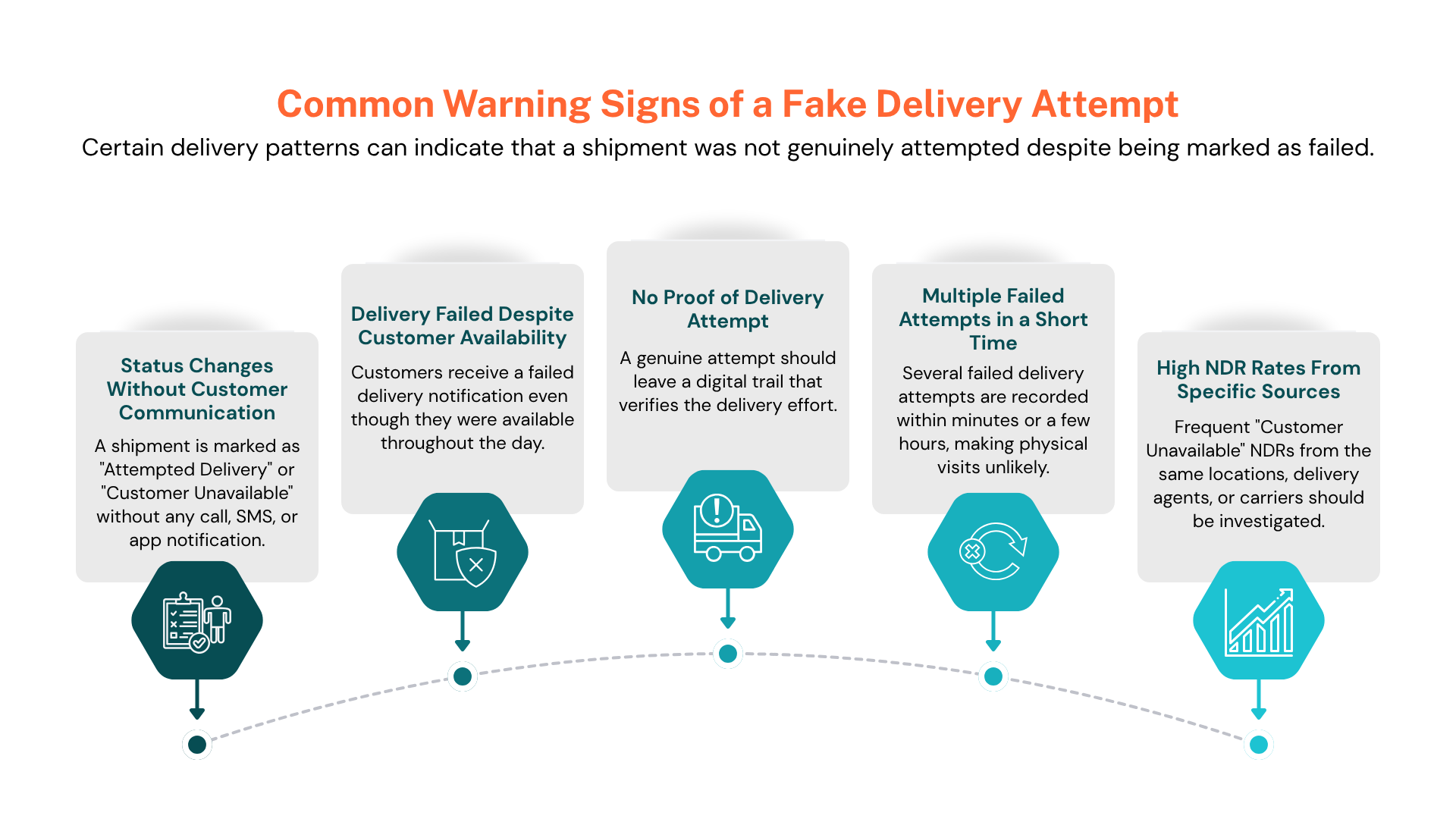
Common Warning Signs of a Fake Delivery Attempt
Fake delivery attempts are not always easy to detect. However, certain patterns can indicate that a delivery was not genuinely attempted.
Delivery Status Changes Without Customer Communication
One of the most common indicators is when a shipment suddenly changes to “Attempted Delivery” or “Customer Unavailable” without any prior communication.
In a legitimate delivery attempt, customers often receive a call, SMS, or app notification from the delivery executive.
Customers Receive “Delivery Failed” Notifications Despite Being Available
Customers frequently report being at home throughout the day only to receive a notification stating that delivery could not be completed.
Scenario Example:
A customer stays home all day waiting for a package. Later in the evening, they receive a tracking update saying “Customer Unavailable.” However, they never received a call, text message, or visit from the delivery agent.
This discrepancy should immediately raise concerns.
No Call, SMS, or Proof of Delivery Attempt
A genuine delivery attempt generally leaves a trace in the form of:
- Call records
- SMS notifications
- GPS logs
- Delivery photographs
- Electronic proof of attempt
When none of these exist, the authenticity of the delivery attempt becomes questionable.
Multiple Failed Attempts Within a Short Time
Another warning sign is when several delivery attempts are recorded within a few hours or even minutes.
In many cases, physically visiting multiple customer locations within such a short timeframe may not be possible, indicating potential process issues.
Frequent NDRs From Specific Locations or Carriers
If certain regions, delivery executives, or courier partners consistently generate high volumes of “customer unavailable” NDRs, businesses should investigate further.
Tracking such patterns helps identify recurring operational issues before they affect customer experience at scale.
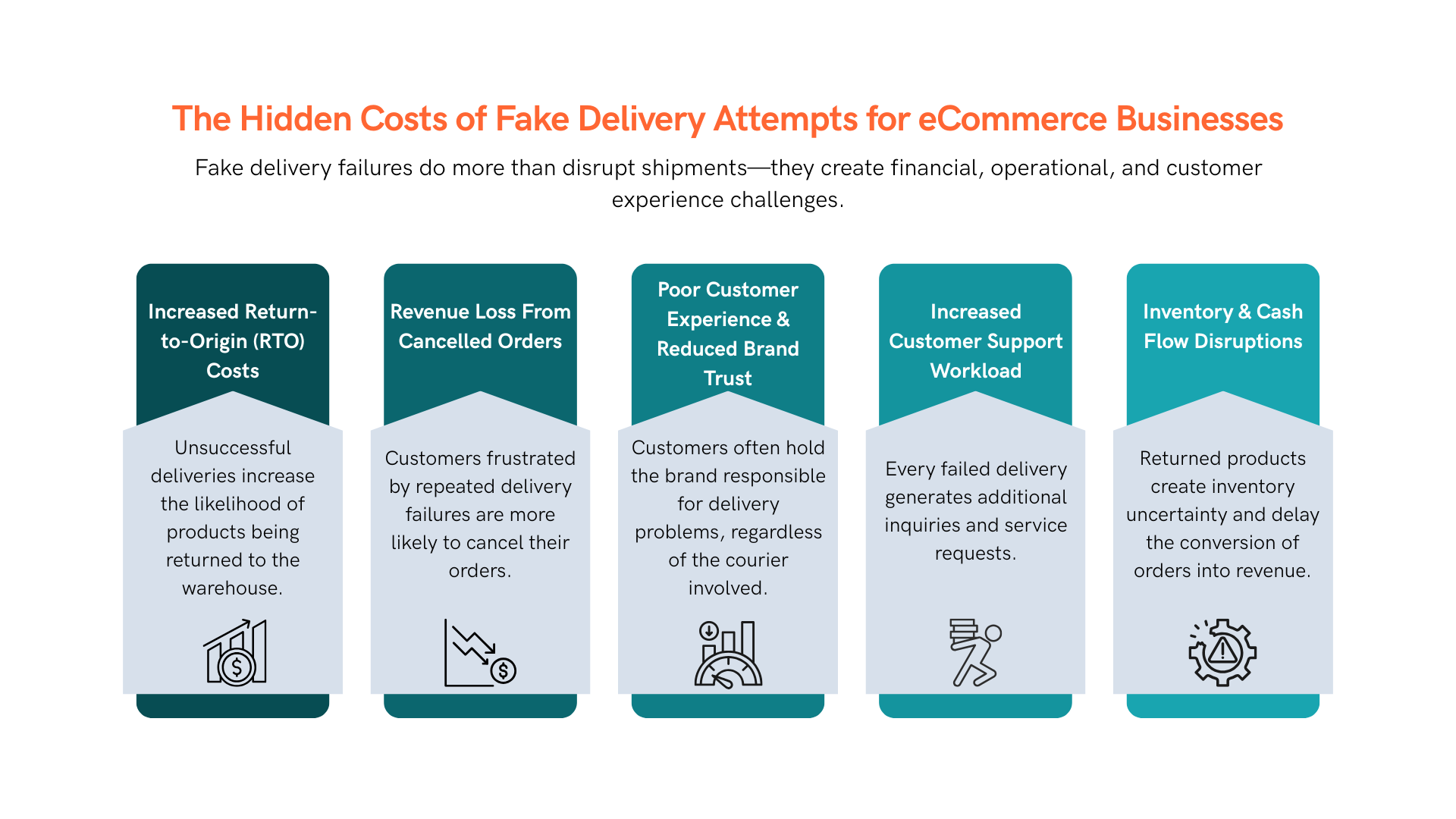
The Hidden Costs of Fake Delivery Attempts for eCommerce Businesses
Many businesses underestimate the financial impact of delivery failures until they begin affecting profitability.
Increased Return-to-Origin (RTO) Costs
Every unsuccessful delivery increases the likelihood of an order being returned to the warehouse.
Businesses must bear:
- Forward shipping costs
- Reverse logistics costs
- Additional handling expenses
- Repackaging costs
Industry reports suggest that avoidable delivery failures are among the leading contributors to rising RTO rates in eCommerce.
Revenue Loss From Cancelled Orders
Customers who experience repeated failed delivery attempts often cancel their orders altogether.
This results in:
- Lost sales
- Wasted marketing spend
- Reduced customer lifetime value
Poor Customer Experience and Reduced Brand Trust
Customers typically blame the brand rather than the courier partner.
Repeated delivery issues can lead to:
- Negative reviews
- Social media complaints
- Lower repeat purchase rates
- Increased customer churn
Increased Customer Support Workload
Every failed delivery generates additional customer service interactions.
Support teams spend valuable time handling:
- Delivery inquiries
- Rescheduling requests
- Refund discussions
- Escalation management
Inventory and Cash Flow Disruptions
Returned products create inventory uncertainty and delay revenue realization.
Scenario Example:
A COD order is falsely marked as undelivered. The shipment enters the return cycle and eventually reaches the warehouse. The business absorbs reverse logistics costs, loses the sale, and ties up inventory that could have been sold elsewhere.
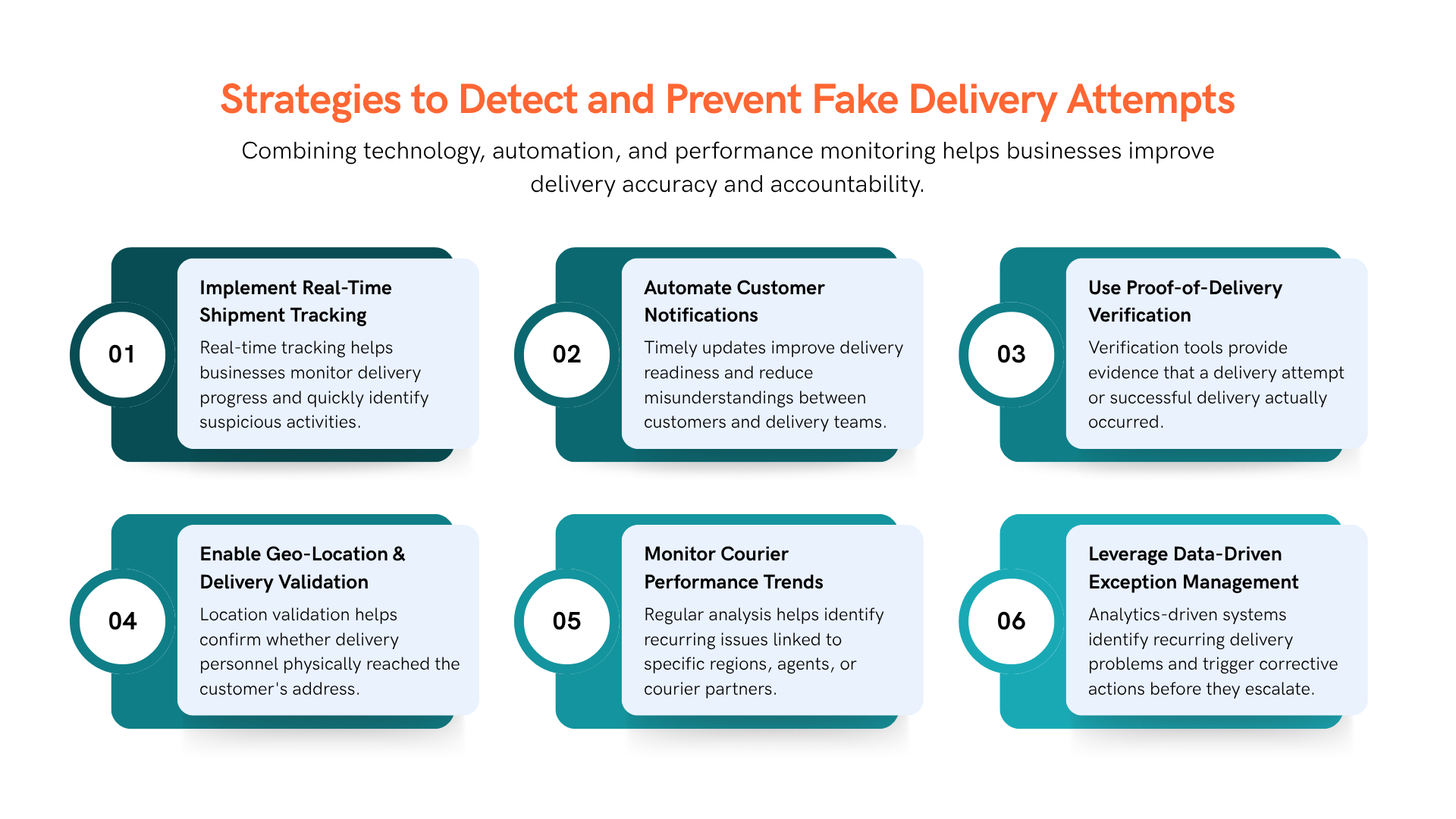
Strategies to Detect and Prevent Fake Delivery Attempts
Reducing fake delivery attempts requires a combination of technology, process controls, and performance monitoring.
Implement Real-Time Shipment Tracking
Real-time visibility allows businesses to monitor delivery progress and identify unusual activity.
Advanced tracking systems help detect:
- Delayed deliveries
- Unusual route deviations
- Suspicious delivery attempt patterns
Automate Customer Notifications
Proactive communication reduces misunderstandings and improves delivery readiness.
Businesses should send:
- Order dispatch notifications
- Out-for-delivery alerts
- Estimated delivery windows
- Delivery confirmation messages
Use Proof-of-Delivery Verification
Proof-of-delivery mechanisms create accountability.
Examples include:
- OTP verification
- Delivery photographs
- Digital signatures
- Time-stamped delivery records
Enable Geo-Location and Delivery Validation
GPS-based validation can verify whether the delivery executive actually visited the customer’s location.
Scenario Example:
If a delivery attempt is recorded but GPS data shows that the delivery executive never reached the customer’s address, the shipment can be automatically flagged for investigation.
Monitor Courier Performance Trends
Businesses should regularly analyze carrier performance data to identify:
- High NDR rates
- Repeated customer complaints
- Frequent delivery failures by specific regions or agents
Performance benchmarking helps improve courier accountability.
Leverage Data-Driven Exception Management
Modern logistics teams increasingly use analytics to identify recurring delivery issues before they escalate.
Exception management systems can:
- Detect unusual delivery patterns
- Trigger automated investigations
- Escalate suspicious delivery attempts
- Improve delivery success rates over time
Using Intelligent NDR Management to Reduce Fake Delivery Attempts and Improve Delivery Success
Many fake delivery attempts eventually appear as NDRs and, if left unresolved, progress into costly RTOs.
This makes NDR management one of the most effective tools for reducing delivery failures.
When delivery exceptions occur, businesses need immediate visibility into the reason behind the failure. Automated follow-ups can help verify whether customers were genuinely unavailable, whether delivery information was incorrect, or whether the delivery attempt itself requires further investigation.
An effective NDR management process typically includes:
- Automated customer outreach
- Delivery intent confirmation
- Rescheduling options
- Address verification
- Escalation workflows
- Exception tracking and reporting
Modern logistics platforms increasingly use AI-driven workflows, automated customer communication, and advanced analytics to identify recurring delivery issues and improve first-attempt delivery rates.
When delivery failures become difficult to manage manually, businesses need a structured NDR management process. Solutions such as NDR Management platform help brands automatically identify failed deliveries, engage customers through multiple communication channels, capture delivery intent, and reduce Return-to-Origin rates through automated recovery workflows. This not only improves delivery success but also provides visibility into recurring delivery issues that may indicate fake delivery attempts.
Every failed delivery does not have to become an RTO. With automated NDR management, customer communication workflows, and delivery exception analytics, businesses can recover more shipments, improve customer satisfaction, and gain better control over their logistics operations. Explore how eShipz‘s NDR Management solution helps brands proactively address delivery failures and reduce revenue leakage.

Conclusion
Fake delivery attempts are more than just a logistics inconvenience. They directly impact customer trust, operational efficiency, and profitability. As eCommerce businesses continue to scale, relying on manual processes is no longer sufficient to identify and address delivery exceptions.
By combining real-time tracking, proof-of-delivery validation, automated customer communication, courier performance monitoring, and intelligent NDR management, businesses can significantly reduce delivery failures and improve delivery success rates.
The key is to identify warning signs early, act on delivery exceptions quickly, and create a transparent last-mile delivery experience that benefits customers, brands, and logistics partners alike.
Ready to reduce RTOs and improve delivery success? Explore eShipz’s NDR Management solution and transform delivery failures into successful customer experiences.