




You spend money acquiring a customer, process the order, pay for shipping, and then watch the package come back to your warehouse. Sound familiar?
If you’re dealing with a high return-to-origin rate in 2026, you’re not alone. Return-to-Origin (RTO) continues to be one of the biggest profit killers for ecommerce businesses, especially in markets where Cash on Delivery (COD) remains a preferred payment method. From failed delivery attempts and address issues to courier inefficiencies and customer behavior, several factors can quietly drive up RTO rates and erode profitability.
The challenge has become even more significant as ecommerce brands face rising logistics costs, growing customer expectations, and expanding demand from Tier-2 and Tier-3 cities. According to industry reports, return-to-origin shipments have become one of the biggest margin challenges for ecommerce businesses, with many brands actively investing in automation and delivery intelligence to reduce losses.
In this guide, we’ll break down the most common reasons behind high RTO rates, explain why traditional prevention methods are becoming less effective, and explore practical strategies brands are using to improve delivery success in 2026.
What Is Return-to-Origin (RTO) and Why Does It Matter?
Return-to-Origin (RTO) occurs when a shipment cannot be delivered to the customer and is returned to the seller’s warehouse. Unlike customer-initiated returns, where the buyer receives the product and chooses to send it back, an RTO means the order never successfully reaches the customer.
For ecommerce businesses, every RTO order represents a double loss:
- Forward shipping costs are already incurred
- Reverse logistics costs must also be paid
- Revenue is never realized
- Inventory remains tied up for longer periods
The Hidden Costs of RTO
Many brands focus only on shipping charges when calculating RTO impact. However, the actual cost extends much further:
- Double shipping charges for forward and reverse movement
- Inventory blockage that delays resale opportunities
- Reduced profit margins due to additional operational costs
- Lower courier performance scores caused by repeated delivery failures
- Increased customer acquisition waste when marketing spend fails to convert into completed orders
Industry estimates suggest that a failed delivery can cost businesses anywhere from ₹180 to ₹400 when logistics and processing expenses are combined.
Most importantly, a high return-to-origin rate is rarely caused by a single issue. It is usually a symptom of multiple operational gaps across order verification, courier performance, customer communication, and delivery management.
Recent Market Trends: Why RTO Reduction Is a Priority in 2026
The ecommerce landscape has changed significantly over the past few years.
Tier-2 and Tier-3 cities now contribute a substantial share of new ecommerce orders, creating tremendous growth opportunities while introducing new delivery challenges. At the same time, COD continues to account for a significant portion of ecommerce transactions, making delivery success a critical profitability metric.
Several trends are shaping RTO management in 2026:
- Increased focus on delivery intelligence and automation
- Greater use of AI-powered order verification
- Real-time Non-Delivery Report (NDR) management
- Data-driven courier allocation
- Proactive customer engagement before delivery attempts
Brands that treat RTO prevention as a strategic initiative rather than a logistics problem are consistently outperforming competitors.
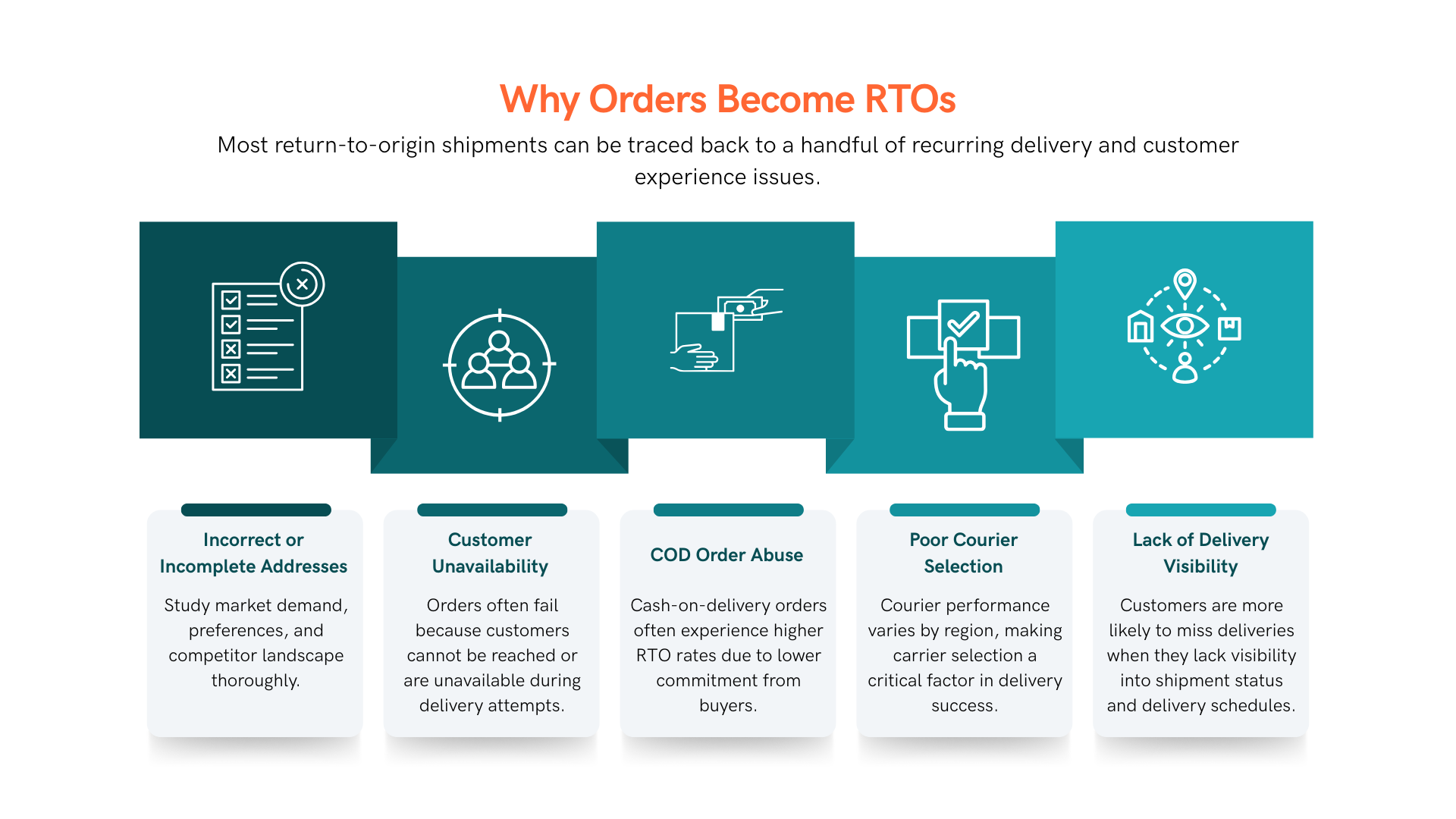
The 5 Most Common Reasons Behind a High Return-to-Origin Rate
Incorrect or Incomplete Addresses
One of the most common causes of delivery failure remains poor address quality.
Customers often enter:
- Incorrect house or apartment numbers
- Missing landmarks
- Wrong PIN codes
- Incomplete locality details
Even minor inaccuracies can create significant delivery delays, especially in regions where address standardization is limited.
Without proper address validation before shipment creation, these orders are more likely to result in failed delivery attempts and eventual RTOs.
Customer Unavailability
Many deliveries fail simply because customers are unavailable when the courier arrives.
Common scenarios include:
- Customers being at work during delivery hours
- Unreachable phone numbers
- Temporary travel or relocation
- Missed delivery calls
When communication breaks down, courier partners often have limited opportunities to complete the delivery successfully.
COD Order Abuse
COD remains a major contributor to RTO challenges.
Because customers do not make an upfront payment, some orders are placed with low purchase intent. Common issues include:
- Impulse purchases
- Fake orders
- Multiple orders for comparison shopping
- Order cancellations after dispatch
- Delivery refusals
Industry data consistently shows that COD orders experience significantly higher RTO rates than prepaid orders.
Poor Courier Selection
Not every courier performs equally well across every region.
A courier that performs exceptionally in metropolitan areas may struggle in specific Tier-2 or Tier-3 locations.
For example, a fashion brand may experience elevated RTO rates in certain PIN codes because the selected courier partner has lower delivery success in those areas.
Using the same carrier across all locations without analyzing regional performance often leads to unnecessary delivery failures.
Lack of Delivery Visibility
Customers increasingly expect real-time shipment updates.
When buyers do not know:
- When the order will arrive
- Whether delivery is delayed
- If a delivery attempt has been scheduled
they are more likely to miss delivery attempts or lose interest in the purchase.
Insufficient communication often transforms otherwise successful deliveries into preventable RTOs.
Why Traditional RTO Reduction Tactics No Longer Work in 2026
Many ecommerce businesses still rely on methods that worked years ago but struggle to scale today.
Manual Confirmation Calls
Calling every customer before dispatch may have worked when order volumes were low. Today, growing shipment volumes make manual verification expensive and inconsistent.
Spreadsheet-Based Courier Tracking
Tracking courier performance through spreadsheets creates delayed insights and limits the ability to respond quickly to delivery issues.
Reactive Customer Support
Waiting until a customer reports a problem often means the shipment has already entered the RTO cycle.
Single Courier Dependency
Relying on one carrier for every shipment ignores performance differences across regions and serviceability zones.
As ecommerce operations become more complex, brands need:
- Automated shipment monitoring
- Intelligent courier allocation
- Real-time exception management
- Automated customer engagement workflows
Manual processes simply cannot keep pace with modern delivery networks.

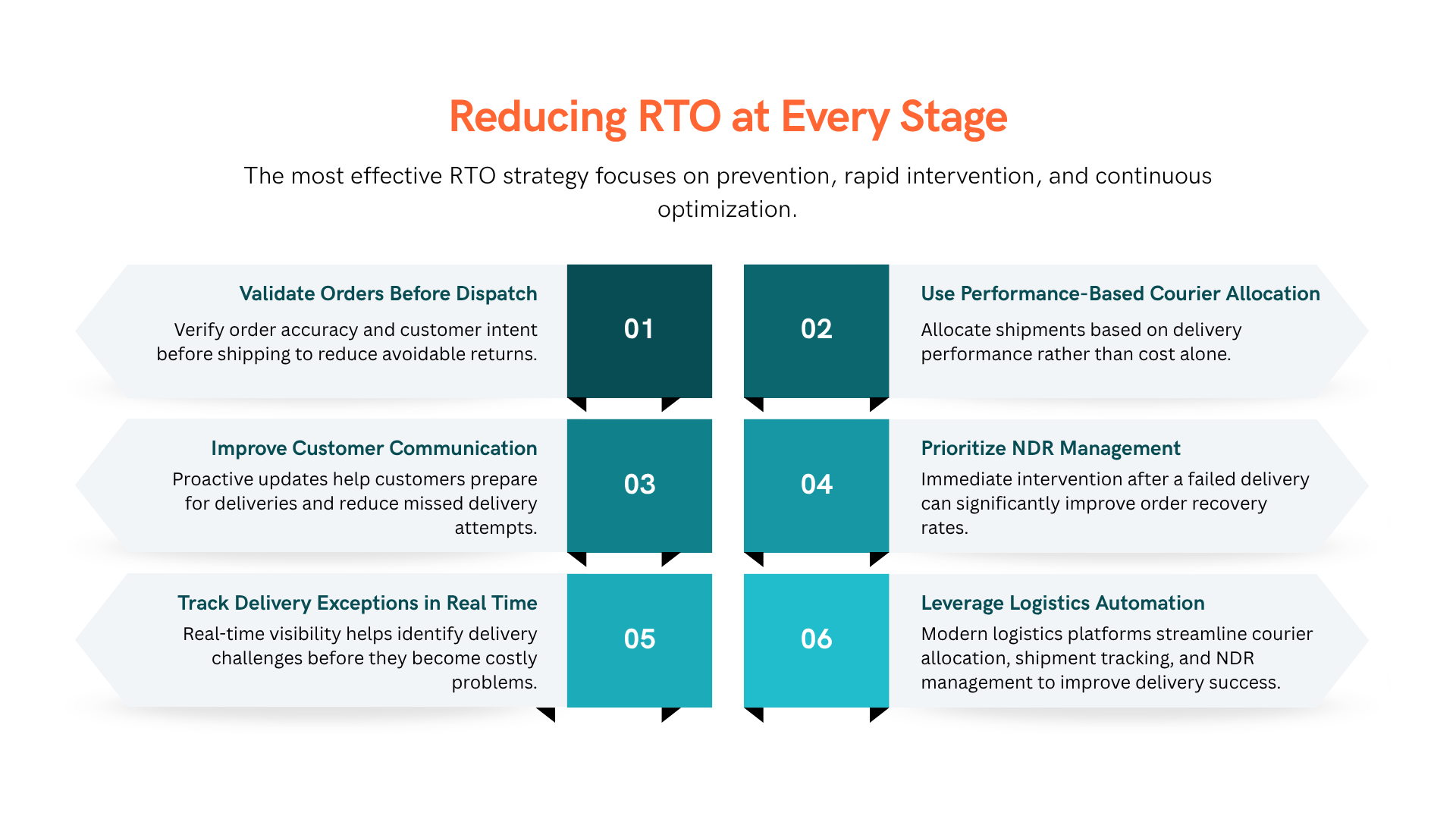
How to Fix High RTO Rates: Practical Strategies That Deliver Results
Validate Orders Before Dispatch
The best RTO is the one that never happens.
Brands should implement:
- Address verification systems
- PIN code validation
- COD confirmation workflows
- Fraud detection mechanisms
- Customer intent verification
Early validation helps eliminate low-quality orders before shipping costs are incurred.
Use Performance-Based Courier Allocation
Instead of assigning shipments based solely on price, evaluate courier performance by:
- Delivery success rate
- Region-specific reliability
- Historical RTO trends
- NDR resolution efficiency
Avoid repeatedly using carriers that consistently underperform in specific locations.
Improve Customer Communication
Proactive communication significantly improves delivery success.
Best practices include:
- Automated WhatsApp notifications
- SMS updates
- Email alerts
- Delivery reminders before arrival
Keeping customers informed reduces missed delivery attempts and improves engagement.
Prioritize NDR Management
When a delivery attempt fails, immediate action is critical.
Effective NDR management includes:
- Rapid customer outreach
- Address correction workflows
- Rescheduling delivery attempts
- Courier coordination
The sooner brands intervene, the greater the chance of recovering the order before it becomes an RTO.
Track Delivery Exceptions in Real Time
Real-time visibility allows brands to identify patterns before they become costly problems.
Monitor:
- Failed delivery reasons
- High-risk PIN codes
- Courier performance issues
- Customer availability trends
Modern logistics platforms help automate courier allocation, shipment visibility, and NDR workflows, reducing manual intervention while improving delivery success rates.
Turning Failed Deliveries into Successful Deliveries Before They Become RTOs
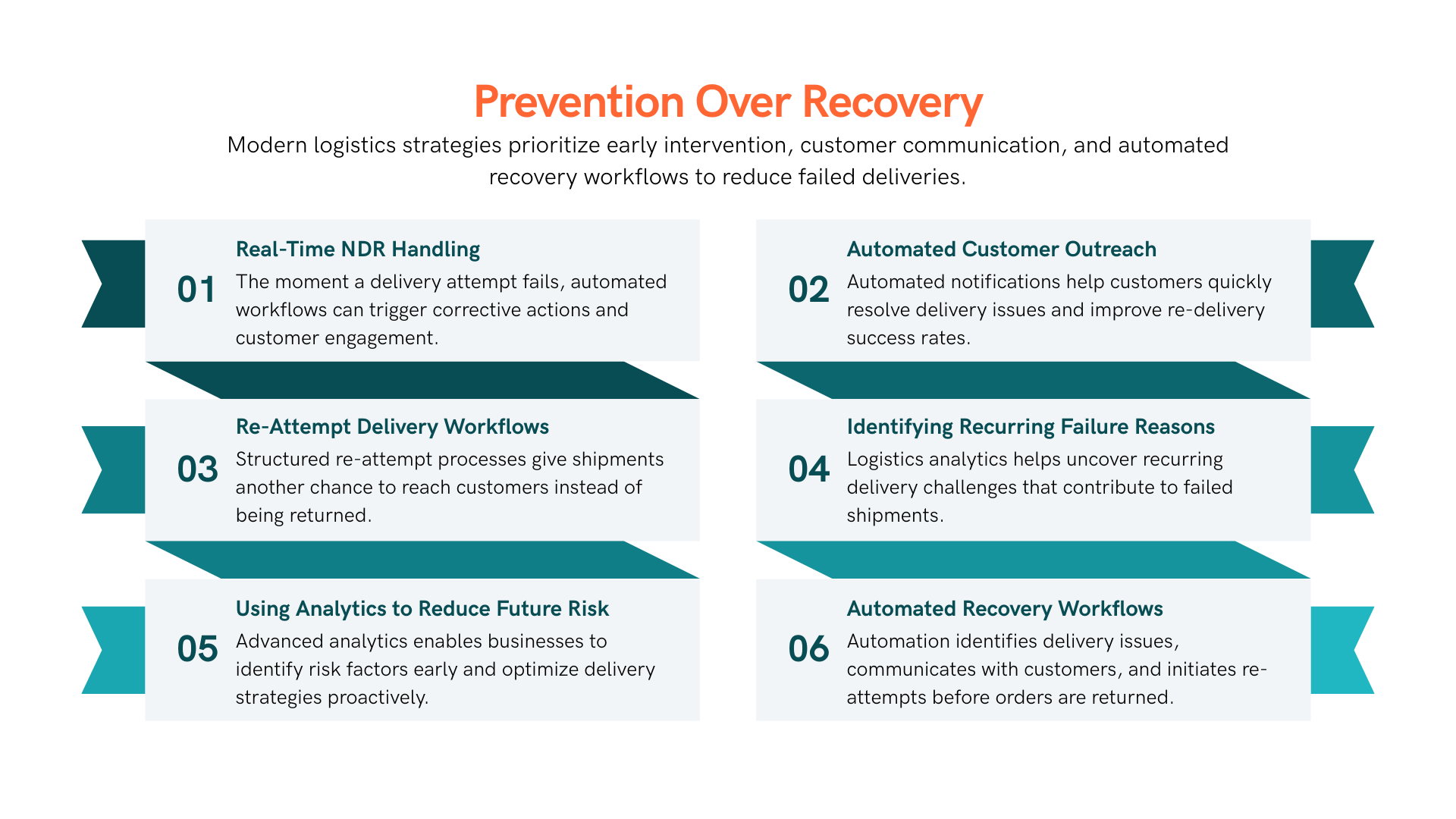
The most successful ecommerce brands in 2026 focus on prevention rather than recovery.
Instead of accepting failed deliveries as inevitable, they use technology to intervene before orders enter the return cycle.
Real-Time NDR Handling
The moment a delivery attempt fails, automated workflows can trigger customer communication and corrective actions.
Automated Customer Outreach
Customers can instantly receive:
- Delivery failure notifications
- Rescheduling options
- Address update requests
- Confirmation messages
This reduces delays and improves the likelihood of successful re-delivery.
Re-Attempt Delivery Workflows
Not every failed delivery should immediately proceed to RTO status.
Structured re-attempt workflows can recover a significant percentage of failed shipments before they are returned.
Identifying Recurring Failure Reasons
Analytics can reveal recurring patterns such as:
- Frequently failing PIN codes
- High-risk customer segments
- Specific courier weaknesses
- Product categories with elevated RTO rates
Using Analytics to Reduce Future Risk
Advanced logistics intelligence enables brands to proactively identify risk factors and optimize delivery strategies before problems occur.
Instead of treating failed deliveries as inevitable losses, brands are increasingly using automated recovery workflows to identify delivery issues, communicate with customers, and trigger re-attempts before an order is returned to origin.
Conclusion
High RTO rates are rarely caused by a single issue. They often stem from a combination of poor address quality, courier inefficiencies, weak customer communication, and delayed exception handling.
The brands achieving lower RTO rates in 2026 are those that proactively monitor deliveries, automate NDR management, and use data to optimize carrier performance. As order volumes continue to grow and customer expectations rise, manual processes alone are no longer enough.
If you’re looking to build a more proactive delivery operation, explore how logistics automation, real-time tracking, courier intelligence, and failed delivery recovery solutions can help reduce RTOs before they impact your margins.
Explore how smarter logistics automation can help reduce RTOs and improve delivery performance – discover eShipz’s logistics automation.