





For Indian small and medium-sized enterprises, selling to customers outside the country is becoming more accessible through e-commerce websites, marketplaces, social commerce, and digital payment systems. But reaching an international customer profitably is not as simple as getting an order. Affordable International Shipping from India plays a major role in determining the final selling price, profit margin, and customer experience. According to NITI Aayog, India’s e-commerce exports were estimated at around US$4-5 billion in FY2023 and could potentially reach US$200-300 billion by 2030 under favorable conditions, highlighting the growing opportunity for MSMEs and other small businesses.
For an SME, international shipping is more than a courier expense. Freight, packaging, customs, duties, taxes, delivery delays, returns, and failed deliveries can all influence the actual cost of fulfilling an international order.
The challenge is therefore not simply finding the cheapest shipping rate. It is about creating a shipping strategy that balances cost, delivery speed, reliability, visibility, and scalability.
This guide explains what affects international shipping costs from India, how SMEs can reduce those expenses, where technology can help, and what businesses should consider before expanding into international markets.
Why Is Affordable International Shipping Essential for SMEs?
International customers can open new revenue opportunities for Indian SMEs, but logistics can quickly become one of the biggest operational expenses.
A product that is competitively priced in India may become significantly more expensive once international delivery charges are added. This can affect both the customer’s willingness to buy and the seller’s profit margin.
Here are some of the main reasons cost-effective shipping matters.
Lower overall export costs
Shipping expenses can represent a significant portion of the total cost of an international order, particularly for low-value products.
For example, a handmade product may be reasonably priced in India but become difficult to sell overseas if the delivery charge is close to or higher than the product price.
Reducing unnecessary logistics expenses helps businesses maintain a more attractive overall price.
Better profit margins
SMEs typically operate with tighter margins than large enterprises. A small increase in freight, packaging, or return costs can have a noticeable impact on profitability.
Lower logistics expenses give businesses more flexibility to maintain margins, offer promotions, or reinvest in customer acquisition and product development.
More competitive international pricing
Indian SMEs compete with sellers from different countries. International customers can easily compare product and delivery prices across multiple online stores.
Efficient international shipping from India can help businesses offer competitive landed prices without reducing the quality of their products.
Access to more international markets
High shipping costs can make some countries commercially unattractive.
When businesses have access to different shipping options, they can test new markets with smaller order volumes and identify where demand is strong before making larger investments.
Better customer experience
Customers want more than a product. They also expect reasonable shipping costs, accurate delivery estimates, tracking, and clear information about duties and taxes.
Reliable international delivery services can reduce uncertainty and help create a better post-purchase experience.
The hidden cost of returns
International returns deserve special attention.
A returned parcel can involve another shipping charge, customs procedures, handling fees, inventory processing, and potential losses if the product cannot be resold.
For this reason, SMEs should evaluate return costs when calculating their actual shipping expense instead of looking only at the initial delivery rate.
What Does the Market Say About International Shipping from India?
From Local Sellers to Global Brands: The Rise of Cross-Border E-commerce
India’s e-commerce export opportunity is expanding as more consumers purchase products from overseas sellers and more Indian businesses use digital channels to reach international customers.
NITI Aayog estimates that India’s e-commerce exports could grow to US$200-300 billion by 2030 under favorable conditions. The report also highlights the role of India’s approximately 63 million MSMEs, which contribute significantly to the country’s economy and exports.
This creates a significant opportunity for small businesses selling products such as:
- Fashion and apparel
- Handicrafts
- Jewellery and accessories
- Beauty and personal care
- Home décor
- Food and specialty products
- Consumer goods
- Industrial products and components
Digital marketplaces and D2C websites have reduced some of the barriers to finding overseas customers. However, logistics remains a critical part of the equation.
Technology is changing SME logistics
Traditional shipping management often involved manually checking rates, preparing documents, generating labels, tracking parcels, and contacting carriers.
Technology has changed this model.
Modern logistics systems can help businesses manage:
- Multiple courier partners
- Rate comparison
- Shipping labels
- Shipment tracking
- Documentation
- Delivery notifications
- Returns
- Shipping analytics
This is particularly useful for SMEs because they can access logistics capabilities without building a large internal operations team.
Government support is also evolving
India’s export ecosystem is increasingly focused on making international trade more accessible to smaller businesses.
Initiatives around e-commerce exports and E-Commerce Export Hubs are intended to bring together services such as logistics, packaging, warehousing, customs processing, and other export-related support.
For SMEs, this can reduce some of the operational complexity involved in moving from domestic sales to international markets.
What Makes International Shipping Affordable for SMEs?
There is no universal cheapest shipping method.
The right option depends on the product, package size, destination, delivery expectations, shipment volume, and total landed cost.
Here are the major factors businesses should evaluate.
Package weight and dimensions
Both actual and volumetric weight can affect shipping prices.
A lightweight product packed inside a large box may be charged based on its dimensional size rather than its actual weight.
This makes packaging optimization an important part of cost control.
Destination country
Shipping costs vary significantly between countries.
Factors such as distance, carrier availability, customs requirements, delivery infrastructure, and remote-area surcharges can influence the final cost.
A shipping strategy that works well for the UAE may not necessarily be the most efficient option for Europe or North America.
Shipping speed
Shipping services can generally be divided into economy, standard, and express options.
- Economy shipping is generally suitable when cost is more important than speed.
- Standard shipping offers a balance between price and delivery time.
- Express international shipping is appropriate when customers require faster delivery or when the product is time-sensitive or high-value.
Using express delivery for every order may unnecessarily reduce margins.
Shipment volume
Businesses with consistent shipment volumes may have more opportunities to negotiate better rates.
An SME shipping ten parcels a month will have different logistics requirements from a business shipping several hundred parcels.
As volumes increase, businesses can review their carrier agreements and identify opportunities for better pricing.
Consolidated shipping
For some businesses, combining shipments can improve logistics efficiency.
Consolidation may be useful when multiple orders are travelling to the same destination or region and delivery urgency is relatively low.
However, businesses should consider additional handling, storage, customs, and delivery requirements before choosing this approach.
Customs duties and taxes
International freight is only one part of the total cost.
Depending on the destination and product, businesses may also need to account for:
- Import duties
- Taxes
- Customs-related fees
- Brokerage charges
- Documentation requirements
A low freight rate does not necessarily mean a low total shipping cost.
Packaging
Packaging should protect the product without unnecessarily increasing its weight or dimensions.
Businesses can reduce costs by reviewing box sizes, removing excess material, and creating standard packaging formats for commonly shipped products.
Carrier and logistics partner
The right carrier should be selected based on more than price.
SMEs should compare:
- Destination coverage
- Delivery timelines
- Pricing
- Tracking capabilities
- Customs support
- Pickup options
- Claims management
- Return handling
- Service reliability
Total landed cost
A better way to compare shipping options is to calculate the total landed cost.
This can include:
Product cost + packaging + freight + duties and taxes + handling fees + payment-related costs + potential return expenses
Looking at this complete picture helps businesses avoid choosing a shipping service that appears cheap but creates additional costs elsewhere.
For a deeper look at hidden expenses, delays, and other issues that affect cross-border logistics, see eShipz’s guide to cross-border shipping for Indian brands.
Who Benefits from Affordable International Shipping?
Cost-effective logistics can benefit almost every type of SME selling internationally, but the impact varies by business model.
| SME type | How affordable shipping helps |
| D2C brands | Makes international orders more viable and protects margins |
| Handicraft businesses | Helps Indian-made products reach overseas customers |
| Fashion brands | Improves international price competitiveness |
| Beauty brands | Makes it easier to test new countries |
| Food and specialty product businesses | Supports smaller international consignments |
| Manufacturers | Makes samples and smaller B2B orders more economical |
| First-time exporters | Reduces the financial risk of testing overseas demand |
For first-time exporters in particular, starting with small international parcel shipping volumes can help businesses understand demand, customs requirements, delivery times, and customer expectations before scaling.
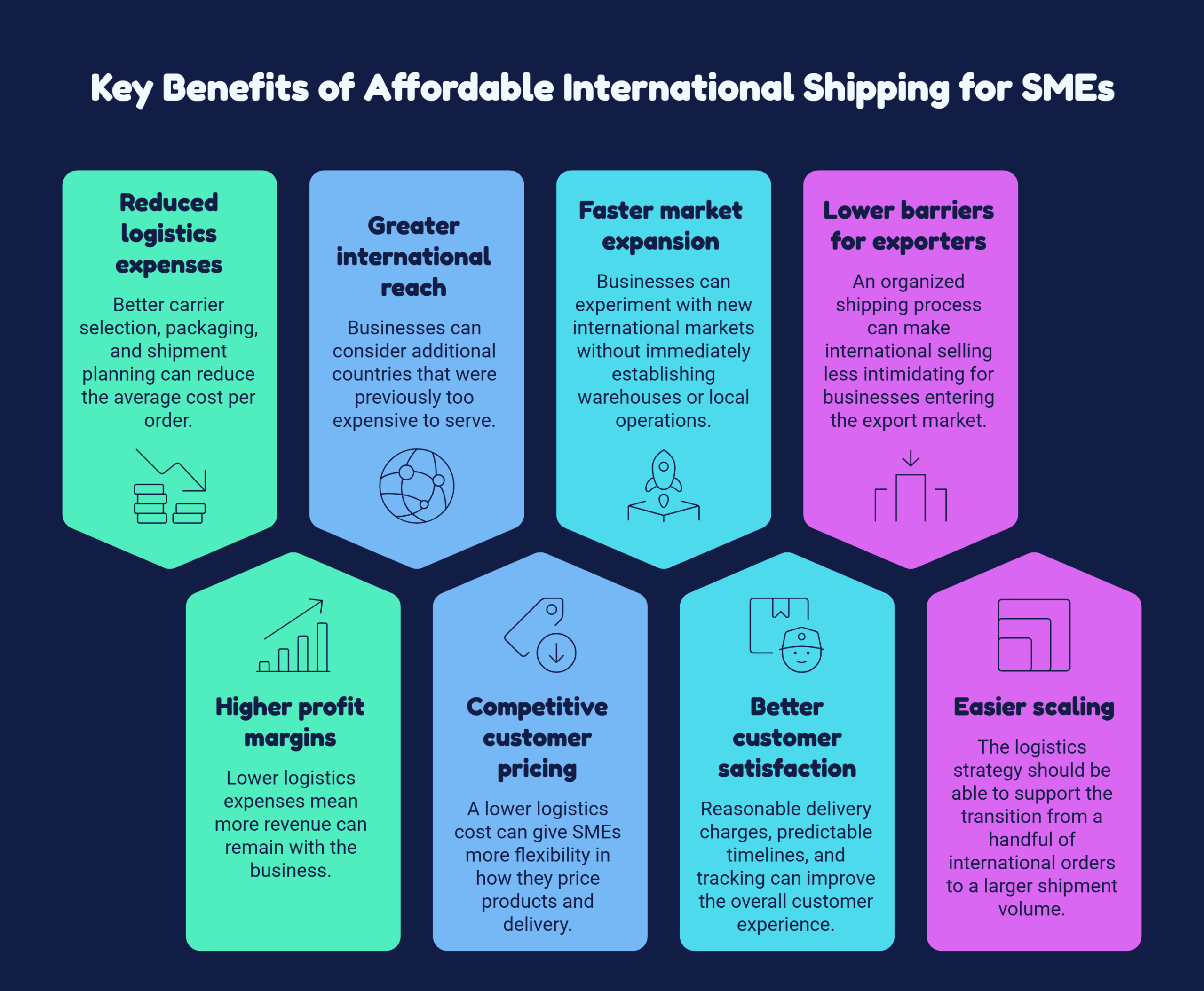
Key Benefits of Affordable International Shipping for SMEs
Reducing shipping expenses can create several business advantages beyond the immediate saving on freight.
Reduced logistics expenses
Better carrier selection, packaging, and shipment planning can reduce the average cost per order.
Higher profit margins
Lower logistics expenses mean more revenue can remain with the business.
Greater international reach
When shipping becomes more affordable, businesses can consider additional countries that were previously too expensive to serve.
Competitive customer pricing
A lower logistics cost can give SMEs more flexibility in how they price products and delivery.
Faster market expansion
Businesses can experiment with new international markets without immediately establishing warehouses or local operations.
Better customer satisfaction
Reasonable delivery charges, predictable timelines, and tracking can improve the overall customer experience.
Lower barriers for first-time exporters
An organized shipping process can make international selling less intimidating for businesses entering the export market for the first time.
Easier scaling
The logistics strategy should be able to support the transition from a handful of international orders to a larger shipment volume.
How SMEs Can Reduce International Shipping Costs
Reducing shipping costs requires a combination of operational discipline, carrier selection, packaging optimization, and technology.
Compare multiple carriers
Do not automatically assign every shipment to one courier.
Different carriers may perform differently based on destination, package size, service level, and delivery requirements.
A multi-carrier approach can give SMEs greater flexibility.
Choose shipping speed according to customer needs
If the customer does not require a parcel within a few days, an economy or standard service may be more appropriate.
Reserve express shipping for urgent orders, premium products, samples, or customers who are willing to pay for speed.
Optimize packaging
Packaging is one of the easiest areas to review.
Businesses should:
- Measure packed dimensions
- Reduce unnecessary box space
- Use lightweight materials
- Standardize packaging sizes
- Avoid oversized boxes
- Protect products without excessive filler
A small reduction in package dimensions can make a difference when volumetric weight is used.
Negotiate volume-based rates
Once shipment volume becomes predictable, businesses should review their rates.
Even a small reduction in average cost per shipment can create meaningful annual savings.
Consolidate where appropriate
Businesses shipping multiple orders to the same market can explore consolidation where delivery schedules allow it.
This can be especially useful for B2B orders, inventory transfers, or shipments where immediate delivery is not required.
Prepare accurate customs documentation
Documentation errors can result in delays, additional handling, or returned shipments.
Businesses should ensure that product descriptions, declared values, addresses, and other shipment information are accurate and consistent.
Understand duties and taxes before shipping
A customer surprised by an import charge may refuse delivery or request a return.
Businesses should understand the applicable duties and taxes for their target markets and communicate responsibility for these charges clearly.
Monitor failed deliveries and returns
The cost of an international order does not end when the parcel leaves the warehouse.
Track:
- Failed delivery rates
- Return rates
- Customs delays
- Reattempt costs
- Return-to-origin costs
- Damaged shipments
- Average delivery time
This helps identify where money is being lost.
Use logistics technology
Technology can help SMEs compare rates, automate shipping workflows, monitor carrier performance, and improve shipment visibility.
Businesses can also use shipping data to determine which carrier and service level works best for different destinations and products.
For additional ideas on controlling logistics expenses, businesses can explore these ways to reduce shipping costs for Indian D2C brands.
The Role of Technology in Making International Shipping More Affordable
Technology has become an important part of modern international logistics.
For SMEs, the biggest advantage is not simply automation. It is better decision-making.
Multi-carrier rate comparison
Businesses can compare available carriers and service levels instead of relying on one default option.
This allows them to select shipping services based on cost, delivery speed, and destination.
Automated shipping labels
Manual label creation can take time and introduce errors.
Automated label generation can make the process faster and more consistent as order volumes increase.
Digital documentation
International shipping involves several pieces of shipment information.
Digital workflows can make it easier to manage documentation and reduce repetitive data entry.
Real-time tracking
Tracking provides visibility throughout the delivery journey.
For businesses, it can help identify delays and exceptions.
For customers, it provides reassurance that the order is moving.
Shipment analytics
Shipping data can reveal important patterns.
For example, an SME may discover that:
- One carrier performs better in a particular country
- A product has unusually high volumetric weight
- A destination generates a high return rate
- Express shipping does not produce enough additional sales to justify its cost
- Certain markets have higher customs delays
These insights can help businesses continuously improve their logistics strategy.
Automated customer communication
Automated shipment updates can keep customers informed without requiring the support team to manually respond to every tracking query.
This can reduce support workload while improving the customer experience.
Inventory and fulfilment integration
As order volumes grow, connecting shipping with inventory and fulfilment systems can reduce operational duplication.
This creates a smoother workflow from order placement to final delivery.
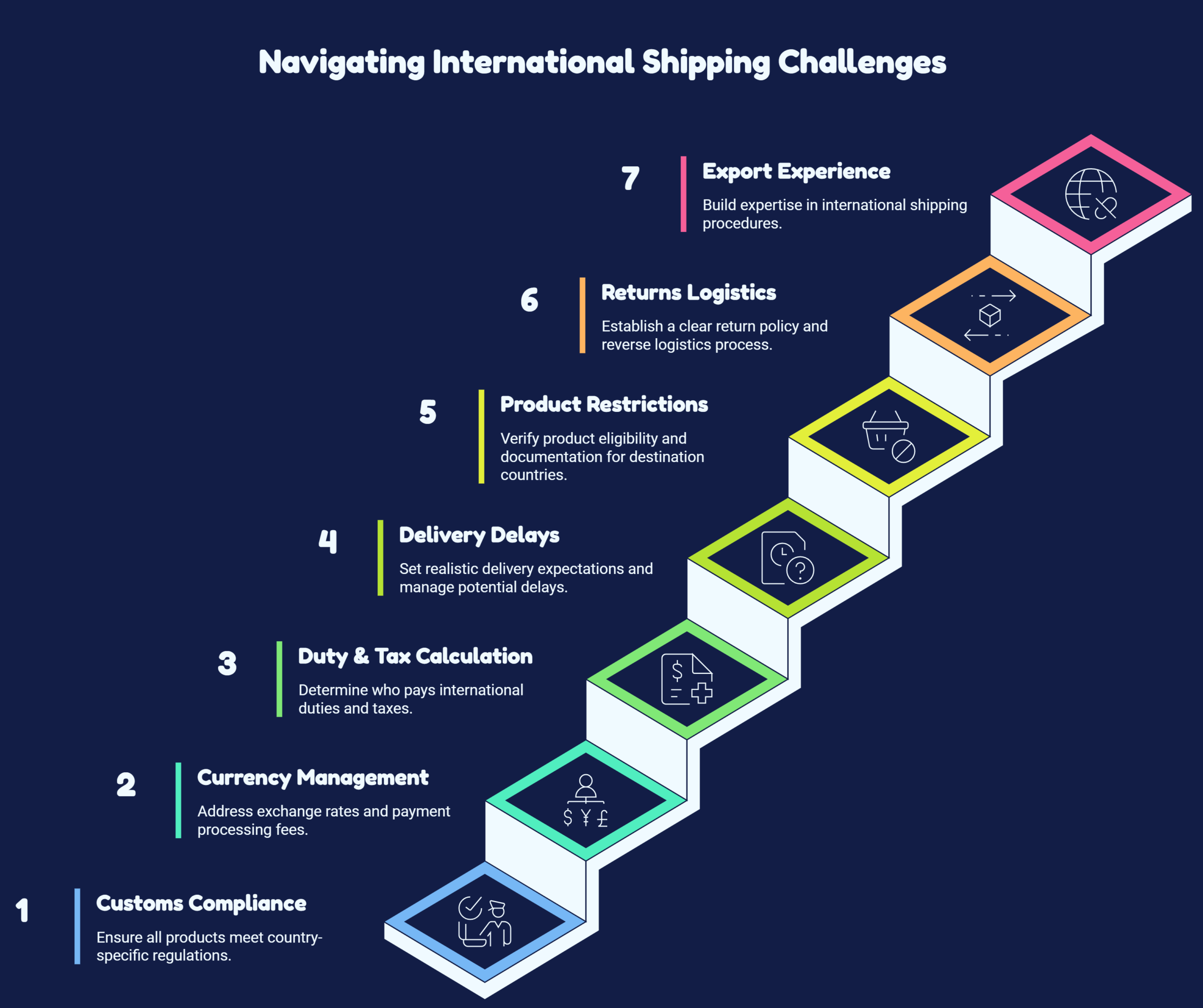
Challenges SMEs Still Need to Consider
Affordable logistics does not eliminate the complexity of international commerce.
Businesses still need to prepare for several challenges.
Customs and regulatory compliance
Different countries have different requirements for imported products.
Product classification, documentation, declarations, restricted goods, and import rules can vary by market.
Currency and payment issues
International sales can involve currency conversion, exchange-rate fluctuations, payment processing fees, and settlement timelines.
These costs should be considered when calculating the profitability of international orders.
International duties and taxes
Duties and taxes can affect the final amount paid by the customer and the overall cost of the transaction.
Businesses need a clear approach to who pays these charges.
Delivery delays
International shipments can be delayed because of customs inspections, documentation problems, weather, carrier congestion, incorrect addresses, or local delivery issues.
Businesses should set realistic delivery expectations rather than relying only on the fastest advertised transit time.
Product restrictions
Some products may be prohibited or require additional documentation in particular countries.
SMEs should verify destination-specific requirements before accepting international orders.
Returns and reverse logistics
Returns can be particularly expensive when a product has to travel back across borders.
A clear return policy and appropriate reverse-logistics process can help businesses control this cost.
Limited export experience
First-time exporters may be unfamiliar with customs procedures, shipping documents, duties, and international delivery terms.
Building the right process early can prevent small operational mistakes from becoming expensive problems.
A Practical Shipping Strategy for First-Time Exporters
SMEs do not need to start by shipping to every country.
A phased approach can reduce financial and operational risk.
Step 1: Select products carefully
Choose products that have sufficient margins and are practical to ship internationally.
Lightweight, compact products are often easier to ship cost-effectively than large or heavy products.
Step 2: Select a few target markets
Start with a small number of countries where there is clear customer demand and manageable logistics.
Step 3: Calculate the complete cost
Include product cost, packaging, freight, duties, taxes, payment costs, and potential returns.
Step 4: Compare shipping services
Evaluate economy, standard, and express services.
Do not assume that the fastest service is always the best option.
Step 5: Test with smaller shipments
Use early international orders to understand actual delivery times, customs performance, customer response, and return rates.
Step 6: Track performance
Monitor cost per shipment, successful delivery rate, delivery time, returns, and customs-related issues.
Step 7: Scale gradually
Once the business identifies profitable markets and reliable shipping patterns, it can negotiate better rates, improve packaging, automate workflows, and increase order volumes.
This approach makes Affordable International Shipping from India part of a broader growth strategy rather than simply a search for the lowest courier price.

Conclusion: Making Global Trade More Accessible to Indian SMEs
International markets offer Indian SMEs a significant opportunity to grow beyond domestic demand. E-commerce, digital marketplaces, and technology have made it easier for smaller businesses to find customers in other countries.
But international growth is only sustainable when the economics work.
Shipping costs influence product pricing, customer conversion, profit margins, and the ability to expand into new markets. Businesses therefore need to look beyond the basic courier rate and consider the complete cost of fulfilling an international order.
The most effective strategy combines appropriate shipping services, efficient packaging, accurate documentation, carrier flexibility, transparent pricing, shipment tracking, and effective returns management.
Technology can further simplify the process by helping SMEs compare options, automate repetitive tasks, monitor performance, and make data-driven logistics decisions.
India’s growing e-commerce export ecosystem and increasing focus on MSMEs also indicate that more small businesses are likely to participate in cross-border commerce in the coming years. NITI Aayog’s projection of US$200-300 billion in potential e-commerce exports by 2030 highlights the scale of this opportunity.
For Indian SMEs, Affordable International Shipping from India is not simply about finding a cheaper courier. It is about building a logistics strategy that supports profitable, reliable, and scalable global commerce.
When shipping becomes more predictable and cost-efficient, international customers become easier to serve, new markets become easier to test, and small Indian businesses can take a more confident step toward becoming global brands.
Frequently Asked Questions About International Shipping from India
- What is the most affordable way to ship internationally from India?
There is no single cheapest international shipping method for every business. Economy services may be suitable for non-urgent shipments, while standard and express services may provide better value for time-sensitive orders. SMEs should compare freight, delivery speed, duties, taxes, packaging, and potential return costs before selecting a service.
- How can Indian SMEs reduce international shipping costs?
SMEs can reduce costs by comparing multiple carriers, optimizing packaging, reducing volumetric weight, selecting the right delivery speed, negotiating rates as volumes increase, consolidating shipments where practical, and using technology to manage carrier selection and shipment data.
- What factors affect international shipping costs from India?
Important factors include package weight, dimensions, destination country, shipping mode, shipment volume, customs requirements, duties, taxes, packaging, carrier charges, and return expenses.
- Is express international shipping worth the additional cost?
It depends on the order. Express services can be useful for urgent orders, high-value products, samples, and customers who prioritize speed. For less time-sensitive products, standard or economy services may provide better cost efficiency.
- How can packaging reduce international shipping costs?
Efficient packaging can reduce both actual and volumetric weight. SMEs can use appropriately sized boxes, lightweight protective materials, and standard packaging formats to avoid paying for unnecessary space and weight.
- What should SMEs consider when choosing international delivery services?
Businesses should compare price, delivery timelines, destination coverage, customs support, tracking, reliability, return handling, claims processes, and scalability. A slightly higher shipping rate may be worthwhile if it results in fewer failed deliveries, delays, and returns.
- Can a small business start international package shipping without large export volumes?
Yes. SMEs can begin with smaller international orders and gradually expand as they learn which products and markets are commercially viable. Starting with selected destinations can help businesses control financial risk while gaining experience with customs, delivery, and customer expectations.