





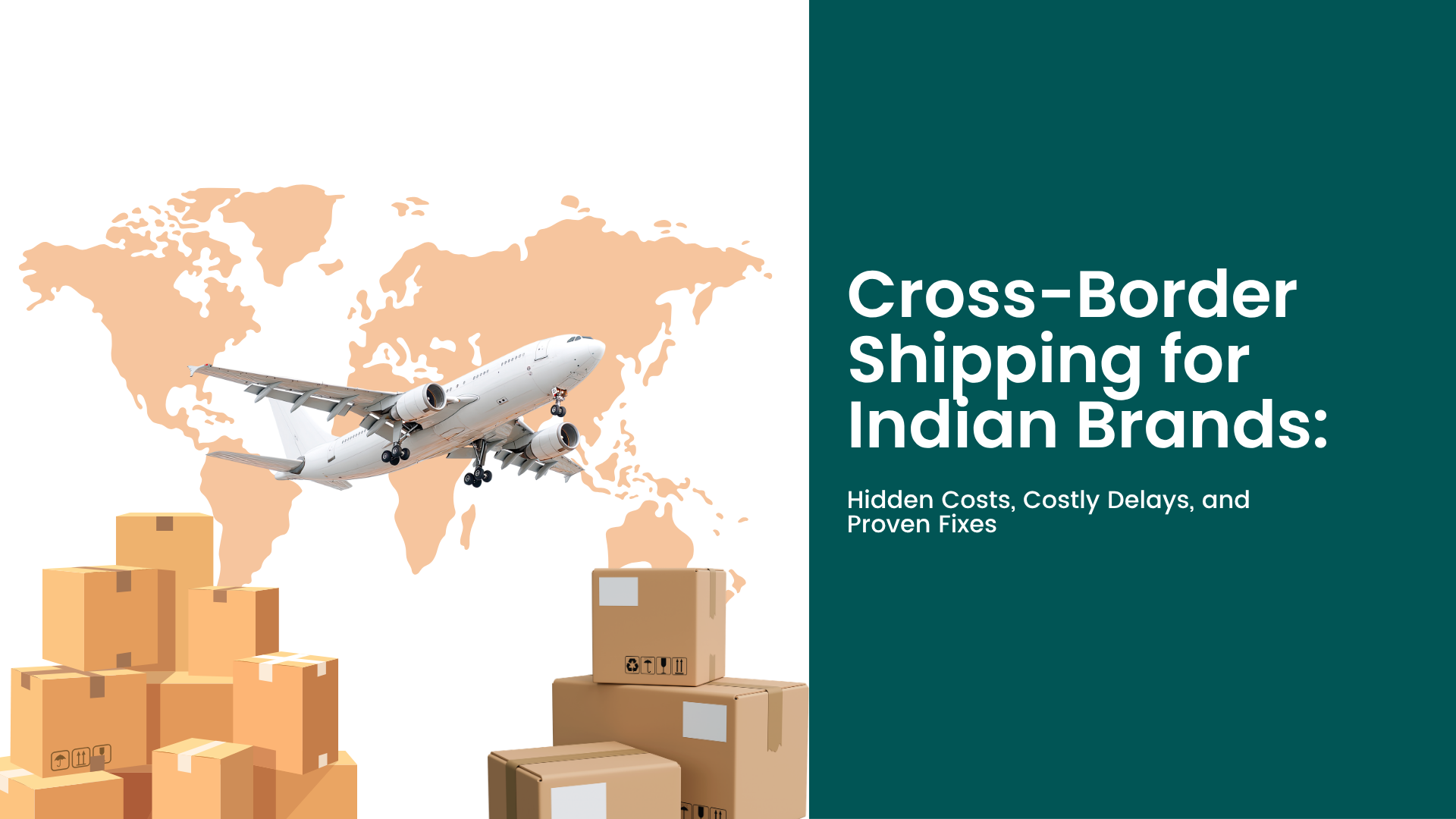
Indian brands are expanding globally faster than ever, but many underestimate the real complexity of international fulfillment. Cross-Border Shipping for Indian Brands is often viewed as a simple extension of domestic delivery, where brands only factor in courier charges and expected transit timelines. In reality, global shipping comes with multiple hidden costs that quietly reduce margins and disrupt customer experience.
A D2C skincare brand shipping to the UAE may display a shipping fee of ₹800 at checkout, assuming that is the total logistics expense. However, customs inspections, volumetric weight recalculations, currency conversion fluctuations, failed delivery reattempts, and return-to-origin charges can easily push the actual shipping cost far beyond the original estimate.
According to the International Trade Administration’s eCommerce Export Resource Center, cross-border eCommerce continues to grow as brands increasingly target overseas consumers, making logistics efficiency a critical factor for global expansion.
International shipping costs go far beyond freight charges. Indian brands frequently overlook:
- Customs duties and taxes
- Currency conversion fluctuations
- Volumetric weight charges
- Failed delivery attempts
- Return-to-origin expenses
- Packaging compliance costs
- Warehouse holding charges
- Documentation penalties
These hidden variables make cross-border logistics far more operationally sensitive than domestic shipping.
Rising Global Demand Is Increasing Logistics Complexity
The opportunity for Indian brands to sell internationally is growing, but so are shipping expectations. Customers now expect faster delivery, real-time tracking, and transparent landed costs regardless of geography.
As more Indian D2C and marketplace sellers expand into regions such as the UAE, Europe, Southeast Asia, and North America, logistics operations must become far more intelligent.
Brands can no longer rely on static courier decisions or manual documentation workflows. International customers compare shipping experiences globally, not locally. This means even smaller brands are now expected to deliver enterprise-level fulfillment experiences.
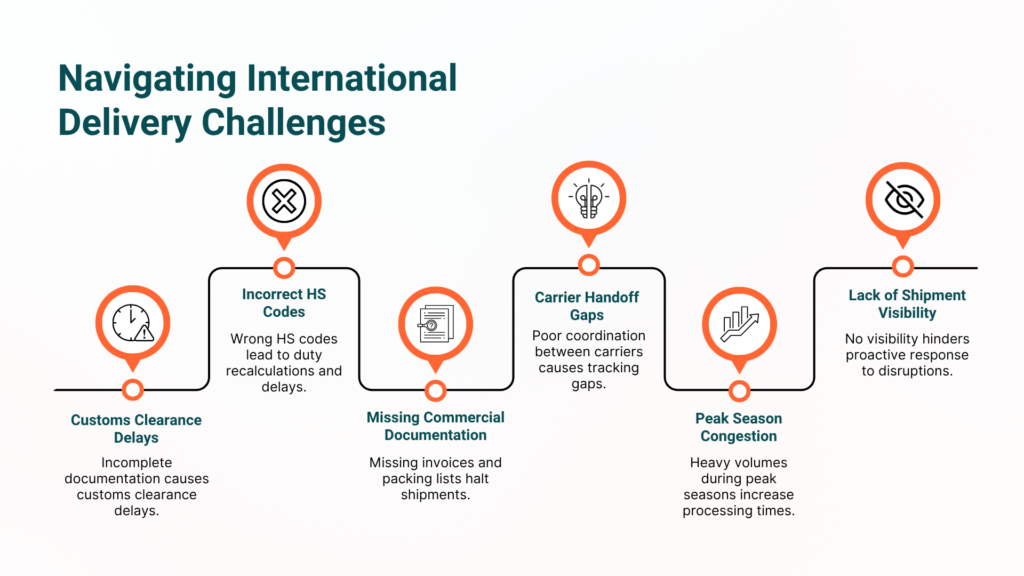
Why International Deliveries Get Delayed Even After Dispatch
Many brands assume that once an order leaves the warehouse, the logistics process is largely complete. This assumption causes major blind spots.
International delivery delays often happen after dispatch because multiple operational dependencies still remain active.
Customs Clearance Delays
Customs remains one of the biggest reasons for shipping delays. Parcels can be held due to:
- Incomplete invoices
- Missing declarations
- Incorrect product descriptions
- Unclear valuation details
A small documentation error can delay shipments for several days.
Incorrect HS Codes
HS codes directly impact customs processing and tax calculations.
If a product is assigned the wrong code:
- Duties may be recalculated
- Parcels may be flagged for manual review
- Clearance timelines can increase significantly
For example, an apparel brand shipping to Europe may dispatch all festive orders on time, but an incorrect product classification can keep shipments stuck at transit hubs.
Missing Commercial Documentation
Cross-border shipping requires documentation accuracy.
Common missing documents include:
- Commercial invoice
- Packing list
- Country-specific declarations
- KYC documents where required
Without these, shipments can remain idle despite being physically in transit.
Carrier Handoff Gaps
Cross-border shipping often involves multiple logistics partners.
A parcel may move through:
- Domestic pickup partner
- Export clearance partner
- Airline or freight carrier
- Destination courier partner
Poor coordination between these handoffs creates tracking gaps and fulfillment delays.
Peak Season Congestion
During festive sales, global shopping events, or holiday periods, carrier networks experience heavy volume spikes.
This leads to:
- Longer airport processing times
- Customs backlogs
- Last-mile delays
Even brands with efficient warehouse operations can be impacted if shipping networks are congested.
Lack of Shipment Visibility
Without centralized visibility, brands cannot proactively respond to disruptions.
This creates problems such as:
- Delayed customer communication
- Reactive exception handling
- Increased support tickets
Shipment visibility is no longer optional in cross-border operations.
Real-World Scenarios Where Predictive Logistics Outperforms Rule-Based Shipping
Traditional shipping systems often follow fixed logic such as assigning the cheapest courier or defaulting to a pre-set route.
This approach works until real-world disruptions occur.
Predictive logistics systems use live operational data to optimize decisions dynamically.
E-commerce Brands During Festive Sales
During high-volume periods, static courier assignments can become risky.
A rule-based system may continue routing shipments through a carrier experiencing delays.
A predictive system instead:
- Monitors carrier performance
- Detects delay patterns
- Reroutes shipments automatically
This reduces SLA failures during demand spikes.
Multi-Warehouse Inventory Allocation
Brands shipping globally often store inventory across multiple fulfillment centers.
A rule-based system may assign orders based on warehouse priority alone.
Predictive systems consider:
- Proximity to destination
- Carrier reliability
- Current inventory availability
- Shipping cost efficiency
This improves both speed and profitability.
High-Value Electronics Shipments
Electronics shipments face higher operational risk due to:
- Theft concerns
- Fragility
- Insurance dependency
Predictive logistics can prioritize safer carriers, route optimization, and packaging workflows.
This is where solutions like Consumer Electronics Fulfilment Automation Software help streamline high-value operations.
Deliveries in Low-Serviceability Regions
Certain international pin codes have weaker last-mile infrastructure.
Predictive systems can identify:
- Higher failure probability
- Delivery risk scores
- Alternate carrier opportunities
This reduces delivery failures.
Failed Delivery Recovery
Failed deliveries create avoidable cost leakage.
A rule-based system often marks deliveries failed without proactive recovery.
Predictive logistics can trigger recovery workflows automatically.
For example, solutions like ReDelivR can support failed delivery recovery by helping brands reduce loss from undelivered shipments.
Same-Day and Next-Day Optimization
Fast shipping commitments require constant network optimization.
Predictive systems analyze:
- Carrier capacity
- Delivery zone constraints
- Historical performance
This allows better carrier allocation in time-sensitive scenarios.

The Biggest Cross-Border Mistakes Indian Brands Make While Scaling Globally
Many growing brands enter international markets using domestic logistics workflows that simply do not scale.
This creates operational inefficiencies early in expansion.
Depending on a Single Courier Partner
No single carrier performs equally well across all countries.
Relying on one courier limits:
- Pricing flexibility
- Delivery performance optimization
- Risk diversification
Multi-carrier strategies are essential.
Not Optimizing Shipping Routes
Static routing increases costs unnecessarily.
Brands should continuously optimize routes based on:
- Destination demand
- Carrier performance
- Transit reliability
Ignoring Country-Wise Delivery Performance
Delivery performance differs significantly by geography.
A courier performing well in the UAE may underperform in Germany or the UK.
Brands should monitor country-level logistics analytics.
Underestimating Returns Management
International returns are expensive and operationally complex.
Without return workflows, brands face:
- Customer dissatisfaction
- Reverse logistics cost leakage
- Inventory loss
No Branded Tracking Experience
Tracking experiences directly impact customer trust.
Generic tracking pages reduce:
- Brand recall
- Communication clarity
- Upsell opportunities
Manual Logistics Workflows
Manual logistics creates operational bottlenecks in:
- Label generation
- Documentation
- Courier assignment
- Tracking updates
As order volumes grow, manual processes become unsustainable.
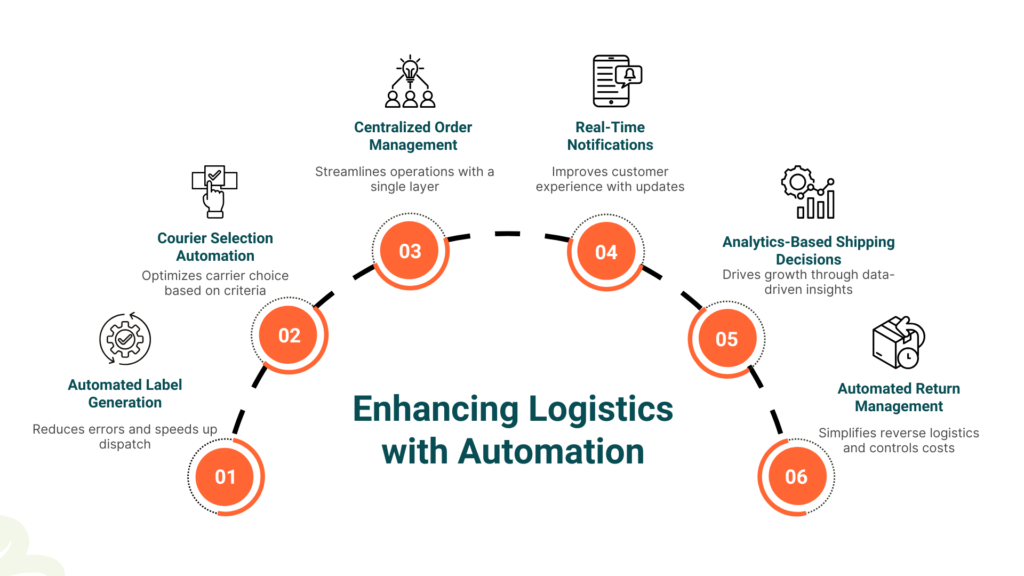
How Smart Logistics Automation Reduces Delays and Shipping Costs
Modern brands reduce logistics inefficiencies by automating critical shipping workflows.
Automation improves both operational accuracy and shipping efficiency.
Automated Label Generation
Manual label creation increases error probability.
Automation helps:
- Reduce incorrect shipping details
- Speed up dispatch workflows
- Standardize carrier documentation
Courier Selection Automation
Instead of manually choosing carriers, automation allocates carriers based on:
- Destination
- Cost efficiency
- Delivery speed
- Performance benchmarks
This improves decision quality at scale.
Centralized Order Management
Centralized logistics systems create a single operational layer for:
- Orders
- Shipments
- Tracking
- Returns
This reduces workflow fragmentation.
Real-Time Notifications
Automated customer notifications reduce anxiety and support dependency.
Brands can share:
- Shipment updates
- Delay alerts
- Delivery milestones
Analytics-Based Shipping Decisions
Shipping analytics help brands understand:
- Carrier performance
- Cost leakage
- Delivery success rates
- Delay trends
This turns logistics into a measurable growth function.
Automated Return Management
Returns automation simplifies reverse logistics workflows and reduces manual intervention.
This improves customer experience while controlling operational costs.
What Indian Brands Should Look for in a Cross-Border Shipping Partner
Selecting the right shipping partner is a strategic growth decision.
Brands should prioritize logistics platforms that offer:
Multi-Carrier Support
Enables flexibility across geographies and pricing tiers.
Real-Time Visibility
Improves shipment monitoring and customer communication.
Customs and Documentation Support
Reduces clearance delays and documentation errors.
Automated Workflows
Improves scalability while reducing operational dependency on manual processes.
Return Management
Essential for customer retention and operational recovery.
Delivery Analytics
Supports better logistics decision-making over time.
Platform Scalability
Your logistics stack should support growth into multiple markets without operational breakdown.
Commerce Integrations
Look for platforms that integrate with:
- Shopify
- Amazon
- WooCommerce
For brands planning to scale internationally, choosing a logistics platform that combines automation, visibility, and carrier flexibility can significantly reduce operational friction.
Explore solutions such as eShipz Shipping Solutions to understand how automation-first shipping workflows can support international growth without unnecessary complexity.
Conclusion
International expansion is a major opportunity for Indian brands, but cross-border logistics can quickly become margin-draining when hidden costs and operational inefficiencies are ignored.
Courier fees are only one part of the equation.
Brands must proactively manage customs workflows, carrier performance, documentation accuracy, shipping visibility, returns, and automation to stay competitive globally.
As customer expectations rise and international competition intensifies, the brands that treat logistics as a strategic capability rather than a backend function will be better positioned for sustainable global growth.