



It is 9:40 PM on the first night of a festive sale. A customer in Indore pays for a pair of sneakers and gets an order confirmation. Two days later the courier still has not picked up the parcel. The tracking page says “shipment created” and nothing else. On day four the customer cancels, asks for a refund and leaves a one-star review. That is what shipping bottlenecks in eCommerce look like from the customer’s side: one slow step in the chain that ends as a lost sale and a public complaint.
In 2027, shipping is part of the customer experience, and shoppers judge a brand on delivery as much as on the product. India has nearly 300 million online shoppers today, and BCG expects that number to reach 440 million by 2030 (BCG report, via The Economic Times). More shoppers in more cities means more parcels and more places for an order to get stuck.
This guide covers what shipping bottlenecks in eCommerce are, why they matter in 2027, the trends behind them, their causes and real costs, and a step-by-step plan to remove them.
What Are Shipping Bottlenecks in eCommerce?
A shipping bottleneck is any point where orders slow down or stop between checkout and delivery. The payment is done and the stock exists, yet the parcel sits somewhere it should not. Most shipping bottlenecks in eCommerce appear at one of seven stages of the order-to-delivery path:
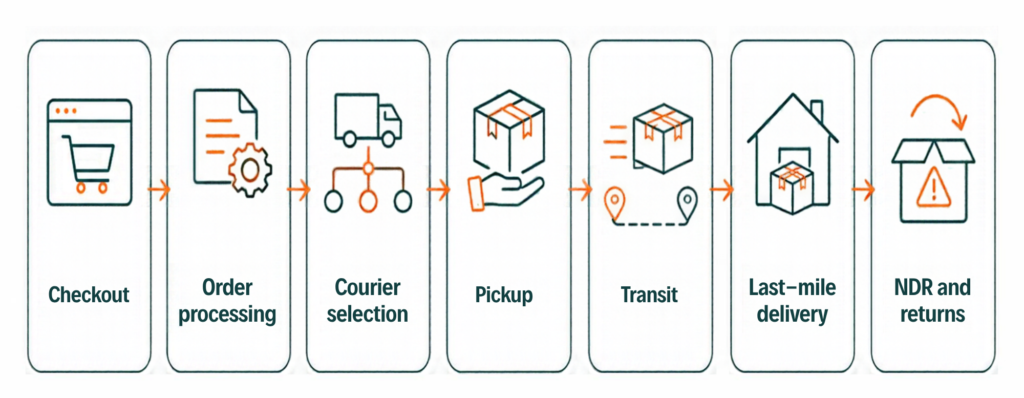
| Stage | Where it chokes | What the customer sees |
| Order processing | Manual entry, address errors, stock mismatches | Order confirmed, then silence for a day |
| Courier selection | Wrong carrier for the pin code, no backup | Higher cost or a slower route |
| Pickup | Courier misses the pickup slot | “Shipment created” for days |
| Transit | Hub delays, missing scans | Tracking frozen |
| Last-mile delivery | Failed attempts, unserviceable pin codes | “Out for delivery” again tomorrow |
| NDR | Slow follow-up with the customer | Parcel returns to the seller |
| Returns | Slow reverse pickup, no tracking | Refund delayed |
Each stage looks small on its own. Together they decide whether a parcel arrives in three days or nine.
A simple test: pick ten orders from last week and trace each one from payment to delivery. If three or four of them waited more than a day at any single stage, you have found your bottleneck. Most teams are surprised by how many orders wait at pickup and at the first NDR, because those two stages rarely get a dashboard of their own.
Why Fixing Shipping Bottlenecks in eCommerce Is Essential in 2027
Customer expectations have a new floor. Shoppers expect a delivery date at checkout, a tracking link within hours and a message before something goes wrong. A brand that misses this gets blamed, even when the courier caused the delay.
Delivery shapes repeat purchases. A late parcel shows up in reviews, ratings and the next buying decision. The product can be excellent and the customer still does not come back.
Margins are tight. Every failed delivery, RTO or wrong courier choice cuts into profit. A Ramco Systems analysis in Commercial Vehicle magazine says last-mile delivery now makes up over 50 percent of total shipping costs, and that 50.6 percent of people shop online because of free shipping. Brands cannot simply pass the cost to the buyer.
Growth makes it worse. A manual process that works at 100 orders a day breaks at 1,000. The person booking couriers by hand falls behind, tracking sheets go stale and errors multiply.
Doing nothing has a price. You lose customers, then pay a higher acquisition cost to replace them. Fixing shipping bottlenecks in eCommerce costs less than buying the same customer twice.
Shipping Trends Shaping eCommerce in 2027
- Order volumes are moving to smaller cities. McKinsey found that more than 60 percent of eCommerce shipments in India now start in Tier 2 and Tier 3 cities. An Infisum report says 66 percent of new D2C orders come from those cities. Smaller cities often mean thinner courier coverage and messier addresses.
- Quick commerce raises the speed bar. The same Infisum report puts Blinkit at a 44 percent share of Indian quick commerce, with 900 million orders processed in FY26. Shoppers used to groceries in minutes tend to expect same-day or next-day delivery from other brands too.
- Single-courier setups are giving way to multi-carrier ones. C.H. Robinson’s 2027 Freight Market Outlook says conflict, shifting trade relationships and climate disruption are testing long-held assumptions about how goods move. A brand tied to one courier has no fallback when capacity changes.
- AI and visibility move into daily operations. ASCM’s 2027 supply chain trends rank agentic AI second and end-to-end visibility sixth. In shipping, that means automatic courier allocation, predicted delays and exceptions handled without someone opening a spreadsheet.
- Payments, COD and returns are shifting. Mordor Intelligence reports that UPI processed 228 billion transactions in 2025, with Tier II and III cities producing 60 percent of the added volume. It expects the move away from cash on delivery to reduce reverse-logistics risk over time. Until then, refused parcels and returns stay a margin problem.
- Peak seasons keep growing for brands that grow. Whatever your last sale day looked like, plan for more orders on the next one. Courier capacity does not stretch on demand, so a brand that books backup carriers before the season starts with a fallback when the main one fills up.
Top Causes of Shipping Bottlenecks in eCommerce
Nine causes show up again and again behind shipping bottlenecks in eCommerce.
- Single-courier dependence. One carrier’s delay or pin-code gap stalls the whole operation. A strike, a hub backlog or a coverage hole stops every order in that region.
- Manual courier selection. Someone picks a carrier by habit or by the lowest rate card. The choice is slow, inconsistent and blind to performance. The result is higher freight and more late parcels.
- No carrier performance visibility. Without data on which courier fails on which pin codes, you keep sending parcels down routes that already failed.
- High NDR and failed deliveries. Wrong addresses, unreachable customers and no quick follow-up send parcels back to origin.
- COD risk. Fake orders, refusals and delayed remittances tie up cash and add RTO charges for orders that were never going to be accepted.
- Disconnected systems. Store, WMS, ERP and courier data sit in separate places. Staff re-key information, errors creep in and order status never matches reality.
- Returns and reverse logistics chaos. Slow pickups, no tracking and late refunds leave customers upset and stock stuck in transit.
- Peak-season surges. Courier capacity and warehouse processing hit their limits at the same time, so dispatches slip across the board.
- Weak tracking and communication. When customers cannot see where an order is, support tickets pile up with “where is my order” contacts.
The Real Cost of Shipping Bottlenecks in eCommerce
The cost comes in three layers.
Direct costs: RTO charges, reshipping, higher freight from the wrong courier choice and freight billing errors.
Indirect costs: customer churn, negative reviews, support load (WISMO calls) and lost repeat sales.
Operational costs: staff hours spent on manual booking, tracking and reconciliation.
| Bottleneck | Where the cost shows up | Business impact |
| Single-courier dependence | Delays, re-bookings | Lost orders in affected pin codes |
| Manual courier selection | Freight invoice | Higher cost per shipment |
| Failed deliveries (NDR) | RTO and reshipping charges | Margin loss, stock out of sale |
| COD refusals | Reverse freight, delayed cash | Cash flow strain |
| Weak tracking | Support team hours | Higher cost to serve |
| Slow returns | Refund delays, idle stock | Poor reviews, fewer repeat buyers |
| Billing errors | Overcharges nobody checks | Silent margin leak |
Freight billing errors deserve a special mention because nobody sees them. A wrong weight slab, a duplicate charge or a zone mismatch adds a few rupees to each invoice, and the invoice is paid because checking it line by line takes too long. Over thousands of shipments, that is real money leaving every month.
A quick example (illustrative numbers): a brand ships 5,000 orders a month and 10 percent become RTO. That is 500 parcels. If each one costs ₹200 in forward and reverse freight, handling and repackaging, the loss is ₹1,00,000 a month, or ₹12 lakh a year, before counting the sale itself. Add support: if 20 percent of orders trigger a “where is my order” contact at ₹40 each, that is another ₹40,000 a month. Replace these figures with your own to see your real number.
Benefits of Removing Shipping Bottlenecks in eCommerce
- Faster delivery and a more reliable EDD
- Lower RTO and NDR rates
- Lower shipping cost per order
- Higher customer satisfaction and repeat purchase rate
- Fewer support tickets
- Less manual work, so the team can focus on growth
- Room to handle sales and peak seasons without a scramble
How to Fix Shipping Bottlenecks in eCommerce: A Step-by-Step Approach
- Audit your current shipping flow. Map every stage from checkout to delivery and note where orders wait. Time each stage for a sample of 200 recent orders, and split the results by courier and by pin code. The pattern that shows up is usually narrower than expected: two couriers and a dozen pin codes cause most of the delays.
- Go multi-courier. Add carriers to spread risk and cover more pin codes. Multi carrier shipping software lets you book across carriers from one screen. eShipz’s multi-carrier shipping guide explains how to choose and mix carriers.
- Automate courier allocation. Let rules or AI pick the carrier for each order by cost, speed and past performance on that pin code. This is where shipping automation software pays back first. Read more in this guide to shipping automation software.
- Fix NDR proactively. Trigger a message the moment a courier raises an NDR, collect the correct address or a preferred slot, and send the re-attempt request without a person in the middle.
- Manage COD and returns systematically. Score COD orders for risk, confirm high-risk ones before dispatch, offer a small incentive for prepaid payment, and give every return a tracked pickup and a clear refund timeline.
- Give customers real-time tracking and an accurate EDD. Shipment tracking software that shows live status on a branded page cuts “where is my order” tickets. Add a delivery estimate on the product page and in the confirmation message, and send a proactive update when a parcel is running late. Customers forgive a delay they were told about.
- Integrate your tech stack. Connect your store, OMS or WMS, ERP and carriers so data is entered once. Good logistics management software treats these connections as the core job. Shipping software for ecommerce that only books labels leaves the gaps between systems exactly where they were.
- Monitor and audit. A control tower dashboard shows delays as they happen. A regular freight audit catches overcharges before they become normal.
Mistakes That Keep Shipping Bottlenecks in eCommerce in Place
Three habits slow brands down as much as any courier does. The first is choosing couriers on rate cards alone, which ignores delivery success on your actual pin codes. The second is treating NDR as a customer service task that happens whenever someone has time, so the first call goes out on day three instead of hour one. The third is tracking shipments in one tool and orders in another, which means nobody sees the full picture until a customer complains. Each of these is cheap to fix once you spot it.
A Quick-Start Checklist to Tackle Shipping Bottlenecks in eCommerce
Start small and measure. One fix, done well, tells you more than a six-month overhaul plan.
- Pull the last 90 days of data: delivery time, RTO %, NDR % and cost per shipment by courier
- Identify your top 3 problem pin codes or couriers
- Add at least one backup courier
- Set up automated tracking updates for customers
- Start with one fix, such as NDR or courier allocation, then expand
- Review weekly and adjust
Doing this by hand works up to a point. Here is how automation takes it further.

How eShipz Helps Reduce Shipping Bottlenecks in eCommerce
eShipz is an all-in-one, AI-powered logistics automation platform that works with 350+ brands. Each bottleneck above maps to a specific capability:
| Bottleneck | How eShipz addresses it |
| Single-courier dependence | Multi-courier shipping API with carrier integrations |
| Manual courier selection | AI-powered courier allocation |
| High failed deliveries | NDR management and redelivery automation |
| COD risk and delays | COD management |
| Customer anxiety and WISMO tickets | Real-time tracking, EDD and post-shipment engagement |
| Proof and disputes | ePOD |
| Returns chaos | Returns management |
| No visibility | Control tower and dashboard |
| Billing errors | Freight audit |
| Disconnected systems | Shopify, sales channel, OMS and WMS, ERP and TMS integrations |
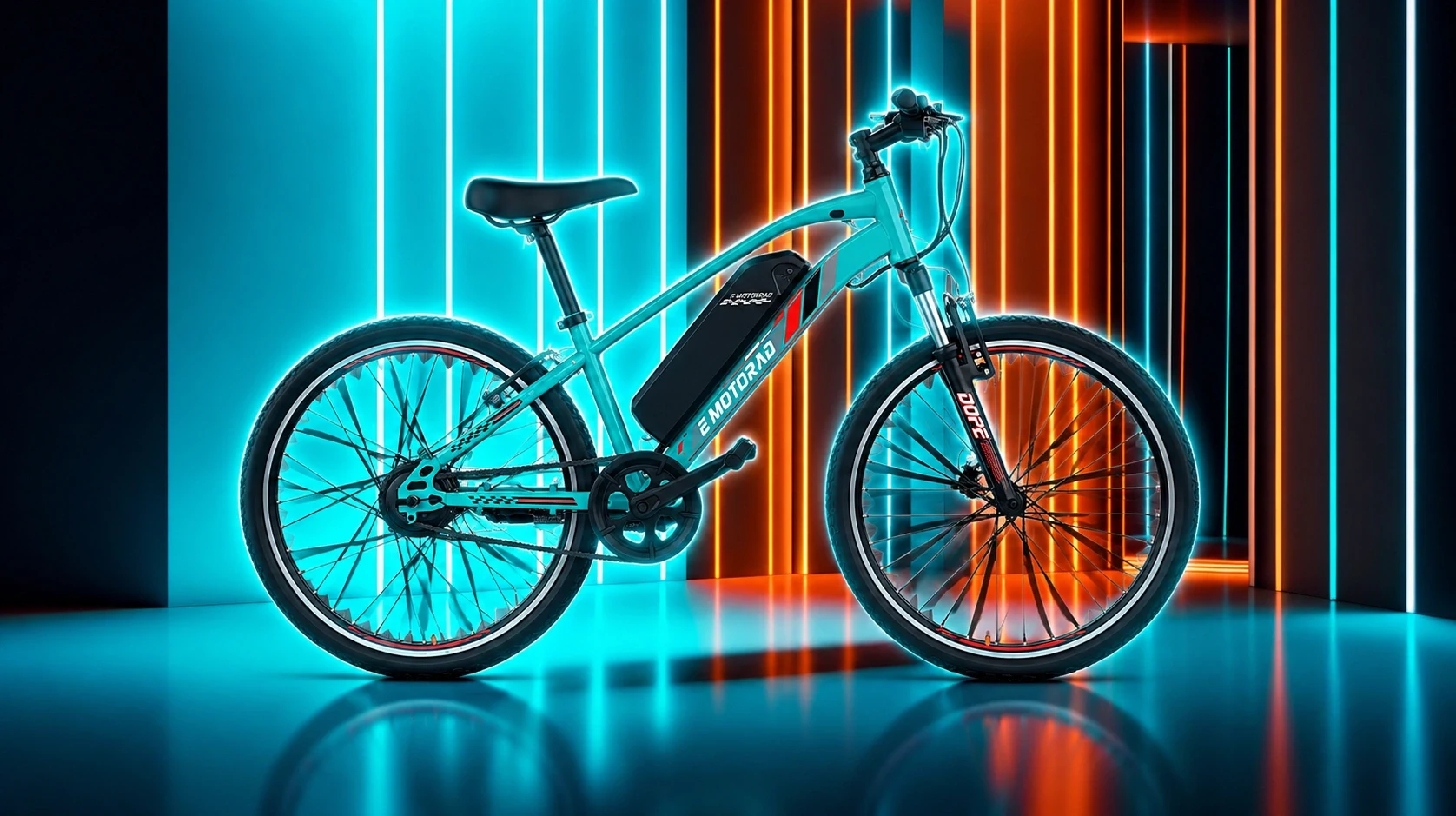
Customer proof. EMotorad ships bulky, high-value e-cycles across India, a category where one failed delivery is expensive. The EMotorad case study shows how automating shipping with eShipz improved delivery speed, accuracy and logistics efficiency. [ADD 2 TO 3 OUTCOME FIGURES FROM THE CASE STUDY HERE]
eShipz supports D2C and eCommerce, retail and fashion, B2B and quick commerce operations, so most shipping setups have a matching starting point.
Conclusion
Shipping bottlenecks in eCommerce are costly, but they are fixable. Most of them trace back to a handful of causes: one courier, manual decisions, failed deliveries, weak tracking and disconnected systems. Fixing even one brings faster delivery, lower cost per order and customers who come back for a second purchase and recommend you to friends. Do not wait for peak season to find out where orders stall. Start with your last 90 days of data, find your three worst pin codes or couriers, and add one backup carrier this month. To see how automation handles the rest, book a demo with eShipz and walk through your own shipping data with the team.
FAQs
- What is the biggest shipping bottleneck for eCommerce brands?
Dependence on a single courier. When that one carrier has a pin-code gap or a hub delay, every order in the affected region stalls. Among all shipping bottlenecks in eCommerce, this one is also the easiest to reduce by adding a backup carrier.
- How can I reduce RTO and NDR?
Contact the customer the moment an NDR is raised, confirm the address and a delivery slot, and request a re-attempt automatically. Confirm risky COD orders before dispatch and offer a small discount for prepaid payment.
- Is multi-courier shipping worth it for small brands?
Yes, once you ship to more than a handful of cities. A second carrier covers pin codes the first one misses and gives you a fallback during delays. Multi carrier shipping software keeps the extra work small.
- How does AI help in courier allocation?
It compares carriers for each order using cost, delivery speed and past success on that pin code, then picks the best fit. It also learns from failures, so poor routes get used less over time.
- How do I prepare shipping for peak season?
Review last year’s peak data, add backup carriers early, test your NDR and tracking flows before the sale, and brief your support team on expected volumes. Shipping automation software removes most manual steps that slow down sale days.
- How do I know if my store has shipping bottlenecks?
Look at four numbers by courier and pin code: average delivery time, NDR rate, RTO rate and support tickets per 100 orders. Rising numbers in any of them point to shipping bottlenecks in eCommerce that need attention.
- What software helps fix shipping bottlenecks in eCommerce?
Ecommerce shipping solutions that combine courier allocation, NDR handling, shipment tracking software and freight audit cover most causes. Logistics management software that connects to your store and ERP keeps the data in one place.