





Online shopping has changed the way brands think about the box that arrives at a customer’s door. A decade ago, packaging was purely functional, something to keep a product safe between the warehouse and the doorstep. Today, ecommerce packaging is a brand touchpoint, a marketing tool, and a critical part of the customer experience, all rolled into one. According to Grand View Research, the global e-commerce packaging market was valued at over 106 billion dollars in 2025 and is projected to grow at a compound annual growth rate of 17.9 percent through 2033, with India alone expected to grow at nearly 27 percent CAGR over the same period. That kind of growth tells you everything about how central packaging has become to online retail.
But here is the catch. Not every product needs the same box. A pair of running shoes, a smartphone, a lipstick, and a cricket bat all travel through the same courier network, yet each has completely different packaging needs. Toys need to meet child safety standards. Sports gear needs to survive rough handling. Apparel needs to protect fabric quality while staying light enough to keep shipping costs down. Electronics need shock absorption and anti-static protection. Cosmetics need leak-proofing and tamper-evidence. Treating all of these categories the same way is one of the most common (and expensive) mistakes ecommerce sellers make.
This guide breaks down ecommerce packaging category by category, so you can match the right materials, design, and strategy to what you are actually shipping. We will also cover why packaging matters so much for growing brands, the trends shaping the industry right now, and how to pick a packaging approach that protects your margins as well as your products.
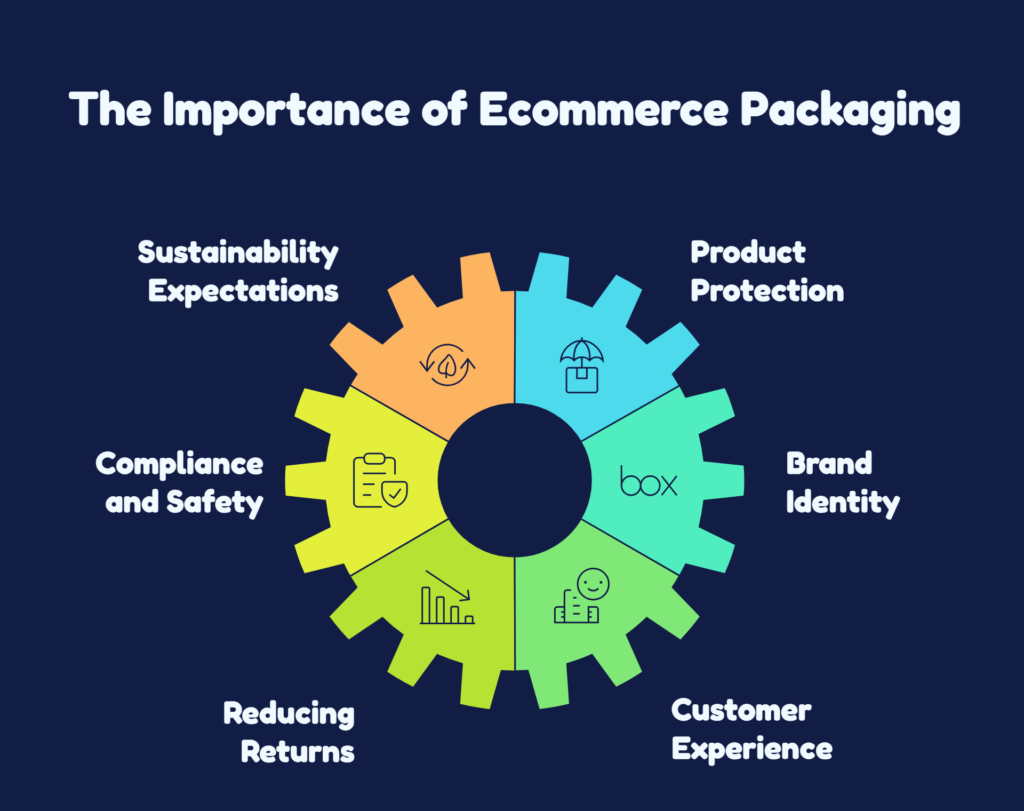
Why Is Ecommerce Packaging Essential?
Before getting into category-specific details, it helps to understand why ecommerce packaging deserves this much attention in the first place.
Product protection- The core job of any package is to prevent damage during transit. Drops, crushing under other parcels, vibration, and moisture exposure are all realities of the shipping journey, and packaging is the first line of defense against every one of them.
Brand identity- For most direct-to-consumer brands, the delivery box is the first physical interaction a customer has with the brand. A generic brown box says one thing. A well-designed box with branded tape, a custom insert, or a thank-you card says something else entirely.
Customer experience- Unboxing has become part of the shopping experience itself. Social media is full of unboxing videos and reviews, and a thoughtful unboxing moment can turn a one-time buyer into a repeat customer or even a source of free marketing through user-generated content.
Reducing returns and refunds- Poor packaging is one of the leading causes of transit damage, and transit damage is one of the leading causes of returns. Getting packaging right for each product category directly reduces the cost of damage-related refunds and re-shipments.
Compliance and safety- Certain categories carry legal packaging obligations. Toys need to meet child safety norms around choking hazards and small parts. Cosmetics need tamper-evident seals and accurate ingredient labeling. Getting this wrong can mean regulatory trouble, not just an unhappy customer.
Sustainability expectations- Shoppers increasingly notice how much packaging waste arrives with their order. Brands that use recyclable, right-sized, or minimal packaging are building goodwill that shows up in repeat purchase behavior.
Current Market Trends in Ecommerce Packaging
The way brands approach ecommerce packaging is shifting quickly, driven by cost pressure, sustainability demand, and the sheer scale of online retail. A few trends stand out.
Sustainable and eco-friendly materials- Recyclable mailers, biodegradable void fill, and FSC-certified corrugated boxes are moving from “nice to have” to expected, particularly among younger shoppers and in categories like apparel and cosmetics.
Right-sized packaging- Oversized boxes with excess void fill push up dimensional (volumetric) weight, which directly increases shipping cost. More sellers are matching box size closely to product size to cut both material waste and freight charges.
Smart packaging- QR codes and NFC tags on packaging are being used for product authentication, warranty registration, and even interactive unboxing experiences, especially in electronics and premium D2C categories.
Personalization- Custom inserts, branded tissue paper, and handwritten-style thank-you notes are common now among D2C brands trying to build a memorable unboxing moment without a huge budget.
Automation on the packing line- As order volumes scale, more warehouses are adopting auto-boxing machines that size cartons on demand, which reduces both labor cost and material waste.
Category-specific innovation- Electronics brands are shifting toward mono-material and molded fiber packaging that is easier to recycle. Apparel brands are replacing plastic poly bags with paper or recycled-content mailers. The push toward category-specific solutions is one of the clearest signs that generic packaging strategies are losing ground.
Together, these trends point to the same conclusion: generic, one-format-fits-all ecommerce packaging is becoming harder to justify, whether the goal is cost control, sustainability, or customer experience. Brands that invest early in category-specific packaging strategies tend to see the benefit show up in fewer damage claims and stronger repeat purchase rates.
With that context in place, here is how ecommerce packaging needs differ across five of the most common product categories sold online.
Packaging for Toys
Toy packaging carries more regulatory weight than almost any other ecommerce category, because the end user is often a child.
Key concerns- Compliance with child safety standards such as ASTM F963, EN71, and CPSIA is non-negotiable. Choking hazard warnings must be clearly printed for products with small parts, and tamper-evidence matters for items with batteries or moving pieces.
Materials- Sturdy corrugated boxes are the standard for outer packaging, often paired with blister packs or poly bags that carry mandatory suffocation warnings for the inner packaging of smaller items.
Design considerations- Toy packaging usually leans into colorful, playful branding, since the box itself is part of the product’s appeal to both the child and the parent making the purchase. Window boxes that let the toy be seen without opening the package are common for this reason. At the same time, small parts and batteries need secure, separate inner compartments to prevent loss or hazard during transit.
Trend to watch- Parents are increasingly drawn to plastic-free, FSC-certified toy packaging, and brands that highlight this on the box itself often see it reflected positively in reviews.
Packaging for Sports Equipment
Sports equipment packaging has to deal with two challenges most other categories do not: odd shapes and rough handling.
Key concerns- Bats, balls, mats, dumbbells, and similar items rarely fit neatly into a standard rectangular carton. Sharp edges, heavy weight, and irregular dimensions all increase the risk of damage to both the product and the packaging during sports equipment shipping.
Materials- Double-walled corrugated boxes provide the crush resistance needed for heavier items, while foam inserts and molded pulp trays help stabilize awkwardly shaped equipment inside the box so it does not shift during transit.
Design considerations- Durability matters more than aesthetics here. Sports equipment packaging needs to survive rough handling across multiple courier touchpoints, and moisture resistance is important for gear that may be used outdoors.
Trend to watch- Recycled cardboard with minimal, functional branding is becoming the norm in this category, since the priority is protection rather than a premium unboxing moment.
Packaging for Athleisure Wear and Apparel
Apparel is one of the highest-volume categories in ecommerce, and it is also one of the categories with the highest return rates, which makes packaging design particularly important here.
Key concerns- Clothing packaging needs to protect garment shape and fabric quality, guard against moisture during transit, and make the returns process simple, since apparel returns are a routine part of the business.
Materials- Poly mailers remain the most common choice for apparel packaging for ecommerce because they are lightweight and cost-effective, though recyclable and compostable versions are rapidly replacing traditional plastic mailers. Branded tissue paper is common for mid-range and premium brands, while garment bags are typically reserved for higher-end apparel lines.
Design considerations- Weight matters a lot in apparel shipping packaging, since lighter mailers directly reduce shipping cost at scale. Resealable mailers make returns easier for the customer, which in turn improves the overall experience even when a return happens. Small branded touches, like a sticker or a printed thank-you note, add a sense of care without adding significant weight or cost.
Trend to watch- The shift from single-use plastic poly bags to paper mailers and recycled-content polybags is one of the most visible sustainability trends in apparel packaging right now, driven by both consumer preference and tightening plastic regulations in several markets. Packaging decisions for apparel also tie closely into how stock is organized in the first place, so it helps to pair this with a solid clothing inventory management process to keep sizes, styles, and SKUs accurate before an order ever reaches the packing table.
Packaging for Electronics
Electronics packaging is where protection engineering matters most, since the products are fragile, valuable, and often sensitive to static.
Key concerns- Shock and vibration protection are essential to prevent internal component damage. Anti-static protection is required for circuit boards and sensitive components, and tamper-proofing matters for high-value items where authenticity is a concern for both the brand and the buyer.
Materials- Molded pulp or EPE foam inserts are widely used to cushion devices and hold accessories in place, while anti-static bags protect components from electrostatic discharge. Rigid boxes with custom die-cut trays are standard for premium electronics where presentation matters as much as protection.
Design considerations- Well-designed electronics packaging for ecommerce shipping includes secure compartments for cables and accessories, warranty or authenticity seals, and a clean, minimal unboxing experience, following the model popularized by premium electronics brands.
Trend to watch- Many electronics brands are actively moving away from single-use plastics toward molded fiber and mono-material packaging designs, both to meet sustainability commitments and to simplify recycling for the end customer.
Packaging for Cosmetics
Cosmetics packaging has to solve for leaks, breakage, and regulatory labeling requirements, often within a very small footprint.
Key concerns- Leak-proofing for liquid products is critical, along with breakage protection for glass bottles and jars. Tamper-evidence is expected by most buyers, and some formulas are temperature-sensitive, which adds another layer of consideration during transit.
Materials- Rigid boxes with foam or paper inserts are common for protecting bottles and jars, alongside bubble wrap and secondary sealed pouches that catch any leakage before it reaches the outer packaging.
Design considerations- Cosmetics is one of the categories where the box itself often carries significant brand weight, so embossing, foiling, and premium finishes are common. Small-format inserts are frequently used for sample products, and ingredient labeling must comply with regional regulations, which varies by market.
Trend to watch- Refillable packaging and the “skinny” packaging trend, which reduces secondary packaging to the minimum necessary, are both gaining real traction in beauty ecommerce as brands look to cut both cost and environmental impact.
Choosing the Right Ecommerce Packaging Partner or Strategy
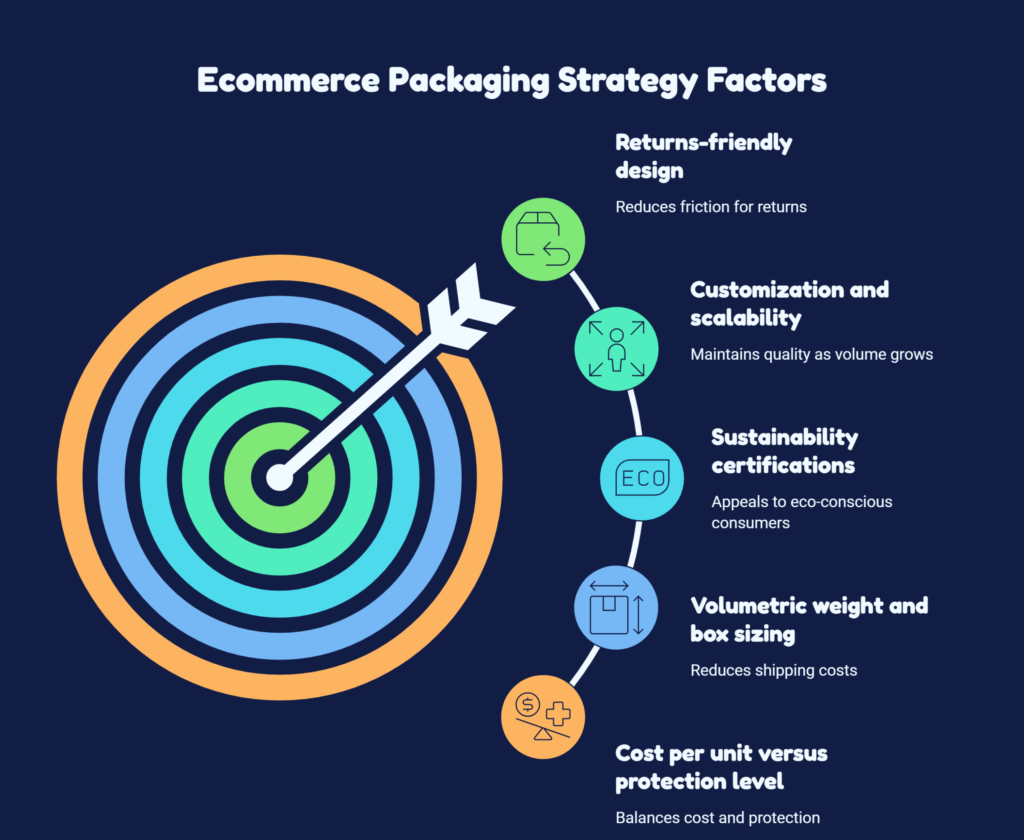
Once you understand what each category needs, the next step is building a packaging strategy that works at scale. A few factors matter most.
Cost per unit versus protection level- More protective packaging generally costs more, so the goal is to find the minimum level of protection that reliably prevents damage for that specific product category, not the maximum available.
Volumetric weight and box sizing- Courier charges are often based on volumetric weight rather than actual weight, so oversized boxes with excess void fill quietly inflate shipping costs. Right-sizing packaging to the product is one of the most effective ways to reduce shipping packaging cost without cutting corners on protection.
Sustainability certifications- As more consumers factor packaging waste into their buying decisions, certifications like FSC for paper and board, or clearly recyclable mono-material designs, are becoming a genuine differentiator rather than just a marketing line.
Customization and scalability- A packaging approach that works for a hundred orders a month may not hold up at ten thousand. Brands scaling quickly need packaging partners and material suppliers who can maintain quality and turnaround time as volume grows.
Returns-friendly design- Especially in apparel and D2C categories in India, resealable and reusable packaging reduces friction for the customer during returns, which can meaningfully improve satisfaction scores even when the return itself is unavoidable. This works best when it is backed by the right systems on the logistics side too. If you are evaluating providers, this guide on choosing multi carrier shipping software with ePOD and returns covers what to look for so packaging and reverse logistics work together instead of against each other.
Balancing protection, cost, and brand experience looks different for every category, which is exactly why a single, generic packaging approach rarely works well across an entire product catalog. Many D2C brands in India solve this by working with more than one type of packaging supplier or format across their catalog rather than forcing every SKU into the same box, which keeps both damage rates and shipping costs under control as the business scales.
Corrugated boxes remain the default choice for most categories because they balance strength, cost, and recyclability well, while poly mailers continue to dominate lightweight categories like apparel. For heavier or higher-value items, a 5 ply corrugated box offers noticeably better crush resistance than standard 3 ply options, which is worth the marginal cost increase for products where damage claims are common.
Conclusion
Ecommerce packaging is no longer a one-size-fits-all decision. What works for a lipstick will damage a cricket bat, and what protects a smartphone would be overkill and expensive for a t-shirt. Matching packaging materials and design to the specific demands of each product category, whether that is child safety compliance for toys, shock protection for electronics, or leak-proofing for cosmetics, is one of the most practical ways to reduce damage, cut unnecessary shipping costs, and build a better first impression with every order.
As the ecommerce packaging market continues to grow, brands that treat packaging as a category-by-category decision, rather than an afterthought, are the ones best positioned to reduce returns, control costs, and build the kind of unboxing experience that keeps customers coming back.

Frequently Asked Questions
- What is ecommerce packaging?
Ecommerce packaging refers to the materials and design used to protect, present, and ship products purchased online. It includes the outer shipping box or mailer, inner protective materials like foam or void fill, and any branding elements such as inserts or tape. - Why does ecommerce packaging vary so much by product category?
Different products face different risks during transit. Fragile electronics need shock absorption, liquids like cosmetics need leak-proofing, and toys need compliance with child safety regulations. A single generic packaging format cannot address all of these needs effectively. - What is the best packaging for ecommerce products with irregular shapes, like sports equipment?
Double-walled corrugated boxes combined with foam inserts or molded pulp trays work well for irregularly shaped items, since they stabilize the product inside the box and prevent shifting during transit. - How can sellers reduce ecommerce packaging costs?
Right-sizing boxes to match product dimensions is one of the most effective ways to cut costs, since many couriers charge based on volumetric weight rather than actual weight. Reducing excess void fill and choosing lighter materials, such as poly mailers for apparel, also helps control shipping expenses. - Is sustainable ecommerce packaging actually in demand from customers?
Yes. Consumer preference for recyclable, biodegradable, and minimal packaging has grown steadily, particularly in categories like apparel and cosmetics, and many brands now highlight sustainability credentials directly on their packaging. - What packaging is required for toys sold online? Toy packaging generally needs to meet safety standards such as ASTM F963, EN71, or CPSIA depending on the market, include choking hazard warnings where relevant, and use secure inner packaging to protect small parts and batteries.
- How does good ecommerce packaging reduce returns?
Packaging designed for the specific product category reduces transit damage, which is one of the most common reasons for returns and refunds. Returns-friendly features, such as resealable mailers, also make the return process smoother when it does happen, improving overall customer satisfaction.