





Ecommerce brands rarely start out juggling multiple carriers on purpose. It usually happens because one carrier cannot cover every pin code, one courier’s rates spike during peak season, or a single service disruption suddenly holds up hundreds of orders. Within a year, an operations team is logging into four or five carrier dashboards, manually comparing rates, printing labels one at a time, and still missing SLAs. This is where multi-carrier shipping software becomes less of a convenience and more of a necessity. It gives brands one dashboard to compare rates, generate labels, track shipments, and manage returns across every carrier they work with, instead of duct-taping five logins together.
The market backs this up. The global parcel management and multi-carrier shipping software market was valued at roughly USD 2.93 billion in 2026 and is projected to reach nearly USD 4.98 billion by 2031, growing at a CAGR above 11%, according to Mordor Intelligence. That growth is a direct response to the same problem playing out across thousands of ecommerce operations: manual carrier management does not scale.
This post walks through why multi-carrier automation has become essential, the trends pushing adoption, the features worth prioritizing, a comparison of the platforms leading the space in 2026, and a framework for picking the right one for your business.
Why Multi-Carrier Shipping Automation Is Essential Today
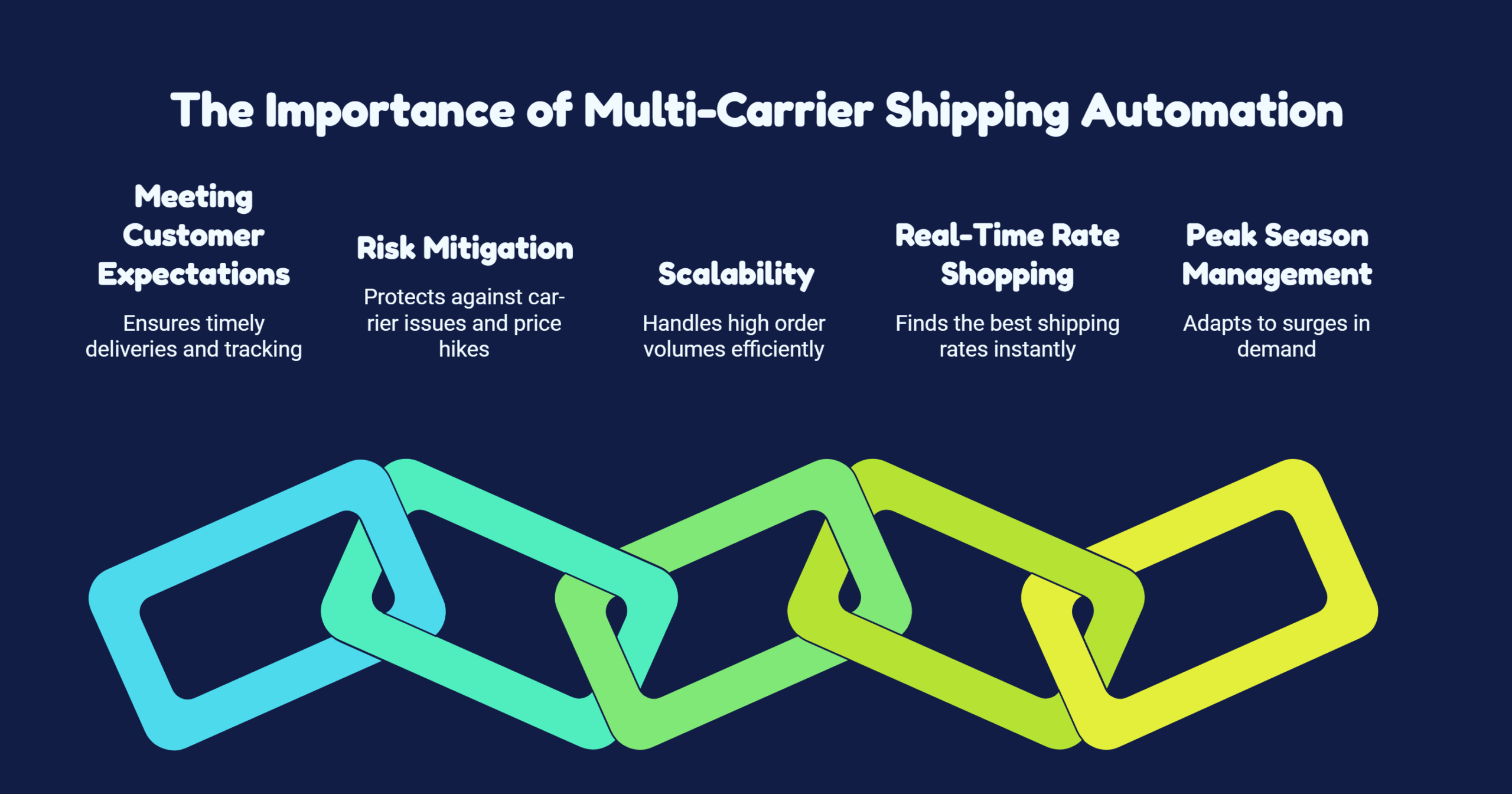
Customer expectations have moved the goalposts
Shoppers now expect delivery windows that rival same-day retail, live tracking updates, and shipping costs that don’t erase their cart’s discount. A brand relying on one carrier cannot flex fast enough to meet all three at once across every region it ships to.
Carrier diversification is now a risk strategy, not a luxury
Depending on a single carrier means depending on that carrier’s rate hikes, capacity limits, and service outages. Brands that spread volume across two or three carriers protect themselves from being stuck when one partner raises prices mid-contract or has a bad week operationally.
Manual shipping processes break down at volume
Copying tracking numbers between spreadsheets, manually picking a carrier for each order, and printing labels one screen at a time works fine at 20 orders a day. At 2,000 orders a day, it produces mislabeled packages, missed cutoff times, and SLA breaches that customer service ends up absorbing.
Automation enables real-time rate shopping
A multi-carrier shipping software platform can compare live rates from every connected carrier at the moment of label creation, automatically routing each order to the cheapest or fastest option based on rules the business sets. That single capability alone often pays for the software.
Peak season needs dynamic carrier allocation
During sale events, a single carrier’s network gets overloaded fast. Automation platforms that can shift volume between carriers in real time, based on current capacity and delivery performance, keep orders moving when demand spikes.
Market Trends Driving Adoption
Several forces are accelerating how fast brands move from single-carrier setups to fully automated, multi-carrier operations.
- Post-pandemic supply chain caution. The disruptions of the past few years pushed many brands to formally diversify their carrier base rather than treat it as a backup plan.
- AI and machine learning in carrier selection. Newer platforms don’t just apply static if-then rules. They factor in historical delivery performance by pin code, order value, and carrier reliability to predict which carrier is most likely to deliver successfully, not just cheaply.
- Real-time tracking as a baseline expectation. Branded tracking pages and proactive delay notifications have shifted from a nice-to-have to something customers assume exists.
- Sustainability-conscious carrier selection. A growing number of platforms are adding carbon-emission data into their carrier comparison logic, letting brands weigh delivery speed and cost against environmental impact.
- API-first, headless commerce adoption. As more brands build custom storefronts or use headless commerce architecture, they need shipping platforms with flexible APIs rather than rigid, plugin-only integrations.
What logistics automation platforms handle multi-carrier ecommerce shipping? The ones gaining traction in 2026 share a common thread: they combine rate comparison, label automation, and tracking into one API-accessible layer, rather than forcing teams to stitch together separate tools for each function.
Key Features to Look for in a Multi-Carrier Shipping Platform
Not every platform on the market covers the same ground. Before comparing vendors, it helps to know which capabilities actually move the needle.
- Rate shopping and carrier comparison engine – Live rate comparison across every connected carrier at checkout or label creation, not a static rate card that goes stale.
- Multi-carrier label generation – Bulk label printing across carriers in one workflow, with the ability to set default routing rules by weight, zone, or order value.
- Real-time tracking and branded notifications – A single tracking view for the operations team, paired with branded tracking pages and SMS/email/WhatsApp updates for customers.
- Returns management automation – Self-serve return portals, automated pickup scheduling, and reverse logistics tracking that doesn’t require manual intervention for every return.
- Ecommerce platform and marketplace integrations – Native or near-native connections to Shopify, WooCommerce, Magento, and major marketplaces, so order data syncs without manual exports.
- Address validation and fraud detection – Catching invalid addresses and suspicious COD orders before a label is even generated, which cuts down on failed deliveries.
- Analytics and reporting dashboards – Visibility into carrier performance, delivery success rates, and shipping cost trends over time, so decisions are based on data rather than gut feel.
- Scalability for volume spikes – Infrastructure that holds up during flash sales and peak season without slowing down label generation or rate lookups.
Best Logistics Automation Platforms for Multi-Carrier Shipping (2026)
Here’s how the leading platforms compare on standout features, who they fit best, and where they fall short.
eShipz
eShipz is a shipping automation and logistics intelligence platform connecting to 400-plus domestic and international carriers, aimed at ecommerce brands, retailers, 3PLs, and manufacturers that need both automation and detailed operational visibility.
Standout features: Rule-based and AI-assisted courier allocation, NDR management with automated recovery workflows, ERP/WMS/TMS-compatible API, in-depth carrier performance analytics.
Best for: Mid-market to enterprise brands and 3PLs needing to manage carrier decisions across a large network with strong reporting.
Pricing: Custom, based on shipment volume and integration needs.
Limitation: Larger feature set means onboarding takes a bit more setup than a bare-bones label tool.
What logistics automation platforms handle multi-carrier ecommerce shipping? As this comparison shows, the answer depends on what a business actually needs solved. A brand shipping internationally needs different strengths than a brand managing high COD volume domestically, which is why picking the “best” platform is really about matching features to operational priorities.
ShipStation
ShipStation remains one of the most widely used order and shipping management tools for ecommerce sellers, particularly in the US market. It connects to dozens of carriers and sales channels, supports batch label printing, and offers solid automation rules for routing orders.
Standout features: Branded tracking pages, automation rules engine, wide marketplace integration list.
Best for: SMB to mid-market sellers running multiple online stores.
Pricing: Tiered monthly plans based on shipment volume.
Limitation: International carrier coverage and rate-shopping depth lag behind some newer, API-first competitors.
Shippo
Shippo positions itself as a developer-friendly shipping API alongside a standard web dashboard, giving smaller brands and platforms building custom checkout flows a flexible way to add multi-carrier shipping without heavy engineering lift.
Standout features: Simple API, flat per-label pricing option, easy Shopify and WooCommerce plugins.
Best for: SMBs and platforms embedding shipping into their own software.
Pricing: Pay-as-you-go or subscription tiers.
Limitation: Advanced routing rules and analytics are more limited than enterprise-focused platforms.
EasyPost
EasyPost is built primarily as a shipping API, giving engineering teams a single integration point to reach a large number of carriers. It’s less of a dashboard product and more of an infrastructure layer that other platforms and brands build on top of.
Standout features: Broad carrier network reachable through one API, address verification, insurance API.
Best for: Companies with engineering resources who want to build custom shipping logic rather than use an off-the-shelf dashboard.
Pricing: Usage-based, with enterprise contracts for high volume.
Limitation: Less useful for non-technical teams who want a ready-made interface.
Easyship
Easyship focuses heavily on cross-border ecommerce, automating duties and tax calculation alongside multi-carrier rate shopping. That makes it a strong fit for brands selling internationally rather than purely domestic sellers.
Standout features: Automated customs documentation, landed-cost calculator at checkout, courier network spanning 250+ options.
Best for: Brands with significant cross-border order volume.
Pricing: Free tier available, with paid plans scaling by shipment volume.
Limitation: Domestic-only sellers may find some of the cross-border tooling unnecessary overhead.
ShipBob
ShipBob combines fulfillment (warehousing and pick-pack-ship) with multi-carrier shipping automation, which sets it apart from pure software platforms. Brands that outsource fulfillment entirely get carrier optimization built into the service.
Standout features: Distributed fulfillment network, automatic carrier selection based on delivery zone, 2-day shipping options.
Best for: Brands that want to outsource both warehousing and shipping decisions.
Pricing: Custom, based on storage, pick-pack, and shipping volume.
Limitation: Less suited to brands that manage their own warehouse and just need the software layer.
Shiprocket
Shiprocket has built a strong presence with sellers who need deep courier coverage across regional and last-mile carriers, alongside COD and NDR (non-delivery report) management tools tailored to high-COD-volume markets.
Standout features: Large regional carrier network, COD reconciliation tools, NDR automation with WhatsApp follow-ups.
Best for: D2C brands with heavy COD order volume and a need for deep regional carrier reach.
Pricing: Subscription plus per-shipment charges.
Limitation: Analytics and enterprise-grade API depth are lighter than platforms built for large-scale international operations.
Related reading: How to Choose Multi Carrier Shipping Software With ePOD & Returns and Best Logistics Software for Small to Medium Businesses
How to Choose the Right Platform for Your Business
Business size and order volume
A brand shipping 50 orders a day has very different needs than one shipping 5,000. Smaller sellers often do fine with a lighter, self-serve platform, while high-volume operations need deeper automation rules and dedicated support.
Domestic vs. international shipping needs
If most orders stay within one country, prioritize deep domestic carrier coverage and fast label generation. If a meaningful share of orders cross borders, customs automation and landed-cost calculation become non-negotiable.
Budget and pricing model
Per-shipment pricing suits businesses with unpredictable or seasonal volume. Subscription pricing tends to work out cheaper at consistent, high volume. Model both against your actual shipment counts before committing.
Integration compatibility
Check that the platform connects cleanly with your existing ecommerce platform, ERP, or WMS. A shipping tool that requires manual data re-entry defeats the purpose of automation.
Support and onboarding quality
Shipping issues tend to surface during peak periods, exactly when you need fast support. Ask vendors about response times and whether onboarding includes help setting up routing rules, not just account creation.
Benefits and Outcomes of Implementing Automation
- Lower shipping costs through consistent rate shopping across carriers, rather than defaulting to one contract regardless of the order.
- Faster fulfillment since labels, manifests, and pickup requests generate automatically instead of manually per order.
- Fewer errors in labeling and address entry, which directly reduces failed deliveries and returns.
- Better customer retention from transparent tracking and fewer “where is my order” support tickets.
- Time back for operations teams, who shift from repetitive label printing to actual carrier strategy and exception handling.
- Clearer data for negotiation, since performance analytics show which carriers actually deliver on cost and speed promises, strengthening a brand’s position at contract renewal time.
Common Challenges During Implementation
Automation isn’t plug-and-play for every business, and it helps to know the friction points in advance.
- Integration hiccups with legacy systems. Older ERPs or custom-built order systems sometimes need extra development work to connect cleanly.
- Change management for operations teams. Staff used to manual carrier selection need training and a transition period before trusting automated rules.
- Carrier sprawl without clear rules. Adding too many carriers without a defined routing logic just recreates the original chaos in a new dashboard. Start with two or three carriers and clear rules, then expand.

Conclusion
Manual, single-carrier shipping simply cannot keep pace with what ecommerce customers now expect or what peak-season volume demands. Multi-carrier shipping software gives operations teams the ability to compare rates in real time, automate label generation, track every shipment from one place, and recover faster when something goes wrong. The right platform depends less on which vendor has the longest feature list and more on matching capabilities to your order volume, shipping geography, and budget. Take the time to map your actual requirements against the platforms above before committing, since the cost of switching later is higher than the cost of a careful evaluation now.
FAQs
- What is multi-carrier shipping software?
It’s a platform that connects a business to multiple shipping carriers through one dashboard or API, allowing automated rate comparison, label generation, tracking, and returns management across all connected carriers instead of managing each one separately. - What logistics automation platforms handle multi-carrier ecommerce shipping?
Platforms like eShipz, ShipStation, Shippo, EasyPost, Easyship, ShipBob and Shiprocket all support multi-carrier automation, though they differ in carrier network size, regional strength, and how deep their rate-shopping and analytics tools go. - How much does shipping automation software typically cost?
Pricing varies widely. Some platforms charge per shipment, others use monthly subscription tiers based on order volume, and enterprise platforms often price custom contracts based on integration complexity and shipment scale. - Can small businesses use multi-carrier shipping platforms, or are they built for large enterprises only?
Most platforms offer tiered plans, including free or low-cost options for low-volume sellers. Smaller businesses can start with basic rate shopping and label automation, then scale up features as order volume grows. - Does multi-carrier shipping software actually reduce shipping costs?
Yes, primarily through real-time rate shopping, which compares live rates across every connected carrier and routes each order to the most cost-effective option that still meets the delivery promise made to the customer. - How long does it take to implement a multi-carrier shipping platform?
Implementation timelines range from a few days for simple plugin-based setups to several weeks for enterprise integrations involving ERP or WMS connections and custom routing rule configuration. - What’s the difference between a shipping API and a shipping dashboard platform?
A shipping API, like EasyPost, gives engineering teams raw access to carrier functions to build custom workflows. A dashboard platform, like eShipz or Shiprocket, provides a ready-made interface for non-technical teams to manage shipping without custom development.