




A customer opens a support chat on Tuesday morning. Her order has said “Delivered” since Saturday, and she insists nothing arrived. Your team pulls the proof of delivery and finds a photo of a closed gate, a signature that is a single line, or a timestamp from a street three kilometres from her address. Someone now has to decide whether the carrier, the rider or the customer is wrong. Without consistent POD verification, that decision is a coin flip, and the cost of a wrong call lands on your margin.
Proof of delivery (POD) is the signature, photo, OTP or geo-stamp that confirms a shipment reached the right person. In logistics, it is the last piece of evidence a shipment produces. It decides refunds, COD remittances, carrier payments and insurance claims.
The trouble is volume. Redseer expects India’s express parcel market to reach 24 to 29 billion shipments by FY30, up from 8 to 9 billion in FY24. No operations team triples its headcount to match that, yet most still open POD images one at a time. AI closes the gap. The 2026 MHI Annual Industry Report, a survey of 500 supply chain professionals, found that 41% of respondents’ companies now use AI, up from 30% a year earlier.
This guide covers why checking PODs matters, what AI inspects, how the workflow runs, and how to start with one slice of your shipments.

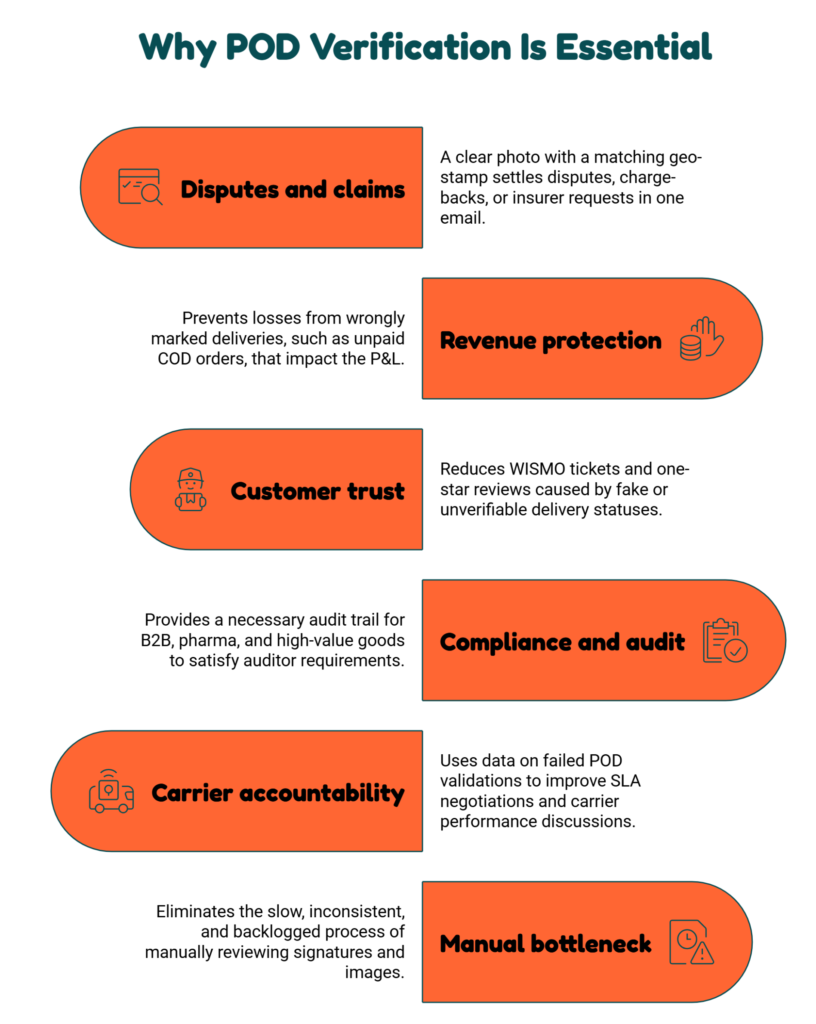
Why POD Verification Is Essential
A POD is only useful if someone checks it. Most sit unread in carrier portals until a dispute forces a search. Here is what that costs.
Disputes and claims. When a customer disputes a delivery, files a chargeback or an insurer asks for evidence, the POD is the first document anyone requests. A clear photo with a matching geo-stamp settles the matter in one email. A blurry photo starts a week of back and forth with the carrier.
Revenue protection. A wrongly marked delivery has a price. Take a ₹2,400 COD order marked delivered but never paid for. You lose the product, the freight and the sale, and you may still owe a refund. Multiply that across a month and the remittance gap becomes visible on the P&L.
Customer trust. Fake or unverifiable deliveries create WISMO tickets and one-star reviews. Shipway reports that “where is my order” queries make up 30% to 50% of inbound retail customer service volume. Every false “Delivered” status adds to that pile.
Compliance and audit. B2B consignments, pharma and high-value goods need an audit trail showing who received the shipment, when, where and in what condition. An auditor will not accept “the carrier said so.”
Carrier accountability. SLA talks go better with data. If you can show how many of one carrier’s PODs failed validation last month, and on which lanes, the conversation changes.
The manual bottleneck. Manual checking looks like this: open an image, zoom in to read a name, compare it with the order, check the time, open the next one. Two reviewers will judge the same blurry signature differently. At month end the backlog grows, so most PODs are never looked at unless someone complains. That is where the problems hide.
Market Trends: Why the Shift to AI Is Happening Now
Volume is outrunning headcount. Redseer projects e-commerce shipments in India to grow from 4.8 to 5.5 billion in FY25 to 15 to 16 billion by FY30. Quick commerce was already 7% to 10% of express parcels in FY24. Those orders mean more handovers per day, shorter delivery windows and less time to review each one.
Customers expect answers now. Shoppers are used to live tracking and quick resolution. Asking a carrier for a POD copy and waiting three days for it no longer fits that expectation.
RTO and delivery-fraud pressure. Eshopbox puts average RTO rates in Indian e-commerce at 20% to 40%, depending on industry and location. With margins under that kind of pressure, brands are paying closer attention to exceptions: failed deliveries, disputed deliveries and deliveries that were reported but never happened.
AI adoption is real, and uneven. OCR, image recognition and anomaly detection are now standard tools in logistics software. A January 2026 survey by BCG and Alpega found that only about one in ten logistics service providers could point to measurable financial impact from AI. That is a good reason to start with a narrow, measurable use case. Proof of delivery is one: the inputs are structured, the rules are clear, and the result is easy to count.
Every carrier sends something different. One returns an image URL, another a PDF, a third only an OTP status, and timestamp formats rarely match. A brand with five carriers has five POD formats to read. What it needs is one layer that standardizes them and checks them the same way.
Manual POD verification cannot absorb that growth. Automation can.
What Is AI-Powered POD Verification?
It is software that reads every proof of delivery as it arrives, compares it with the order record and flags the ones that look wrong.
Two terms get mixed up here. Electronic proof of delivery (ePOD) is the digital capture of the evidence: the rider’s app records a photo, a signature, an OTP and a location. ePOD software and other POD software handle that capture and storage. AI proof of delivery adds a checking layer on top, so the evidence is examined and not just filed.
An AI POD check covers:
- Signature or stamp: is one present, and is it legible?
- Receiver name: does it match the name on the order?
- Photo quality and authenticity: blur, darkness, duplicates, and images reused across shipments.
- Geo-tag and timestamp: does the location match the delivery address, and does the time fit the route?
- OTP and status: was the OTP entered, and does it agree with the status the carrier sent?
- Anomaly flags: deliveries that happen suspiciously fast, the same image on two orders, or an address that does not match.
Here is how the two approaches compare day to day.
| Area | Manual verification | AI-assisted verification |
| Speed | Minutes per POD, often days before anyone looks | Seconds, as the POD arrives |
| Coverage | A sample, or only disputed shipments | Every POD |
| Consistency | Varies by reviewer and by shift | Same rules applied every time |
| Fraud detection | Depends on someone noticing a repeat image | Duplicate and reused images flagged automatically |
| Carrier formats | Staff learn each portal | Formats normalized into one view |
| Exceptions | Found during disputes | Routed to a review queue immediately |
| Audit trail | Screenshots and emails | Time-stamped record of every check |
Benefits and Outcomes
Swift. A review that takes a person a couple of minutes (open the image, zoom, cross-check the order) takes software seconds. A bad delivery gets caught the day it happens, while the carrier’s claim window is still open and the rider can still be reached.
Smart. The system applies the same rules to every POD. It catches things people miss at the end of a long shift: the same photo on two different orders, or a delivery logged 40 seconds after the previous one in a different pincode.
Scalable. Doubling POD volume does not double the work. Your team reviews exceptions, and the software handles the rest.
Those three properties lead to results you can measure:
- Faster claim resolution and COD reconciliation. Evidence is ready when the dispute arrives, so claims close sooner and remittance gaps are found early.
- Fewer RTOs and WISMO tickets. Catching a false delivery early lets you contact the customer or escalate before the order is lost. eShipz has a guide on NDR management strategies to cut RTOs that covers the failed-delivery side of this.
- Clearer carrier performance. You can compare carriers by POD failure rate, by lane and by month.
- Better customer experience. When a customer says “I never got it,” support can answer in minutes with evidence, and repeat purchases tend to follow resolved problems.
How Does POD Verification Work? A Step-by-Step Workflow
- Capture. The system pulls POD data from carrier APIs: images, signatures, OTP confirmations and geo-stamps. The sooner it arrives, the sooner it is checked.
- Standardize. Each carrier’s data is converted into one format. Timestamps share a time zone, images share a structure, and statuses map to a common set of values. This step is dull and necessary. Without it, no rule can be applied across carriers.
- Validate. AI checks legibility, the receiver’s name, the location and the timestamp against the order. It also compares the image with others already stored, to catch duplicates.
- Flag exceptions. A POD that fails a check, or looks suspicious, goes to a human review queue with the reason attached: “name mismatch,” “location 2.8 km from address,” “image matches order 48213.” The reviewer starts with a hypothesis, not a blank screen.
- Act. Depending on the finding, the system can notify the customer, escalate to the carrier or open a claim. Rules decide which action fires for which failure.
- Learn. Outcomes feed back in. If reviewers keep clearing a certain flag as a false alarm, the threshold gets adjusted. If a new pattern of fraud appears, a new rule is added.
Where Can You Start? A Practical Roadmap
You do not need to roll out POD verification across every carrier and region on day one. A staged approach works better.
Step 1: Audit your current process. Measure how long a POD takes to reach you after delivery, how many deliveries end in dispute, and what share of PODs are missing, blurry or unreadable. You need these numbers as a baseline.
Step 2: Pick one high-impact segment. Good choices are COD shipments (cash is at stake), high-value orders, or your largest carrier. A narrow start gives you results you can show quickly.
Step 3: Centralize carrier data. Bring tracking and POD data from your carriers into one platform. Verification cannot run on data scattered across portals and email threads.
Step 4: Define what counts as a valid POD. Write the rules: signature required above a certain order value, photo must show the package at the door, geo-stamp within a set distance of the address. Then decide who handles each type of exception and how fast.
Step 5: Pilot, measure, scale. Run the pilot for a few weeks, compare against the baseline, adjust the rules and then extend to more carriers and regions.
Track four metrics throughout: POD turnaround time, dispute rate, RTO rate and WISMO ticket volume. If those move in the right direction, the pilot is working.
How eShipz Approaches Delivery Exceptions and Proof of Delivery
Proof of delivery is part of the broader delivery story, and eShipz treats it that way. A few things the platform does today:
One dashboard for non-delivered shipments. Shipments that fail delivery land in the NDR section, so teams see everything under exception in one place and can act before an order turns into an RTO.
Single and bulk actions. Teams can act on one shipment from the dashboard. For larger volumes, they can download a pre-filled file containing AWB numbers and carrier details, set the action for each row (such as a re-attempt with a preferred date and time) and upload it to process many shipments at once.
Multi-carrier coverage. eShipz’s G2 profile lists 400+ carriers on one platform, so delivery data is not locked in separate carrier portals. This is the same standardization problem described in the workflow above.
Proof of delivery. eShipz offers IntelliProof, an AI-driven ePOD product built for faster invoicing, fewer errors and real-time tracking. Delivered, exception and re-attempt statuses then sit next to the POD record, which gives ops teams the full delivery story without switching tools.
For more on how AI is changing exception handling, read eShipz’s piece on the role of AI in NDR management and delivery accuracy.

Conclusion
POD verification is moving from a back-office chore to an automated, strategic capability. The shift is driven by volume, carrier complexity and the cost of getting a delivery dispute wrong.
- Swift: PODs are checked in seconds, so problems are caught while they can still be fixed.
- Smart: every POD is judged by the same rules, and duplicates, mismatches and odd timestamps are flagged.
- Scalable: volume can grow without a matching rise in headcount, because people only review exceptions.
If your team is still opening POD images one at a time, start small. Audit your current process, pick one segment and measure the change. To see how eShipz can help you manage delivery exceptions and proof of delivery in one place, book a demo with the eShipz team.
Frequently Asked Questions
- What is POD verification?
POD verification is the process of checking that a proof of delivery is valid, complete and consistent with the order. It confirms that the signature, photo, OTP and geo-stamp are present, legible and match the receiver, address and time of delivery. - What is the difference between POD and ePOD?
A POD is the evidence that a delivery happened, traditionally a signed paper slip. An ePOD (electronic proof of delivery) captures the same evidence digitally through a rider’s app, usually as a photo, a signature, an OTP or a location stamp. ePOD software stores it so teams can search and share it. - How does AI check a proof of delivery?
AI reads the POD data and compares it with the order record. It uses OCR to read names and signatures, image analysis to judge quality and spot duplicates, and rules to compare the geo-stamp and timestamp against the delivery address and route. Anything that fails goes to a person. - Can AI detect fake or reused POD images?
Yes, in many cases. The system can compare each new image with those already stored and flag exact or near matches across different orders. It can also flag photos with no usable detail, or geo-stamps far from the delivery address. A flag is a prompt for review, not a verdict. - Does AI replace human review of PODs?
No. AI handles the routine checks on every POD, and people handle the exceptions that need judgment, such as a disputed signature or an unusual address. The aim is to move the team’s time from opening images to resolving real problems. - Which shipments should I start with?
Start with the segment where a wrong delivery costs the most: COD orders, high-value orders or your largest carrier. A focused pilot is easier to measure and gives you evidence for expanding. - How do I know if it is working?
Compare four numbers against your baseline: POD turnaround time, dispute rate, RTO rate and WISMO ticket volume. Falling disputes and faster claim resolution are the clearest early signs.